
| 2026 Social Security limit | 2026 amount or formula input | What it controls | Primary authority to check |
|---|---|---|---|
| Contribution and benefit base | $184,500 | Maximum earnings subject to OASDI payroll tax and maximum annual earnings credited for benefit-computation purposes | SSA Contribution and Benefit Base table [1] |
| Maximum monthly retirement benefit at age 62 | $2,969 | Highest monthly retired-worker benefit for a worker claiming at 62 in 2026, assuming the earnings history required to reach the maximum | SSA maximum-benefit FAQ [2] |
| Maximum monthly retirement benefit at full retirement age | $4,152 | Highest monthly retired-worker benefit for a worker claiming at full retirement age in 2026 | SSA maximum-benefit FAQ [2] |
| Maximum monthly retirement benefit at age 70 | $5,181 | Highest monthly retired-worker benefit for a worker claiming at 70 in 2026 | SSA maximum-benefit FAQ and SSA 2026 COLA fact sheet [2][3] |
| Retirement earnings test: under full retirement age | $24,480 per year; $2,040 per month | Amount a beneficiary under FRA may earn before SSA withholds $1 in benefits for each $2 above the limit | SSA Receiving Benefits While Working [4] |
| Retirement earnings test: year of reaching full retirement age | $65,160 per year; $5,430 per month | Amount a beneficiary may earn before SSA withholds $1 in benefits for each $3 above the limit, counting only earnings before the month FRA is reached | SSA Receiving Benefits While Working [4] |
| Quarter of coverage | $1,890 | Earnings needed in 2026 to receive one Social Security work credit, subject to the annual maximum number of credits | SSA 2026 COLA fact sheet [3] |
| PIA formula bend points for workers first eligible in 2026 | $1,286 and $7,749 | Average indexed monthly earnings breakpoints used in the primary insurance amount formula | SSA PIA Formula Bend Points [5] |
| Family maximum bend points for workers first eligible in 2026 | $1,286, $1,857, and $2,422 | Breakpoints used to compute the maximum family benefit payable on one worker’s record | SSA Family Maximum Benefit formula [6] |
| 2026 COLA | 2.8% | Increase effective for December 2025 benefits, paid in January 2026 | SSA 2026 COLA fact sheet [3] |
| Full retirement age milestone | 67 for workers born in 1960 or later | Claiming-age benchmark for unreduced retirement benefits for this cohort | SSA maximum-benefit FAQ and SSA 2026 COLA fact sheet [2][3] |
The phrase “maximum Social Security payout 2026 legal limits” covers more than one number. It includes a tax cap, three public-facing maximum retirement benefits, two earnings-test thresholds, one work-credit threshold, formula bend points, and a family-benefit formula. Treating all of them as “the Social Security maximum” is how bad client memos get written.
The controlling 2026 age-70 maximum is $5,181 per month. If a secondary summary shows $5,251, the safer citation path is not to reconcile headlines; it is to cite SSA’s own maximum-benefit page and 2026 COLA fact sheet, both of which support the $5,181 figure for 2026.[2][3]
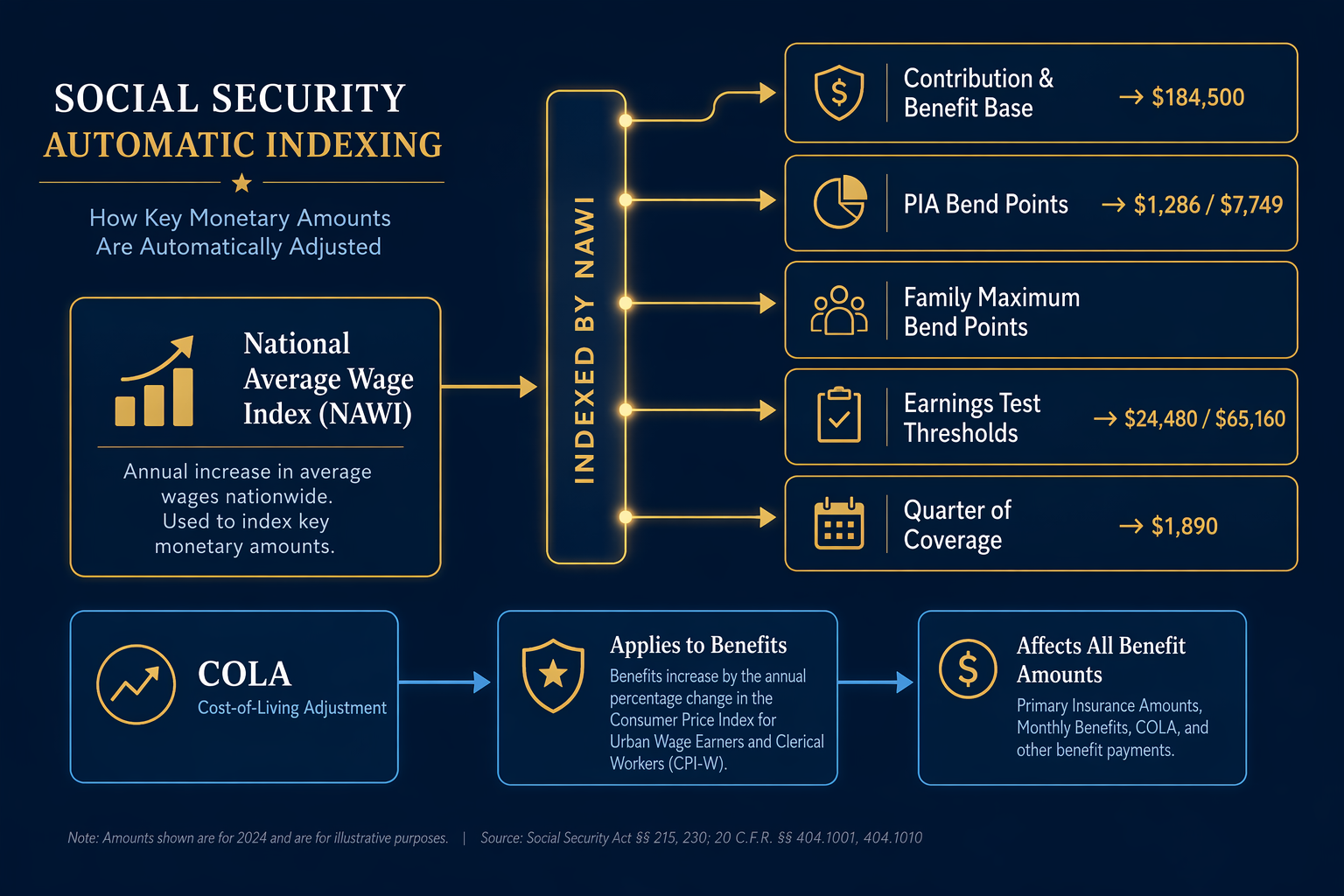
Why These Numbers Move Together, But Not Identically
The 2026 limits are not annual guesses. Most of the legal thresholds move through automatic indexing tied to the national average wage index, while benefit payments already in force are adjusted through the separate cost-of-living adjustment mechanism. That distinction matters because a wage-indexed formula input and a COLA-adjusted benefit check answer different legal questions.
The wage base, PIA bend points, family maximum bend points, quarter-of-coverage amount, and earnings-test thresholds are part of the indexed architecture of the Social Security Act. The COLA, by contrast, adjusts monthly benefits after entitlement using the annual benefit-adjustment process. SSA’s 2026 fact sheet gives the 2.8% COLA effective for December 2025 benefits, paid in January 2026.[3]
For file work, the useful habit is to label the number by legal function before copying it: taxable maximum, benefit maximum, earnings-test exempt amount, work-credit amount, PIA bend point, or family maximum bend point. The dollar signs look interchangeable only until the wrong one lands in payroll advice or a benefits estimate.
The $184,500 Wage Base Is a Tax Limit and a Benefit-Computation Limit
For 2026, the contribution and benefit base is $184,500, up 4.8% from 2025. Earnings above that amount are not subject to the OASDI portion of Social Security payroll tax, and earnings above that amount are not credited as covered earnings for purposes of computing future Social Security retirement benefits.[1]
That dual role is easy to miss. Payroll departments usually encounter the wage base as a tax ceiling. Benefits lawyers and retirement planners encounter it again as the ceiling on annual covered earnings that can count toward a worker’s indexed earnings record. Those are related consequences of the same contribution and benefit base, not separate 2026 limits.
SSA’s historical table also shows why older figures should not be recycled. The base was $137,700 in 2020 and is $184,500 for 2026.[1] A memo that cites a stale wage base is not merely using an old tax number; it may also distort the earnings-history assumptions behind a maximum-benefit calculation.
For policy context on proposals that would change or remove the taxable maximum, see the wage-cap discussion in the Moreno-Warren Social Security plan analysis. That debate is adjacent to the 2026 reference number; it does not change the current $184,500 limit.
The Maximum Monthly Benefit Depends on Claiming Age
SSA lists three different 2026 maximum monthly retirement benefits: $2,969 at age 62, $4,152 at full retirement age, and $5,181 at age 70.[2] Those figures should not be collapsed into a single “maximum payout” unless the claiming age is stated in the same sentence.
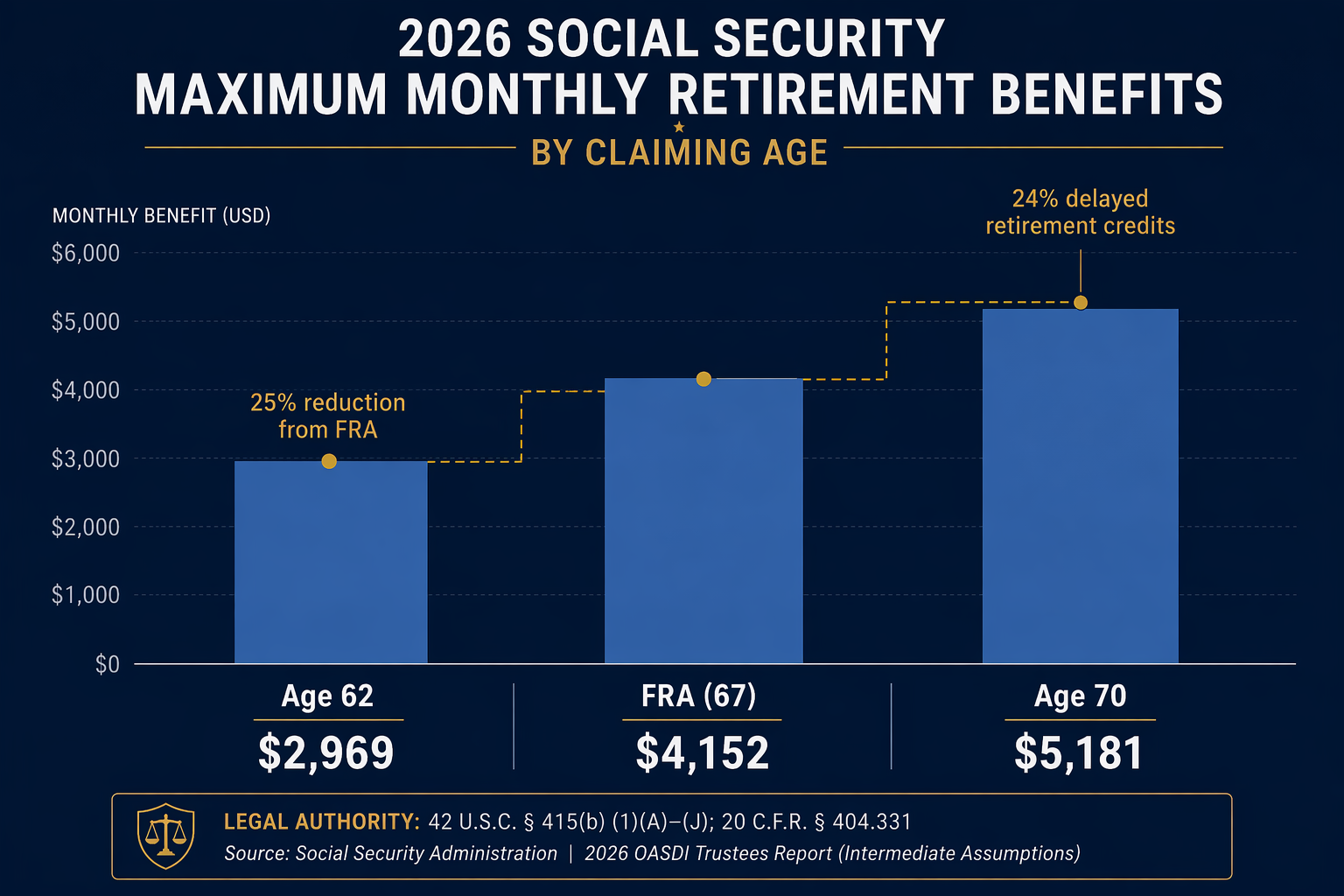
The age-62 amount reflects early claiming. The full-retirement-age amount reflects the worker’s unreduced retirement benefit at FRA. The age-70 amount reflects delayed retirement credits. Each figure assumes the worker’s earnings history is high enough, over the relevant computation period, to support the statutory maximum.
The 2026 full retirement age reference is now 67 for workers born in 1960 or later. That is not a new 2026 benefit cut. It is the final scheduled step from the 1983 Amendments becoming fully visible for the cohort reaching age 67 in 2026.[2][3]
The legal consequence is practical: a client file discussing the maximum benefit should identify both the claiming age and the worker cohort. A sentence saying only that “the 2026 maximum Social Security benefit is $5,181” is incomplete unless the file is clearly discussing a worker claiming at age 70.
For early-claiming consequences beyond the maximum-benefit figure, see the early retirement advice analysis. For household coordination under possible benefit-reduction scenarios, see the couples strategy piece. Neither changes SSA’s 2026 maximum amounts.
PIA Bend Points Are Formula Inputs, Not Benefit Maximums
For workers first eligible in 2026, the PIA formula bend points are $1,286 and $7,749.[5] These are not payment caps. They are the average indexed monthly earnings thresholds at which the percentage factors in the primary insurance amount formula change.
SSA’s bend-point page describes the indexing method: the 1979 bend points of $180 and $1,085 are indexed to the national average wage index for the year two years before first eligibility. For 2026 eligibility, that means the 2024 national average wage index is the operative indexing year.[5]
This is where a maximum-benefit number and a formula number often get mixed together. The $4,152 FRA maximum is an output for a worker whose covered earnings history reaches the top of the system often enough to produce the maximum retired-worker benefit. The $1,286 and $7,749 bend points are inputs used to compute a worker’s primary insurance amount from average indexed monthly earnings.
| PIA formula element | 2026 value | How to describe it in a legal or tax file |
|---|---|---|
| First bend point | $1,286 | AIME threshold for the first segment of the PIA formula |
| Second bend point | $7,749 | AIME threshold for the second segment of the PIA formula |
| Maximum monthly benefit at FRA | $4,152 | Payment maximum for a worker claiming at full retirement age in 2026 |
The Family Maximum Is a Formula, Not One Dollar Figure
For 2026, SSA gives family maximum bend points of $1,286, $1,857, and $2,422.[6] Those bend points are used to compute the maximum amount payable on one worker’s record to the worker and eligible family members. The family maximum is therefore not a single universal 2026 dollar cap.
The important drafting point is to avoid writing that “the family maximum is $2,422.” It is not. $2,422 is the third bend point in the 2026 family maximum formula. The actual family maximum depends on the worker’s primary insurance amount and the formula applied to it.
SSA describes the family maximum as generally ranging from 150% to 188% of the worker’s primary insurance amount, depending on the PIA segment involved.[6] That range is useful as orientation, but a payable family maximum still requires running the formula rather than selecting a flat 2026 cap.
The Earnings Test Withholds Before FRA; It Is Not a Permanent Forfeiture Rule
The 2026 retirement earnings test has two exempt amounts. A beneficiary under full retirement age may earn $24,480 for the year, or $2,040 per month, before SSA withholds $1 in benefits for each $2 above the limit. In the year the beneficiary reaches full retirement age, the higher exempt amount is $65,160 for the year, or $5,430 per month, with $1 withheld for each $3 above the limit.[4]
Only earnings before the month the beneficiary reaches full retirement age count under the higher annual limit. Once FRA is reached, the retirement earnings test no longer applies.[4]
For advice files, the clean distinction is withholding versus permanent loss. SSA explains that benefits withheld because of the earnings test are later accounted for in recalculating the monthly benefit after full retirement age.[4] The earnings test can still create cash-flow problems, but it should not be described as a confiscation of benefits.
The $1,890 Quarter-of-Coverage Amount Is an Eligibility Credit Threshold
In 2026, one quarter of coverage requires $1,890 in earnings.[3] This is a work-credit threshold, not a monthly benefit amount, tax maximum, or earnings-test exempt amount.
The number matters most when checking insured status. A worker can earn multiple credits in a year, subject to Social Security’s annual credit rules, but the $1,890 figure itself is simply the 2026 earnings amount needed for one credit.[3]
COLA Belongs in the File, But It Is a Different Mechanism
The 2026 COLA is 2.8%, effective for December 2025 benefits and payable in January 2026.[3] It explains the annual adjustment to benefit payments, but it is not the same legal mechanism as the wage-indexing rules that set the wage base and bend points.
That separation matters in tax planning. COLAs can increase benefit amounts while other tax thresholds remain fixed under separate statutes. For that interaction, see the 2027 COLA and Social Security taxation analysis. The 2026 reference point remains SSA’s final 2.8% COLA, not later projections for future years.
Use the Right Limit for the Right Legal Question
| If the question is... | Use this 2026 number | Do not substitute |
|---|---|---|
| How much wage income is subject to OASDI tax? | $184,500 wage base | Maximum monthly retirement benefit |
| What is the highest monthly retired-worker benefit? | $2,969, $4,152, or $5,181 depending on claiming age | PIA bend points |
| How much can a beneficiary earn before withholding before FRA? | $24,480 or $65,160 depending on age status | Wage base |
| How much earnings are needed for one work credit? | $1,890 quarter-of-coverage amount | Earnings-test monthly amount |
| Where does the PIA formula change percentage factors? | $1,286 and $7,749 PIA bend points | Family maximum bend points |
| How is the family maximum computed? | $1,286, $1,857, and $2,422 family maximum bend points | One flat family benefit cap |
Solvency projections and possible automatic reductions are separate from the 2026 limits compiled here. They can become legal planning constraints of their own, but they should not be folded into a table of current indexed limits. For that separate mechanism, see the 2032 benefit-cut analysis.
For 2026 work, the safest citation hierarchy is straightforward: use SSA’s tables, fact sheets, and formula pages for the operative numbers; use secondary coverage only as context; and update the file when SSA publishes the next indexed values. These limits are statutory outputs from indexed formulas, not discretionary annual estimates.
Comments
Join the discussion with an anonymous comment.