
A Social Security disability claim now moves through a workflow that is both slow enough to harm people and automated enough to raise new record-review questions. Average initial decision wait time reached 231 days in FY2024, up from roughly 121 days in 2019; recent reporting also places the initial claims backlog near 950,000 and the hearing backlog near 276,000, with a reported FY2025 initial approval rate of 36%.[1] In FY2023, 30,000 applicants died while waiting for disability determinations.[2]
That is the pressure under which the Social Security Administration is adopting artificial intelligence. The relevant question for disability attorneys is not whether AI has replaced administrative law judges. The better question is where automated systems now touch the claim file, the medical evidence, the hearing record, and the draft decision before a claimant or representative ever sees the final result.
SSA’s public AI materials identify multiple tools used in disability-related work, including Quick Disability Determinations, Compassionate Allowances, IMAGEN, HeaRT, and Insight Software.[3] They are not the same kind of system. Some are front-end triage tools. Some structure medical evidence. One affects hearing transcripts. One operates as a quality-control layer for draft decisions. Their legal significance depends on that placement.
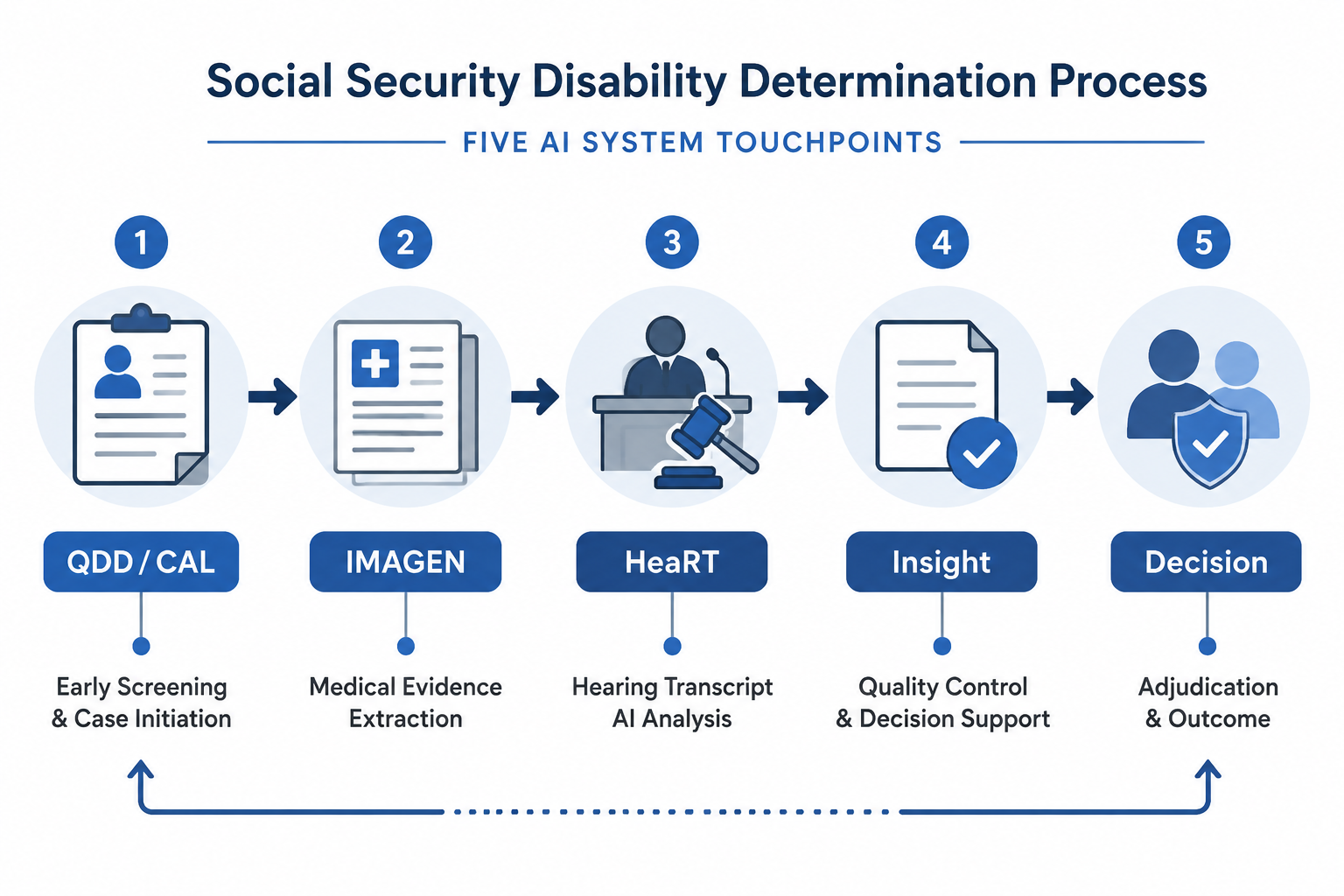
Where SSA’s AI systems enter the disability claim
| System | Point in the process | Stated function | Attorney-facing concern |
|---|---|---|---|
| QDD | Initial screening | Flags claims that appear likely to be allowed for expedited review | Whether fast-track labels reflect the limits of historical training data |
| CAL | Initial screening | Identifies claims involving conditions SSA treats as highly likely to qualify | Whether a claimant outside a recognized pattern receives less early attention |
| IMAGEN | Medical evidence processing | Uses language analysis and predictive tools to extract and structure information from medical records | Whether structured summaries preserve the significance of longitudinal, ambiguous, or symptom-heavy conditions |
| HeaRT | Hearing documentation | Uses generative AI to produce hearing transcripts | Whether transcript errors alter testimony, medical terms, work history, symptoms, or vocational evidence |
| Insight Software | Draft-decision quality review | Reviews draft disability decisions for potential quality issues before finalization | Whether a later appeal should account for this additional review layer without assuming full visibility into it |
The table matters because “AI at SSA” is too broad to be useful. A triage model that moves an obvious allowance forward raises different issues from a transcription system that may mishear a claimant’s testimony. A medical-record extraction tool creates different appellate risks from a draft-decision review tool. Treating them as one system obscures where an error might have entered the administrative record.
QDD and CAL: fast-track systems at the front door
Quick Disability Determinations and Compassionate Allowances are best understood as early screening systems, not adjudicators. QDD uses predictive modeling to identify initial applications that appear likely to result in a favorable disability determination. CAL identifies claims involving conditions that SSA has designated for expedited handling because they are especially likely to meet disability standards.[3]
For a claimant with metastatic cancer or another condition that cleanly fits an expedited category, that screening function can be valuable. It can reduce time spent in the ordinary queue. In a system with hundreds of thousands of pending claims, triage is not an abstract management preference; it determines who waits.
The harder question is what happens to claims that do not look like the historical examples a model has learned to recognize. The National Academy of Social Insurance’s Task Force on Artificial Intelligence, Emerging Technology, and Disability Benefits identified bias and equity risks in AI-supported disability administration, including the risk that systems trained on historical data may reproduce inequities affecting historically marginalized groups.[4] That is a risk finding, not proof that QDD or CAL has produced a particular discriminatory outcome in a particular file.
That distinction is important in practice. A representative usually will not be able to treat the mere existence of QDD or CAL as evidence that a claim was mishandled. But front-end automation still changes what attorneys should be curious about: whether the record was complete at filing, whether diagnoses were stated in terms SSA systems and human reviewers could identify, whether rare or multi-system impairments were buried in scattered records, and whether a claimant who did not receive expedited treatment was later disadvantaged by delay.
The risk is not only that a system flags the wrong claim for speed. It is also that an unflagged claim enters the ordinary queue with an incomplete narrative: fatigue described in one note, pain in another, failed work attempts elsewhere, and no single exhibit that makes the impairment obvious. That has always been a disability-record problem. Automated triage makes the front-loaded presentation of the claim more consequential.
IMAGEN and the problem of turning medical records into structured data
IMAGEN, short for Intelligent Medical Language Analysis Generation, is described as using natural language processing and predictive analytics to scan large medical records and transform clinical text into structured data.[3] In ordinary casework terms, it is aimed at the problem every disability representative knows: thousands of pages of hospital, specialist, primary-care, therapy, imaging, medication, and lab records arriving in a form that is searchable only in the loosest sense.
There is nothing inherently suspect about wanting medical evidence to be easier to search. A well-functioning extraction tool can help locate diagnoses, objective findings, dates of treatment, medication changes, and references to functional limitations. In a claim involving a clearly documented impairment and consistent treatment, structured medical evidence may reduce the chance that an important exhibit disappears into volume.
The concern begins when structure becomes a substitute for the messy significance of the record. Disability evidence is not just a list of diagnoses and lab values. A claimant with fibromyalgia, chronic fatigue syndrome, post-viral symptoms, migraine, trauma-related impairments, or fluctuating mental-health symptoms may have a record whose legal importance lies in persistence, consistency over time, failed treatments, side effects, functional reports, and corroboration across providers rather than in one decisive diagnostic marker. Commentary on SSA’s AI use has specifically raised concern that tools may miss the significance of invisible disabilities that lack clear diagnostic markers.[5]
That does not mean IMAGEN denies claims, or that a structured-data output is necessarily wrong. The narrower and more useful point is that extraction systems tend to reward what can be extracted. A symptom mentioned repeatedly in narrative notes may be less visible than a lab result. A treating provider’s cautious language may be less machine-friendly than a definitive diagnosis. A claimant’s inability to maintain care because of homelessness, insurance gaps, transportation barriers, or psychiatric symptoms may appear as “noncompliance” or inconsistency unless the surrounding record is read as a chronology.
For attorneys, the practical adjustment is file discipline. When medical evidence arrives in bulk, the representative’s review should not assume that SSA’s internal structuring captured the theory of disability. It is worth checking whether key impairments appear consistently in the exhibit list, whether relevant treatment gaps are explained in the record, whether symptom severity is supported by longitudinal notes, and whether functional limitations are tied to source documents rather than left as general assertions.
This is especially important in cases where the medical record is repetitive but not dramatic. A record can be legally significant precisely because it says the same thing for years: pain persists, fatigue persists, panic attacks persist, medication helps only partially, the claimant cannot sustain activity, and work attempts fail. A summarization or extraction layer may help locate those notes. It may also flatten them into less than they are.
HeaRT: faster hearing transcripts, new transcript risks
HeaRT deserves separate attention because hearing transcripts are not merely administrative paperwork. They become the record that Appeals Council reviewers, federal judges, agency counsel, and claimant’s counsel use to reconstruct what happened in the hearing room.
SSA’s HeaRT system was deployed agency-wide by March 2025 and uses generative AI to produce hearing transcripts.[3] The Technology Modernization Fund describes the initiative as supporting more timely and accurate decisions for disability-benefits claimants and identifies $5 million in annual savings associated with the work.[6] The efficiency case is straightforward: hearing recordings must be converted into text, and transcript delay can slow appeals.
The legal problem is that a transcript error is not always harmless. A misheard medication name can affect the apparent seriousness of treatment. A mistranscribed job title can distort vocational testimony. A claimant’s answer about needing to lie down “three times a day” can become something less clear. A phrase about panic attacks, bathroom breaks, hand use, off-task time, or absenteeism can be the difference between testimony that supports the residual functional capacity finding and testimony that contradicts it.
Public commentary on HeaRT has raised concerns about hallucination risk and misinterpretation of accents or complex medical terminology.[7] Those concerns are not unique to disability hearings, but disability hearings make them consequential. Claimants often testify under stress, by phone or video, through imperfect audio, while discussing symptoms, medications, treatment histories, work tasks, and vocational limitations in language that is not always polished. A transcript system that performs adequately on clean speech can still create appellate work when the record is noisy.
The point is not to presume that every HeaRT transcript is unreliable. Many transcripts may be good enough, and faster production may help claimants who otherwise wait longer for post-hearing review. But attorneys should treat the transcript as a generated legal artifact, not as a neutral mirror of the hearing. Where an issue turns on exact testimony, the transcript should be compared against the audio when available, hearing notes, representative notes, pre-hearing submissions, vocational expert interrogatories, and medical terminology in the exhibits.
Several transcript areas deserve particular attention: testimony about frequency and duration of symptoms; statements about failed work attempts; medication names and side effects; medical procedures and diagnoses; exertional limits such as standing, walking, lifting, handling, and reaching; nonexertional limits such as concentration, pace, absences, and interaction; and vocational expert testimony about job numbers or hypothetical limitations.
A hearing transcript error can become harder to fix after the agency or a reviewing court has already relied on it. That makes early preservation important. If the transcript materially changes testimony, the issue is not “AI bias” in the abstract. It is record accuracy: what was said, what was transcribed, what the decision cited, and whether the claimant had a meaningful chance to correct the discrepancy.
Insight Software and the draft decision layer
Insight Software operates at a later point in the process. It has been described as analyzing draft disability decisions in real time before finalization, adding a quality-control layer to the decision-writing process.[8] SSA’s broader AI materials also identify AI-supported tools connected to disability decision quality and processing.[3]
This kind of tool may catch omissions, inconsistencies, or drafting problems before a decision is issued. That is potentially useful. A decision that better identifies the evidence considered and explains the path of reasoning is easier for everyone to evaluate, including the claimant.
The limitation is visibility. Attorneys generally review the final decision, the exhibits, the hearing record, and the procedural history. They do not necessarily see what a quality-control tool flagged, whether the drafter accepted or ignored a suggestion, or whether a change affected the reasoning. It would be a mistake to write as though representatives have a clean audit trail for every automated suggestion inside decision drafting.
Still, Insight changes how a careful reader may approach an appeal. If a final decision contains a conspicuous omission, an internally inconsistent residual functional capacity finding, a mismatch between vocational testimony and findings, or a selective summary of medical evidence, the existence of a quality-control layer may sharpen the question of how that defect survived review. It does not prove error by itself. It can, however, make the completeness and traceability of the agency’s reasoning more important.
What changes for attorneys reviewing disability files
The attorney’s task is still to build and protect the administrative record. AI does not change the burden of making the impairment, duration, severity, and functional consequences legible. It does change the number of points at which a system may have sorted, summarized, transcribed, or checked the material before the attorney sees the agency’s final action.
At intake and initial filing, the most useful adjustment is clarity. Conditions that may qualify for expedited treatment should be identified plainly, with supporting records attached or requested early where possible. For claims that do not fit obvious categories, the file should still make the theory of disability visible: onset, longitudinal treatment, functional decline, failed work attempts, and barriers to treatment should not be left for a reviewer to infer from scattered pages.
At the medical-evidence stage, representatives should assume that structured data may help but will not necessarily preserve nuance. A useful internal review asks whether the record tells the same story in three ways: through diagnoses and objective findings where available, through treatment chronology, and through functional limitations. If one of those strands is weak because the condition is inherently difficult to measure, the other strands become more important.
At the hearing stage, preparation should account for transcription. Claimants do not need to speak like medical experts, but key facts should be stated cleanly: how often symptoms occur, how long they last, what happens after activity, which tasks trigger limitations, how medications affect functioning, and what happened in prior work attempts. If the hearing involves an interpreter, poor audio, an accent, unusual medication names, or complex vocational testimony, the transcript deserves close review.
At appeal, the question becomes traceability. Did the decision rely on a medical summary that omitted contrary longitudinal evidence? Did it quote testimony accurately? Did it treat treatment gaps as noncompliance without discussing the explanation in the file? Did vocational testimony in the transcript match what was asked and answered at the hearing? Did the final decision’s reasoning actually connect the evidence to the residual functional capacity finding?
Representation timing matters here. A 2022 study found that early legal representation increased the probability of a positive initial decision by 23% and reduced total case processing time by nearly one year, though that finding predates SSA’s 2025-2026 restructuring and should not be treated as a measurement of current AI-era effects. The practical lesson is narrower: the earlier someone organizes the record, the fewer opportunities there are for a claim to be defined by incomplete extraction, unclear triage signals, or uncorrected documentation errors.
Rights questions without overclaiming
There is a temptation to compress this topic into two easier stories: AI will rescue disability claimants from delay, or AI will quietly deny meritorious claims. The record supports neither version as a complete account. SSA’s systems are distributed, unevenly mature, and aimed at different tasks. QDD and CAL triage. IMAGEN structures medical records. HeaRT generates hearing transcripts. Insight reviews draft decisions. None of that is the same as a robot judge.
But attorneys do not need to prove that AI decided a case before caring about these systems. Administrative due process depends on notice, a complete record, accurate transcription, reasoned decision-making, and a meaningful opportunity to contest errors. Automated tools can affect each of those values without appearing as the named basis for denial.
The immediate professional obligation is practical: know where automation may have touched the claim, inspect the materials that matter most, preserve objections when the record is wrong or incomplete, and avoid turning documented risks into unsupported accusations. Claimant rights in Social Security disability benefits now depend partly on noticing the quiet points where triage, extraction, transcription, and quality review shape the record before the appeal begins.
References
- SSA Backlogs in 2026: Disability Claim Delays Explained — GWC Firm
- 30,000 died in fiscal 2023 waiting for disability decisions from Social Security — Nextgov, 2024
- Artificial intelligence at Social Security — Social Security Administration
- Task Force on Artificial Intelligence, Emerging Technology, and Disability Benefits Phase One Report — National Academy of Social Insurance
- AI in SSA Disability Reviews — London Disability
- Using artificial intelligence to support disability claim processing — Technology Modernization Fund
- SSA's New HeaRT System — Disability Benefits Help
- How the Social Security Administration Uses AI in SSDI Cases — Keefe Law
Comments
Join the discussion with an anonymous comment.