
The practical problem for lawyers advising on Social Security early retirement and potential benefit cuts is no longer limited to the familiar age-62 reduction. For clients born in 1960 or later, claiming retirement benefits at 62 can reduce the monthly benefit by 30% compared with claiming at full retirement age, under current Social Security rules.[1] If the Old-Age and Survivors Insurance trust fund is exhausted in late 2032 without congressional action, projected across-the-board cuts would fall on top of that already-reduced benefit stream.[2]
That is the counseling collision. A client who claims early has accepted a permanent claiming reduction under present law. The insolvency reduction, by contrast, is not a personal claiming choice; it is the consequence projected if scheduled benefits exceed the payroll-tax and other income available to pay them after trust fund reserves are depleted. Put together, the two mechanisms can leave an early claimant with roughly 45% to 48% less than the unreduced full-retirement-age benefit, depending on which insolvency-cut estimate is used.

Two Reductions That Should Not Be Blurred
The first reduction is mechanical and individual. Social Security calculates retirement benefits around a full retirement age. Claim before that age, and the monthly benefit is reduced. For a worker whose full retirement age is 67, claiming at 62 means filing 60 months early, which produces a 30% reduction under the SSA’s early-retirement reduction table.[1]
That 30% reduction is not a penalty that later disappears when the claimant reaches full retirement age. It is a lower monthly benefit payable for the claiming record, subject to later cost-of-living adjustments and other applicable rules. Lawyers advising around retirement timing, divorce, support, estate planning, Medicaid spend-down, or household cash-flow assumptions need to treat that lower starting benefit as a durable fact of the file.
The second reduction is system-wide and conditional. The Committee for a Responsible Federal Budget reported in July 2026 that the Social Security Trustees project the OASI trust fund will be exhausted in late 2032, at which point benefits would face an automatic cut if lawmakers do not change the law before then.[2] CRFB describes the Trustees’ implied cut as about 22% for OASI, while its own framing also discusses a 24% cut for retirees; it separately notes that the Congressional Budget Office’s February 2026 estimate points to a 28% cut.[2]
| Mechanism | What triggers it | Approximate effect discussed here | Counseling significance |
|---|---|---|---|
| Early claiming | Client claims retirement benefits before full retirement age | 30% reduction at age 62 for workers with full retirement age of 67 | A current-law, claimant-specific reduction that should be documented in the advice record |
| OASI insolvency | Trust fund reserves are exhausted without congressional action | Projected automatic cut of roughly 22% to 28%, depending on source estimate | A policy-risk scenario that should be modeled, not presented as a guaranteed outcome |
| Combined exposure | Early claiming followed by an across-the-board cut | Roughly 45% to 48% below the unreduced full-retirement-age benefit | A materially different cash-flow assumption for clients with limited substitutes |
The combined figure is arithmetic, not a new statutory category. If a client receives 70% of the full-retirement-age benefit after claiming at 62, and that amount is later reduced by 22%, the resulting payment is 54.6% of the original full-retirement-age amount. A 28% cut to the same early-claimed benefit leaves 50.4%. That is why the effective reduction from the unreduced benefit lands in the approximate 45% to 48% range.
What Changed in the 2032 Projection
The late-2032 date matters because it falls inside many ordinary retirement files now being opened or updated. A 62-year-old claimant in 2026 would be in the early years of retirement when the projected insolvency date arrives. A married couple building an estate plan around Social Security income, pension income, required minimum distributions, and long-term care risk may be relying on benefit assumptions that no longer deserve to sit in the file without a stated caveat.
CRFB attributes the accelerated exhaustion date in part to recent legislation. It reports that the Social Security Fairness Act and the One Big Beautiful Bill Act together added more than $369 billion in unfunded liabilities and accelerated insolvency by roughly six months.[2] The point for a legal counseling record is not to assign political responsibility. It is that the projected depletion date moved, and that movement affects the plausibility of retirement-income assumptions made today.
The household figures make the abstract cut easier to see. CRFB estimates that a typical dual-earner couple retiring just after insolvency would lose about $16,900 in annual benefits, while a high-income couple could lose as much as $22,300 annually.[2] Those are not small adjustments to a discretionary account. In many elder law files, that kind of loss changes who can remain housed, who needs family support, and how quickly private savings are exhausted.
The estimates also should not be over-polished. The Trustees, CRFB, and CBO figures do not all state the same cut percentage, and insolvency projections shift as demographics, wages, interest rates, legislation, and program costs change. The responsible counseling move is to show the range and source it, not to pick a single percentage and present it as a settled future benefit schedule.
Why the Same Percentage Cut Does Not Land the Same Way
A 22% or 24% benefit cut does not mean the same thing for every client. Rutgers Law School’s Q&A with Distinguished Professor Jon Dubin reports that 52% to 56% of Social Security beneficiaries derive at least half of their income from the program, and 24% to 27% derive at least 90% of their income from it.[3] For those clients, an insolvency reduction is not merely a lower replacement rate. It is a threat to the income floor.
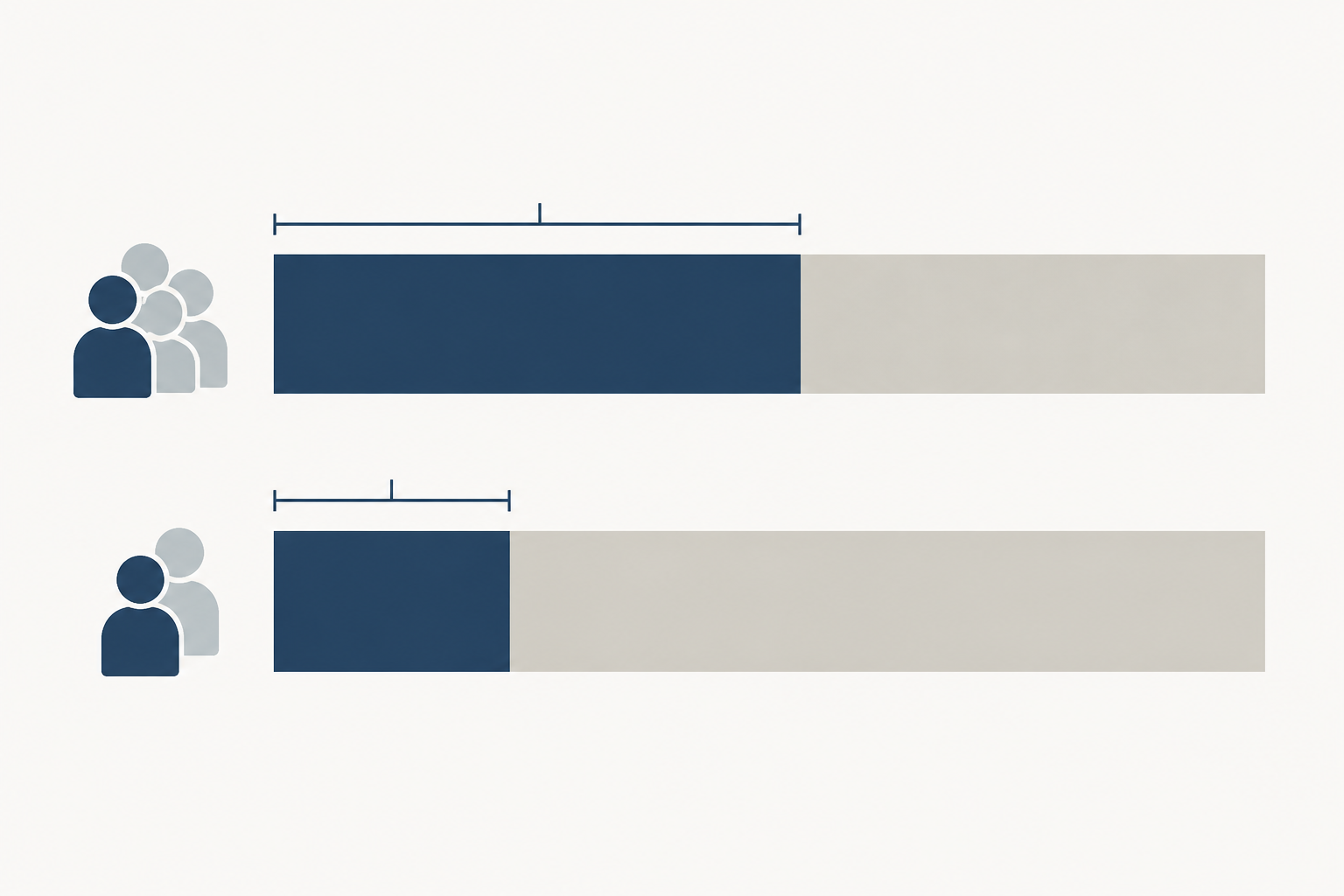
That vulnerability data belongs in the lawyer’s intake analysis. A client with substantial private savings, paid-off housing, and flexible family support may be able to absorb a benefit cut by changing withdrawal timing or spending. A client whose rent, utilities, food, and prescription costs already consume most monthly income has no comparable buffer. The same projected federal percentage creates different legal and practical consequences.
The distinction is especially important when early retirement is driven by health, caregiving, unemployment, unsafe work, or a spouse’s needs. Claiming at 62 is sometimes described as a choice between smaller checks now and larger checks later. In actual files, the choice may be constrained before the consultation begins. The lawyer’s role is not to scold a client into delayed claiming; it is to make sure the client understands what the early-claiming reduction does, what an insolvency scenario could add, and what assumptions are being used in related legal planning.
The Legal Meaning of Insolvency Is Narrower Than Many Clients Assume
Insolvency does not mean Social Security has no money at all. Payroll taxes and other program income would continue to come in. The legal issue is that trust fund reserves would no longer be available to cover the gap between scheduled benefits and incoming revenue. BC Law Impact’s analysis of Social Security insolvency emphasizes that the program’s ability to pay full scheduled old-age benefits depends on that financing structure, and that depletion would force a legal and administrative problem over how benefits are paid absent congressional action.[4]
That matters because clients often hear “insolvency” as either total disappearance or political exaggeration. Neither shorthand is useful in a counseling file. The projected mechanism is partial payment of scheduled benefits unless Congress acts. The fact that Congress could act is not the same as a guarantee that it will act by a certain date, in a certain way, or with full protection for all cohorts.
Legal professionals should also be careful not to convert public-finance projections into individualized legal advice. A benefit statement, an SSA calculator result, or a financial planner’s spreadsheet can help frame the issue. None of them answers whether a specific client should claim early, delay, continue working, draw down other assets, change support arrangements, or revise an estate plan.
What Should Change in Counseling Records
The most defensible change is also the least dramatic: write down the assumptions. If Social Security income appears in a retirement plan, divorce settlement analysis, Medicaid planning discussion, special needs family budget, guardianship file, or estate plan, the record should identify whether the numbers assume scheduled benefits continue in full or whether a reduction scenario was reviewed.
- Ask when the client expects to claim and whether that date is flexible.
- Confirm the client’s full retirement age and the reduction that applies if benefits begin before that age.
- Separate current-law claiming reductions from projected insolvency cuts in written notes.
- Record whether the client depends on Social Security for most or nearly all household income.
- Use more than one insolvency scenario when the client’s plan would fail under a material reduction.
- Avoid language implying that Congress must preserve the client’s scheduled benefit or that a cut is certain in a specific amount.
For some files, a simple three-column note will be enough: scheduled benefit, early-claiming benefit, and early-claiming benefit after an illustrative insolvency reduction. For higher-stakes matters, the lawyer may need to coordinate with a financial professional while still keeping the legal advice distinct. The central issue is informed consent to the assumptions used in the legal work, not optimization of the claiming decision.
The documentation burden should rise with client dependence. If Social Security is a modest part of the household budget, a caveat may be sufficient. If it is the client’s primary income source, the advice record should show that the client was told the early-claiming reduction and the projected insolvency reduction are separate risks with different causes.
The 2026 Rule Changes Are Context, Not the Center
Several 2026 Social Security updates still deserve attention. Kiplinger reports that full retirement age reaches 67 in November 2026, completing the phase-in that began under the 1983 amendments; it also notes changes involving the earnings test and Social Security taxes for high earners.[5] AARP’s 2026 update similarly frames the full-retirement-age shift, taxable earnings changes, and related annual adjustments for consumers.[6]
Those details can matter in individual files. A client who works while claiming before full retirement age may need to understand the earnings test. A high earner may care about the taxable maximum. A worker born near the end of the phase-in needs accurate full-retirement-age information. But none of those annual adjustments should obscure the larger planning problem created by a projected late-2032 depletion date.
State-level cost differences also affect how hard a cut lands. A national percentage reduction produces different household consequences in a high-rent market than in a lower-cost area, and state tax treatment can complicate the client’s actual net position. Those points are useful in counseling, but they do not change the federal mechanics: early claiming reduces the individual benefit under current rules, and trust fund depletion would create a separate across-the-board payment problem unless Congress acts.
Administrative Friction Can Make the Cut Harder to Navigate
Benefit cuts are not the only access concern. Clients already struggle with notices, overpayments, appeals, disability records, representative payee issues, and online account access. If agency staffing, automation, or service changes make it harder for older claimants to get clear answers, the legal significance of careful documentation increases. A client who cannot easily reach the agency may return to counsel, family, or a fiduciary with incomplete information.
That administrative layer does not change the cut projections, and it should not be made to carry more weight than the financing data supports. It does, however, reinforce why lawyers should avoid vague assurances. A client who later receives a smaller-than-expected payment needs to know whether the shortfall comes from early claiming, earnings-test withholding, taxation, an overpayment adjustment, Medicare premiums, or a broader legislative or insolvency-related change.
A Careful Boundary for Legal Advice
Lawyers do not need to become Social Security actuaries to improve the advice record. They do need to stop treating the scheduled benefit as the only plausible number. Under the 2026 projections, an early-retirement discussion that uses a single expected monthly benefit without identifying the 30% age-62 reduction and the late-2032 insolvency scenario is missing a material risk.
The right professional posture is neither alarm nor reassurance. It is attribution, range, and consequence. Attribute the 30% age-62 reduction to SSA’s current-law benefit formula. Attribute the late-2032 depletion date and projected cut range to the specific public sources using them. Explain that Congress can alter the outcome. Then test whether the client’s legal plan still works if scheduled benefits are not paid in full.
For clients with ample alternatives, the answer may be a revised assumption and a note to revisit the issue. For clients who depend heavily on Social Security, the same facts may affect housing plans, family support documents, debt strategy, fiduciary appointments, settlement choices, or long-term care planning. The lawyer still cannot choose the claiming date for the client. But the lawyer can make sure the client is not making that decision inside a file that treats 2032 as if it were irrelevant.
References
- Early Retirement Benefit Reduction, SSA.gov.
- Large Benefit Cuts Loom for Social Security, Committee for a Responsible Federal Budget, July 16, 2026.
- Q&A with Prof. Jon Dubin on the funding crisis, Rutgers Law School, July 2, 2026.
- What Would Social Security’s Insolvency Do to Old-Age Benefits?, BC Law Impact, June 30, 2025.
- Six Changes to Social Security in 2026, Kiplinger.
- 6 Big Social Security Changes for 2026, AARP, updated Nov. 17, 2025.
Comments
Join the discussion with an anonymous comment.