
July 2026 Social Security eligibility work is unusually crowded. A lawyer checking a client’s file now has to separate retirement entitlement from payment amount, disability work rules from SSI means testing, and tax treatment from benefit eligibility. The payment date may matter for household cash flow, but it does not answer the legal requirement question.
This reference consolidates the 2026 Social Security thresholds most likely to affect retirement, SSDI, and SSI counseling in July 2026. It is a source-cited professional reference, not a payment-calendar explainer and not legal advice.
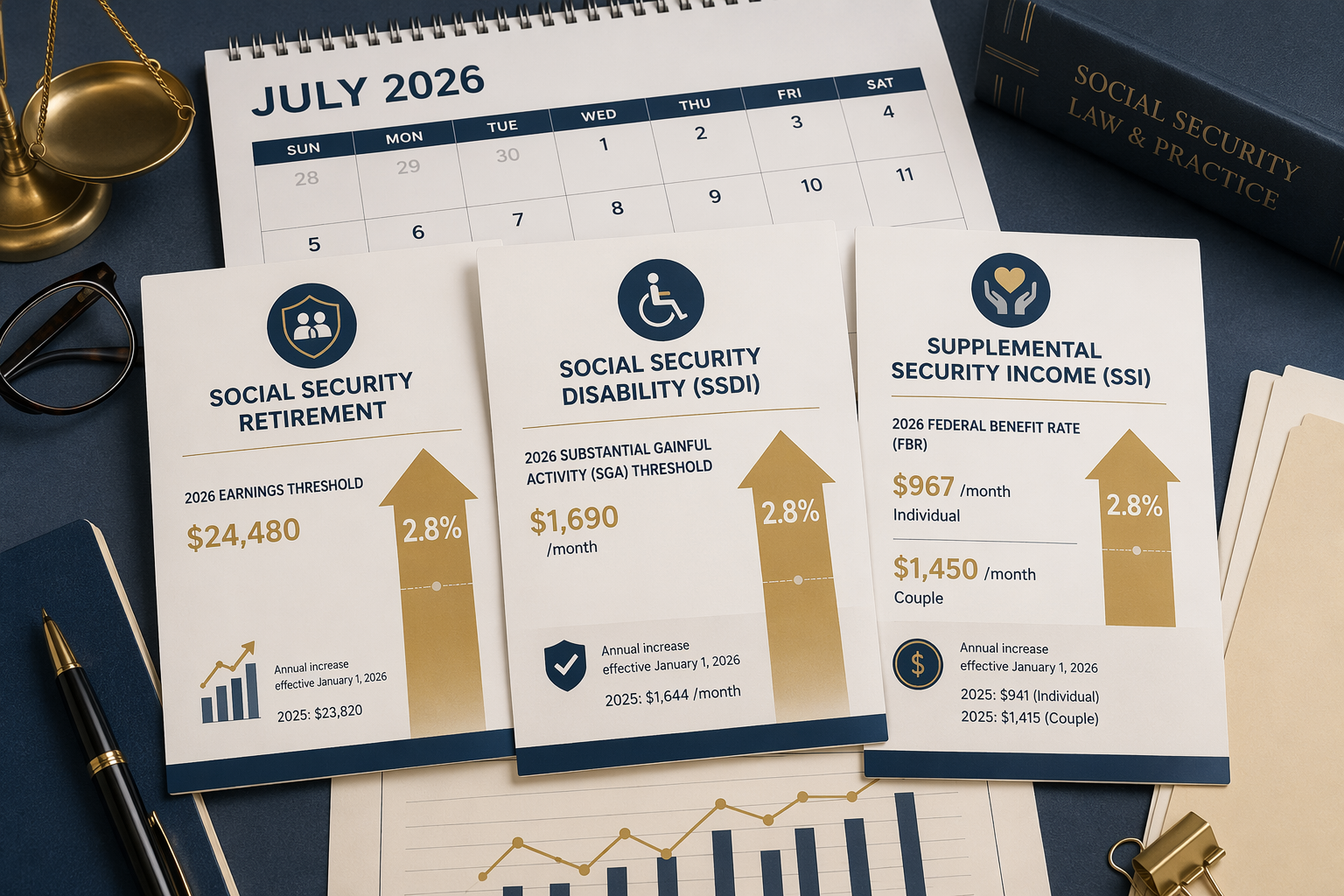
July 2026 Eligibility Thresholds at a Glance
| Issue | 2026 figure or rule | Legal relevance |
|---|---|---|
| COLA | 2.8% cost-of-living adjustment; average retirement benefit reported at $2,071 per month | Affects benefit amounts, not insured status or basic retirement eligibility [1] |
| Full retirement age | 67 for workers born in 1960 or later | Controls unreduced retirement benefits and the retirement earnings test category [2] |
| Retirement work credits | $1,890 in covered earnings for one credit; 40 credits generally needed for retirement eligibility | Goes to insured status, not monthly payment timing [2] |
| Retirement earnings test: under FRA | $24,480 annual exempt amount; $1 withheld for every $2 above the limit | Applies before full retirement age when benefits are claimed early [2] |
| Retirement earnings test: year FRA is reached | $65,160 annual exempt amount; $1 withheld for every $3 above the limit | Applies only to earnings before the month full retirement age is reached [2] |
| SSDI substantial gainful activity, non-blind | $1,690 per month | A work-activity screen for disability entitlement and continuing eligibility [2] |
| SSDI substantial gainful activity, blind | $2,830 per month | Higher SGA threshold for blind beneficiaries [2] |
| Trial work period | $1,210 per month | A work month at or above this level counts toward the trial work period [2] |
| SSI federal benefit rate | $994 per month for an individual; $1,491 per month for a couple | Maximum federal SSI payment before countable income adjustments [3] |
| SSI resources | $2,000 for an individual; $3,000 for a couple | Resource eligibility limit; unchanged by the 2026 COLA figure [3] |
| SSI student earned income exclusion | $9,730 annual exclusion | Can reduce countable earned income for eligible students [2] |
| WEP/GPO repeal | Social Security Fairness Act repeal in effect after January 2025 implementation | Changes prior public-sector retirement assumptions; it is not a July 2026 enactment [4] |
| Senior tax deduction | Up to $6,000 for filers age 65+, phasing out at $75,000 MAGI for single filers and $150,000 for joint filers | Affects tax planning, not gross Social Security entitlement or eligibility [5][6] |
Retirement Eligibility: Insured Status, FRA, and Earnings Are Separate Questions
The cleanest retirement eligibility question remains insured status. In 2026, a worker earns one Social Security credit for each $1,890 in covered earnings, and 40 credits are generally required for retirement benefits [2]. That figure answers a different question from the client’s filing age, benefit amount, or July deposit date.
Full retirement age now reaches 67 for workers born in 1960 or later [2]. For counseling purposes, that is the end point of the long phase-in from prior law, and it matters because the month a client reaches FRA changes the earnings-test analysis. It also matters because clients often treat “age 62,” “Medicare age,” and “full retirement age” as if they were interchangeable. They are not.
For a client who claims retirement benefits before FRA and keeps working, the 2026 annual exempt amount is $24,480. SSA withholds $1 in benefits for every $2 in earnings above that limit [2]. In the calendar year the client reaches FRA, the higher exempt amount is $65,160, with $1 withheld for every $3 above the limit, and only earnings before the month FRA is reached count for that test [2].
That withholding rule is not the same as a tax rule, and it is not a permanent ineligibility rule. In intake, the useful sequence is usually: confirm insured status, identify the client’s FRA, determine whether early filing has occurred or is planned, then apply the earnings test if the client has wages or self-employment income before FRA.
The 2.8% COLA belongs in the benefit-amount column. SSA’s 2026 COLA materials report a 2.8% increase and an average retirement benefit of $2,071 per month [1]. Those figures may affect budgeting, support calculations, and tax projections, but they do not supply the 40 credits needed for retirement entitlement and do not move a client’s full retirement age.
WEP and GPO Assumptions Need a Fresh Check
The Social Security Fairness Act belongs in a July 2026 retirement review because it changed a category of advice that many public-sector retirees heard for years. SSA describes the Act as eliminating the Windfall Elimination Provision and Government Pension Offset, with effects tied to benefits payable after December 2023 and implementation activity beginning in 2025 [4].
That timing matters. July 2026 is not the enactment date. It is a practical checkpoint after SSA’s public implementation update. SSA reported that, by July 2025, it had disbursed $17 billion in retroactive payments to 3.1 million beneficiaries and had taken more than 289,715 new applications related to the change [4]. More current agency processing figures may exist, so a file involving a government pension should be checked against SSA’s current case status rather than a stale WEP/GPO assumption.
The Senior Deduction Is a Tax Planning Item, Not an Eligibility Rule
The new senior deduction is easy to overread in a benefits consultation. Reports on the 2026 change describe a deduction of up to $6,000 for filers age 65 and older, with phaseouts beginning at $75,000 modified adjusted gross income for single filers and $150,000 for joint filers [5][6]. That may matter when projecting after-tax income from Social Security, pensions, withdrawals, and wages.
It does not change gross Social Security eligibility. A client does not become insured for retirement benefits because of a tax deduction, and the deduction does not replace the separate federal rules that determine whether Social Security benefits are taxable. For a related tax-planning discussion, see How the 2027 COLA Forecast Reshapes Social Security Taxation.
Disability Eligibility: SGA Is Not the Same as a Trial Work Month
For SSDI files, the 2026 substantial gainful activity figures are the first bright-line numbers to check. SSA lists SGA at $1,690 per month for non-blind individuals and $2,830 per month for blind individuals in 2026 [2]. Those amounts are used to evaluate work activity in disability entitlement and continuing eligibility contexts.
The trial work period threshold is lower: $1,210 per month in 2026 [2]. That figure does not mean the client has performed SGA. It means the month can count as a trial work month. Collapsing those two concepts can produce bad advice, especially when a client is testing work capacity and believes any earnings below SGA are legally irrelevant.
| Disability work concept | 2026 amount | What it answers |
|---|---|---|
| Non-blind SGA | $1,690/month | Whether non-blind work activity may be substantial gainful activity [2] |
| Blind SGA | $2,830/month | Whether blind work activity may be substantial gainful activity [2] |
| Trial work period service month | $1,210/month | Whether a month counts toward the trial work period [2] |
A practical SSDI review should identify the program first. SSDI is tied to insured status and disability rules; SSI is means-tested. A client may use “disability” to describe both, but the file cannot. For broader disability-processing context, including technology concerns in claims administration, see How AI is changing Social Security disability benefits and rights.
SSI Eligibility: Benefit Rate, Resources, and Exclusions Do Different Work
SSI creates more intake traps because several numbers sit close together but govern different parts of the analysis. The 2026 federal benefit rate is $994 per month for an eligible individual and $1,491 per month for an eligible couple [3]. That is the maximum federal payment before countable income and other adjustments, not a general income limit for every SSI applicant.
The resource limits remain the familiar $2,000 for an individual and $3,000 for a couple [3]. Estate planners and elder law attorneys should resist treating the COLA as if it loosened those resource caps. It did not. A client whose monthly federal SSI amount rises with the COLA can still have a resource problem if countable assets exceed the SSI limit.
For students, the 2026 student earned income exclusion is $9,730 annually [2]. That figure can reduce countable earned income for an eligible student, but it is not a general earnings permission for every SSI recipient. The client’s age, student status, earned income, and remaining exclusion all have to be checked before the number does any work.
- Use the federal benefit rate to estimate the maximum federal SSI payment before reductions.
- Use the resource limit to test countable assets as a condition of SSI eligibility.
- Use the student earned income exclusion only when the recipient satisfies the student criteria.
- Check state supplementation separately; it is outside this federal-threshold reference.
SSI payment timing is a separate statutory and administrative question. It may matter when rent, facility charges, or representative payee accounting are at issue, but it should not be allowed to crowd out the eligibility analysis. For a payment-date discussion, see SSI Early Deposit Dates Are Set by Statute, Not Banks.
What Changed From 2025, and What Did Not
The cited sources support a narrow set of current-year comparisons. The 2026 COLA is 2.8%, and SSA’s 2026 materials place the average retirement benefit at $2,071 per month [1]. SSA’s 2026 thresholds also show the current work-credit amount, earnings-test limits, SGA levels, trial work period amount, and student earned income exclusion [2].
What did not change in a way that can be assumed from the COLA is just as important. The SSI resource limits remain $2,000 and $3,000 [3]. The senior deduction affects tax planning rather than gross benefit eligibility [5][6]. The Fairness Act repeal of WEP/GPO changes benefit calculations and application assumptions for affected public-sector retirees, but July 2026 should not be described as the date of enactment [4].
Where a practitioner needs a precise 2025-to-2026 delta not supplied in the cited materials, the safer approach is to cite the current 2026 threshold and retrieve the prior-year SSA source for the historical comparison. A guessed percentage change is worse than no comparison.
Issues This Reference Does Not Resolve
Some Social Security-adjacent questions are important but outside this July 2026 eligibility threshold reference. State SSI supplements can materially affect payment expectations, but they are state-specific. Medicare IRMAA brackets may affect net retirement planning, but they are Medicare premium rules, not Social Security entitlement rules.
The SSA public Fairness Act implementation figures cited here come from the agency’s July 2025 update [4]. If SSA has issued newer processing totals, those newer figures should control a live counseling conversation. Likewise, any legislative proposal introduced shortly before this article date, including unresolved reform bills, should be checked for amendments before being treated as operative law.
Trust Fund Outlook Belongs in Planning, Not Eligibility Screening
The long-range financing issue is not an eligibility threshold, but it now belongs in retirement counseling. Reporting on the 2026 Trustees Report states that the OASI trust fund is projected to become insolvent in the fourth quarter of 2032, with 78% of scheduled benefits payable after that point if Congress does not act [7].
That projection should not be turned into a July 2026 denial rule. It is a planning risk, especially for couples, early-retirement decisions, and long-term income projections. For related planning analysis, see Social Security Cuts in 2033 Require New Legal Strategies for Couples and Lawyers Must Rethink Early Retirement Advice as Cuts Loom.
For July 2026 files, the professional discipline is simple: identify the program, apply the current threshold for that program, and check the source date before advising the client.
References
- 2026 Social Security Changes, Social Security Administration.
- What's New in 2026, Social Security Administration.
- SSI Federal Payment Amounts for 2026, Social Security Administration.
- Social Security Fairness Act, Social Security Administration.
- Social Security 2026 benefit amounts will be affected by these changes, CNBC, November 21, 2025.
- 2026 Changes to Social Security Benefits, NARFE, February 2, 2026.
- Social Security reform, CNBC, July 14, 2026.
Comments
Join the discussion with an anonymous comment.