
The first legal issues under South Carolina's H.4764 are not hidden in a jail pod or buried in a later civil-rights complaint. They are on the face of the bill: a statewide mandate, a forced choice among 287(g) models, an Attorney General enforcement mechanism, and an immunity clause that sounds broader than it can be.
As of July 22, 2026, H.4764 has not become law. It was prefiled in December 2025, passed the South Carolina House 84-26 on April 2, 2026, and remains pending in the Senate Judiciary Committee.[1] That status matters. Counties and agencies are not yet operating under a final statute. But the bill is developed enough to map the litigation risk it would create if enacted in its current form.

The bill would require every law enforcement agency in South Carolina that operates a correctional facility to enter into a 287(g) agreement with ICE. The agency would have to choose one of three models: the Jail Enforcement Model, the Warrant Service Officer Model, or the Task Force Model.[1] That is not a small administrative preference. It is the statutory point at which local custody, federal immigration enforcement, training, supervision, records, and county money begin to occupy the same file.
The Immunity Clause Is Not the End of the File
H.4764 tries to calm local agencies with an immunity provision. Its protection is limited to acts taken in “good faith” and does not cover “actual fraud, actual malice, intent to harm, or a crime involving moral turpitude.”[1] That language may be politically useful, but it does not make federal constitutional claims disappear.
A state legislature can define or limit state-law liability. It cannot bar a federal Section 1983 claim alleging that a county actor, acting under color of law, violated the Fourth Amendment, the Fourteenth Amendment, or another federal right. If a plaintiff pleads an unlawful stop, discriminatory enforcement, prolonged detention without lawful authority, denial of due process, or unconstitutional jail conditions, the county does not get out of federal court by pointing to a state good-faith clause.
The qualifier also invites the fight the bill appears designed to avoid. “Good faith” is not self-proving. “Actual malice” and “intent to harm” are fact questions. In civil-rights litigation, intent is often built from training records, emails, body-camera footage, stop data, booking records, detainee communications, public statements, and patterns of enforcement. A county that treats the immunity clause as a permission slip may instead hand plaintiffs the discovery plan.
That is the practical weakness in the statutory shield. The clause may help in some state-law claims. It may support a motion at a later stage if the facts are clean. But it does not prevent the complaint from being filed, does not stop federal claims from being pleaded, and does not relieve the county attorney from explaining why “good faith” will now be litigated through the conduct of deputies, jail staff, supervisors, and elected officials.
The Mandate Creates Different Risk Depending on the 287(g) Model
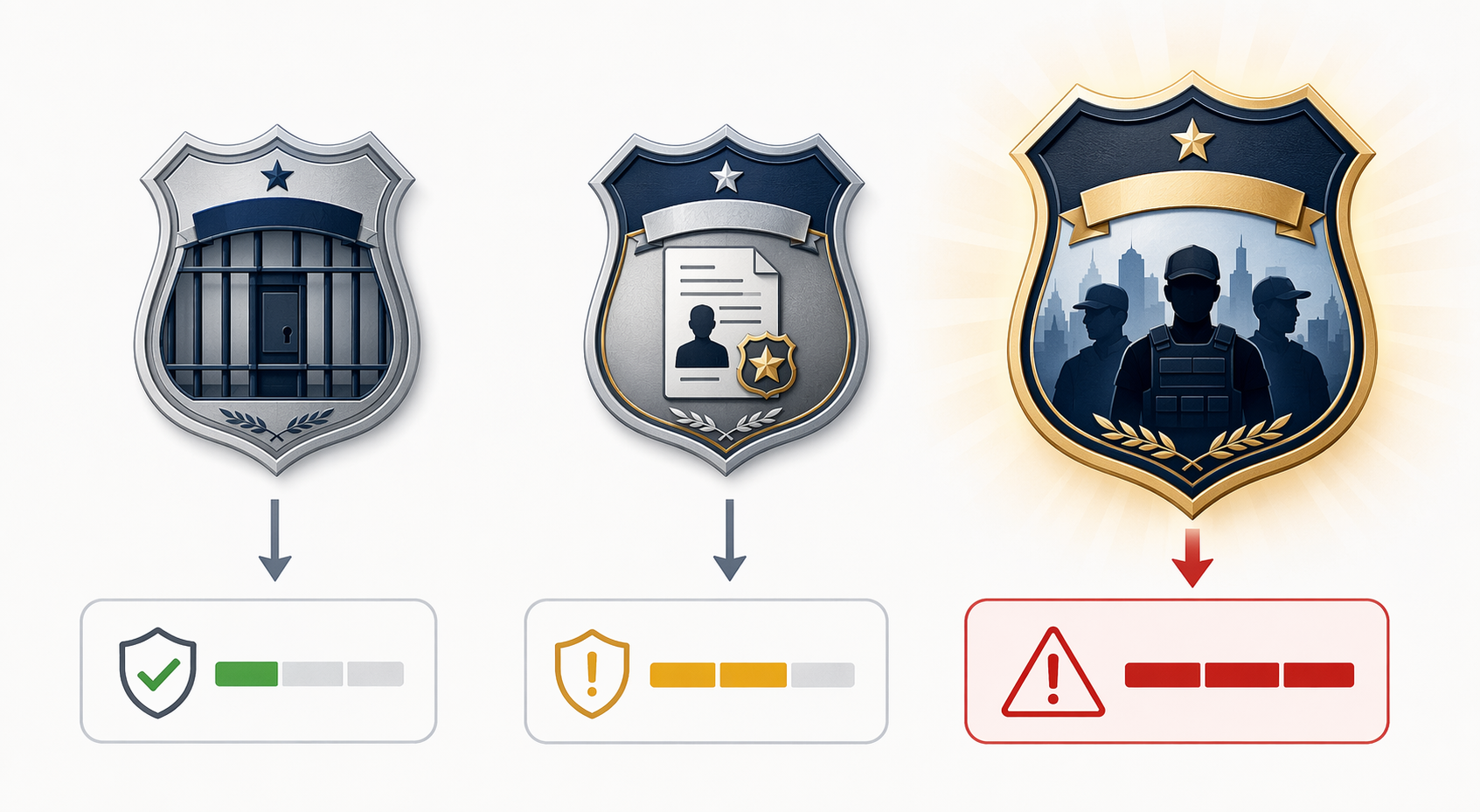
H.4764 does not require one uniform operational design. It requires participation through one of three ICE models.[1] That choice matters because liability follows function: who encountered the person, who made the custody decision, who supervised the officer, who controlled the records, and whose policy caused the alleged violation.
| 287(g) model | Core function under the bill’s framework | Primary local-government risk |
|---|---|---|
| Jail Enforcement Model | Screening and immigration-processing functions inside local jails | Detention authority, booking practices, hold decisions, records access, and jail-condition claims |
| Warrant Service Officer Model | Service of ICE administrative warrants by designated local officers | Whether the local officer had lawful authority for the seizure or continued detention |
| Task Force Model | ICE-directed field enforcement activity by trained local officers | Stops, searches, arrests, discriminatory-enforcement claims, command-control disputes, and Monell exposure |
The Jail Enforcement Model is the easiest to describe and still capable of producing serious litigation. A person is already in local custody; the immigration function occurs inside the jail. That does not make the county a passive landlord. The jail controls intake paperwork, housing conditions, access to counsel, release timing, communications, and records. If ICE involvement changes the length or conditions of custody, the local agency should expect questions about who had legal authority at each point.
The Warrant Service Officer Model is narrower, but it concentrates risk around the moment of seizure. ICE administrative warrants are not the same thing as judicial criminal warrants. If a local officer relies on the wrong document for the wrong kind of custody decision, a plaintiff’s lawyer will not need a complicated theory. The claim will ask whether a state or local officer had authority to detain the person at the time and under the circumstances presented.
The Task Force Model is the hardest one for counties to price because it moves local officers into field enforcement directed by ICE.[1] That is where Monell questions become more than a pleading label. If a local officer stops a vehicle, questions a passenger, participates in an arrest, or helps transport a person after an ICE-directed operation, the county may argue that federal direction breaks the chain of municipal responsibility. Plaintiffs will answer that the county chose the model, selected and trained the officers, accepted the operational role, and maintained the employment relationship.
Neither side’s position is frivolous in the abstract. That is exactly why the model is risky. The county will want federal-command insulation; the plaintiff will plead local policy, custom, failure to train, ratification, and deliberate indifference. The county’s agreement file, council minutes, sheriff’s statements, training materials, complaint history, and after-action reviews will become evidence about whether the alleged constitutional violation was an accident, an officer-level mistake, or the predictable result of a local policy choice.
South Carolina Already Has the Flashpoints Plaintiffs Would Use
The risk analysis does not depend on assuming that every South Carolina agency will engage in unlawful enforcement. It depends on recognizing that future plaintiffs will not plead from a blank page. They will look for existing incidents, public statements, denials of information, and prior immigration-enforcement disputes to support foreseeability and intent.
One likely flashpoint is North Charleston. The ACLU of South Carolina described November 2025 traffic stops by state troopers that witnesses characterized as targeting “exclusively Latino-appearing drivers.”[2] That account is advocacy material, not a judicial finding. Still, for pleading purposes, it identifies the kind of factual pattern that would matter if H.4764 later pushes more local officers into immigration-adjacent field activity: vehicle stops, perceived ethnicity, state-law pretexts, ICE coordination, and whether supervisors tolerated or encouraged the practice.
Another flashpoint is Lexington County. According to the ACLU of South Carolina’s reporting on local ICE collaboration, the Lexington County Sheriff’s Department, operating under the Jail Enforcement Model, refused in February 2026 to disclose ICE detainee charges after ICE instructed the department, “You’re not releasing this information.”[3] That episode is not proof that every jail-based 287(g) program will conceal records. It does show why records control is not an afterthought. If a county holds the person, local officials still need to know what they can disclose, what state public-records law requires, what federal restrictions actually apply, and who made the decision to withhold information.
Those two examples point in different directions. North Charleston is about field contact and alleged discriminatory targeting. Lexington County is about jail collaboration and information control. H.4764 would make both categories more important because it would convert optional participation into a statewide obligation for covered agencies.
The Fiscal Opt-Out Is a Procedure, Not a Safe Harbor
H.4764 includes a fiscal impracticability route. A covered agency may avoid the participation requirement only if the governing body makes formal written findings that compliance would be fiscally impracticable.[1] For a small county or municipality, that sounds useful until the governing body asks what record it must create, what costs count, and how much specificity is enough.
The opt-out creates its own administrative burden. Someone must estimate training costs, staffing effects, transportation obligations, detention costs, records-management needs, insurance implications, overtime, translation access, technology demands, and litigation reserves. A bare resolution saying the county cannot afford it may invite a state enforcement action. A detailed resolution may become discoverable evidence in later litigation about what the county knew the program would cost and what risks officials anticipated.
The North Carolina Justice Center has reported that the cumulative cost of ICE collaboration to North Carolina counties exceeded $81.7 million over a decade.[4] That number is not a South Carolina damages estimate and should not be treated as one. Its value here is narrower: it shows why local governing bodies should not treat 287(g) participation as cost-free simply because the immigration mission is federal.
Attorney General Enforcement Changes the County’s Litigation Posture
H.4764 would authorize the South Carolina Attorney General to bring a circuit court action to compel a noncompliant agency.[1] That provision does more than add political pressure. It changes the sequence of legal exposure.
A county that believes participation is unlawful, fiscally impracticable, operationally unsafe, or inconsistent with federal priorities may not be able to sit quietly. It may need to build a record before the Attorney General sues, defend the adequacy of its fiscal findings, or explain why a particular 287(g) model is impossible to implement. The enforcement mechanism also creates a forum in which state officials may argue that local agencies have no discretion while local officials argue that compliance would expose them to federal liability.
That tension is not theoretical in South Carolina. A prior state immigration-enforcement law, SB 20, produced federal litigation, and key provisions were struck down as unconstitutional in United States v. South Carolina.[5] H.4764 is a different bill and would need to be analyzed on its own terms. But the earlier case is a useful institutional warning: state immigration-enforcement mandates can fail not because officials lacked enthusiasm, but because federal constitutional and preemption limits still apply.
National 287(g) Findings Make Foreseeability Easier to Plead
National advocacy findings do not prove what a South Carolina sheriff’s office will do next year. They do, however, shape foreseeability. The ACLU’s February 2026 “Deputized for Disaster” report found that at least 65% of 287(g)-participating agencies nationally had records of racial profiling and civil-rights violations, and at least 77% operated facilities with documented inhumane conditions.[6] Those are advocacy-research conclusions, drawn from records the ACLU identified, and they should be cited as such. In litigation, their practical use would be to argue that the risk was known before local officials signed or expanded an agreement.
Custody-condition evidence adds pressure on the jail side of the bill. Human Rights Watch reported 52 deaths in ICE custody during the first 500 days of the second Trump term, through June 4, 2026, and described that mortality rate as more than double the rate during the first Trump term and nearly four times the Biden-era rate.[7] NPR and South Carolina Public Radio, using a different time window, reported 29 ICE custody deaths in fiscal year 2026 through April 17, 2026.[8] Those figures should not be merged. They measure different periods. Their common relevance is that ICE detention conditions are already being scrutinized, and local jail participation would not occur outside that scrutiny.
For county risk purposes, the question is not whether an advocacy report establishes liability. It does not. The question is whether officials can credibly say the risk of racial-profiling claims, detention-condition claims, and records-access disputes was unforeseeable after those materials were public. That will be a difficult sentence to write in a litigation hold memo.
What a Post-Enactment Lawsuit Would Likely Look Like
If H.4764 becomes law in its current form, the first legal fights may not come from a damages case. They may come from local resistance, fiscal-impracticability findings, public-records disputes, or pre-enforcement challenges. But the damages pathway is not hard to see.
- A covered agency signs or is compelled to sign a 287(g) agreement.
- The agency selects a model, trains selected officers, and changes jail or field procedures.
- A person is stopped, questioned, held, transferred, denied records, or subjected to conditions allegedly tied to the program.
- Plaintiffs plead federal constitutional claims under Section 1983 and seek municipal liability under Monell.
- The county invokes state-law immunity, federal direction, officer discretion, or lack of causation.
- Discovery focuses on intent, training, supervision, written policies, ICE communications, governing-body knowledge, complaint history, and fiscal warnings.
That sequence is why the bill’s “good faith” language is less protective than it looks. The harder the county leans on good faith, the more plaintiffs will seek evidence of what officials knew before the incident. If the governing body debated costs, reviewed national reports, heard public comments about profiling, considered the Task Force Model, or received advice about detention authority, those materials may become relevant to deliberate indifference, intent, or causation.
The records officer is part of that risk map. So is the jail administrator. So is the captain who approved a roster of trained officers. So is the county attorney who warned that an ICE administrative warrant would not answer every Fourth Amendment question. Civil-rights litigation rarely names only the person with the cleanest legal title. It names the people, policies, customs, and failures that can plausibly connect the injury to the government entity.
The Risk H.4764 Cannot Draft Around
A South Carolina county evaluating H.4764 should separate three questions that the bill tends to collapse. First, can the state require covered local agencies to seek 287(g) participation? Second, can a particular local agency perform the assigned function without violating federal rights? Third, who pays when the answer to the second question is litigated after an actual stop, detention, transfer, injury, or disclosure fight?
The bill supplies an answer to the first question and gestures at the third. It does not eliminate the second. A statutory command to cooperate with ICE does not tell a deputy when a vehicle stop becomes an unlawful seizure. It does not tell jail staff how long a person may be held on a particular document. It does not decide whether ICE direction defeats, shares, or complicates municipal liability. It does not make discriminatory intent disappear from a complaint. It does not make records disputes vanish because a federal officer told a local agency not to release information.
This is not legal advice, and H.4764 may change before any final vote. As drafted and as pending on July 22, 2026, its legal risk is not merely that someone may sue. The risk is that the bill appears to create the factual predicates for exactly the intent, command-control, detention-authority, records-access, and constitutional-violation disputes its immunity clause cannot resolve.
References
- H. 4764, South Carolina Legislature.
- 5 ugly facts about ICE collaboration, ACLU of South Carolina.
- Are your local police collaborating with ICE?, ACLU of South Carolina.
- The Fiscal Cost of North Carolina’s ICE Collaboration, North Carolina Justice Center.
- United States v. South Carolina, ACLU of South Carolina.
- As Forced ICE Collaboration Bill advances, new report exposes abuses tied to 287(g), ACLU of South Carolina, February 2026.
- Dying in Detention, Human Rights Watch, June 25, 2026.
- ICE detention deaths hit highest annual total in five years, NPR / South Carolina Public Radio, April 17, 2026.
Comments
Join the discussion with an anonymous comment.