
The legally interesting fact about the SOXL drop around July 7 is not that semiconductor stocks sold off. It is the size of the gap. One measurement has the Direxion Daily Semiconductor Bull 3X Shares down roughly 30% for the month through July 14, after a 23% drop on June 23, a 16% drop on July 1, and another 16% drop on July 7.[1] A different measurement, using a late-June peak-to-trough window, puts the decline at more than 50%, while the Philadelphia Semiconductor Index fell about 20% over the same broad period.[2] Those are not interchangeable figures. The first describes a monthly loss through a particular date; the second captures a steeper peak-to-trough collapse. Together, they frame the question securities lawyers actually have to answer: how much of the investor harm was ordinary chip-market direction, and how much was the product’s leveraged structure doing what a daily-reset, swap-based ETF is built to do in a hostile path?
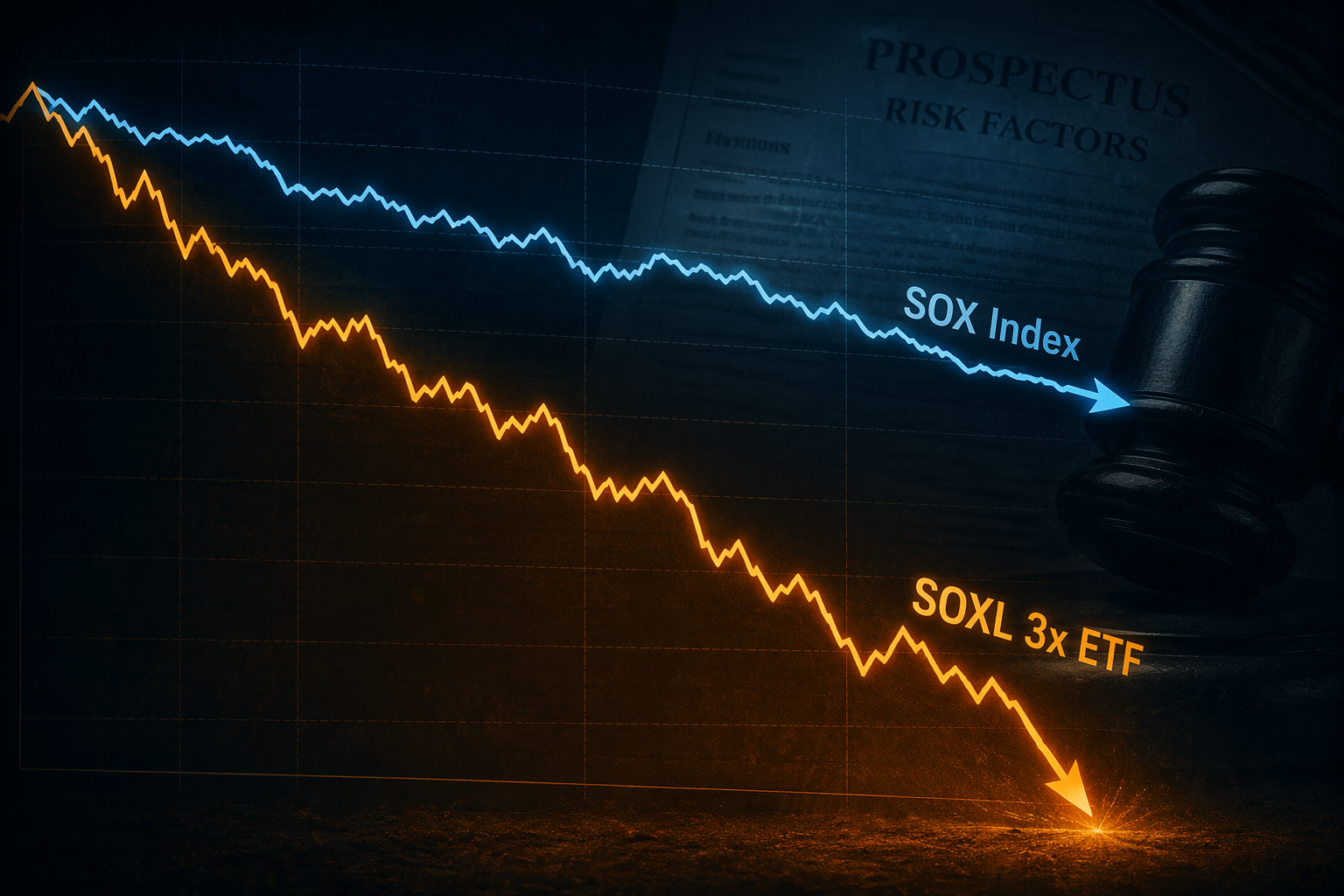
A complaint cannot survive on indignation that a 3x ETF fell hard. SOXL tells investors, in substance, that it seeks three times the daily performance of its semiconductor benchmark before fees and expenses. A sophisticated trader using it intraday or for a brief tactical exposure understands the bargain. The pleading problem becomes more serious only if plaintiffs can separate the loss into two components: the decline one would expect from semiconductor weakness, and the additional loss allegedly caused by daily compounding, financing costs, derivatives exposure, and retail-facing distribution that failed to make those costs and mechanics real to investors.
That is why the July 2026 record is harder to wave away than a generic “AI bubble” story. SOXL reportedly had $16.9 billion in assets under management, $7.9 billion in embedded swap financing costs, and 39.6% of net assets in derivatives exposure.[1] Those figures do not prove a disclosure violation. They do, however, give plaintiffs a numerical hook for materiality and loss causation that is more concrete than the usual allegation that leverage is risky.
The July 7 selloff was a market event, but the legal theory is a product-structure theory
The July 7 leg did have identifiable market triggers. Chip stocks sold off as investors treated Samsung’s record profit as insufficient against elevated expectations, while other headlines involving Meta Compute and DeepSeek chip plans added to concern about whether AI spending could keep supporting semiconductor valuations.[3] Reuters later described the pullback as raising worries about the strength of the AI rally and the role of leveraged trades.[2]
Those facts matter, but only up to a point. They explain why the underlying market moved. They do not explain why a fund tied to a semiconductor index appears to have fallen far more than the index over the same rough period. For a securities-liability analysis, the selloff triggers are the beginning of the loss-causation story, not the end of it.
| Date or window | Reported movement | Why it matters legally |
|---|---|---|
| June 23, 2026 | SOXL down 23% | Part of the path that set up compounding and reset effects before July 7 |
| July 1, 2026 | SOXL down 16% | Another large daily move in the same drawdown sequence |
| July 7, 2026 | SOXL down 16% | The selloff date tied to AI-chip-market headlines and investor attention |
| Month through July 14, 2026 | SOXL down roughly 30% | A narrower calendar-window measurement reported by 247wallst |
| Late-June peak to trough | SOXL down more than 50%; SOX down about 20% | The wider measurement that exposes the leverage-decay differential |
The distinction between those windows is not cosmetic. Plaintiffs who plead only the most dramatic number invite a defense argument that the complaint is cherry-picking a peak and trough. Plaintiffs who plead both measurements, and explain what each one measures, are in a better position to show that the alleged injury is not just semiconductor beta with a larger number attached.
Why daily reset decay is the fact pattern, not a footnote
A daily leveraged ETF is designed around daily exposure. Over longer periods, the ending result depends on the path of daily returns. In a smooth upward path, compounding can help. In a volatile or downward path, it can create results that diverge sharply from a simple three-times-the-index mental model. That is not an accident in the sense of operational malfunction; it is the product design.
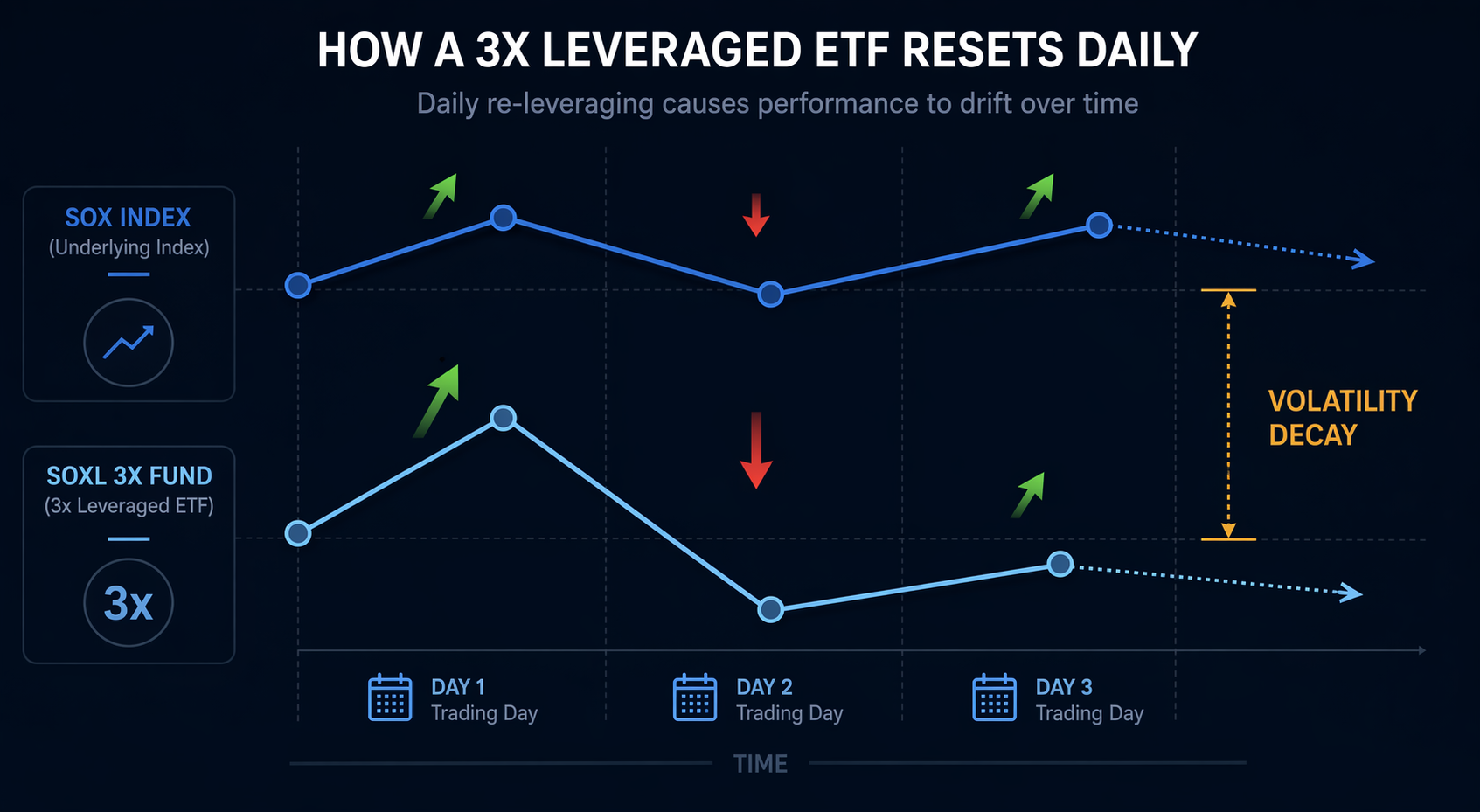
The SEC’s 2023 investor bulletin gives plaintiffs and defendants the same sharp instrument. The bulletin warned that leveraged and inverse ETFs may not perform as investors expect over periods longer than one day. It used concrete examples, including a scenario in which an index gained 2% over four months while a 2x leveraged fund lost 6%, and another in which a 3x inverse fund lost 90%.[4]
For plaintiffs, that bulletin helps make the risk foreseeable. It is one thing to allege, after the fact, that volatility decay surprised investors. It is stronger to point to the regulator’s own public explanation of how a leveraged ETF can produce counterintuitive losses over time. The July sequence — large down days, a claimed more-than-50% peak-to-trough fund loss, and an approximately 20% decline in the underlying SOX index — gives that regulatory warning a concrete setting.[2][4]
For Direxion, the same bulletin cuts the other way. A defense brief would likely argue that the SEC had already warned the market, that leveraged ETF risks were publicly known, and that SOXL’s own offering materials and risk disclosures cannot be transformed into fraud allegations merely because the warned-of risk materialized. That is a familiar and often effective pleading-stage move: recast every alleged omission as an already disclosed risk.
The harder question is whether general warnings about daily reset decay adequately communicated the scale and mechanics of this fund’s July exposure. The $7.9 billion embedded swap-cost figure is important for that reason.[1] A court would not treat a large financing-cost number as liability by itself. But if plaintiffs can plead that retail investors were led to understand SOXL mainly as an amplified AI-chip trade, while the cost and derivatives structure materially changed the expected holding-period risk, the case starts to look less like regret over a bad macro call and more like a disclosure case.
The prior Direxion dismissal does not end the analysis
There was a prior securities class action against Direxion that was dismissed in 2023 on pleading grounds. The underlying ruling was not fully accessible in the available research materials, so it should not be overstated here.[5] A pleading-stage dismissal is not a merits adjudication that every later leveraged-ETF claim is doomed. It means the earlier plaintiffs did not plead a viable claim under the standards applied to that record.
That difference matters because a July 2026 complaint would not be litigated in a vacuum. It would likely plead a new drawdown, a new market environment shaped by AI-chip retail enthusiasm, a larger factual record about daily reset decay, and the SEC’s 2023 bulletin as part of the disclosure landscape. None of those facts guarantees survival. They do give plaintiffs a route to argue that the earlier dismissal addressed a different case.
The most credible renewed claim would not simply say that SOXL was too dangerous. Courts are not usually receptive to fraud-by-volatility theories. The better theory would identify specific statements or omissions about holding-period risk, financing costs, swap exposure, expected divergence from the index, or the intended investor profile, then connect those alleged defects to the July loss differential. That connection is the difference between pleading “the ETF went down” and pleading a loss caused by a materially misleading risk presentation.
What plaintiffs would still have to plead
- A challenged disclosure or omission, not just the existence of a large loss.
- Materiality, including why the daily reset and swap-cost information would have mattered to a reasonable investor in this product.
- Loss causation, with a plausible separation between semiconductor-market losses and product-structure losses.
- Scienter where required, or another viable state-of-mind theory depending on the claims pleaded.
- A way around the defense argument that the risk was already disclosed in fund documents and publicly described by the SEC.
That last point is likely to do much of the work at the motion-to-dismiss stage. If Direxion can show that the complained-of mechanics were plainly described, plaintiffs face the familiar problem that securities law does not insure investors against risks they were told about. If plaintiffs can show that disclosures were formal but functionally incomplete — especially as to cost scale, derivatives exposure, and holding-period divergence — the prior dismissal becomes less decisive.
Options activity is relevant, but it is not the backbone of a disclosure case
The reported options-market signals are striking: a November put/call ratio of 22.68 and a December put/call ratio of 15.22.[1] Those ratios may show that some market participants were positioning for further downside or hedging aggressively. They do not, without more, establish what SOXL investors understood, what Direxion disclosed, or why the July losses occurred.
For plaintiffs, options data might support context: the market recognized unusual downside pressure, and sophisticated participants may have understood risks that retail holders did not. For defendants, the same data could show that risks were visible in the market. Either way, the put/call ratios are supporting atmosphere. They are not a substitute for a misstatement, an omission, or a causal chain.
The broader securities-litigation environment makes attention more likely, not liability more certain
Broadridge’s 2026 Global Class Action Annual Report reported more than $4 billion in global securities class action recoveries in 2025 and noted rising AI-related securities filings.[6] That belongs in the analysis because plaintiffs’ firms watch loss size, investor concentration, and narrative fit. A large retail-facing AI-adjacent product drawdown with a regulator-issued leveraged-ETF bulletin already on the shelf is the sort of fact pattern that will at least get screened.
There is a caveat. The available research included the Broadridge report data from a summary source, not a fully crawled methodology and breakdown. It is useful as litigation-environment context, not as proof that a Direxion claim is viable. Class action activity can explain why lawyers are paying attention; it cannot supply the missing elements of a securities claim.
Where the exposure profile stands as of July 21, 2026
As of July 21, 2026, no new securities class action against Direxion over the July 2026 SOXL collapse had been identified in the available materials. That matters. This is a counsel-facing risk assessment, not a report on a filed complaint and not legal advice.
Still, ETF counsel should not treat the 2023 dismissal as a complete answer to the July 2026 fact pattern. The more-than-50% peak-to-trough SOXL decline, the approximately 20% SOX comparison, the daily sequence of large losses, the $16.9 billion AUM figure, the $7.9 billion embedded swap-cost figure, and the 39.6% derivatives exposure give plaintiffs more to work with than a bare allegation that a leveraged ETF behaved badly.[1][2] The SEC bulletin then supplies a developed regulatory warning record that both sides can use.
That is the exposure theory plaintiffs would test: not that SOXL should never exist, but that the July 2026 losses may support a materially different disclosure and loss-causation case, one focused on whether daily reset mechanics, swap financing costs, and derivatives exposure transformed an underlying market decline into a category of harm that retail investors were not adequately positioned to understand.
References
- The 2 Pressure Points That Will Determine SOXL's Next 12 Months, 247wallst, July 14, 2026.
- Chip stock pullback sparks worries about AI rally strength, leveraged trades, Reuters, July 17, 2026.
- Chip stocks sell off as high expectations overshadow Samsung results, CNBC, July 7, 2026.
- Updated Investor Bulletin: Leveraged and Inverse ETFs, SEC Office of Investor Education and Advocacy, 2023.
- Direxion representation materials, Ropes & Gray.
- 2026 Global Class Action Annual Report, Broadridge Financial Solutions, 2026.
Comments
Join the discussion with an anonymous comment.