
This is dated legal analysis for practitioners, not advice. The easy client-facing shortcut is wrong in both directions: marriage does not create one national rule, and a separate signature does not end the inquiry. Liability turns on the state property regime, the doctrine of necessaries, and whatever divorce, bankruptcy, or tax overlay changes the collection remedy.
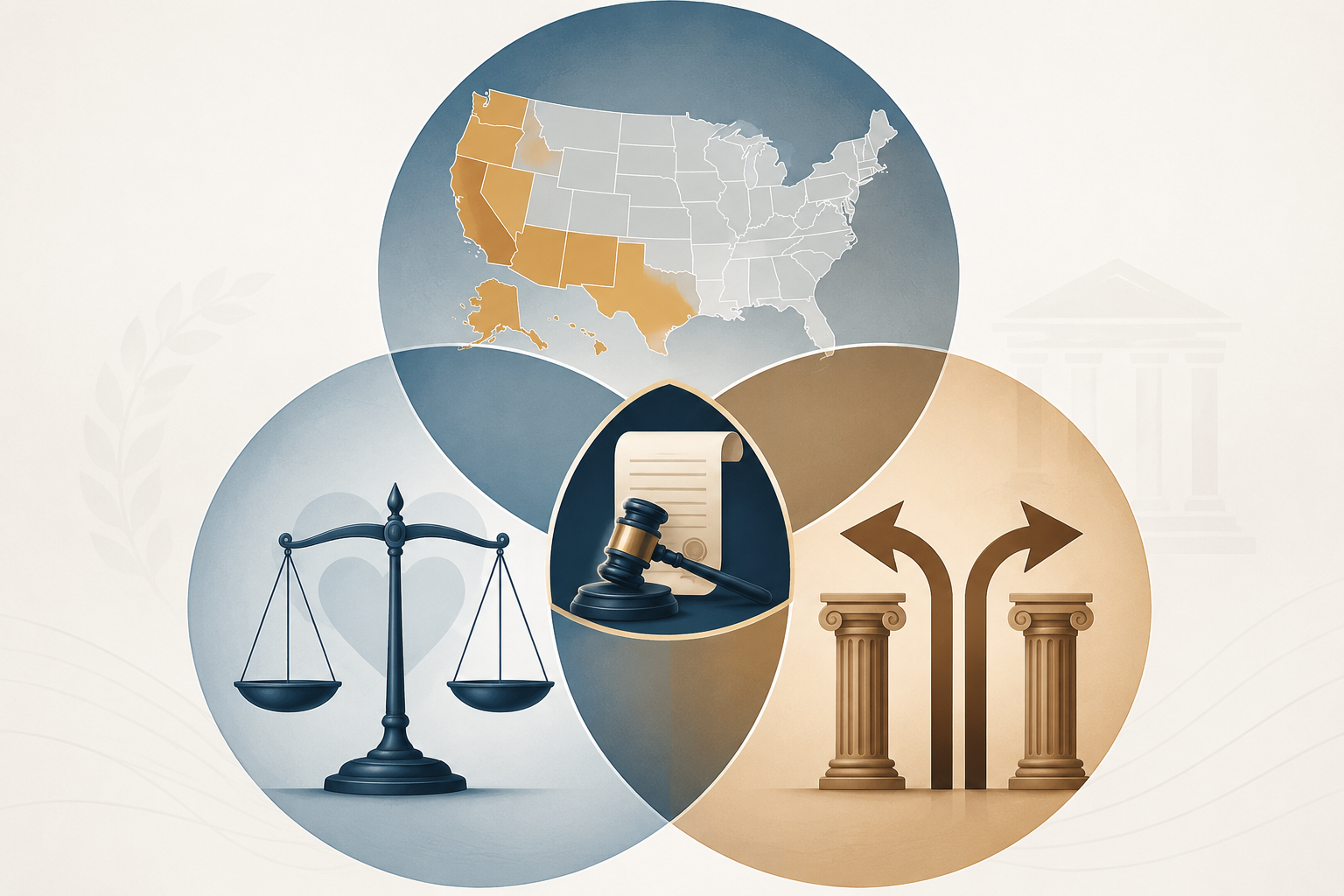
Start With the State Regime
Before anyone asks whose name is on the account, the jurisdiction has to be identified. Community property states, opt-in community property states, and common law states do not start from the same liability baseline, so the same debt can lead to very different collection paths depending on where the spouses live. [1]
- Community property states include Arizona, California, Idaho, Louisiana, Nevada, New Mexico, Texas, Washington, and Wisconsin; Alaska, South Dakota, and Tennessee are opt-in community property jurisdictions. [1]
- Common law states usually begin from separate liability, with equitable distribution reserved for divorce rather than used as a default creditor rule. [1]
- California is the clearest statutory example: section 910 makes the community estate liable for a debt incurred by either spouse during marriage, while section 913 protects separate property from the other spouse's debts except for necessaries. [2]
Community Property Changes the Collection Pool
In a community property case, the useful question is not only who signed, but what property the creditor can reach. California's statute is explicit about the community estate, and the separate-property carveout matters because a creditor who starts with a marital debt does not automatically get to treat premarital assets, inheritances kept separate, or other separate property as fair game. [2]
That regime still does not make every debt mechanically identical. Student loans are a useful example: most community property states treat them as community debts at divorce, but California looks to which spouse actually benefited, so the allocation can diverge from a flat split. [4]
Bankruptcy adds a federal layer that can matter more than the family-law label. Under 11 U.S.C. section 524(a)(3), a single-spouse discharge in a community property state can protect after-acquired community property from prepetition community claims, but the non-filing spouse's separate property remains exposed; creditors generally have 60 days after the first meeting of creditors to object. [3]
Necessaries Can Reach the Non-Debtor Spouse
The doctrine of necessaries is the cross-cutting overlay that makes a pure separate-liability story incomplete. New York authorities describe it as reaching essential goods and services such as medical care, food, shelter, and legal fees when the debtor spouse cannot pay, the creditor relied on the non-debtor spouse's credit, and the non-debtor spouse has the ability to pay; that formulation is useful, but it is not a national rule. [5]
The practical effect is creditor-facing: necessaries can expand the reachable pool even where a contract names only one spouse, and they can do so in states that otherwise look closer to a separate-property system.
Divorce Allocates Between Spouses, Not Against Creditors
Equitable distribution at divorce can reassign marital debts between the spouses, but it does not rewrite the creditor's rights in the underlying contract or lien. If both names remain on the obligation, the creditor still has both obligors in play, even when the divorce decree says one spouse should reimburse the other. [1][6]
- Premarital agreements can allocate debt between spouses under UPAA-style language, but they are still private allocations, not creditor defenses. [1][4]
- Postnuptial transfers or allocations that are designed to hinder collection can be attacked as fraudulent. [4]
- Joint tax returns create joint and several liability; Form 8379 can recover an injured spouse's refund share, but it does not provide a general shield against wage garnishment or property liens. [7][8]
- A co-signer remains liable on the loan if the borrower defaults, which is why name placement and divorce paperwork are different questions. [6]
The file is not complete until counsel has checked the state property regime, the necessaries doctrine, and any divorce, bankruptcy, or tax overlay together. That is where the creditor-facing remedy usually reveals the real liability analysis.
References
- Debt and Marriage: When Do I Owe My Spouse's Debts? - Nolo - updated Nov. 2025
- California Family Code Sections 910-916 - Justia
- 11 U.S.C. Section 524 - Cornell Legal Information Institute
- Community Property Debts: When is the Spouse Liable for the Debt Incurred by the Other Spouse? - Stimmel Law
- Must You Pay Your Spouse's Debts? Current Application of the Doctrine of Necessaries in New York - New York State Bar Association
- Cosigning a Loan FAQs - Federal Trade Commission
- About Form 8379, Injured Spouse Allocation - Internal Revenue Service
- Do You Inherit Your Spouse's Debt After Marriage? - J. David Tax Law
Comments
Join the discussion with an anonymous comment.