
The strongest argument for SSA’s AI-assisted disability processing is not theoretical. As of May 2026, SSA reported that the initial disability claims backlog had fallen from about 1.27 million claims to under 830,000, and that initial disability decisions were moving 42 days faster year over year.[1] For a claimant waiting on rent, medication, transportation, or a family member’s patience, 42 days is not an efficiency talking point. It is a month and a half of pressure removed from the file.
That is the part too many critiques of automation skip. Delay has its own harm. A disability system that takes too long can functionally deny access even before it issues a denial. Anyone searching for social security disability payment delay legal help is usually not asking whether modernization is philosophically pure. They are asking why a claim is stuck, whether the record is complete, and whether someone with authority has actually seen the medical facts that matter.
The harder question is what those faster averages conceal. SSA’s dashboard can show movement in the aggregate; it does not, by itself, tell an attorney whether an unusual neurological presentation was summarized accurately, whether a fluctuating mental health condition was routed as routine, or whether a treating-source limitation was buried in a record extract that no one later questioned. SSA also maintains a Combined Disability Processing Time data page that can be used as a current baseline check, but that page is still a timing measure, not an audit of file-level fairness.[2]

Where AI touches the disability claim file
SSA’s AI ecosystem is not one machine making one decision. It is better understood as a set of tools touching different points in the disability process: medical evidence extraction, predictive fast-tracking, condition-based acceleration, hearing transcription, and quality review. Those distinctions matter because the risk is different at each point. A tool that extracts evidence can miss or mislabel a fact. A tool that predicts likely allowance can accelerate the obvious case while leaving a less legible one in the ordinary queue. A transcription tool can shape what later reviewers think was said at hearing.
| System | Where it sits in the claim process | Main timeline effect | Attorney-facing concern |
|---|---|---|---|
| IMAGEN | Medical evidence review and extraction | Reduces clerical burden in reading and sorting records | Key diagnoses, limitations, or treating-source notes may be missed, mislabeled, or over-summarized |
| QDD | Predictive screening for likely allowances | Moves some strong initial claims faster | Atypical claims may fail to look like likely allowances even when meritorious |
| CAL | Condition-based fast-track processing | Accelerates claims involving listed qualifying conditions | Claims outside clear fast-track categories may receive no comparable benefit |
| HeaRT | Hearing transcription | Creates automated hearing records for later use | Transcript errors can affect how testimony and vocational facts are reviewed |
| Insight | Quality review support | Assists review of decisions and file quality | Quality checks may depend on what the system is trained or configured to notice |
The official SSA description of Quick Disability Determinations, or QDD, is a useful anchor because it shows the agency’s own view of one part of this system. SSA describes QDD as a predictive model that analyzes data in an electronic disability file to identify claims in which there is a high potential that the claimant is disabled and where medical evidence can be obtained quickly.[3] That is an acceleration mechanism, not a final substitute for the legal standard. It also immediately tells attorneys what kind of claim benefits most: one that looks strongly allowable from the available electronic signals.
The remaining systems are described in more detail in practitioner-facing reporting from disability law firms rather than in a neutral public audit. Keefe Disability Law describes IMAGEN as an SSA tool used to extract medical evidence from records, HeaRT as an AI hearing transcription tool, and Insight as a quality review system.[4] Woods & Woods similarly discusses SSA’s AI rollout in claims and service changes, including IMAGEN and related automation concerns.[5] Those descriptions are useful because attorneys encounter the downstream effects in real files, but they should not be treated as independent reliability studies.
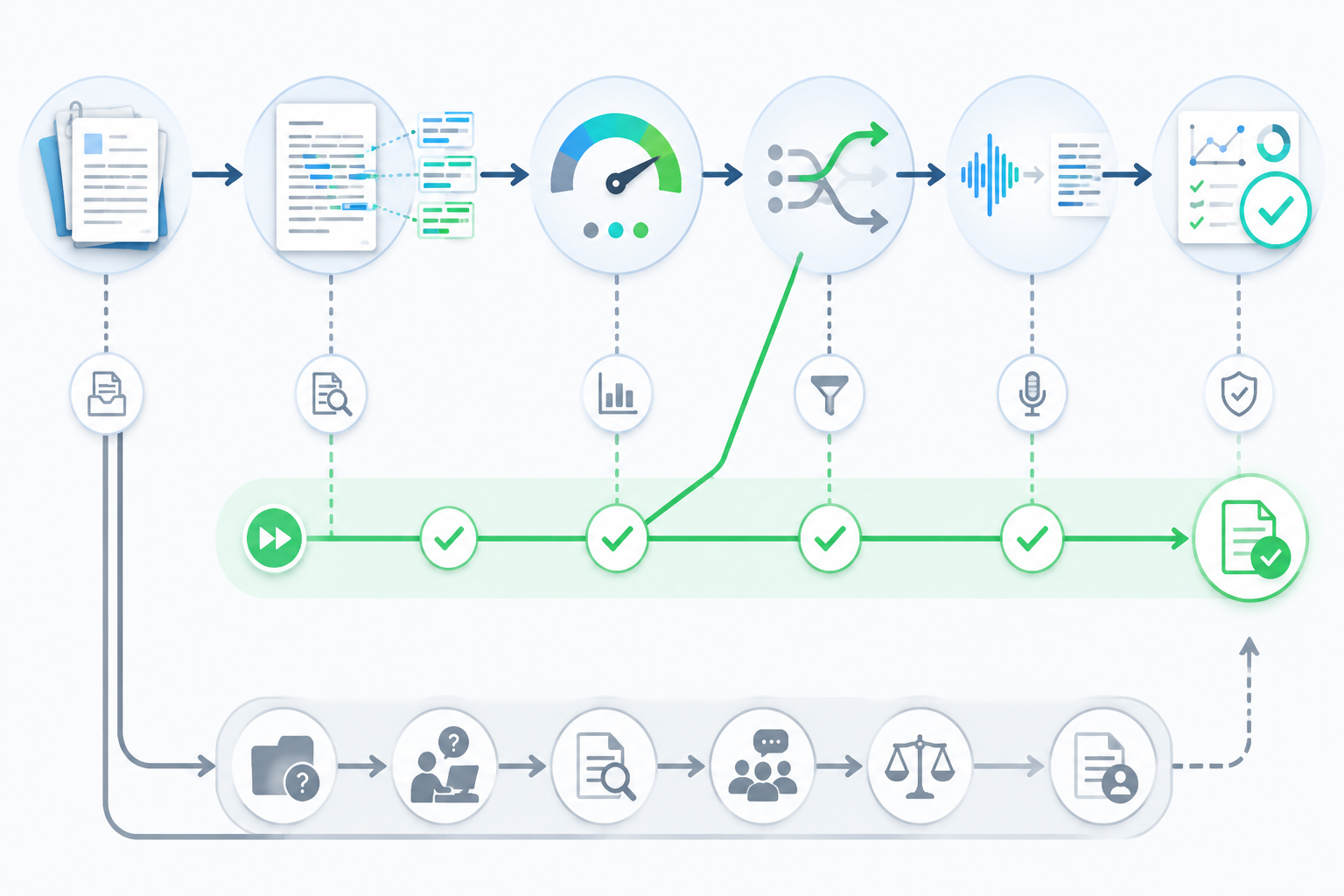
IMAGEN: faster evidence handling, with extraction risk built in
IMAGEN is the system attorneys should watch most closely because it works near the raw material of the case: medical records. If a tool can help locate diagnoses, tests, treatment notes, and other evidence faster, it can reduce the clerical drag that has long slowed disability files. There is nothing noble about making a human reviewer dig through repetitive, poorly indexed records if software can reliably surface what matters.
But extraction is not neutral merely because it is mechanical. A claim file is not a pile of words with equal legal weight. A two-line functional restriction from a treating specialist may matter more than ten pages of normal review-of-systems text. A diagnosis may matter less than the longitudinal evidence showing persistence, failed treatment, and work-related limitation. When an extraction tool surfaces the convenient parts of the record and underweights the clinically awkward ones, the file can become cleaner and less accurate at the same time.
The practical failure mode is not that IMAGEN “denies” a claim. The narrower and more supportable concern is that automated extraction may influence what humans see first, what they trust as complete, and what they do not spend time reopening. Keefe’s description of IMAGEN as an evidence-extraction tool supports that workflow concern, but there is no public neutral audit in the research materials showing a measured IMAGEN error rate across claim types.[4]
For attorneys and paralegals, this shifts attention toward record presentation. Dense records still need organization. Functional limitations should not be left to inference. If a claimant’s case depends on episodic impairment, medication side effects, post-exertional crashes, cognitive fluctuation, or a rare diagnosis that appears under several names, the submission should make those points visible without requiring a perfect extraction pass.
QDD and CAL reward claims that are obvious early
QDD and CAL sit closer to triage. QDD uses predictive modeling to identify claims with a high likelihood of allowance where medical evidence can be obtained quickly.[3] Compassionate Allowances, or CAL, is a separate fast-track path for claims involving conditions that SSA recognizes as clearly meeting disability standards. Practitioner descriptions place CAL alongside QDD as part of the broader acceleration environment, but the two should not be collapsed into one tool.[4][5]
The distinction matters. CAL is condition-driven: if the qualifying condition is there and documented in the expected way, the path can be direct. QDD is predictive: it looks for electronic indicators of likely allowance and quick evidence availability. In both settings, speed comes from recognizability. The file that announces itself clearly can move. The file that requires synthesis may not.
That does not make QDD or CAL unfair by design. It means they are not designed to solve the hardest category of delay: the claim that is medically serious but not cleanly categorized. A claimant with multiple moderate impairments that combine into severe functional loss may not resemble a classic fast-track allowance. A claimant with a rare disease, incomplete specialist access, or inconsistent terminology across providers may have a strong case that does not look strong to a system searching for familiar patterns.
This is where legal help for a Social Security disability payment delay becomes less about asking “Why is SSA slow?” and more about asking “What does the file look like to the system?” A claim can be delayed because the agency has a backlog, because medical evidence is missing, because the case needs human judgment, or because the electronic profile did not trigger acceleration. Those are different problems. They call for different file reviews.
HeaRT: the hearing record becomes another automated artifact
HeaRT matters later in the process, when a claim reaches hearing. Practitioner sources describe it as an AI transcription system used for hearings.[4][5] A transcript is not the decision, but it can become the record through which testimony is later understood, reviewed, or challenged. That gives transcription errors a legal afterlife.
The risk is familiar to anyone who has read a rough transcript in a medically technical case. Drug names blur. Assistive devices are misheard. A claimant’s answer about how often symptoms occur can become ambiguous if the time frame is lost. Vocational testimony depends on precise hypotheticals, and a small transcription error can make a limitation look broader, narrower, or simply incoherent.
The research materials do not establish a public error rate for HeaRT. The responsible point is narrower: if automated transcription is part of the hearing infrastructure, attorneys have reason to treat the hearing record as a document that may need verification, especially where the case turns on symptom frequency, off-task time, absenteeism, manipulative limitations, cognitive restrictions, or vocational-expert wording.
Insight and the limits of quality review
Insight is described in practitioner materials as an AI-supported quality review system.[4][5] Quality review sounds reassuring, and sometimes it is. A system that catches inconsistencies, missing elements, or outlier decisions could improve file handling. Disability processing has always needed better feedback loops.
The caution is that quality review depends on the definition of quality. If a review tool is better at detecting formal defects than substantive medical nuance, it may help standardize decisions without necessarily improving the treatment of atypical files. If it flags what is measurable but not what is medically subtle, the claim can pass a system check while still missing the claimant’s strongest evidence.
Again, the available materials do not justify a claim that Insight is producing a particular error pattern. They justify a monitoring posture. Attorneys should care about whether the final file reflects the actual theory of disability, not only whether it appears administratively complete.
Atypical claims are the stress test
The clean case is not where the system’s weaknesses usually show first. If a claimant has a qualifying Compassionate Allowance condition, a well-documented terminal illness, or an obvious impairment with records that line up exactly as expected, automation can be a mercy. The claim may move faster because the evidence is easy to identify and the route is familiar.
The atypical claim carries a different burden. It may involve several impairments that are not disabling in isolation but are disabling in combination. It may include normal test results alongside disabling symptoms. It may rely on a treating provider’s longitudinal observations rather than a single dramatic scan or lab result. It may include mental health symptoms that fluctuate, autoimmune disease activity that comes in waves, or pain and fatigue evidence that is often documented unevenly.
Those claims are already harder in a human system. AI does not create the underlying evidentiary problem. It can, however, change where the problem appears. A paralegal may no longer be fighting only a late-arriving record or an overworked adjudicator. The file may first be shaped by extraction, routing, predictive scoring, and standardized review cues before the attorney ever sees the reason the case did not move.
This is the distributional issue hidden inside faster averages. A 42-day improvement across initial decisions can be real and still leave a subgroup worse off or unchanged.[1] SSA’s public dashboard does not answer whether claimants with medically unusual profiles receive the same timing benefit, whether false negatives in fast-track screening are concentrated in certain conditions, or whether regional office practices alter the effect of the tools. Those questions require file-level study that the available research materials do not provide.
What delay may mean in an AI-assisted file
Payment delay is often discussed as if it has one cause. In disability practice, it rarely does. The same visible problem — no decision, no payment, no clear answer — can come from very different places in the process. AI adds another layer, but it does not erase the older ones.
- A system-timeline delay: the claim is moving through an overloaded queue even after SSA’s reported backlog reduction.
- An evidence delay: records are missing, stale, internally inconsistent, or not tied clearly to work-related limitations.
- A routing delay: the claim did not qualify for QDD, CAL, or another accelerated path and remains in ordinary processing.
- A presentation delay: the record contains the necessary facts, but they are hard to locate, extract, or connect to the disability theory.
- A review delay: the case requires human judgment because the impairment pattern does not map cleanly onto standard indicators.
Legal professionals cannot responsibly promise that better packaging will make a delayed claim fast. They can, however, distinguish a queue problem from a record problem. That distinction is useful in client communication. It prevents the false comfort of saying “SSA is just backed up” when the file may actually have a documentation gap, and it prevents the opposite mistake of blaming the claimant’s records when the delay is a system-timeline issue.
Hallucation concerns belong in the discussion, but carefully
AI hallucination has become the easiest way to talk about legal AI risk, and it is also easy to overstate. Nash Disability Law cites reporting of 518 AI hallucination cases in U.S. courts in 2025, using the figure as a warning about reliance on AI-generated legal and factual material.[6] The research materials here do not independently verify the underlying dataset behind that number, so it should not be repeated as a settled national benchmark.
Still, the warning is relevant in a narrower sense. Disability claims depend on exact medical facts. If an AI system summarizes, extracts, or transcribes inaccurately, the problem may not look like a spectacular invented case citation. It may look like a missing onset detail, a confused medication history, a misstated frequency of seizures, or a functional limitation that gets softened into a symptom description. Those errors are quieter and, in a disability file, potentially more consequential.
How attorneys can adapt without pretending to control the system
The attorney’s role is not to outguess every SSA tool. It is to make the legally important evidence hard to miss and to preserve enough file clarity that a human reviewer can correct what automation may flatten. That starts before the denial, not after the record has already been summarized badly.
Medical-record organization now carries more weight. Chronologies, provider indexes, diagnosis crosswalks, and concise explanations of why particular visits matter can reduce dependence on an extraction tool’s first pass. This is especially important when the same condition appears under different labels, when a specialist’s note contains the crucial limitation, or when a primary care record understates symptoms that a later specialist documents more fully.
Functional evidence should be explicit. A file that merely proves a diagnosis may not show why the claimant cannot sustain full-time work. Attorneys should be alert to the gap between “has condition” and “has work-preclusive limitation,” particularly in claims involving fatigue, pain, cognitive impairment, psychiatric symptoms, or episodic decompensation. If the limitation is central, it should not appear only as a passing phrase buried in a long treatment note.
Client preparation also changes slightly. Claimants should understand that consistency still matters, but consistency does not mean flattening symptoms into a rehearsed script. They may need help explaining fluctuation, bad days, treatment side effects, and failed work attempts in concrete terms. If a hearing transcript later becomes an important artifact, unclear testimony can be difficult to repair.
Client communication about timelines should become more precise. SSA’s reported 42-day year-over-year improvement is meaningful, but it is an average.[1] It does not promise any individual claimant a decision by a particular date. It also does not prove that a delayed claim is defective. Attorneys can use the SSA performance dashboard and the Combined Disability Processing Time page as baseline references while still explaining that local processing, evidence development, appeal posture, and claim complexity may produce a very different experience.[1][2]
The professional significance is in the outliers
SSA’s AI systems appear to be helping initial disability processing move faster in ways the agency has publicly measured. That matters. A smaller backlog and faster initial decisions can reduce real hardship for claimants who would otherwise spend weeks or months waiting for action.[1]
The legal significance is not settled by the average. It sits in the distribution of risk: which files benefit from automation, which files simply remain slow, and which files become harder to see because their strongest evidence does not look like the system’s preferred signal. Until there is more transparent, file-level evidence about error rates, false negatives, regional variation, and atypical medical presentations, disability attorneys have reason to watch the automated points of contact closely rather than treating faster processing as proof that the record has been understood.
References
- SSA Performance, Social Security Administration
- Combined Disability Processing Time, Social Security Administration
- Quick Disability Determinations, Social Security Administration
- How the Social Security Administration Uses AI in SSDI Cases, Keefe Disability Law
- Social Security AI Rollout: Claims and Service Changes, Woods & Woods
- Can You Trust AI for Your Disability Case?, Nash Disability Law
Comments
Join the discussion with an anonymous comment.