
For an SSI payment eligibility legal update in August 2026, the first answer is still the unglamorous one: current law controls. The federal SSI maximum for 2026 is $994 per month for an eligible individual and $1,491 per month for an eligible couple, reflecting the 2026 federal payment amounts in effect after the 2.8% cost-of-living adjustment.[1] Because August 1, 2026 falls on a Saturday, the August SSI payment is scheduled to be issued on July 31, 2026.[1]
Those figures are the ceiling, not the usual deposit. Income, living arrangements, in-kind support, state supplements, and prior overpayments can all pull the actual payment below the federal maximum. For disability-based SSI work screening, the 2026 substantial gainful activity threshold is $1,690 per month for non-blind individuals and $2,830 per month for blind individuals.[2] For many clients, the practical question is not whether the statutory maximum looks livable on paper. It is whether the household can get through the month without crossing a rule that was written for a much older economy.
The August 2026 Rules Clients Still Have to Live Under
The resource limits remain the sharpest trap in ordinary counseling. An SSI applicant or recipient generally may not have more than $2,000 in countable resources as an individual, or $3,000 as a couple. Those limits have not changed since 1989.[3] That means a modest tax refund, back pay, family help, a small settlement, or a bank balance that briefly sits too high can become an eligibility problem even when no one would describe the person as financially secure.
The income exclusions are just as dated. The general unearned income disregard is $20 per month, unchanged since SSI began in 1974. The earned income exclusion is $65 per month, followed by exclusion of one-half of remaining earnings, and that $65 figure has been frozen since 1972.[3] Practitioners should be careful not to describe these amounts as policy judgments freshly made for 2026. They are old thresholds still doing current legal work.
| Current-law item | August 2026 rule |
|---|---|
| Federal SSI maximum | $994/month individual; $1,491/month couple |
| Countable resource limit | $2,000 individual; $3,000 couple |
| General income disregard | $20/month |
| Earned income exclusion | $65/month, then one-half of remaining earnings |
| 2026 SGA threshold | $1,690/month non-blind; $2,830/month blind |
| August 2026 payment date | July 31, 2026, because August 1 is a Saturday |
The distinction between maximum benefit and average benefit also matters in client expectations. The Center on Budget and Policy Priorities reported an average SSI monthly benefit of $737 in January 2026 after income deductions.[3] It also reported that fewer than four in ten SSI disability applications were approved between 2021 and 2023.[3] That approval figure should not be turned into a prediction for any individual claimant, but it is a useful reminder that SSI counseling often involves both eligibility maintenance and realistic case development.
What the SSI Restoration Act Would Change
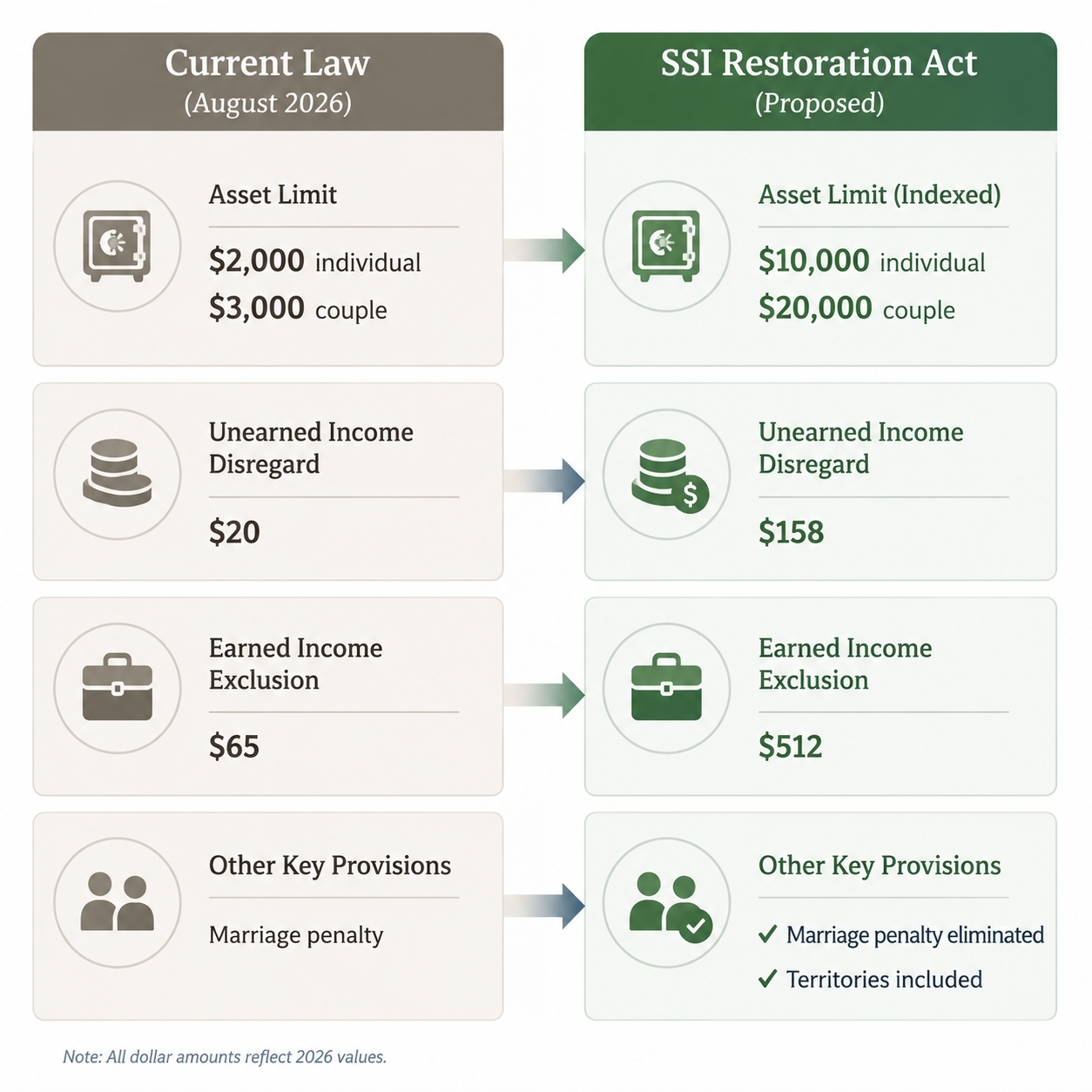
The Supplemental Security Income Restoration Act is the pending bill that would do the most to change the client conversations described above. Its core move is not a technical clean-up. It would raise the countable resource limit to $10,000 for an individual and $20,000 for couples, with indexing for inflation.[4] For a person living close to the line, that difference is not cosmetic. It changes whether saving for a security deposit, a car repair, burial expenses, or a period between caregivers has to be treated as a benefits risk.
The bill would also update the income disregards that current law has left nearly frozen in place. Justice in Aging describes the proposal as increasing the general income disregard from $20 to $158 per month and increasing the earned income exclusion from $65 to $512 per month.[4] That would not make every earnings issue disappear, and it would not eliminate reporting duties. It would, however, give clients more room to receive small amounts of income without watching benefits fall dollar for dollar almost immediately.
The Restoration Act would also address the SSI marriage penalty by setting the couples benefit at twice the individual rate.[5] Current SSI rules treat marriage as a financial event with consequences that clients may experience as a cut in basic support. A repeal of that penalty would be more than symbolic; it would change planning for couples who now have to ask whether marrying will reduce the income they rely on for rent, utilities, food, and care.
The territorial expansion is another major feature. The bill would extend SSI to Puerto Rico, Guam, the U.S. Virgin Islands, and the Northern Mariana Islands.[4] That should be kept separate from ordinary state supplement questions. The proposal concerns geographic eligibility for the federal SSI program itself, not merely a change in state-administered add-ons.
The bill also proposes reforms to in-kind support and maintenance rules.[4] That phrase can sound technical until it reaches a client who sleeps on a relative’s couch, receives help with groceries, or has rent paid directly by family. Any reform in this area would need careful implementation guidance, because clients and advocates would still need to know what must be reported, what reduces a payment, and what documentation SSA will expect.
The Bill Is Bipartisan, Reintroduced, and Still Not Law
The current Restoration Act was reintroduced on March 5, 2026 as S.4001 in the Senate and H.R. 7828 in the House, with more than 30 cosponsors, and was referred to committee.[5] That status is important. A bipartisan bill with notable support is not the same thing as enacted law, an effective date, SSA instructions, or a safe basis for changing client behavior.
There is a cautionary comparison close at hand. CNBC reported that a prior 2023 version had 37 bipartisan cosponsors but died in committee.[5] That history does not prove the 2026 bill will meet the same end. It does show why practitioners should resist telling clients that reform is essentially guaranteed simply because the proposal is serious and overdue.
The cost and poverty estimates should be read with the same discipline. CNBC reported that the Roosevelt Institute estimated full funding would cost about $61 billion annually and would reduce poverty among SSI recipients by 60% if enacted.[5] Those are attributed think-tank estimates, not a Congressional Budget Office score and not an appropriation. They help explain the scale of the proposal and the likely budget fight; they do not change August 2026 eligibility advice.

What Is Already Changing Around SSI Administration
Even without the Restoration Act, the administrative environment around SSI is shifting. SSA announced a new Supplemental Security Income Improvements Team in February 2026 and described several operational changes, including full-scale monthly wage data through the Payroll Information Exchange from a payroll provider beginning in September 2025.[6] For practitioners, that means wage reporting and wage reconciliation deserve close attention. A client may think a small job is invisible because it is irregular or part-time; SSA’s data environment is moving in the opposite direction.
SSA also described expanded automated asset verification for new SSI-Aged claims and policy clarifications involving settlement awards, inheritances, in-kind support, and resource transfers.[6] Those are exactly the fact patterns that create intake surprises. A client may come in focused on medical eligibility while the case turns on a bank account, a relative’s transfer, or the timing of a settlement distribution.
Overpayments remain a live counseling issue under current law. SSA states that if an SSI overpayment is not repaid within 30 days, withholding is generally the lesser of 10% of the person’s total monthly income or the full monthly payment.[7] SSA also states that waiver requests use Form SSA-632-BK, and overpayments under $2,000 may be handled by phone in some circumstances.[7] None of that makes an overpayment harmless. It means the response window and waiver record matter as soon as the notice arrives.
A Narrow Supreme Court Note, Not an Eligibility Rewrite
The Supreme Court’s 2025 decision in Advocate Christ Medical Center v. Kennedy has appeared in SSI-adjacent statutory interpretation discussions, but its practical role for eligibility counseling is limited. The case addressed the meaning of being “entitled to SSI” in a hospital reimbursement context, not whether an applicant meets SSI financial or disability eligibility rules.[8] It may interest lawyers tracking how SSI language travels through other federal statutes. It should not be treated as changing the resource limit, income exclusions, payment amount, or reporting obligations.
Counseling Posture for August 2026
The safest advice remains current-law advice. Clients should still be counseled against exceeding the $2,000 individual or $3,000 couple resource limit, should still report income and household changes, and should still treat settlement awards, inheritances, transfers, and family support as SSI events before the money moves. Proposed $10,000 and $20,000 limits are not planning rules until Congress enacts them and SSA implements them.
At the same time, the Restoration Act is substantial enough that practitioners should monitor it closely. If it advances, the work will not be limited to celebrating higher limits. Lawyers and advocates will need effective dates, transition rules, SSA operating instructions, systems updates, notice language, and guidance on pending applications, suspended benefits, past overpayments, and households that changed behavior under the old rules.
As of August 2026, the operative line is plain: the Restoration Act would be the most consequential SSI eligibility reform in decades, but it remains pending. The rules clients can rely on this month are the 2026 payment amounts, the existing resource limits, the old income disregards, the current reporting duties, and the payment mechanics already in force.
References
- SSI Federal Payment Amounts for 2026 — SSA.
- What’s New in 2026? — SSA Red Book.
- Supplemental Security Income — Center on Budget and Policy Priorities.
- Supplemental Security Income (SSI) Restoration Act — Justice in Aging.
- Supplemental Security Income updates in new bipartisan bill — CNBC, March 5, 2026.
- New Supplemental Security Income Improvements Team — SSA News, February 18, 2026.
- Overpayments | SSI — SSA.
- Supreme Court Clarifies “Entitle[ment] to” SSI — Donoff & Lutz.
Comments
Join the discussion with an anonymous comment.