
The legal importance of the July 17 stopgap funding bill is not that Congress has discovered a novel way to avoid a shutdown. It is that House GOP leaders reportedly chose December 4, 2026, as the next expiration date, which would carry federal funding beyond the September 30 fiscal-year deadline and past the November 3 midterm elections before forcing another appropriations decision. The reported bill also attaches the SAVE America Act, a voter-citizenship measure that changes the procedural risk profile of what might otherwise look like a familiar continuing resolution. Those details are based on reporting from The Hill, Bloomberg Tax, and The Washington Post; the underlying bill text was not available for direct review through the sources used here.[1][2][3]
That distinction matters. In federal appropriations practice, a stopgap funding bill is not a handshake agreement to keep the lights on. It is a legal instrument operating inside a constitutional and statutory system that tells agencies when they may obligate money, when they must stop, and which narrow categories of work may continue if Congress misses the deadline.

Why a December 4 CR changes the legal calendar
September 30 is the date federal lawyers and budget officers build around because annual appropriations generally expire at the end of the fiscal year. If Congress has not enacted regular appropriations or a temporary substitute by then, agencies do not merely face uncertainty; many obligations become legally unavailable. A continuing resolution, usually abbreviated CR, supplies temporary budget authority so covered agencies can keep operating for the period and at the rate Congress specifies.
A December 4 expiration would therefore do two things at once. It would prevent the immediate September 30 lapse for covered activities, and it would relocate the decisive funding confrontation into a lame-duck session after the electorate has already voted. That is a political fact, but it has legal-operational consequences: agencies would plan for one set of temporary authorities in October and November, then prepare for another lapse risk just as the post-election Congress negotiates final appropriations, another CR, or some combination of both.
The constitutional rule is short; the administrative consequences are not
The starting point is the Appropriations Clause: “No Money shall be drawn from the Treasury, but in Consequence of Appropriations made by Law.” That language is spare, but it is the reason a missed appropriations deadline becomes a legal barrier rather than a management inconvenience.[4]
The Antideficiency Act gives that constitutional rule daily force. It bars federal officers and employees from making or authorizing expenditures or obligations exceeding available appropriations, or involving the government in obligations before appropriations exist. During a lapse, agencies must generally stop non-excepted work because the legal authority to incur new obligations is missing. The statute permits acceptance of voluntary services only within narrow exceptions, including emergencies involving the safety of human life or the protection of property.[5]
That is why shutdown planning is such a lawyered exercise. Someone has to decide whether a contract action, grant award, inspection, benefit-administration task, IT function, or enforcement activity is supported by available budget authority or falls within an exception. The Government Accountability Office has described practical effects of CRs and funding uncertainty that include hiring freezes, delayed grant awards, canceled testing, disrupted nutrition assistance, and administrative burden from shutdown planning.[5]
The phrase “stopgap” can make the device sound softer than it is. A CR does not suspend appropriations law. It supplies temporary appropriations on specified terms, and everything outside those terms still has to be tested against the same constitutional and statutory limits.
What a continuing resolution actually controls
The most useful way to read a CR is not as a miniature omnibus bill, but as a temporary operating instruction. The Congressional Research Service framework, summarized by the Bipartisan Policy Center, breaks that instruction into six recurring components: coverage, duration, rate of operations, treatment of new activities, anomalies, and legislative provisions.[6]
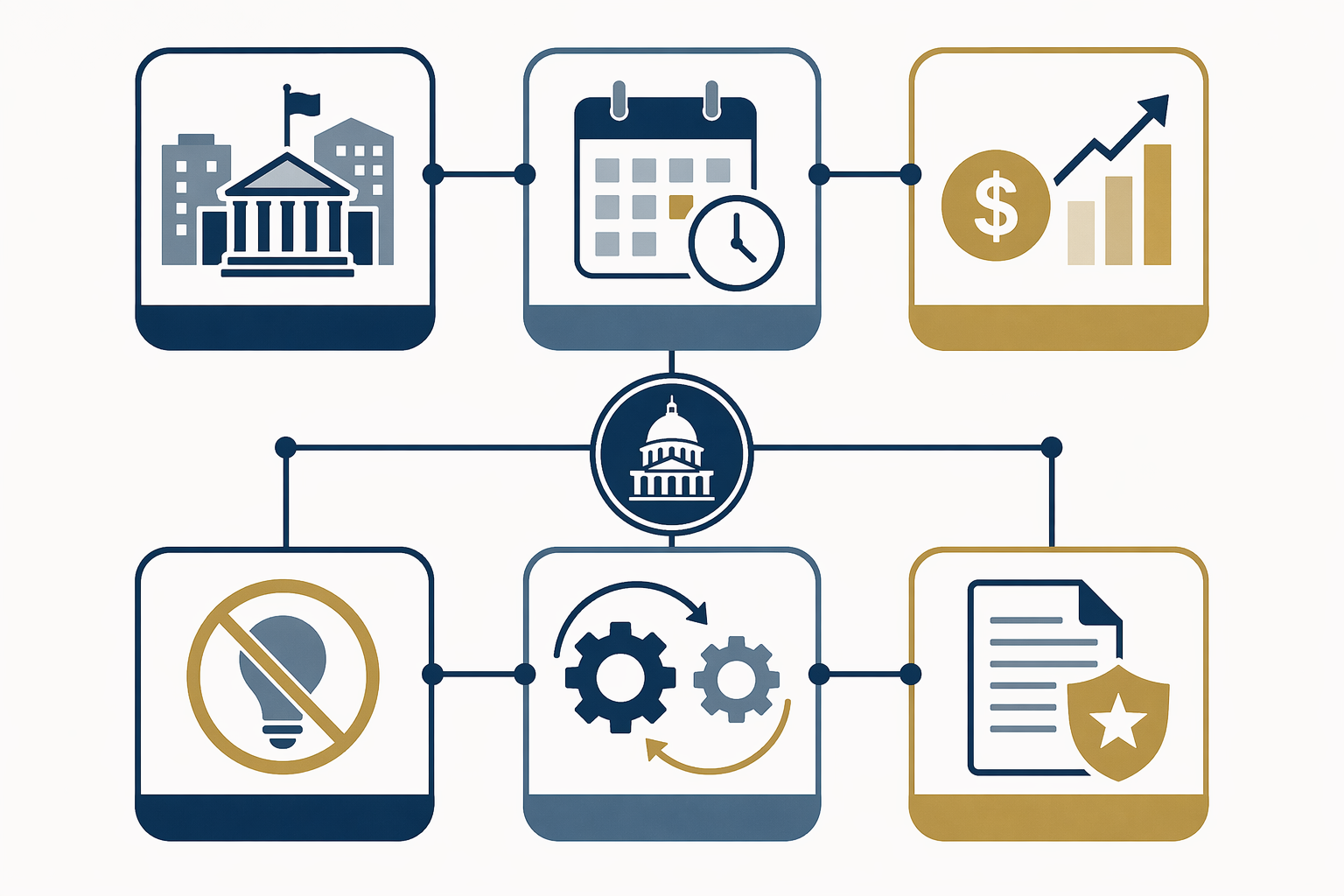
| CR component | Legal-operational question it answers |
|---|---|
| Coverage | Which agencies, accounts, and activities receive temporary authority. |
| Duration | How long the temporary authority lasts, either by number of days or a fixed date. |
| Rate of operations | What funding rate applies during the temporary period, usually tied to the prior fiscal year or another specified formula. |
| New activities | Whether agencies may start programs or projects not previously funded, usually prohibited unless Congress expressly allows them. |
| Anomalies | Account-specific departures from the default rate or default restrictions. |
| Legislative provisions | Policy language, extensions, or riders attached to the temporary funding measure. |
Coverage is the first question because no agency can safely assume it is included. A CR may cover departments whose regular appropriations have not been enacted, but accounts with enacted full-year appropriations do not need the same temporary authority. For counsel and compliance teams, coverage analysis comes before program judgment: if the account is not covered and no other authority exists, the agency cannot treat general government-wide continuity as enough.
Duration is the component receiving the most public attention in the FY 2027 bill. A CR running through December 4 would give agencies authority past the September 30 deadline, but only temporarily. Payroll systems, grants calendars, contracting schedules, regulatory work plans, and litigation support functions would still have to account for another cliff on that date unless Congress enacts full-year appropriations or another temporary measure first.
The rate of operations is where temporary funding often becomes operationally constraining even when no shutdown occurs. A CR commonly funds activities at a prior-year rate or another specified level, which can leave agencies unable to accelerate work, expand capacity, or align spending with a program’s current-year needs. It preserves legal continuity while narrowing managerial freedom.
Restrictions on new activities are equally important. If Congress has not provided specific authority, agencies generally cannot use a CR period to launch new programs or projects simply because the eventual appropriations bill might fund them. That matters for grant competitions, new procurement lines, pilot programs, system deployments, and statutory implementation schedules. The legal question is not whether the work is desirable or likely to be funded later; it is whether current authority exists.
Anomalies are the safety valves. Congress can depart from the default CR formula for particular accounts or programs when the ordinary temporary rate would create a problem. Those deviations may increase, decrease, extend, or otherwise adjust authority for specific needs. They are also where agencies and committees spend serious time, because an omitted anomaly can leave a program technically funded but practically unable to operate as intended.
Legislative provisions are the point at which a CR can become procedurally harder to move. Some provisions are housekeeping extensions needed to keep expiring authorities alive. Others are policy riders. The reported attachment of the SAVE America Act belongs in this category, and it is legally significant because it may affect Senate processing and veto risk even if the temporary funding architecture itself is conventional.[1][8]
The Senate cannot treat this like reconciliation
A continuing resolution is normally enacted as a joint resolution and must pass both chambers in identical form before presentment to the president. It is not a reconciliation bill. That distinction controls the Senate path: a CR generally remains subject to the Senate’s ordinary cloture requirement, meaning 60 votes are needed to limit debate, while reconciliation measures can move under special procedures that avoid the filibuster if they satisfy reconciliation rules, including the Byrd Rule.[7]
That procedural fact is not decorative. If a House-passed CR carries a policy rider that cannot command 60 votes in the Senate, the Senate may strip the provision, amend the measure, or force negotiations over a different vehicle. Each move consumes floor time and increases the possibility that the chambers approach September 30 without identical text ready for enactment.
The reported SAVE America Act attachment therefore matters less as a campaign message than as a procedural complication. The Hill reported that Senate action could strip the measure and potentially trigger a Trump veto threat.[8] That sequence is familiar: a temporary funding bill can be legally ordinary in form while a rider makes the passage path unstable.
Routine does not mean harmless
Congress’s dependence on CRs is not new. Pew Research Center found that since the current fiscal-year system took effect for FY 1977, Congress has enacted all twelve regular appropriations bills on time only four times: FY 1977, FY 1989, FY 1995, and FY 1997.[9] That record explains why agencies have mature shutdown plans and CR operating practices. It does not make the practice costless.
Temporary authority changes behavior. Agencies may delay hiring because a position is difficult to support under short-duration funding. Grants officers may hold awards because the account’s future level is uncertain. Procurement teams may defer obligations if the period of performance or funding source cannot be squared with the CR. Program offices may avoid starting new work even when the policy need is pressing, because the temporary measure does not authorize new starts.
Those effects are different from a shutdown, but they are not merely administrative preferences. They reflect the risk that an official who obligates funds without authority may create an Antideficiency Act problem. The safe course is often to wait, narrow the action, seek an anomaly, or document why an exception applies. That is why CRs generate legal work even when they avert the more visible harm of a lapse.
FY 2027 starts from a thin appropriations record
The July CR also lands in a weak regular-appropriations posture. As of the CRFB appropriations watch current to July 15, 2026, the House had passed three of the twelve regular appropriations bills: Agriculture, Military Construction-VA, and National Security-State. The Senate had moved no appropriations bills to the floor, and CRFB listed the budget resolution status as “TBD.”[10]
That status does not prove a shutdown will occur. It does show why a CR became the practical vehicle months before the fiscal year closed. With nine House bills not yet passed and no Senate floor movement reported in that tracker, the legal work of maintaining authority shifts from full-year account-by-account appropriations to temporary coverage, rates, anomalies, and riders.
CRFB’s fiscal deadlines tracker separately identifies the September 30, 2026, end of the fiscal year as a key deadline.[11] The reported December 4 date would not erase that deadline. It would answer it temporarily, then create a second appropriations deadline in the lame-duck period.
Why agencies are not treating this as an abstract exercise
FY 2026 gave agencies unusually recent practice in the consequences of lapsed appropriations. Reporting cited in July 2026 described three shutdowns in that fiscal year: a 43-day general shutdown from October 1 to November 12, a 3-day partial shutdown from January 31 to February 3, and a 75-day Department of Homeland Security-focused shutdown from February 14 to April 30. The 43-day shutdown was described as the longest in U.S. history.[1][2]
Those episodes are not evidence that FY 2027 must repeat the same pattern. They do explain institutional caution. A payroll administrator who has already sorted excepted employees from furloughed employees, a grants officer who has delayed awards, or agency counsel who has reviewed whether a function protects human life or property will not read a December 4 CR as a complete solution. It is temporary authority with a visible terminal date.
The midterm timing matters, but not mechanically
The December 4 date places the next funding deadline after the November 3 midterms. That matters because the bargaining environment will be different after voters have acted, even though the same Congress remains in place until the new Congress begins. Members will know the election results. Retiring or defeated members may be voting in a lame-duck session. Party leaders will negotiate against a known, not hypothetical, incoming balance of power.
The electoral background described by Brookings helps explain why moving the deadline can have strategic value. Brookings reported in August 2025 that the president’s party had lost House seats in 20 of 22 midterms since 1938; using then-current indicators including Trump approval at 45.8 percent, net approval of -5.1, and a Democratic generic-ballot lead of 3.9 points, its historical model projected a Republican loss of 12 to 19 House seats.[12]
That analysis predated the FY 2026 shutdown record, so it should not be treated as a live forecast without qualification. Nor should any shutdown be treated as an automatic election-deciding event. LSE’s U.S. politics analysis in October 2025 argued that shutdowns in midterm years, including 2013 and 2018, tend to have little political impact as singular issues, while still creating second-order effects through workforce reductions and service disruptions.[13]
For federal legal practice, the more concrete point is timing. A pre-election lapse forces agencies to make shutdown determinations while campaigns are still asking voters to assign blame. A post-election deadline shifts those determinations into a lame-duck negotiation, after electoral accountability has already been expressed but before the next Congress can legislate. The legal standard does not change; the leverage around the standard does.
What to watch in the July CR
Until the bill text is directly reviewable, the safest reading is limited. The reported December 4 expiration date and the reported SAVE America Act attachment are enough to identify the legal posture: a conventional temporary appropriations vehicle, introduced early, with a policy provision that may complicate Senate passage and presentment.[1][2][3][8]
- Whether the CR covers all unfinished appropriations accounts or leaves any account outside temporary authority.
- Whether the rate of operations follows the prior fiscal year or uses account-specific adjustments.
- Which anomalies are included, because those exceptions often determine whether a program can function during the temporary period.
- Whether the Senate strips or modifies the reported SAVE America Act provision.
- Whether the final expiration remains December 4 or moves closer to, or farther beyond, the midterm election.
The legal process for a stopgap funding bill in a midterm year is therefore both ordinary and consequential. The ordinary part is the legal architecture: appropriations must be made by law, agencies cannot obligate beyond available authority, and a CR supplies temporary authority through familiar components. The consequential part is the date choice. A December 4 CR would bridge September 30, avoid an immediate pre-election lapse for covered activities, and postpone the hardest appropriations confrontation until the lame-duck session, when the legal machinery will be the same but the bargaining environment will not.
References
- House GOP unveils stopgap funding bill to avoid shutdown before midterms, The Hill.
- House GOP Plans Government Funding Stopgap Through December 4, Bloomberg Tax.
- House Republicans seek to push funding deadline to avoid shutdown before midterms, The Washington Post, July 17, 2026.
- Appropriations Clause, Constitution Annotated, Congress.gov.
- What Is a Continuing Resolution and How Does It Impact Government Operations?, U.S. Government Accountability Office.
- What to Know About Continuing Resolutions, Bipartisan Policy Center.
- Terms and Conditions in Reconciliation Bills, Legislative Procedure, March 25, 2026.
- Trump demands GOP action on SAVE Act, The Hill.
- Congress has long struggled to pass spending bills on time, Pew Research Center, October 1, 2025.
- Appropriations Watch: FY 2027, Committee for a Responsible Federal Budget.
- Upcoming Congressional Fiscal Policy Deadlines, Committee for a Responsible Federal Budget.
- What history tells us about the 2026 midterm elections, Brookings, August 2025.
- The 2026 midterms: What the government shutdown may mean for the midterms, LSE USAPP, October 10, 2025.
Comments
Join the discussion with an anonymous comment.