
Subaru’s weight-label recall is not the kind of defect story that begins with a fractured part or a burned cabin. The remedy is a corrected certification label, mailed after owner notification, for 541,237 vehicles covered by NHTSA recall 26V436000: 2019–2026 Ascent, 2020–2027 Outback, 2021–2027 Forester, and 2024–2027 Crosstrek models. Owner notification letters are scheduled for August 25, 2026, while corrected labels are expected in January 2027, and the available reports identify no crashes or injuries tied to the issue. The noncompliance is with Federal Motor Vehicle Safety Standard 110, because the label states an incorrect gross axle weight rating, or GAWR.[1]
That combination makes the recall look small as a repair event and unusually clean as a product-liability example. Subaru is not asking owners to bring vehicles in for new tires, brakes, axles, suspension parts, or software. It is correcting the information that tells owners and service providers how much load the vehicle can safely carry at an axle. In product-liability terms, the sticker is not peripheral paperwork. It is the warning instrument.
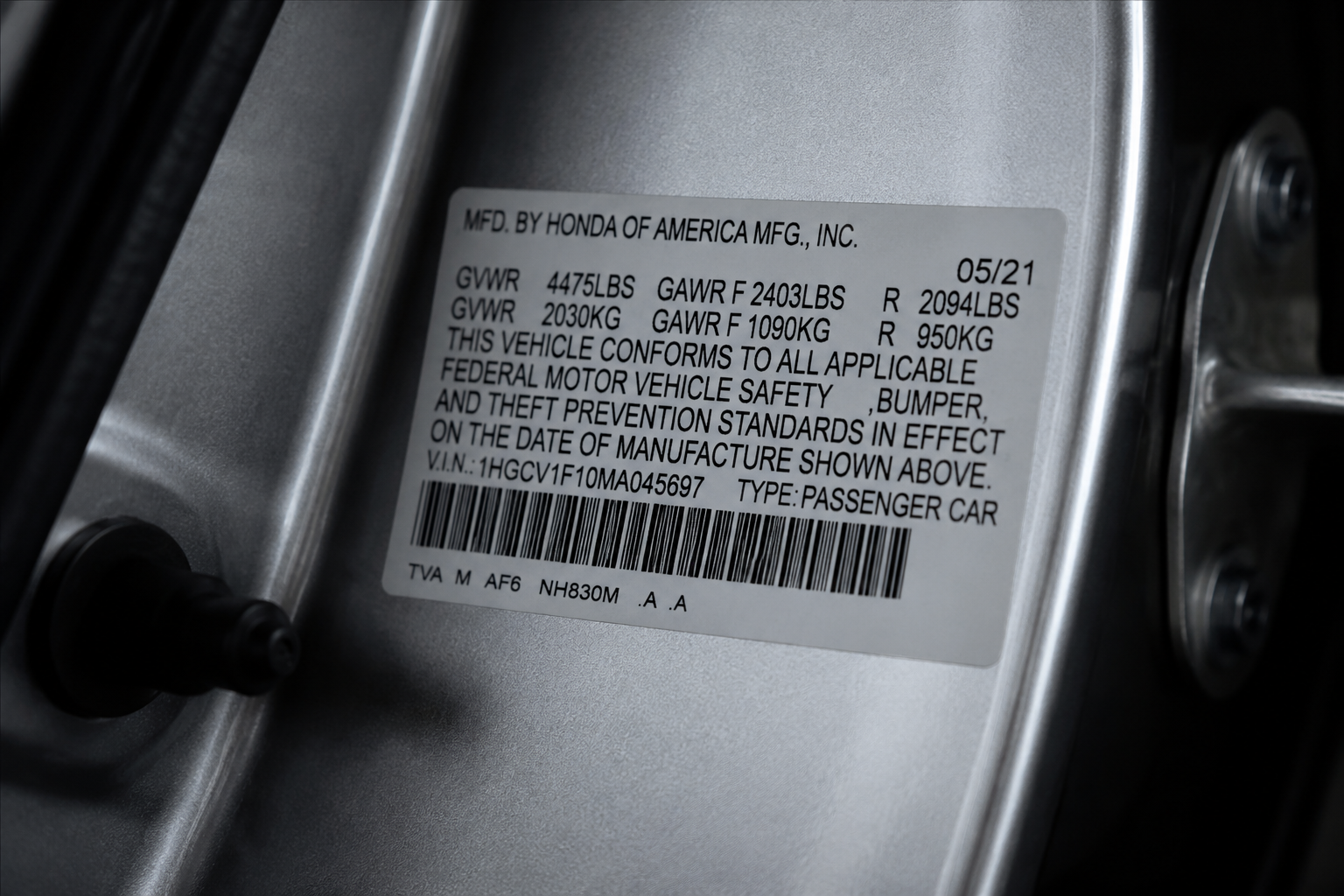
One important fact remains missing from the public materials summarized so far: the precise numerical gap between the printed GAWR and the correct GAWR. Without that number, no careful analysis can rank the safety severity with confidence. A small overstatement and a large overstatement do not create the same real-world risk, even if both can support the same basic legal theory. The record supports a labeling noncompliance; it does not yet support a quantified overload-risk calculation.
Why This Fits Failure-to-Warn Better Than Design or Manufacturing Defect
Automotive product-liability claims are commonly sorted into design defects, manufacturing defects, and failure-to-warn or marketing defects. Design-defect claims ask whether the product line was unreasonably dangerous as designed. Manufacturing-defect claims ask whether a particular product departed from its intended design. Failure-to-warn claims ask whether the product carried adequate instructions or warnings for foreseeable use and misuse.[2][3]
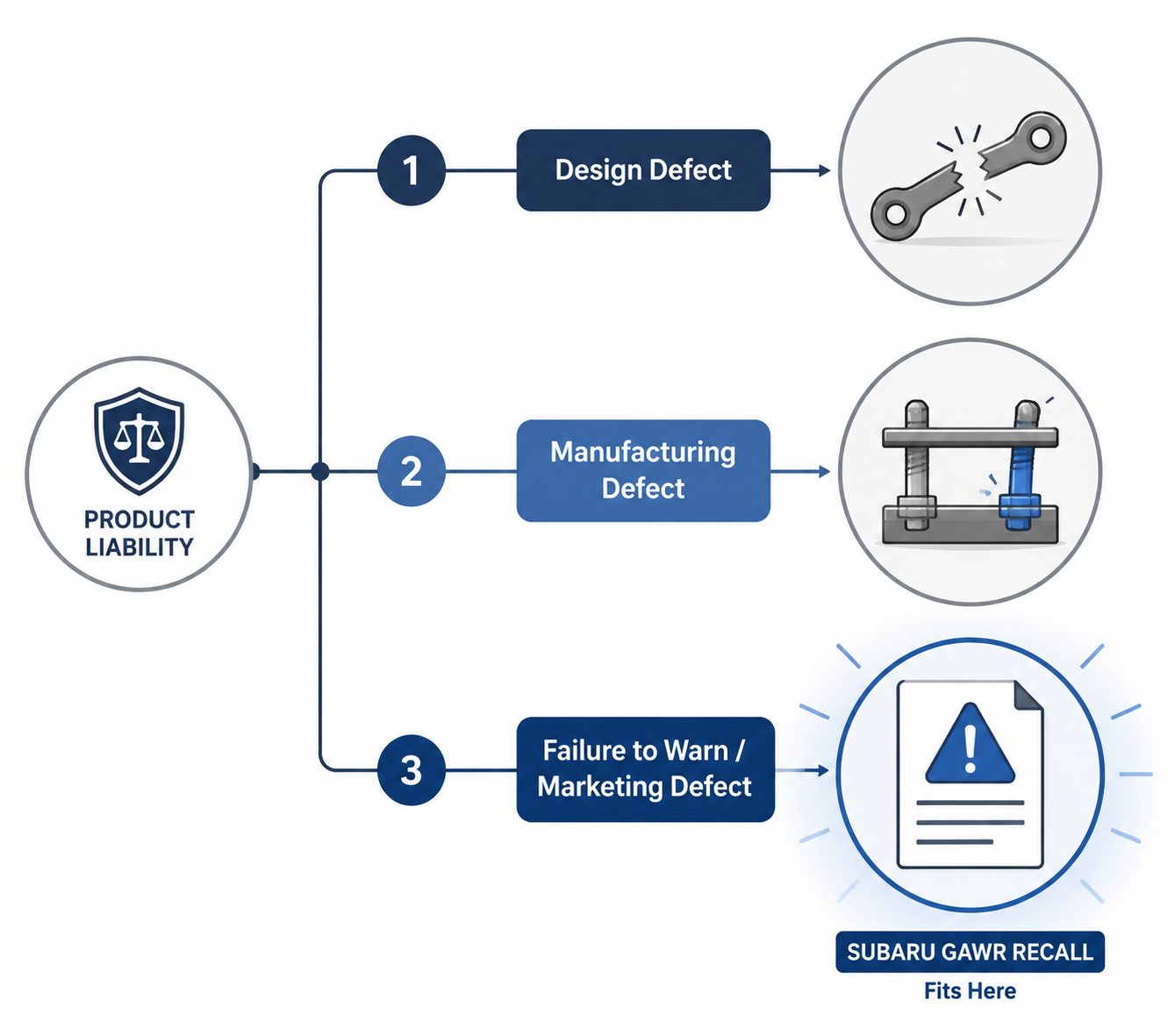
The Subaru recall belongs almost entirely in the third category. There is no present record, in the cited materials, that the affected vehicles were designed with inadequate axle capacity. There is no present record that an individual vehicle’s axle, wheel, tire, or suspension assembly was built differently from Subaru’s specifications. The alleged defect is that the certification label communicated the wrong GAWR.
That is why the “just a sticker” instinct is legally unhelpful. A warning defect does not become less of a warning defect because the warning is printed on adhesive material. The legal question is whether a foreseeable user was given accurate safety information at the point where the product tells the user how to use it without exceeding a rated limit.
| Defect theory | What the theory would need | Fit to the Subaru GAWR recall |
|---|---|---|
| Design defect | A vehicle design that is unreasonably dangerous even when built as intended | Weak on the current record; the cited materials concern the label, not axle design |
| Manufacturing defect | A departure from the intended design in particular vehicles | Weak on the current record; no cited material identifies a wrongly built component |
| Failure to warn / marketing defect | An inadequate warning or instruction about foreseeable use | Strongest fit; the certification label allegedly gave the wrong GAWR |
The Label Is the Warning
A certification label is easy to underread because it is not written in the tone of a consumer warning. It does not say, in large red letters, that overloading can affect handling, tires, or braking. It gives ratings. Those ratings are the operating boundary. For an owner loading passengers and cargo, a shop selecting replacement tires or rims, or a plaintiff lawyer later reconstructing what information the vehicle supplied, the number is the instruction.
The clean failure-to-warn theory runs this way: Subaru supplied vehicles with a certification label; the label misstated the GAWR; GAWR is safety-relevant because it informs loading and equipment decisions; foreseeable users may rely on the label; and reliance on an overstated or otherwise incorrect rating could contribute to overload or tire-and-rim mismatch risk. The current record supports that chain as a theory of exposure. It does not prove that any owner actually overloaded a vehicle, selected the wrong equipment, or suffered a crash because of the label.
That distinction matters. Product-liability analysis often becomes cloudy when a mechanical failure, driver behavior, maintenance history, and crash reconstruction all compete for causal attention. A mislabeled GAWR narrows the inquiry. The alleged defect is the communication itself. The difficult questions move from metallurgy and accident physics to reliance, materiality, timing, and harm.
The Ascent portion of the recall also creates a timing question because the affected model years run from 2019 through 2026, with 383,800 Ascent vehicles included in the total recall population.[1] A seven-year span does not, by itself, prove that Subaru knew of the problem for seven years or consciously delayed a recall. It does, however, make detection and escalation a legitimate line of inquiry: when was the label content first approved, when was the discrepancy discovered, who reviewed it, and why will corrected labels not be available until months after owner notification?
Recall Evidence Cuts Both Ways
A recall can be potent evidence for a plaintiff because it identifies a defect population and shows that the manufacturer or regulator treated the condition as serious enough to correct. Plaintiff-side commentary on vehicle recalls commonly frames a recall as strong proof that a defect existed, while also recognizing the defense response: the manufacturer will argue that the recall shows responsible remedial conduct rather than tort culpability.[4]
The Subaru record illustrates that dual use. On one side, the recall gives plaintiffs a neatly defined population, a specific federal standard, a specific vehicle label, and a specific corrective act. On the other, Subaru’s voluntary correction can be offered as evidence that the company acted to bring vehicles into compliance once the issue was identified. The recall does not automatically establish causation, damages, reliance, or punitive intent.
This is also where the comparison to a more visually dramatic mechanical recall, such as the contemporaneous Kia Telluride seat-fire recall referenced in the research materials, helps only briefly. A seat-fire theory directs attention to a component condition that may ignite. The Subaru theory directs attention to the information architecture around rated vehicle use. The legal interest is not spectacle; it is the unusually direct match between the alleged defect and the warning category.
No Reported Injuries Changes the Damages Picture
The absence of reported crashes or injuries does not erase the defect theory. It does make ordinary personal-injury litigation harder to value at this stage. A plaintiff with no crash, no bodily injury, no property damage, and a free corrected label has a different case from a plaintiff who can connect an overload event or tire failure to the mislabeled rating.
For an injury claim, the plaintiff would still need to show more than the existence of the recall. The claim would need a compensable injury, reliance or foreseeable use connected to the incorrect label, and causation linking the label to the event. If the missing GAWR discrepancy turns out to be modest, defendants would likely argue that the label error was immaterial to the accident mechanism. If it turns out to be substantial, plaintiffs would have a better materiality argument, but still not a shortcut around causation.
The stronger near-term exposure may sit elsewhere: regulatory compliance, warranty theories, loss-of-value allegations, and delayed-remedy arguments. Those theories do not require the same crash narrative. They ask whether consumers received a vehicle that complied with federal labeling requirements, whether the defect impaired value or ordinary expectations, and whether the correction was timely enough once the issue was known.
The Five-Month Remedy Gap Is More Interesting Than the Sticker
A label-only remedy is usually a poor fit for traditional lemon-law rhetoric. The available California-focused analysis of this Subaru recall states that a label-only recall is “usually not on its own” a lemon-law claim, but notes that the analysis can change if the corrected label is significantly delayed.[1]
That caution is appropriate. Lemon-law frameworks vary by state, and the available analysis is anchored to California’s Song-Beverly Act rather than a nationwide rule. Still, the timing is not trivial. Owners are scheduled to be notified in August 2026, while corrected labels are expected in January 2027.[1] For a defect whose remedy is the correct information, the delay means owners may know the existing label is wrong before they have the replacement that tells them the correct rating.
That is not the same as being deprived of transportation. It is also not nothing. During the gap, cautious owners, fleet managers, towing-equipment installers, tire shops, and lawyers evaluating a vehicle after an incident may have a notice of noncompliance without the final corrected number. The practical consequence is uncertainty around the very rating the label is supposed to settle.
Punitive Damages Require More Than Duration
The seven-year Ascent span is the fact most likely to invite punitive-damages speculation. It should be handled carefully. A long-running defect population may support questions about corporate detection systems, internal audits, supplier communications, certification review, and recall timing. It does not automatically show conscious disregard.
A punitive theory would need evidence closer to delayed-recall recklessness: knowledge of the label error, appreciation of the safety consequence, and a decision to leave vehicles in the field without adequate correction. The current public materials do not establish that sequence. They establish a recall, a compliance violation, affected model years, future notification, and a future corrected-label remedy. That record is enough to justify inquiry. It is not enough to plead intent as if discovery had already happened.
Regulatory history explains why counsel would not dismiss compliance timing as academic. In November 2024, NHTSA announced a consent order with Ford that included a $165 million civil penalty tied to recall-law violations, and NHTSA maintains a civil-penalty settlement database for enforcement matters.[5][6] That comparison should not be overextended; the Subaru GAWR recall is a different fact pattern. It simply shows that federal recall compliance, timing, and reporting duties can carry consequences separate from private injury litigation.
Where the Legal Exposure Actually Sits
The cleanest claim is not necessarily the most valuable claim. As a defect theory, the Subaru GAWR recall is unusually tidy: the label is the warning, the wrong rating is the alleged inadequacy, and the foreseeable hazard is misuse of load or equipment limits. As a damages case, the current record is restrained by the absence of reported injuries and the availability of a noninvasive remedy.
That leaves several more plausible pressure points than a wave of crash-injury suits:
- Regulatory exposure if NHTSA or related compliance review focuses on reporting, timing, or adequacy of the remedy.
- Warranty or diminution-in-value claims arguing that consumers received vehicles with a federal safety-labeling noncompliance.
- Delayed-remedy arguments during the period between owner notification and corrected-label availability.
- Individual injury claims only if a plaintiff can connect the incorrect GAWR to a concrete overload, tire, rim, handling, or crash event.
No class action specific to this recall is identified in the research materials as of the research date. That does not make class litigation impossible, but it keeps the analysis forward-looking. Any class theory would have to deal with the familiar problems of injury, reliance, state-law variation, actual value loss, and the effect of a free corrected label.
The Subaru recall is legally important because it shows how a certification label can be the defective product communication itself. The present record supports a strong warning-defect theory, weak present injury damages, unresolved severity because the numerical GAWR discrepancy is not public in the cited materials, and more realistic exposure through compliance, warranty, diminution, or delayed-remedy arguments than through traditional crash-injury claims.
References
- Subaru Recall 26V436000, Mousavi Law Firm,
- The Impact of Vehicle Recalls on Product Liability Cases, Conley Griggs Partin LLP,
- Vehicle Recalls and Defects Law, FindLaw,
- How Recalls Affect Product Liability Lawsuits, McCallister Law Firm,
- NHTSA Finalizes Consent Order with Ford, Including $165 Million Civil Penalty, National Highway Traffic Safety Administration, November 2024,
- Civil Penalty Settlements, National Highway Traffic Safety Administration,
Comments
Join the discussion with an anonymous comment.