
A Subaru owner who runs a Subaru safety recall check and finds an open campaign usually asks the practical question first: does this mean a free repair, a buyback, a replacement vehicle, or cash compensation? The clean legal answer starts with a split. Federal recall law gives the owner a free remedy for a safety defect or noncompliance, and that remedy is not conditioned on the vehicle still being inside the original warranty period. State lemon law remedies are different. They turn on substantial impairment, repair history, and the requirements of the governing state statute, not on the mere existence of a recall notice.[1][2]
That distinction matters because the 2026 Subaru recall picture is not one defect wearing four labels. It is a set of unrelated problems that should be screened separately before anyone tells a client that a buyback is on the table.
| Recall fact pattern | Reported population | Initial legal significance |
|---|---|---|
| Incorrect weight-rating label / FMVSS 110 noncompliance, NHTSA campaign 26V436000 | 541,237 vehicles | Large scale, but the remedy may be a corrected label rather than mechanical repair.[3] |
| Moonroof glass detachment | 69,663 vehicles | Mechanical safety fact pattern; stronger potential impairment analysis if the client has symptoms, failed repair attempts, or loss of use.[4] |
| Fuel filler cap seal issue | 69,153 vehicles | Mechanical or emissions-adjacent safety fact pattern; claim value depends on actual symptoms and repair history.[4] |
| Rear gate bracket failure | Population not specified in the research materials | Potential safety and usability issue; should not be treated as equivalent to a label correction without repair-order support.[4] |
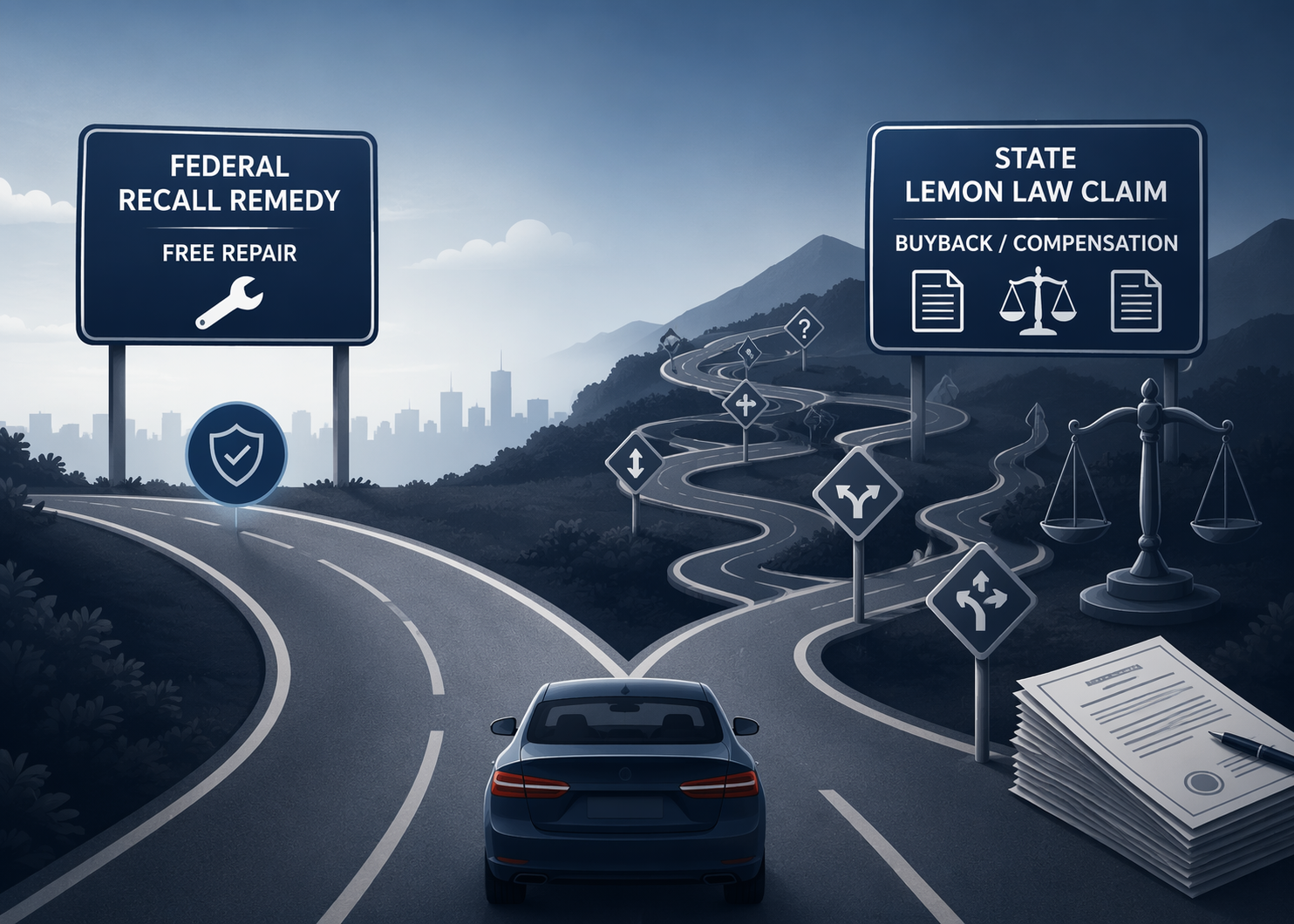
The Recall Remedy Is Real, But It Is Not the Same as Compensation
For intake purposes, the federal recall remedy should be treated as the baseline right. Once a manufacturer determines that a vehicle contains a safety-related defect or fails to comply with a federal motor vehicle safety standard, NHTSA’s recall process requires the manufacturer to notify the agency and provide a remedy. The research materials identify a Part 573 notice obligation within five business days of the defect determination.[1]
The remedy is free to the owner. That point often calms one part of the call and disappoints another. A client may hear “Subaru admitted a defect” and assume the next word is “buyback.” Federal recall law usually points first to repair, replacement, or refund as the manufacturer-selected remedy, with the manufacturer controlling which remedy path will be offered in the campaign.[1][2]
Nor should counsel screen a recall repair as if it were an ordinary warranty claim that expired with time or mileage. The research materials describe recall repairs as not subject to the ordinary statute-of-limitations framing that governs many private claims; an open safety recall remains a free-remedy issue even for an older or higher-mileage vehicle.[1][2]
That does not mean the campaign is practically frictionless. The service customer may be told that parts are unavailable, the remedy is pending, or the dealer cannot reproduce a related complaint. Those facts belong in the file, but they must be sorted. A temporary parts delay may support a loss-of-use chronology. A dealer’s refusal or failure to perform an available recall repair raises a different issue from a manufacturer’s chosen remedy design. Dealer-obligation commentary flags that dealerships generally have duties around recall repairs, though the application depends on the facts and the relationship among the owner, dealer, and manufacturer.[6]
Scale Is Not Severity
The 541,237-vehicle label recall is the number most likely to travel. It is also the fact pattern most likely to be overread. The reported recall involves SUVs with an incorrect weight-rating label, and the remedy described in the public reporting is a corrected label rather than a mechanical component replacement.[3]
A label noncompliance can be legally significant under federal safety standards. It can also be weak as a standalone lemon law case. A California-focused analysis of the Subaru weight-rating label recall reaches that narrower conclusion: a corrected label, by itself, is not enough to make the vehicle a lemon under California’s Song-Beverly framework absent facts showing the required impairment and failed repair history.[5]
That California example should not be flattened into a national rule. State lemon laws vary on covered vehicles, warranty periods, presumptions, notice requirements, number of repair attempts, days out of service, and available remedies. The useful point is more modest: a recall proves that something mattered enough for a federal remedy process, but it does not automatically prove that this owner’s vehicle substantially impaired use, value, or safety under this state’s statute.
The smaller campaigns may deserve more attention in an individual case than the largest one. Moonroof glass detachment, fuel filler cap seal problems, and rear gate bracket failure are closer to the facts that tend to move a lemon law screen: safety concern, drivability or usability consequence, repeat visits, unavailable parts, and a paper trail showing that the promised fix did not actually resolve the condition.[4]
A Practical Screen for Subaru Recall Files
The first pass should be procedural, not emotional. The client’s frustration belongs in the chronology, especially when the vehicle feels unsafe or has been in and out of service. But the attorney’s first job is to decide which legal bucket the documents can actually support.
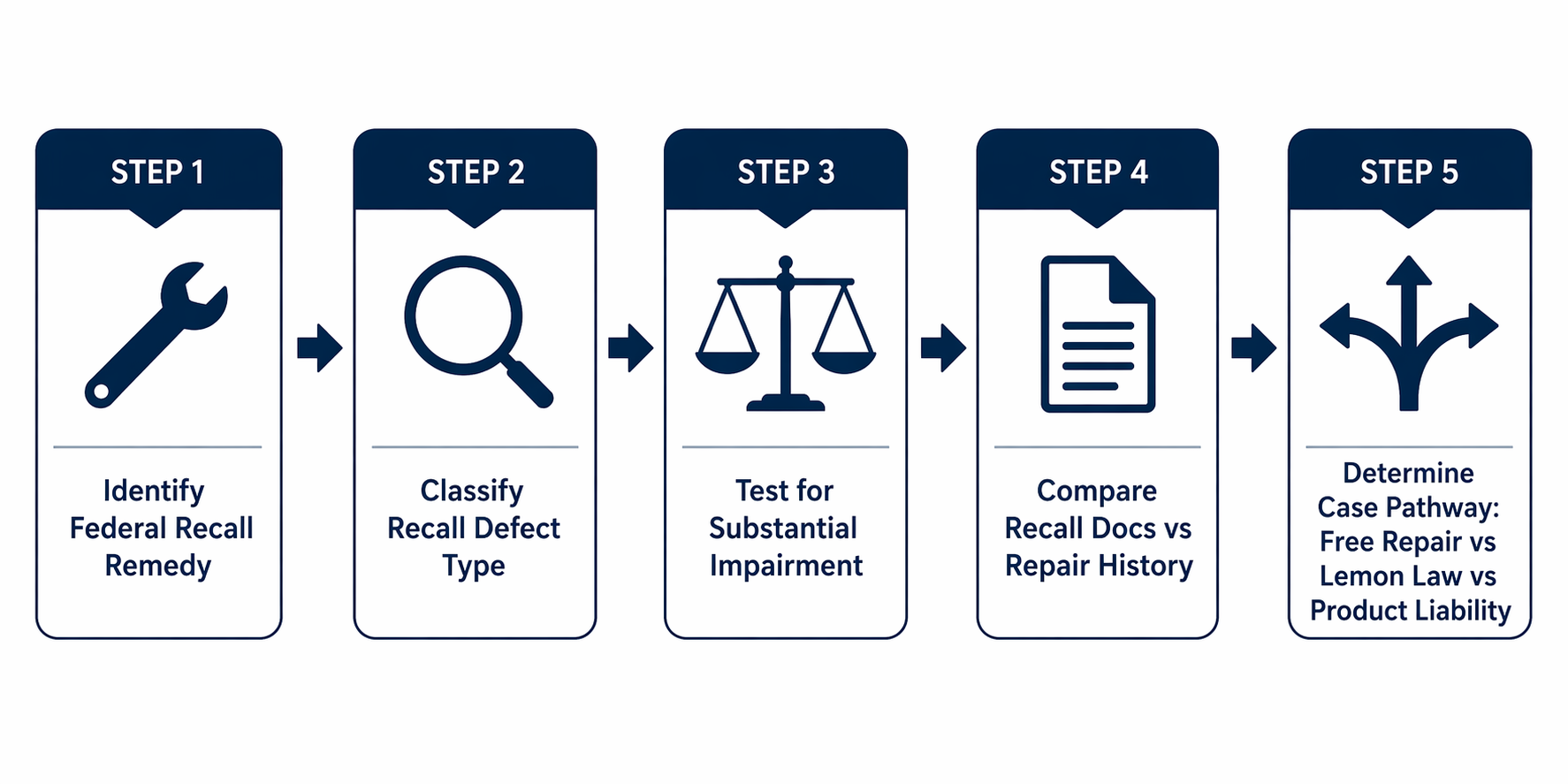
- Identify the federal recall remedy: campaign number, affected component, owner notice, remedy status, parts availability, and whether the dealer has performed or refused the recall work.
- Classify the defect: label correction, glass or body-component detachment, fuel-system seal issue, rear gate bracket problem, or another condition outside the recall.
- Test substantial impairment under the governing state law: use, value, safety, days out of service, number of repair attempts, and whether statutory presumptions apply.
- Compare recall documents with repair orders: the best overlap is the same symptom, same component, same complaint, and same unresolved condition after repair.
- Choose the pathway: free recall repair, lemon law claim, warranty claim, fraud or disclosure theory, product-liability matter, or class-action monitoring.
The fourth step usually decides the call. A recall notice with no symptoms, no service visits, and a completed remedy may be important consumer-safety paperwork, but it is often thin lemon law material. A recall notice paired with three repair orders for the same unresolved safety condition is different. So is a record showing the vehicle sat at the dealer because the recall remedy was not available, if the relevant state law treats days out of service as part of the lemon law analysis.
What to Pull Before Evaluating Damages
- The NHTSA campaign number and owner notice for the client’s VIN.
- Every repair order, including “no problem found” visits and parts-delay entries.
- Communications with Subaru, the dealer, and any third-party service department.
- Dates the vehicle was unavailable, unsafe to drive, or restricted in use.
- The applicable state lemon law requirements for the vehicle, owner, mileage, warranty status, notice, and repair-attempt threshold.
When Recall Evidence Helps a Lemon Law Claim
Recall evidence is strongest when it supplies the manufacturer’s own description of a safety-related defect or federal noncompliance that matches the client’s lived problem. It may help establish that the issue was not idiosyncratic, that the component was safety-relevant, and that the manufacturer had a defined remedy process. Those points can matter in settlement posture even when the recall statute itself does not provide the buyback remedy the client wants.
The matching must be disciplined. A client with a weight-rating label recall and no loading, towing, value, or use consequence is not in the same position as a client whose moonroof glass detached, whose vehicle remained unrepaired, and whose repair orders show repeat complaints. The first file may be a completed federal remedy. The second may justify a state-law analysis of substantial impairment and unsuccessful repair.
The same caution applies when a client describes diminished value. A recall can affect the way an owner feels about a vehicle, and that disappointment is not imaginary. But lemon law compensation usually requires more than lost confidence. The file needs a statutory hook: impairment recognized by the jurisdiction, repair attempts that count, and a remedy failure that can be proven with dates and documents.
Completion Rates Answer a Different Question
NHTSA’s April 2026 report to Congress gives useful context for recall practice. Across recalls initiated from 2012 through 2022, the weighted average completion rate across all manufacturers was 65.8%.[7] The research materials also note that Subaru has exceeded that industry average.[7]
That data can sharpen, but should not settle, the case analysis. A relatively strong manufacturer completion rate may undercut a broad claim that the recall system is categorically ineffective. It does not defeat an individual claim that this owner’s vehicle remained unrepaired, unsafe, or impaired after repeated visits. Completion-rate data measures campaign performance at scale. Lemon law analysis measures what happened to the client’s vehicle under the governing statute.
Where Class Actions and Warranty Extensions Fit
Subaru’s EyeSight litigation history is a reminder that recall, warranty, class settlement, and individual lemon law theories can coexist without answering the same question. The research materials identify a November 2025 EyeSight settlement involving 2013–2024 model-year claims, $2.4 million in attorneys’ fees, $5,000 payments to named plaintiffs, and a warranty extension.[8]
The same materials identify Hall v. Subaru, filed in May 2026, as an 87-page complaint alleging similar collision-avoidance defects in certain 2022–2026 Subaru models.[8] For a practitioner screening an intake, the point is not that every EyeSight complaint is a viable individual claim. It is that a settlement or warranty extension may change the available remedy menu while leaving live disputes about later model years, unresolved symptoms, or adequacy of repair.
Those materials should be kept in their lane. A class-action complaint is an allegation, not a finding. A settlement may provide benefits without establishing liability. A warranty extension may help a client obtain service while leaving state-law remedies to be evaluated separately.
The Working Answer for Subaru Recall Intakes
For legal professionals evaluating Subaru recall calls, the safest answer is narrow and useful: an open Subaru recall gives the owner a federal free-remedy right, but it does not by itself establish entitlement to a buyback, replacement vehicle, or cash compensation. The larger question is whether the recall defect overlaps with an unresolved condition that substantially impairs use, value, or safety and satisfies the applicable state lemon law’s repair-attempt or days-out-of-service requirements.
The 2026 Subaru campaigns show why that sorting matters. A mailed weight-rating label correction, a moonroof glass detachment risk, a fuel filler cap seal issue, and a rear gate bracket problem may all sit under the word “recall.” They should not be screened as the same litigation object. The strongest files are the ones where the recall documents, repair orders, symptoms, and state-law threshold point to the same defect. The weakest are the ones where the recall has been completed, the vehicle has no unresolved impairment, and the claim rests only on the fact that a campaign existed.
This analysis is a research framework for attorneys and other legal professionals. It is not legal advice to Subaru owners, and it is not a substitute for jurisdiction-specific review of the governing lemon law, warranty law, recall record, and repair history.
References
- Honigman LLP two-part series on NHTSA procedures, Part I, Honigman LLP.
- Vehicle Recall Remedies and Your Rights, FindLaw.
- Subaru issues recall for 541,000 SUVs over label with incorrect weight rating, ABC News / Associated Press.
- Subaru Built the Safest Cars in America. In 2026, Half a Million of Them Got Recalled, Vehicle-Safety.org.
- Subaru Weight Rating Label Recall Lemon Law, Mousavi Law Firm.
- Can A Dealership Refuse To Fix A Recall?, Rockpoint Law.
- Report to Congress: Improving Vehicle Safety Recall Completion Rates Report, National Highway Traffic Safety Administration, April 2026.
- Class Action Lawsuit Says Certain 2022-2026 Subaru Models Equipped with Defective Collision Avoidance Features, ClassAction.org.
Comments
Join the discussion with an anonymous comment.