
Brian Coven was 45, an attorney, and a father of three when lung cancer that should have been tracked earlier became fatal. NJ.com and Law.com reported that Summit Medical Group paid $10.5 million on behalf of four physicians after a three-year diagnostic delay that began with a chest X-ray in 2019 and ended with his death in 2024 [1][2]. The settlement was reached April 14, 2026, and publicly reported in July; the agreement is confidential, so the public record does not show how the amount was allocated among the doctors or what confidentiality language the parties used [1][2].
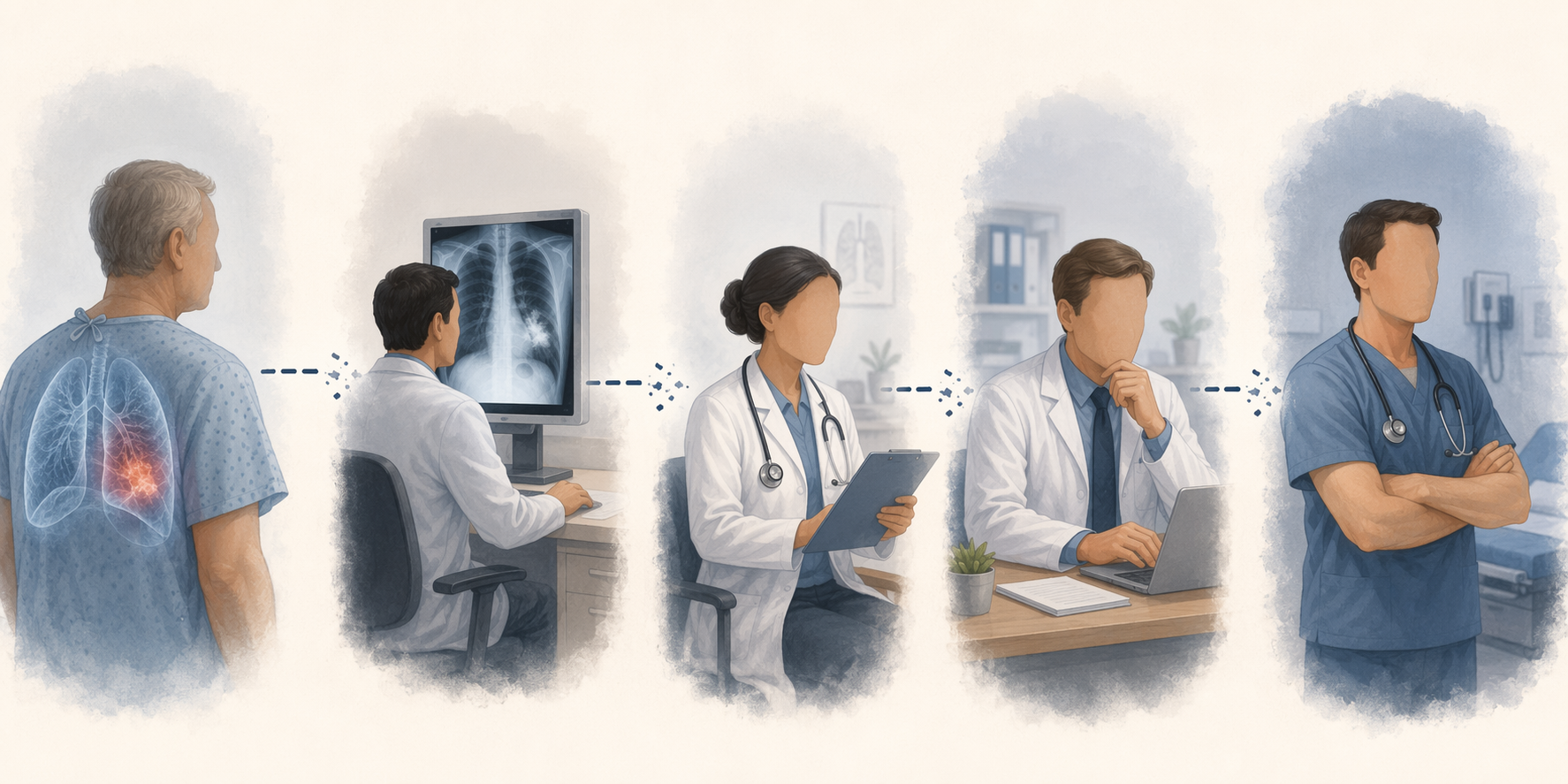
How the failure cascade formed
The number matters, but the file matters more. What the reports show is not one missed read; it is a chain in which each clinician had a chance to turn an abnormality into a tracked diagnostic question and did not [1][2].
| Physician | Public role | What the public record says |
|---|---|---|
| Dr. Arnold Berman | Radiologist | Read the chest X-ray as normal despite an infiltrate [1][2]. |
| Dr. Michael Kole | Pulmonologist | Saw the finding but did not lock down follow-up [1][2]. |
| Dr. Steven Colucio | Primary care physician | Admitted in deposition that he failed to order follow-up testing [1][2]. |
| Dr. Christine Campanella-Coppo | Urgent care physician | Testified that she did not know an infiltrate could be a sign of cancer [1][2]. |

That is the administrative simplicity that makes the case hard to shrug off. A radiology read, a specialty visit, primary care, and urgent care each touched the same patient record, yet no one converted the finding into a durable follow-up plan.
Why causation had teeth
That sequence mattered because the survival testimony pointed the other way. Dr. Roy Herbst testified that more than 90% of patients survive if diagnosed at the stage when the infiltrate was visible [1][2]. That does not guarantee a different result for Coven, but it does make the lost-chance theory concrete instead of speculative.
Why the $10.5 million settlement fits New Jersey
The $10.5 million figure should not be treated as a universal lung-cancer-misdiagnosis benchmark. One malpractice-payout roundup places the national average lung cancer misdiagnosis payout at about $589,535, citing a 2019 Diagnosis journal study [3]. No newer comprehensive replacement study appears in the materials used here. New Jersey then changes the settlement math in a very specific way: compensatory medical-malpractice damages are uncapped, while punitive damages are capped at $350,000 or five times compensatory damages under N.J. Stat. § 2A:15-5.14 [4].
That is the same cap-math problem explored in The $2.9M reality of a $18.2M WakeMed birth injury verdict: the headline number is only useful after you separate it from the recoverable theory beneath it. Here, the absence of a compensatory cap did not make $10.5 million automatic; it kept the full wrongful-death and malpractice claim economically meaningful enough to settle as a real case rather than a symbolic one.
What the public record leaves open
The reporting base is narrow but useful: NJ.com and Law.com/NJ Law Journal gave the public narrative, and the settlement agreement itself remains confidential [1][2]. There is no appellate layer yet, because the case is too recent for one to exist. The Summit Medical Group discussed here is the Berkeley Heights, New Jersey, practice, not Summit Health/CityMD or Summit Medical Group in Tennessee.
For a broader multi-defendant framework, Legal liability theories in Provo Canyon School abuse cases is a useful contrast because it shows how liability analysis changes when several actors each control a different part of the paper trail. A different kind of shift is underway in How AI in cancer detection is reshaping malpractice liability: there the question is how humans and algorithms share responsibility. This case is the opposite problem. The failure was entirely human, and it ran through ordinary communication that never got closed.
Coven’s death gives the file its human weight, but the litigation lesson comes from the sequence: a visible infiltrate, four professionals, and three years in which no one turned the abnormality into a documented follow-up obligation. That is the part risk managers should remember, because the next malpractice claim rarely starts with a catastrophe; it starts with a result that needed someone to own it.
References
- “A great tragedy: $10M settlement reached after doctors missed NJ lawyer’s lung cancer,” NJ.com
- “$10M Settlement Reached Over New Jersey Lawyer’s Death,” Law.com / NJ Law Journal, July 14, 2026
- “Lung Cancer Misdiagnosis Lawsuit Verdicts,” Miller & Zois
- “Is There a Damages Cap in New Jersey?,” Fronzuto Law Group
Comments
Join the discussion with an anonymous comment.