
New York Penal Law Section 140.05 matters here because it is not a vibe test. It makes trespass a violation when a person knowingly enters or remains unlawfully on premises [1], so the reported open-gate exchange in the Hostin bodycam materials matters for what it says about knowledge, access, and whether entry looked permitted or wrongful in the moment [2][3].
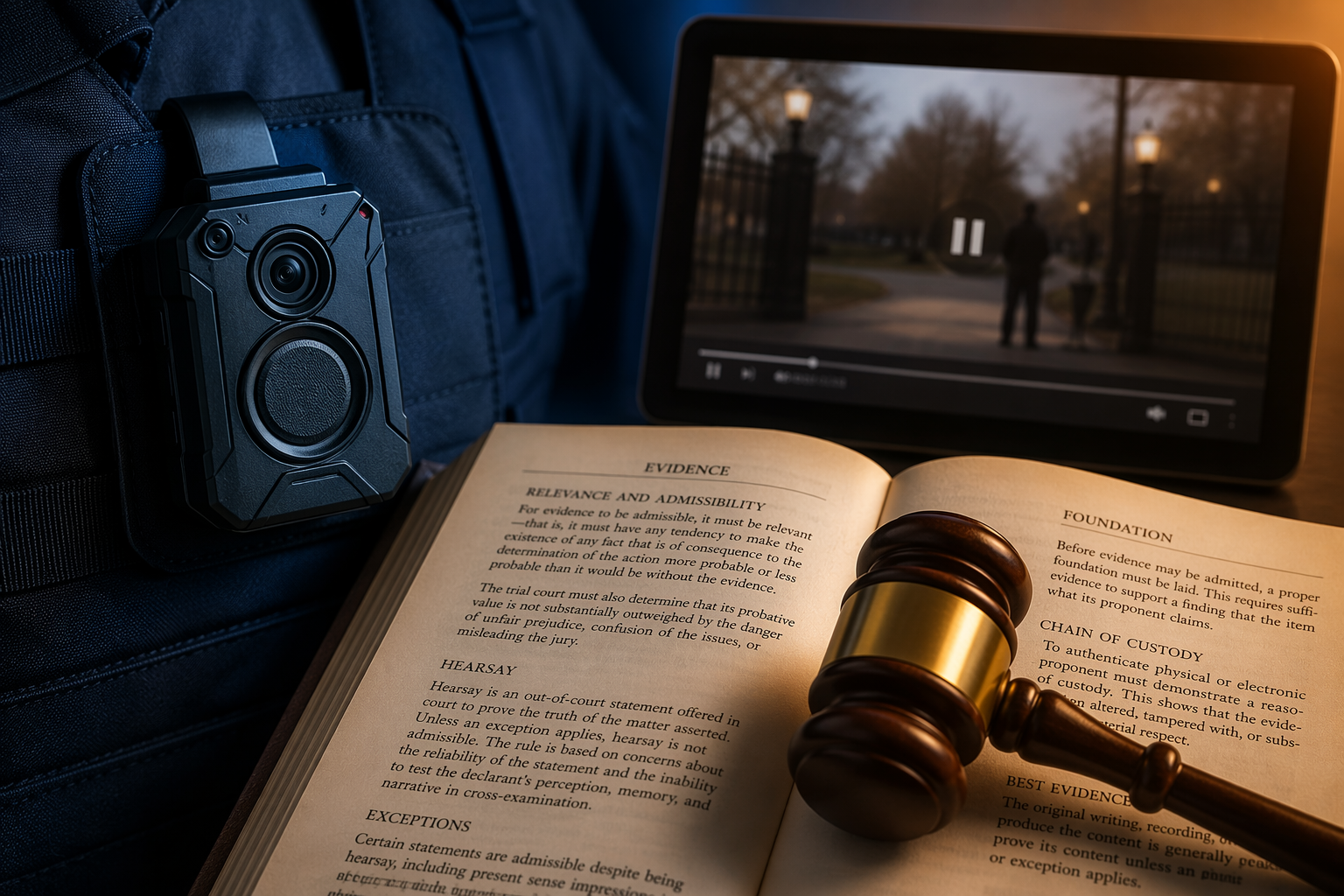
That is the real frame, not the celebrity angle. The useful parts of the record are the recorded file, the officers' words about cameras and discretion, and Gabriel Hostin's explanation that the gate was open [2][3]. Once those are separated, the evidentiary questions stop being theatrical and start being procedural.
What Section 140.05 Demands
Section 140.05 does not ask whether a stop looks uncomfortable on video. It asks whether the defendant knowingly crossed onto premises without privilege [1]. That means the bodycam can matter in two different ways. The recording can help show the setting, the gate, and the movement into the area. The spoken exchange can help show what the people on scene understood while it was happening. But none of that justifies the lazy claim that the clip, standing alone, 'proves trespass.'
| Item in the clip | Main evidentiary question | Why it matters |
|---|---|---|
| The bodycam file itself | Authentication | The proponent has to show it is the actual recording from the stop, not an edited or misidentified clip. |
| Officer remarks inside the video | Hearsay classification | The words may be offered for context or as present-sense impression, but that has to be stated, not assumed [2][5]. |
| Gabriel Hostin's statements | Admission and defense relevance | His own words can be used against him, while also supporting a mistaken-access or no-knowledge theory [2][3]. |
Authenticating The Recording
The first serious issue is foundation. Someone has to identify the device or download, explain how the clip was preserved, and connect the exhibit to the encounter. In a violation-level hearing, that work is often handled quickly and informally, which is exactly where bodycam evidence can be treated too casually if nobody insists on a clean chain from recording to exhibit [5].
The William & Mary discussion is useful because it treats bodycam footage as something that can function either as demonstrative proof or as substantive evidence, depending on how it is introduced and what the court is asked to do with it [5]. That distinction matters in this kind of record. If the video merely illustrates a witness's testimony, the foundation problem is one thing. If it is offered as proof of the encounter itself, the court has to care more about who recorded it, who handled it, and which parts are being asked to carry the case.
What The Voices On The Tape Do
The officer's reported line that 'our hands are tied with cameras everywhere' and the follow-up about 'dimming it down' are not just colorful quotations [2][3]. They are contemporaneous statements inside the recording, so the court has to decide whether they are being used for their truth, for context, or as a present-sense impression of what the officer believed was happening. The point is not to force a label for sport. The point is to keep argument from slipping into evidence without being identified as argument.
Gabriel Hostin's own remarks are easier to classify and harder to ignore. If he said the gate was open and that he believed the area was accessible, those are his statements, and they are usable as admissions [2][3]. But they also help the defense on the merits, because an open gate can support a no-knowing-entry theory or at least a claim that access appeared authorized. The same words can therefore cut in both directions: they can be offered against him and still weaken the prosecution's claim of knowing unlawful entry.
The Counsel Complication
The fact that Sunny Hostin is also a lawyer speaking for her son does not create a new evidence rule, but it does change the posture. Her defense letter is part legal position, part narrative control, and part effort to define the record before the hearing does it for her [4][6]. That matters because celebrity coverage makes small disputes sound larger than they are. The legal problem is still a thin trespass record, a contested recording, and a hearing that has to separate what the video shows from what people want it to mean.
On that record, the cleanest reading is the narrow one. The Hostin incident is useful because it shows how a low-level New York trespass case can turn on explicit authentication, explicit hearsay analysis, and explicit attention to whether the footage proves trespass or merely suggests it [1][2][5]. The reported July 31 hearing date is still ahead, and some details, including Gabriel Hostin's age, have been reported inconsistently, so the sensible conclusion stops with the current record rather than pretending the file already answers everything [6][7].
References
- NY Penal Law § 140.05 — ypdcrime.com / Tilem & Associates
- Sunny Hostin bodycam transcript reporting — New York Post, July 17, 2026
- Sunny Hostin bodycam coverage — Fox News, July 17, 2026
- Sunny Hostin's defense letter to the DA — TMZ, July 13, 2026
- Policing the Admissibility of Body Camera Evidence — William & Mary Law Review
- Sunny Hostin coverage on Gabriel Hostin's defense posture — New York Daily News, July 13, 2026
- Sunny Hostin coverage on the trespass case — People, July 13, 2026
Comments
Join the discussion with an anonymous comment.