
The school-safety problem in the Sunshine Protection Act is not that Congress has voted to make evenings brighter. It is that the House has moved a national clock policy into the school day without answering what happens when buses, walkers, crossings, and drop-off lines operate in darkness for weeks or months at a time. On July 14, 2026, the House passed H.R. 139 by a 308-117 vote; the Senate path remains unsettled, with Majority Leader John Thune saying only that senators are “looking at it.”[1][2]
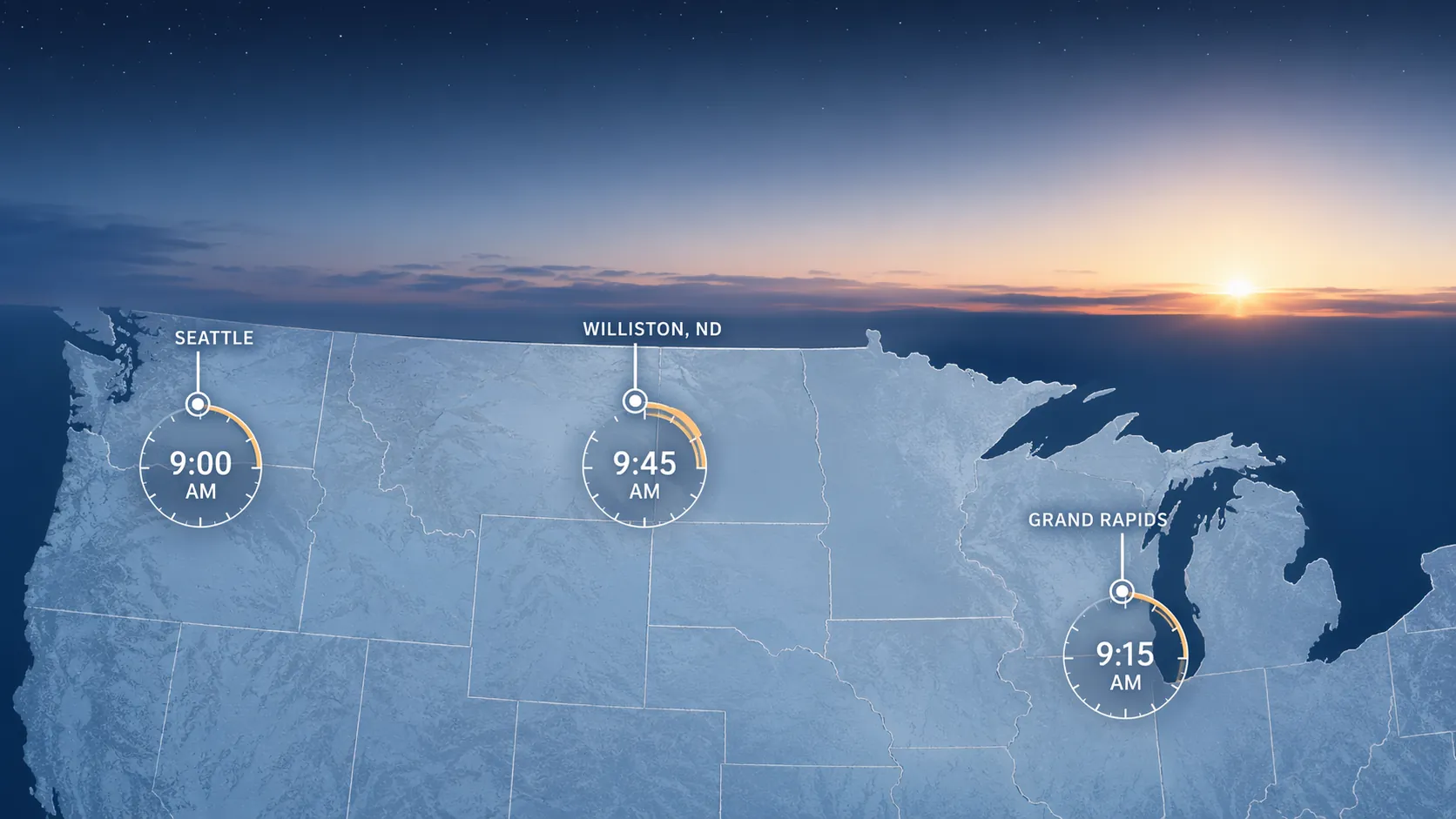
For districts, the legal question does not wait until a child is hurt. If permanent daylight saving time takes effect, winter sunrise would move late enough in some northern communities to change the factual record of ordinary morning operations. Save Standard Time projects winter sunrise near 9 a.m. in Seattle, around 9:15 a.m. in Grand Rapids, and approaching 9:45 a.m. in Williston, North Dakota, under permanent daylight saving time.[3] Those are not marginal lighting differences for a transportation director assigning routes or a principal supervising arrival.
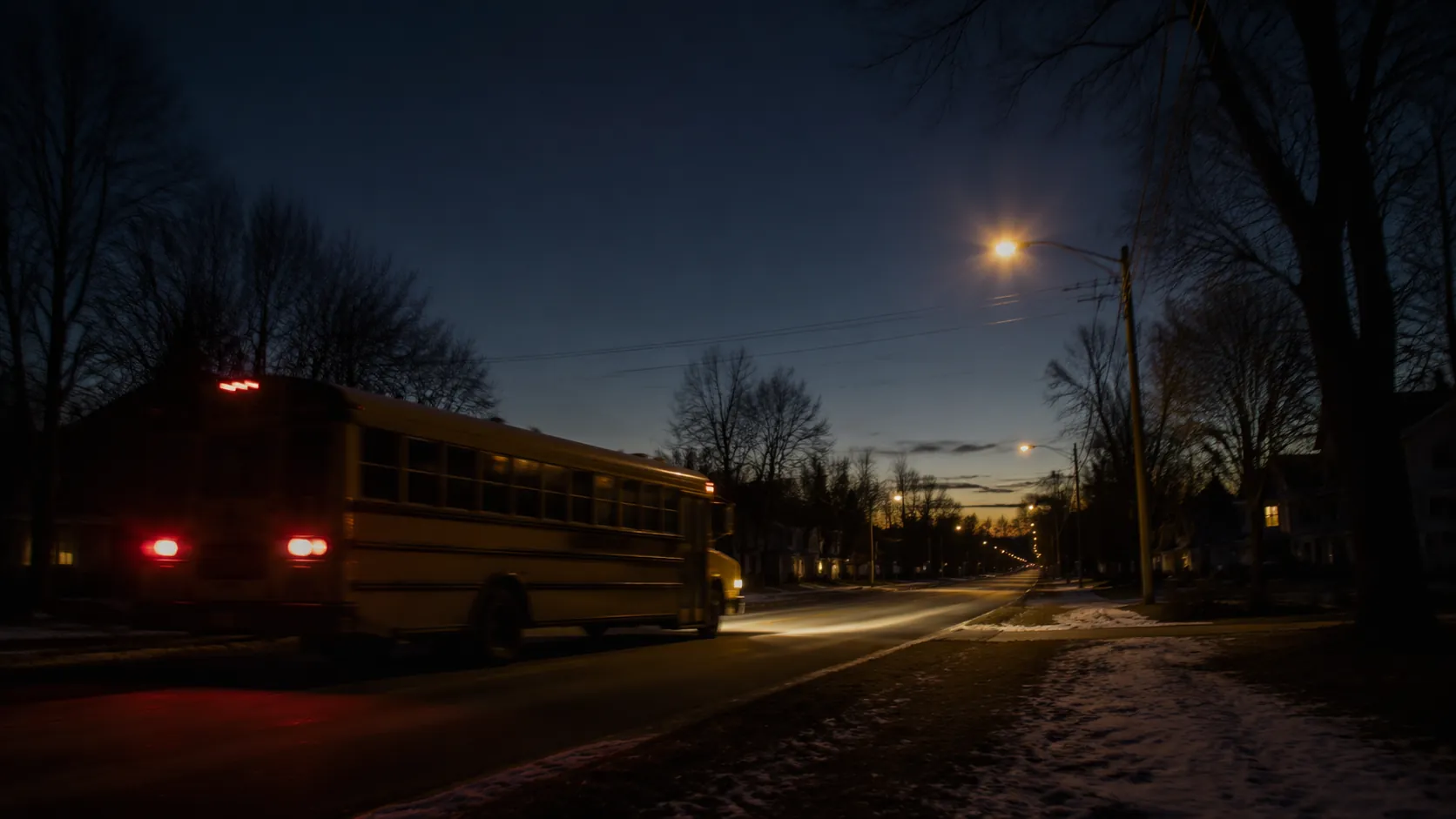
The impact is easy to understate because “time change” sounds administrative. In a liability file, however, it becomes more specific: which bus stops lacked lighting, which students crossed multilane roads before sunrise, which parents complained, which board materials acknowledged winter darkness, and which schedule options were rejected. A statute passed in Washington may set the clock, but a district still decides when children are expected to stand at the curb.
The 1974 Warning Is Factual, Not Predictive
The closest American precedent is the 1974 experiment with year-round daylight saving time. It is useful less as a clean statistical predictor than as a preview of the factual pattern courts, insurers, and plaintiff lawyers would likely revisit today. In January 1974, news reports described eight Florida children killed during the first month of permanent daylight saving time, compared with two during the same period the prior year; public support for the policy reportedly fell from 79% to 42% within three months, and Congress reversed course within 10 months.[4]
That number should be handled carefully. The eight-child figure comes through news coverage and congressional debate, not a single authoritative federal fatality database built for this legal question. Senator Tom Cotton cited the same Florida fatality account in a floor speech opposing permanent daylight saving time.[5] Different historical summaries discuss national consequences in different ways. The legally important point is narrower: the 1974 experience put schoolchildren, darkness, winter commuting, and political reversal in the same record.
What 1974 apparently did not produce is a body of litigated tort guidance for school districts. That absence matters. A district lawyer looking for a case squarely holding that a school system is, or is not, liable for permanent-DST-created dark-morning hazards will not find a neat answer. Existing school-duty cases address more familiar settings: negligent supervision, bus incidents, known dangerous conditions, assaults, off-campus boundaries, and student transportation duties as defined by state law. They were not written for a federal clock change that predictably shifts morning arrival into darkness.
Why the Liability Question Looks Different Now
A modern claim would not need to argue that a school district enacted permanent daylight saving time. Districts plainly would not be the federal timekeeper. The current legal baseline is the Uniform Time Act of 1966, administered through the U.S. Department of Transportation, and Congress controls whether states may adopt permanent daylight saving time.[6] That gives districts an obvious defense against any theory that they created the darkness.
But causation is not the only question. Foreseeability is where the exposure begins. Once a district knows that sunrise will occur after many children are already in transit, its local choices become the record: bell times, bus pickup windows, stop placement, crossing-guard assignments, lighting requests, parent notices, and whether the board discussed risk before winter. The predictable defense — “Congress changed the clock” — may explain the background condition. It does not automatically answer whether the district reasonably managed the child-safety consequences within its control.
That distinction is why the absence of direct caselaw is not as comforting as it first appears. Courts often treat schools as having heightened obligations once students are in their custody or under school-controlled transportation arrangements. The hard boundary is before custody attaches: walking routes, informal gathering spots, public intersections, and bus stops can fall differently depending on jurisdiction. Some states are reluctant to impose school liability for off-campus conditions the district does not own or control. Others look more closely at whether the district selected the bus stop, knew of a hazard, or exercised enough control over the student’s route to create a duty.
Permanent daylight saving time complicates that line because darkness is not a pothole, a broken handrail, or a one-time weather event. It is predictable, seasonal, and schedule-dependent. A plaintiff would likely frame the hazard as the interaction between federal time policy and local school operations: the district knew children would be required to travel before sunrise, knew particular stops or crossings were exposed, and failed to adjust procedures or warnings. Whether that survives dismissal would depend heavily on state duty doctrine, governmental immunity, notice, and the facts in the district’s own files.
The Policy Frame Is Moving Faster Than the School Record
The legislative posture adds another layer of uncertainty. Nineteen states have enacted some form of contingent permanent-daylight-saving-time law, though some depend on federal authorization or neighboring-state action, so the practical effect is not uniform.[7] At the same time, a competing bill, the Sunshine for Our Kids Act, was introduced on July 9, 2026, and would move the country toward permanent standard time while allowing state opt-ins to daylight saving time.[8] That proposal has not erased the immediate significance of H.R. 139; it shows that school-morning safety is already part of the legislative contest.
Education organizations have also put safety objections into the public record. NBC News reported opposition from groups including the National Education Association, the National School Boards Association, the National PTA, and the American Federation of Teachers.[2] That matters for future litigation in a practical way. Once national school groups publicly identify child-safety concerns, it becomes harder for a district to say the risk was obscure, even if the district disputes the magnitude or believes local mitigation is feasible.
The problem for districts is timing. Federal legislation may arrive with a delayed effective date, but transportation departments build routes, negotiate staffing, communicate with families, and coordinate with municipalities on timelines that do not match congressional debate. If a district waits for a final federal answer before examining winter-morning exposure, it may preserve administrative flexibility at the cost of a poor evidentiary record.
Where Claims Would Likely Form
The most likely litigation would still look ordinary at first. A student is struck while walking to a bus stop. A driver fails to see a child crossing near school. A bus stop sits on an unlit shoulder. A family had complained about darkness or traffic before the incident. The permanent-DST issue would enter as foreseeability evidence, not necessarily as an independent cause of action.
| Operational Area | Liability Question |
|---|---|
| Bus stop selection | Did the district choose or maintain a stop where winter darkness made child visibility foreseeably dangerous? |
| Pickup times | Were children required to wait before sunrise when reasonable alternatives had been considered or rejected? |
| School crossings | Did arrival supervision, crossing guards, or traffic controls match the changed lighting conditions? |
| Parent communications | Did the district warn families about dark-morning route risks without shifting all responsibility away from school-controlled decisions? |
| Board documentation | Did leadership identify the risk and make a reasoned record before the first winter under permanent DST? |
The bus-stop cases would be the most jurisdiction-sensitive. Some courts distinguish sharply between school transportation and the public route a child takes to reach it. Others scrutinize the district’s role in assigning stops, setting times, and responding to known hazards. Permanent daylight saving time would not erase those doctrines. It would add a recurring fact pattern that makes notice easier to plead: the darkness did not surprise anyone.
On-campus and near-campus arrivals may be more difficult for districts to distance from. Once staff direct traffic, open doors, manage drop-off lanes, or supervise crossings, the argument shifts from public-condition immunity toward operational reasonableness. A darker arrival window can affect driver visibility, student behavior, staff positioning, and the adequacy of existing procedures. The legal analysis would still turn on state law, but the district’s own winter-arrival plan would become central.
The § 1983 Theory Should Be Treated Carefully
Some plaintiffs may try to move beyond negligence and plead constitutional theories under 42 U.S.C. § 1983, especially if officials had repeated warnings and made no meaningful changes. That path is possible, but difficult. Courts do not convert every school safety failure into a constitutional violation, and doctrines such as state-created danger, special relationship, deliberate indifference, and municipal policy liability are demanding. A dark bus stop, standing alone, is unlikely to become a federal constitutional case merely because it is tragic.
Still, the modern litigation environment is not 1974. Plaintiff lawyers now have richer public-record tools, more developed civil-rights pleading strategies, better access to district communications, and decades of school-duty jurisprudence to work with. A district that has board minutes, parent complaints, transportation emails, police correspondence, and incident reports all pointing to the same winter-morning hazard should expect those documents to be read together.
What Foreseeability Requires Before Winter
The question for district counsel is not whether permanent daylight saving time automatically creates liability. It does not. The question is what a reasonable district examines once dark-morning exposure becomes predictable. Counsel do not need a final appellate case on permanent DST to begin identifying the records that would matter after an incident.
- Transportation exposure: which routes, stops, and pickup windows would operate before sunrise during the darkest weeks.
- Start-time decisions: whether bell schedules or staggered arrivals could materially reduce dark travel for the youngest or most exposed students.
- Crossing supervision: where staffing, municipal traffic controls, or lighting requests would become more important under winter darkness.
- Parent communications: how the district informs families without implying that school-selected routes and stops are beyond review.
- Incident documentation: whether complaints, near misses, transportation changes, and law-enforcement input are captured consistently.
- Board-level risk awareness: whether elected officials receive enough information to make a record before implementation rather than after injury.
Those categories are not a compliance checklist, and they will not answer immunity questions state by state. They are the areas where a district’s knowledge and choices are most likely to be tested. A transportation memo that candidly maps dark stops is different from silence. A board discussion that weighs start-time options is different from treating federal legislation as self-executing. A parent-warning campaign is different from a review of whether the underlying stop remains reasonable.
The strongest district position will usually be built before the first winter morning, not after discovery begins. That does not mean every district must reach the same operational answer. Rural routes, urban crossings, latitude, staffing, municipal infrastructure, and state duty law vary too much for one national rule. But the foreseeable nature of the lighting change makes inaction harder to defend than it would be for a sudden storm or isolated accident.
The Sunshine Protection Act may ultimately stall, change, or be displaced by a standard-time alternative. As of late July 2026, that uncertainty is real. But if permanent daylight saving time becomes federal policy, school districts will inherit the morning it creates. Congress can decide what the clock says. It cannot make a district’s transportation files, parent complaints, crossing assignments, and board minutes legally irrelevant.
References
- House passes bill to make daylight saving time permanent, The Hill
- House passes bill to make daylight saving time permanent, NBC News
- Safety, Save Standard Time
- When the U.S. Tried Permanent Daylight Saving Time in 1974, HISTORY
- Floor Speech on Opposing the Sunshine Protection Act, Office of Senator Tom Cotton
- The Uniform Time Act, U.S. Department of Transportation
- Latest Updates: Daylight Saving Time Legislation Change, Sleep Foundation
- Standard time could become permanent in US under new bill with some exceptions, The Hill
Comments
Join the discussion with an anonymous comment.