
The first fiscal fact worth sitting with is not the Supreme Court caption. It is the customs account running backward. In June 2026, tariff refunds of $49.2 billion helped push customs duties to a negative monthly figure, with a net outflow reported at $25.6 billion and a total IEEPA refund liability estimated at $166 billion.[1] By July 2026, $71 billion had already been paid out.[2] For lawyers advising importers, that is the point at which a favorable trade-remedy ruling stops being only a legal event and becomes a Treasury cash-flow event.

That cash movement changed the way the fiscal year looked in real time. The federal deficit for the first nine months of FY2026 reached $1.37 trillion, a 2% widening from the comparable 2025 period, after earlier monthly data had suggested a narrower deficit path.[2][3] Baseline customs collections were still elevated by historical standards, but the refund month interrupted the observed deficit trajectory. A customs revenue line that had been helping receipts became, for that period, a drain.
That distinction matters for the legal and fiscal question. The refunds do not prove that tariffs were the main driver of the federal fiscal position. They do show that invalidating a tariff authority after substantial collections have occurred can create a deficit-visible repayment obligation, one that budget analysts, bond investors, importers, and government lawyers have to read on the same page.
Why the refund month mattered
The legal chain is compact, but the accounting consequences are not. The Supreme Court’s decision in Learning Resources v. Trump invalidated the administration’s use of IEEPA as tariff authority, creating refund opportunities for duties collected under that route.[4] The Court of International Trade refund process then pushed the issue from legal entitlement into Treasury outflow. Once refund checks move, the question is no longer only whether importers have a claim. It is when the government recognizes and pays the liability.
That timing is what made June unusual. Customs duties are normally discussed as a receipt category, especially during a tariff-heavy administration. In this episode, the refund obligation was large enough to overwhelm the month’s incoming customs collections. Evercore ISI described the program as “large enough to be macroeconomically, fiscally, and market-significant” in 2026.[2] That is a careful formulation. It does not say the refund program is the whole deficit story. It says the cash-flow effect is too large to treat as a footnote.
| Fiscal or legal marker | What it measures | Why it matters for counsel |
|---|---|---|
| $166 billion refund liability | Estimated total IEEPA tariff refunds | Defines the outer cash exposure tied to the invalidated authority |
| $49.2 billion June refunds | Refunds paid or processed in the month | Explains why customs duties turned negative |
| $71 billion paid by July 2026 | Refunds already out the door | Turns a possible claim pool into a realized fiscal outflow |
| $1.37 trillion FY2026 first-nine-month deficit | Treasury deficit through the first three quarters | Shows the refund effect inside the broader federal deficit picture |
The table also shows why refund strategy cannot be reduced to a victory announcement. Some importers will focus on preserving claims, accelerating documentation, and understanding liquidation posture. Others will need to explain to finance teams why a refund right may still sit beside appellate risk and possible replacement duties. The same number can be a receivable, a contingent gain, a policy irritant, and a Treasury financing fact.
The deficit effect is real, but it is not the whole deficit story
The ten-year estimates are useful if they are kept in their lane. The Committee for a Responsible Federal Budget estimate, reported by Fortune, put the lost IEEPA tariff revenue at about $1.7 trillion over ten years and projected federal debt reaching 125% of GDP, or $58 trillion, by 2036.[5] That gives scale to the fiscal hole created by losing the IEEPA tariff stream. It does not, by itself, identify tariffs as the dominant cause of long-run federal debt.
The Tax Foundation’s estimate is lower because it uses a different method. It estimated that IEEPA tariffs would have raised about $1.2 trillion on a dynamic basis after accounting for a 0.7% GDP contraction, and it characterized that amount as 1.7% of projected federal revenue over 2025 to 2035.[6] That comparison is not a clean contradiction of the CRFB figure. The models are answering related but different questions, with different baselines and economic feedback assumptions.
The practical reading is narrower and more useful. The refund program worsens the near-term deficit path and removes a revenue stream that had been counted in some fiscal scenarios. But entitlement spending and debt interest remain the larger structural forces behind the federal debt trajectory. For client counseling, the significance of the refund shock is not that it rewrites the entire debt outlook. It is that it creates pressure for replacement revenue and makes tariff authority choices fiscally salient.
Legal invalidation did not end tariff substitution
Learning Resources constrained one statutory route. It did not eliminate the executive branch’s incentives to find another one. That is the legal implication most likely to matter after the first refund memorandum goes out: the invalidated authority may be gone, but the tariff program can reappear through different provisions with different procedures, limits, and litigation vulnerabilities.
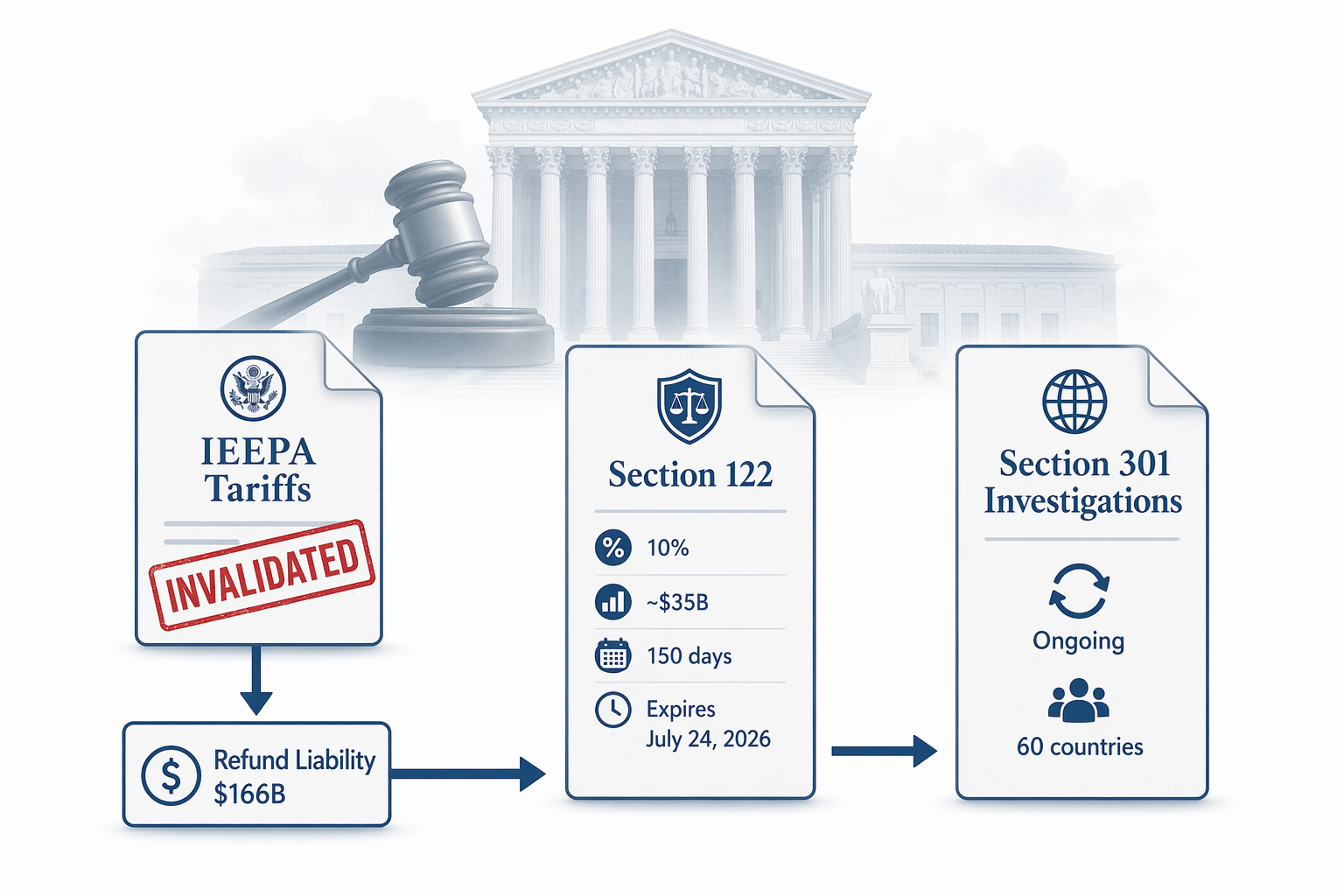
The administration’s Section 122 pivot shows both the usefulness and fragility of substitution. The replacement tariff was set at 10%, was estimated to generate about $35 billion over 150 days, and would recoup roughly 52% of the lost IEEPA revenue for that window. It was scheduled to expire on July 24, 2026.[7] That expiration is not a remote planning issue; as of the article date, it is five days away.
The Court of International Trade’s Oregon v. United States ruling complicated the Section 122 path, but did not create universal relief. Skadden’s analysis notes that the trade court struck down the Section 122 tariffs on May 7, while relief was limited to three plaintiffs and the ruling’s fate remained uncertain.[7] For nonparty importers, that posture matters. A decision may be persuasive, disruptive, and strategically important without immediately eliminating payment obligations across the market.
That is why a backward-looking refund file is not enough. Counsel has to separate at least four questions: whether the client paid duties under the invalidated IEEPA authority; whether the claim is preserved procedurally; whether appellate proceedings could change the refund obligation; and whether replacement tariffs under another authority will offset part of the economic benefit.
- Refund entitlement: identify entries tied to the invalidated IEEPA tariffs and match them to liquidation status and protest posture.
- Timing risk: distinguish amounts already paid from amounts still dependent on administrative processing or appellate outcomes.
- Replacement exposure: model whether Section 122 or later authorities reduce the net recovery.
- Disclosure posture: describe refund claims and substitute-duty exposure as related but not identical contingencies.
Section 301 is the next risk monitor, not a completed answer
Pending Section 301 investigations on 60 countries are the forward-looking legal risk in this sequence.[7] They should not be treated as though they already replace the IEEPA program dollar for dollar. Section 301 has its own procedural predicates, timing, country and conduct analysis, and litigation profile. But the existence of those investigations confirms that the executive branch is not approaching the IEEPA loss as the end of tariff escalation.
For importers, this changes the value conversation. A refund claim may improve cash position for a past entry while the same product, supplier country, or supply chain remains exposed to future tariff action under another statute. The government’s fiscal incentive also points in that direction. A refund liability of this size removes cash from the Treasury and weakens a revenue line that had become politically and fiscally useful. That does not prove a specific replacement action will survive review, but it does explain why replacement authority monitoring belongs in the same workstream as refund recovery.
Incidence modeling belongs in the background
Distributional estimates can help explain why the fiscal issue is politically charged, but they should not displace the legal accounting problem. Yale Budget Lab’s work on tariffs enacted in 2025 through April 2 examined fiscal, economic, and distributional effects, including how tariff costs move through households and the economy.[8] That kind of modeling is useful for understanding incidence. It does not answer whether a specific importer has a refund right, whether an entry has liquidated, or whether a substitute tariff will apply.
The same caution applies to broad claims about who “pays” tariffs. A household-burden model, a customs receipt report, and a litigation order each measure a different thing. Refunds reverse money previously collected from importers of record. Economic incidence may have been passed through in part, absorbed in margins, renegotiated with suppliers, or distributed across customers. The refund check and the economic burden do not necessarily land in the same place.
What practitioners can safely take from the numbers
The strongest conclusion is also the least theatrical one. The IEEPA refund program is large enough to affect the FY2026 deficit trajectory, visible enough to matter for market interpretation, and concrete enough that importer balance sheets may change. It is not large enough to explain the federal government’s structural debt problem on its own. The legal consequence is that a court loss on one authority produces cash claims, but it also intensifies the search for substitute authorities.
That frame supports a disciplined client update. Pursue and value refund opportunities against pending appellate risk. Monitor deficit-driven policy responses because the fiscal loss creates pressure to replace revenue. Treat the Supreme Court decision as a constraint on one statutory route, not as a durable end to tariff escalation.
References
- “US May budget deficit shrinks but customs collections turn negative due to tariff refunds” — Reuters, June 10, 2026.
- “U.S. budget deficit widens as tariff refunds surge” — Transport Topics / Bloomberg.
- “Tariff Refunds Will Make The Federal Spending Deficit Even Bigger” — Investopedia.
- “US Supreme Court decision on IEEPA tariffs reshapes trade authority and introduces potential refund opportunity” — PwC.
- “Trump's $1.7 trillion tariff loss will send national debt to $58 trillion by 2036” — Fortune / CRFB, March 5, 2026.
- “Trump IEEPA Tariff Revenue If Ruled Illegal” — Tax Foundation.
- “US Trade Court Strikes Down Section 122 Tariffs, but Ruling's Fate Is Uncertain” — Skadden.
- “Where We Stand: The Fiscal, Economic, and Distributional Effects of All U.S. Tariffs Enacted in 2025 Through April 2” — Yale Budget Lab.
Comments
Join the discussion with an anonymous comment.