
The legally important fact about the July 18 Miami arrest is not that Andrew and Tristan Tate were taken into custody in the United States. It is how they were taken into custody: US Marshals executed a sealed warrant tied to a UK extradition request, and the Justice Department said the arrests were made “in accordance with the treaties and law enforcement agreements governing Justice Department extraditions.”[1]
That wording matters. A sealed warrant does not prove the UK will get custody. It does not establish that every charge is extraditable, that every defense is weak, or that Romania has lost procedural relevance. It does, however, indicate that the request had moved far enough through US channels for federal officers to make an arrest before the extradition record became public. As of July 19, 2026, the warrant and extradition complaint were not available for public inspection, so the legal analysis has to begin with a narrower proposition: the United States has opened a federal extradition track on behalf of the UK while Romanian proceedings and a Florida state inquiry remain part of the surrounding map.
The legal implications of the Tate brothers’ arrest are therefore procedural before they are theatrical. The arrest did not end the case. It changed the order in which courts, prosecutors, and defense lawyers may have to move.

The Arrest Opens a Federal Extradition Case, Not a US Trial
The Miami arrest places the brothers before a US federal court for an extradition process. That is different from being charged federally in the United States. In an extradition case, the court does not retry the alleged conduct in the way a trial court would. The immediate questions are more limited: whether the treaty framework applies, whether the charged conduct fits extraditable offenses, whether identity and probable cause requirements are satisfied under the governing standard, and whether any recognized bar to surrender applies.
The Justice Department’s public statement points to treaty and law-enforcement agreements, while the reported UK charges include categories — rape, assault causing actual bodily harm, human trafficking, controlling prostitution, sexual assault, indecent images, and extreme pornography — that are not facially exotic to US-UK extradition practice.[1][2] That does not make the extradition automatic. It only means the defense is unlikely to win by treating the request as a diplomatic novelty. The harder work is likely to sit in sequencing, process, and the interaction with other proceedings.
The sealed posture is also not a small inconvenience. Until the complaint, warrant materials, and any certification documents become visible, outside observers cannot responsibly say how the UK framed dual criminality, how it grouped the charges, whether the request covers both indictments in full, or whether the United States has been asked to hold the brothers for every count reported publicly.
The Three Tracks Do Not Line Up Cleanly
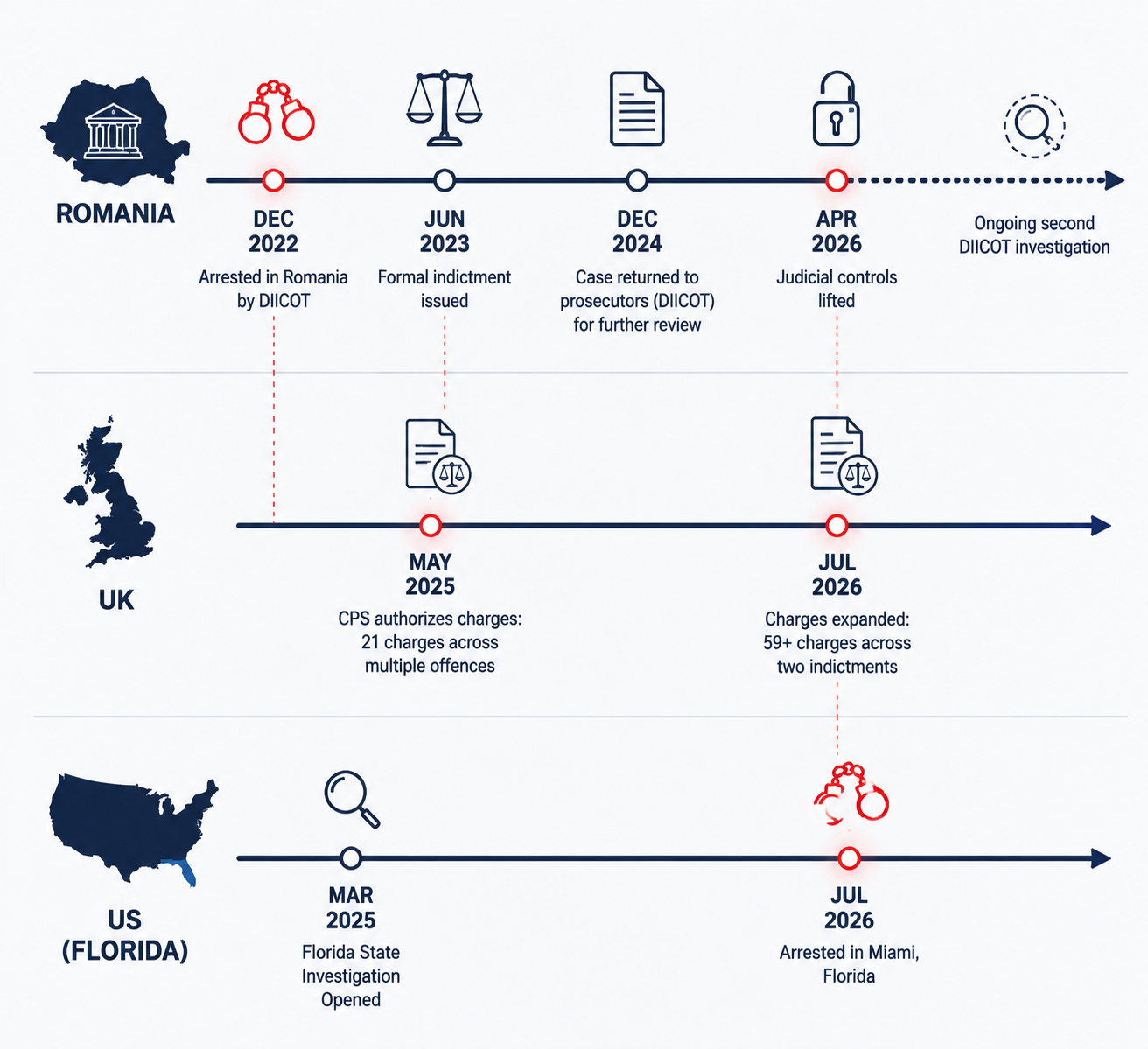
The case now has three legally distinct tracks. Romania is not simply background. The UK is not simply waiting at the end of a queue. The United States is not merely a place of arrest, because it now has to decide whether and when to surrender two people who are also linked to unresolved matters elsewhere.
| Jurisdiction | Publicly Known Posture as of July 19, 2026 | Why It Matters Now |
|---|---|---|
| Romania | The first Romanian case was sent back to prosecutors in December 2024 for procedural irregularities; judicial controls were lifted on April 6, 2026; a separate DIICOT investigation involving 35 alleged victims, including a minor, remains reported as open. | The defense can argue that Romania had not functionally cleared the field, while prosecutors may distinguish stalled trial readiness from an active custody priority. |
| United Kingdom | The CPS authorized 21 charges in May 2025, then a July 2026 package reportedly expanded the case to roughly 59-plus charges across two indictments and 7 alleged victims. | The expanded charge set changes extradition exposure and complicates any clean account of what the US court is being asked to certify. |
| United States | Federal authorities arrested the brothers on the UK extradition request; Florida separately opened a state criminal investigation in March 2025, with no confirmed July 2026 status in the available materials. | The federal extradition case and any state investigative interest are legally separate, but they may compete for attention, custody planning, and defense strategy. |
The Romanian track is the easiest to oversimplify. In December 2024, a Bucharest court declined to send the first case to trial and returned it to prosecutors after finding procedural problems.[3] That was a serious setback for the prosecution, but it was not the same thing as a final acquittal. On April 6, 2026, a Romanian court lifted judicial controls on the brothers, removing restrictions that had limited their movement, but that order also did not erase every Romanian investigative exposure.[4]
The remaining Romanian complication is the second DIICOT investigation, reported as opened in August 2024 and involving 35 alleged victims, including a minor.[5] The available materials do not provide a July 2026 update that would allow a firmer statement about its exact procedural posture. That gap is not cosmetic. If a court is asked to assess whether the UK improperly bypassed Romania, the difference between a pending investigative file, a trial-ready indictment, and a dormant matter could matter.
The UK Case Has Moved From Baseline Charges to a Much Larger Extradition Problem
The UK request did not appear from nowhere in July 2026. In May 2025, the Crown Prosecution Service authorized 21 charges: 10 against Andrew Tate, including rape, actual bodily harm, human trafficking, and controlling prostitution; and 11 against Tristan Tate, including rape, actual bodily harm, and human trafficking. That authorization related to 3 alleged victims.[6]
The July 2026 expansion is what changes the defense burden. Public reports citing the CPS described additional charges against Andrew Tate, including 7 rape charges, 3 trafficking charges, 3 actual bodily harm charges, and 19 charges tied to indecent images or extreme pornography. Tristan Tate reportedly faced additional counts including 1 sexual assault charge, 2 rape charges, and 3 trafficking charges. The total number of alleged victims was reported as 7, and CPS official Malcolm McHaffie said the new charges followed the “receipt of a further file of evidence from Bedfordshire Police.”[2]
That expansion matters in at least three ways. First, the US court may have to parse more conduct categories than the public shorthand “UK extradition warrant” suggests. Second, the defense must decide whether to attack the request as a whole or preserve count-specific objections. Third, the larger the charge package becomes, the more important it is to know whether the extradition complaint consolidates the May 2025 and July 2026 materials or presents them in some more limited form.
There is also a prehistory that may matter less for extraditability than for narrative and process. UK allegations dating to 2014 and 2015 were not prosecuted in 2019, and Hertfordshire Constabulary reopened an investigation in March 2026 after an Independent Office for Police Conduct probe into the original police handling.[7] That history may give the defense material for delay, fairness, or reliability arguments. It does not, on its own, make the charges non-extraditable.
The Romania-UK Sequencing Dispute Is the Most Serious Procedural Fault Line
Joseph McBride, counsel for the brothers, has argued that the UK moved through US authorities despite an alleged understanding that the UK would wait until Romanian proceedings concluded before seeking extradition.[2] If that factual predicate were established, it could become more than a press argument. It could support an abuse-of-process theory: that the requesting state or cooperating authorities used the US process in a way that unfairly disrupted an agreed custody sequence.
The word “if” carries real weight. The alleged UK-Romania understanding has not been publicly confirmed through treaty text, a court order, or an official government statement in the available materials. Treating it as established fact would be a mistake. Treating it as irrelevant would also be premature, because extradition litigation often turns on what the record eventually shows about diplomatic assurances, prior undertakings, custody commitments, and the timing of requests.
The defense problem is awkward. To make an abuse argument in the United States, counsel may need to explain why Romania still mattered procedurally after the first case was returned to prosecutors and judicial controls were lifted. But overemphasizing Romanian exposure could create admissions or characterizations that prosecutors in Romania might later use. Underemphasizing Romania, meanwhile, could make the UK request look like the only live custodial demand.
The prosecution problem is no cleaner. UK authorities will want to present a request that looks treaty-compliant and sufficiently urgent. Romanian authorities may have their own interest in preserving investigative options. US federal lawyers, appearing for the requesting state in extradition proceedings, will have to avoid turning the hearing into a broad audit of two European prosecutorial systems while still answering any claim that the arrest sequence was manipulated.
Florida Is a Separate Question, and the Public Record Is Thin
The US dimension has two parts that should not be collapsed. The federal case is an extradition matter triggered by the UK request. The Florida matter is a state criminal investigation that Attorney General James Uthmeier opened in March 2025.[8]
The public materials available as of July 19, 2026 do not confirm whether the Florida investigation remains active, has been overtaken in practical terms by the federal extradition proceedings, or is waiting on developments abroad. That uncertainty is a material gap. A state investigation could affect defense planning, interview strategy, device litigation, and travel decisions. But without a charge, closure announcement, subpoena record, or official July 2026 update, it should not be described as a pending prosecution.
Nor should the federal arrest be used as evidence that Florida has made a charging decision. US Marshals executing a sealed extradition warrant says something about the federal extradition channel. It does not answer what Florida prosecutors have, what they want, or whether they still intend to act.
Likely Defense Arguments Have Different Levels of Support
The defense arguments already visible in public reporting are not equal in strength, at least on the current record. Some point to real procedural pressure points. Others read more like preservation arguments unless the sealed materials or future filings add substance.
| Argument | Current Public Support | Practical Assessment |
|---|---|---|
| Abuse of process based on alleged UK-Romania sequencing agreement | Asserted by defense counsel; not independently confirmed in the available public record. | Potentially serious if documentary support exists, but the factual predicate remains unverified. |
| Political-offense or political-motivation theory | The brothers have asserted political involvement, including claims linked to the Trump administration, in public reporting. | Difficult to ground on current materials unless tied to recognized treaty exceptions and concrete government conduct. |
| Dual US-UK citizenship | Raised as part of the defense posture in public reporting. | Not an obvious bar by itself; citizenship may affect equities and public messaging more than the core extradition analysis. |
| Charge-specific extraditability or probable cause objections | Cannot be assessed fully until the extradition complaint and supporting documents are public. | Likely to become more important because the UK charge package has expanded substantially. |
The abuse-of-process argument is the one that most directly addresses the legal architecture of the case. If there was a concrete UK-Romania undertaking about custody sequence, and if the UK then used the US arrest channel to avoid that undertaking, the defense has something a court would at least have to confront. But the argument cannot be stronger than its proof. A lawyer’s assertion is not the same as a disclosed intergovernmental agreement.
The political-offense line is harder to evaluate from what is public. Extradition treaties can contain political-offense exceptions or related protections, but modern practice usually treats ordinary violent, sexual, and trafficking offenses differently from classic political offenses. A claim that political actors are interested in the case is not enough. The defense would need to connect that claim to the legal bar actually available in the treaty process.
The citizenship point is also easy to overread. Dual US-UK citizenship may matter to how the brothers describe themselves, and it may appear in arguments about fairness, residence, or governmental interest. But citizenship is not, by itself, a clean answer to a UK request in a US extradition court. The relevant question is whether the treaty and implementing law permit surrender on the charged conduct, not whether the defendants can identify a national affiliation on both sides of the Atlantic.
The Defense Strategy Problem Is Now Three-Dimensional
A single-country defense can prioritize one audience. This case cannot. A filing in the US extradition case may be read by UK prosecutors preparing the substantive prosecution, Romanian prosecutors preserving their investigative position, Florida authorities considering their own options, and civil or regulatory actors watching for admissions. Even routine phrasing becomes hazardous.
If the brothers argue in Miami that Romania remains the proper first forum, they may strengthen the sequencing objection but weaken any public claim that Romanian exposure is over. If they argue that the UK case is stale or mishandled because allegations were not prosecuted in 2019, they may invite the CPS to emphasize the later Bedfordshire evidence file and the expanded 2026 charges. If they attack the Florida inquiry as politically infected, they may raise issues irrelevant to the UK treaty request while giving state authorities a reason to clarify their position.
Prosecutors face a mirror-image coordination problem. The UK wants surrender. Romania may still have unresolved investigative interests. The United States must administer a federal extradition process without prematurely adjudicating foreign charges. Florida, if still active, would have to decide whether its interests are served by waiting, coordinating, or stepping forward. None of those actors controls the whole map.
What the Miami Arrest Actually Changes
Before July 18, the legal picture could still be described as a European custody and prosecution problem with a possible American overlay. After the Miami arrest, the United States is no longer peripheral. A federal court now has to process a UK request while the public record still leaves unresolved questions about Romania’s remaining role and Florida’s investigative status.
The arrest also forces timing choices. The UK may want speed because an extradition case loses practical force if it drifts. The defense may want disclosure before speed, especially on the alleged Romania understanding and the composition of the charge package. US prosecutors may want to keep the hearing within ordinary extradition boundaries. Romanian and Florida authorities may prefer not to have their positions defined by arguments made in a proceeding they do not control.
That is the central legal implication. The Miami arrest did not resolve the Tate brothers’ exposure. It converted it into a sequencing fight. The most consequential next facts are not likely to be public comments from the defendants or broad descriptions of the allegations. They are the extradition complaint, the sealed warrant materials if unsealed, any documentary proof of a UK-Romania sequencing arrangement, any updated Romanian filing, and any official clarification from Florida.
References
- “Tate brothers arrested in Miami,” NPR, July 18, 2026.
- “Andrew and Tristan Tate arrested in Miami,” The Guardian, July 18, 2026.
- “Romanian court says case can't go to trial,” AP News, December 2024.
- “Romanian court lifts judicial controls,” Reuters, April 6, 2026.
- “Legal affairs of the Tate brothers,” Wikipedia.
- “UK prosecutors say 21 charges authorised,” BBC, May 2025.
- “Tate brothers lose court bid,” BBC, 2026.
- “Tate brothers wanted in three jurisdictions,” Tortoise Media, March 13, 2025.
Comments
Join the discussion with an anonymous comment.