
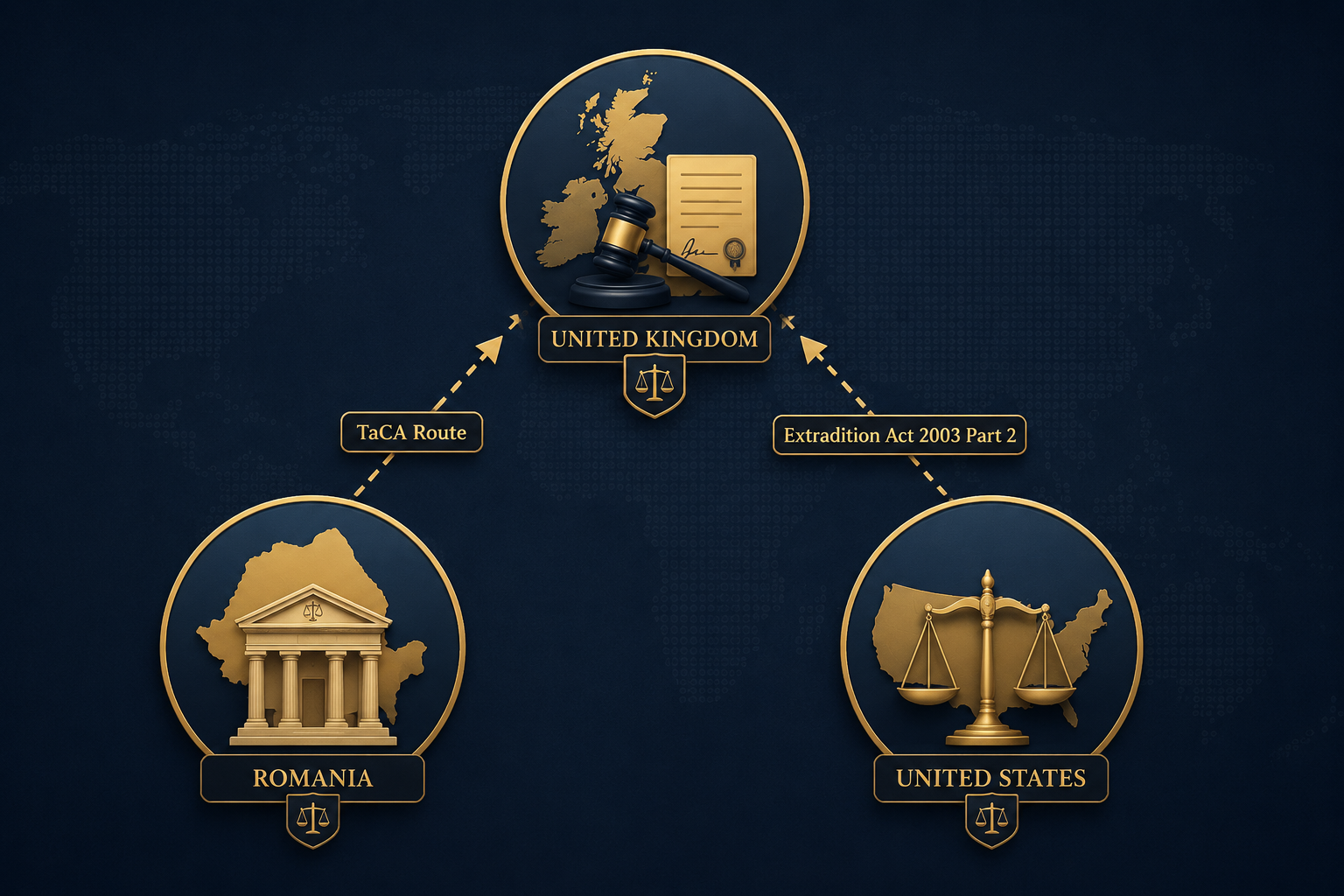
The July 18-19, 2026 Miami arrest did not simply restart the Tate brothers' UK extradition story. It put a second surrender route into active use while an earlier Romania-to-UK route remained unresolved. As of July 20, Andrew Tate faces 42 UK charges and Tristan Tate faces 17, for a combined 59 charges involving seven alleged victims and alleged conduct from July 2010 to August 2017.[1][2]
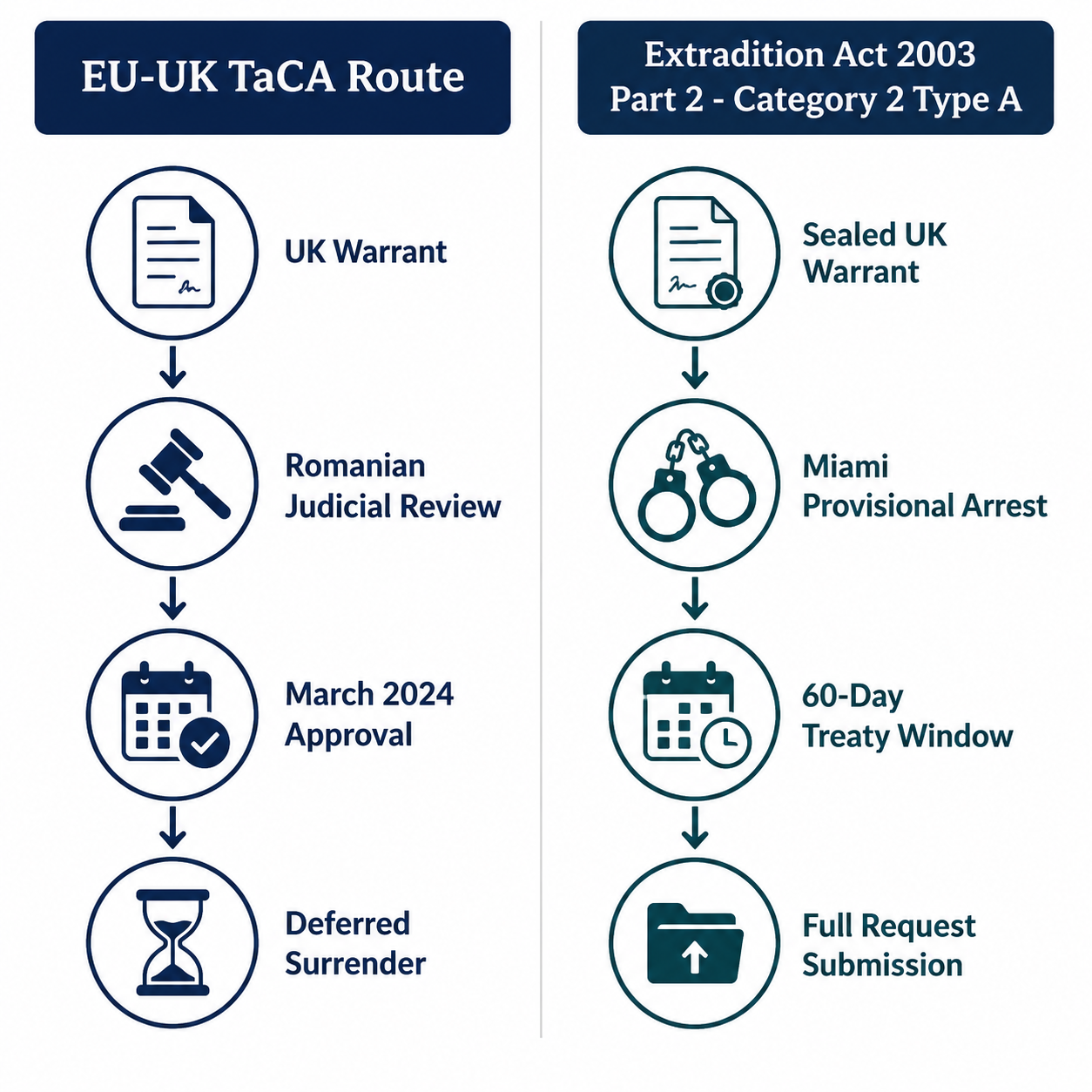
US Marshals arrested the brothers in Miami on a sealed UK warrant, with reports over July 18-19 saying a first federal court appearance was expected early the following week but not giving a fixed date.[3][4] That matters because a provisional arrest in the United States starts a treaty timetable: the UK must submit the full extradition request within 60 days. It also places the case under a different UK statutory pathway from the one used when Romania approved extradition in 2024.
Current Status Before the Earlier Timeline
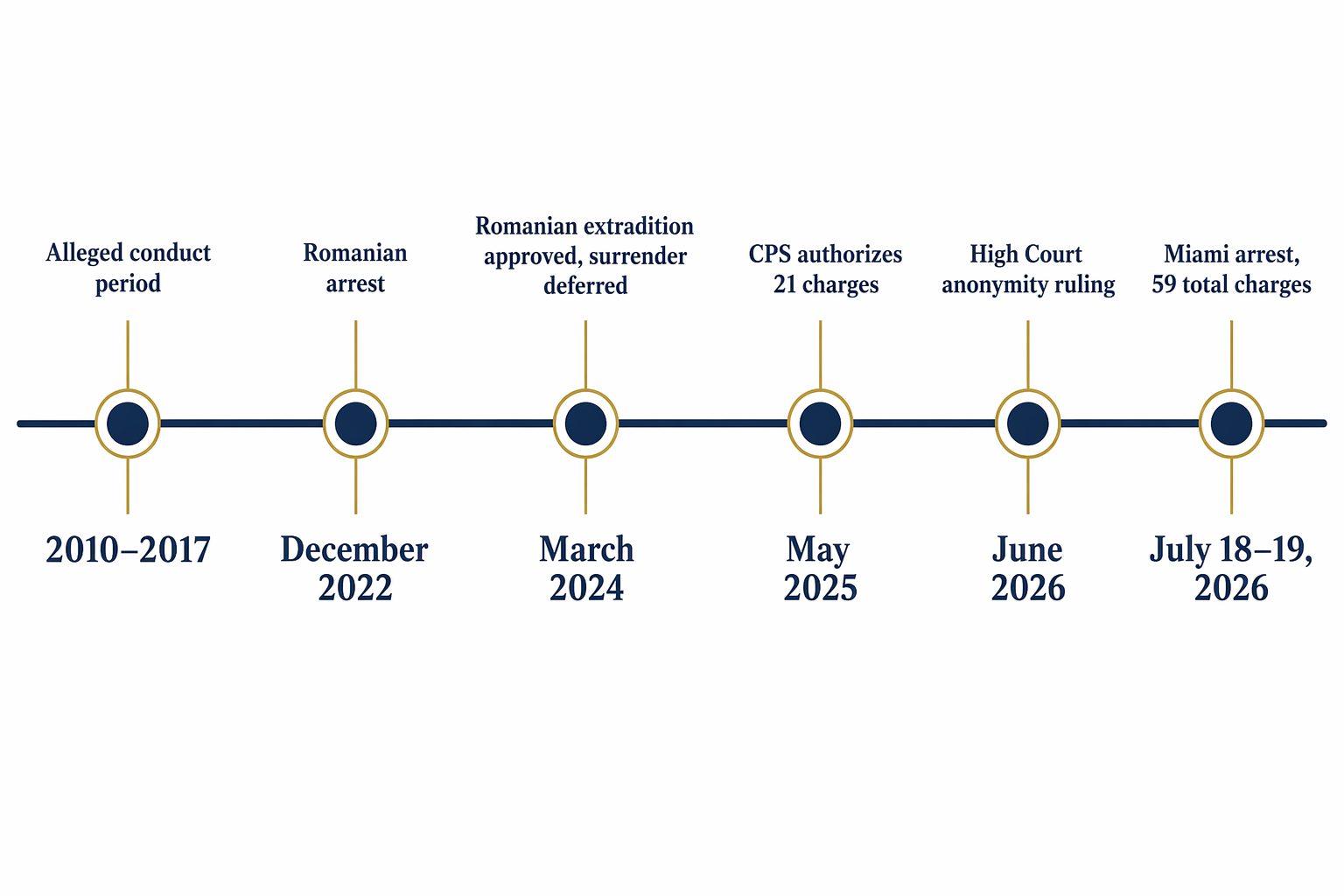
The immediate procedural position is narrow. The UK has secured arrests in the United States on a sealed warrant. The full US extradition request still has to be filed within the treaty window. The charge total has expanded since the earlier UK charging decision: 21 charges were authorized by the CPS in May 2025, and 38 further charges were reported after the Miami arrests, bringing the total to 59.[1][2]
Those facts do not answer who receives the brothers first if more than one state has a live claim on their custody. A Romanian court had already approved their extradition to the UK in March 2024, but deferred surrender until Romanian proceedings concluded.[5] The Miami arrest therefore creates a sequencing problem, not a clean substitution.
| Date or period | Procedural event | Why it matters |
|---|---|---|
| July 2010-August 2017 | Alleged UK conduct period across seven alleged victims | Defines the period now reflected in the 59 UK charges |
| 2014-2019 | UK investigations into the brothers | Shows the UK track did not begin with the 2026 arrest |
| 2017 | The brothers moved to Romania | Made Romania the first surrender forum once UK prosecutors later sought return |
| December 2022 | Romanian arrest following a DIICOT human trafficking investigation | Placed Romanian criminal proceedings ahead of any UK surrender |
| March 2024 | Romanian court approved UK extradition but deferred surrender | Created the first UK extradition route and its main limitation |
| May 2025 | CPS authorized 21 UK charges | Put a defined charging package behind the UK request |
| June 2026 | High Court rejected a bid to identify UK accusers before extradition | Clarified what the defense could demand at the pre-extradition stage |
| July 18-19, 2026 | US Marshals arrested the brothers in Miami on a sealed UK warrant | Activated a separate US-to-UK extradition route with its own timetable |
How the Romania-to-UK Track Was Built
The Romania track is the older live route. UK investigations are reported to have run from 2014 to 2019, after which the CPS initially declined to prosecute; the brothers moved to Romania in 2017.[6] In December 2022, Romanian authorities arrested them in connection with a Romanian DIICOT human trafficking investigation.[6] The Romanian case is not just background color. It is the reason a UK request could be approved yet not immediately executed.
In March 2024, a Romanian court ruled that Andrew and Tristan Tate could be extradited to the UK, but only after the conclusion of Romanian proceedings.[5] That single qualification carries most of the legal weight in the Romania route. Approval of extradition was not the same thing as surrender. It left Romanian judicial control in place while the domestic Romanian case continued.
For UK practitioners, the route is also structurally different from the US route. Since the end of the European Arrest Warrant system for UK cases, surrender between the UK and EU member states operates through the EU-UK Trade and Cooperation Agreement framework, implemented in UK extradition law through the Extradition Act 2003 architecture. CPS guidance treats extradition to the UK as a process governed by the requesting state's warrant or request, the receiving state's courts, and statutory bars or safeguards that must be addressed before surrender.[7]
Why the US Arrest Is a Different Legal Route
The Miami arrest moved the case into the Extradition Act 2003 Part 2 framework because the United States is not a Part 1 territory. In UK terminology, the United States is treated as a Category 2 territory, and the UK-US arrangement is commonly described as a Category 2 Type A framework: the requesting state does not have to provide prima facie evidence in the way required for some other Category 2 territories, but it still has to satisfy the applicable statutory and treaty requirements.[8][9]
The absence of a prima facie evidence requirement is often overread. It does not make extradition automatic. The US court still has to process the request under the treaty and domestic extradition procedure. The UK still has to produce the formal materials in time. Issues such as identity, extraditable conduct, bars to extradition, and specialty remain legally relevant, depending on how they are raised and how the request is framed.[7][8]
Specialty is especially important in a charge-expansion case. CPS guidance explains the principle that a returned person may be prosecuted only for the offences for which extradition was granted, subject to statutory exceptions or further consent.[7] If the UK request to the United States lists particular offences, those listed offences define the safe lane for prosecution after surrender. A headline charge total is less useful than the schedule of offences that survives the extradition process.
Dual criminality is another working constraint. GOV.UK guidance describes extradition as turning on whether conduct is extraditable under the relevant arrangements, with courts examining statutory requirements and bars before extradition can proceed.[8] The question is not whether US and UK statutes use identical labels. It is whether the conduct alleged in the request corresponds sufficiently to criminal conduct under the required legal test.
The Charges Sit Inside the Route, Not Above It
The current UK charging picture is materially larger than the one publicly known in May 2025. The CPS authorized 21 charges that month; after the Miami arrest, BBC and Reuters reported 38 additional charges, producing the combined total of 59. Andrew Tate faces 42 charges and Tristan Tate faces 17, involving seven alleged victims and alleged conduct from July 2010 to August 2017.[1][2]
The charge count keeps the alleged victims visible in the procedural account, but it does not by itself answer the extradition questions. Extradition requests must translate allegations into extraditable offences, treaty-compliant documentation, and charge descriptions that do not later collide with specialty restrictions. That drafting burden is where procedural cases are often won, narrowed, delayed, or sent back for repair.
The June 2026 Anonymity Ruling
The June 2026 High Court ruling sits between the Romanian approval and the Miami arrest, and it is easy to miss because it did not involve physical custody. Its practical point was disclosure: whether the brothers had to be told the identities of the UK complainants before extradition.
Secondary reports say Chamberlain J upheld the CPS's refusal to disclose the complainants' identities at the pre-extradition stage. Courthouse News Service reported the court's statement that the Tates "have no rights under any relevant statutory regime to be told of the identities of the complainants" before extradition, and that the refusal did not breach Article 6 ECHR.[10] BBC also reported that the brothers lost their bid to be told the names of their UK accusers.[11]
The ruling is procedural, not a finding on the allegations. It addresses what must be disclosed before surrender, not what a trial court may require once criminal proceedings are underway. That distinction matters because extradition litigation often borrows the language of fair trial rights while operating at an earlier and narrower stage.
The public-reach point was not tabloid filler. Courthouse News Service reported that the judge noted Andrew Tate's following of more than 10 million users on X and a post that received 2.8 million views in under 10 hours as relevant to risk in the anonymity analysis.[10] Those numbers matter here only because they were reportedly part of the court's reasoning about complainant protection and disclosure before extradition.
What the Miami Court Process Has to Do Next
After a provisional arrest in the United States, the next visible step is the federal court process. Reports on July 18-19 said the first appearance was expected early the following week, but the available reporting did not provide a set hearing date.[3][4] The UK then has to submit the full request within the 60-day treaty window.[4]
At that point, the question becomes documentary and statutory. The request must identify the offences, provide the required warrant and supporting materials, and give the US court enough to apply the treaty and domestic extradition rules. If extradition is granted, specialty will limit what the UK can prosecute after surrender unless further consent or another exception applies.[7]
No nationality bar changes that analysis in the UK materials used here. GOV.UK describes the UK extradition process by territory category, statutory conditions, and applicable bars, rather than by a general refusal to extradite nationals.[8] The brothers' citizenship or residence history may affect practical custody and forum questions, but the materials available for this article do not support treating nationality as a dispositive bar.
The Sequencing Problem That Remains
The hard question is not whether the UK wants the brothers returned. It is which live legal route can produce surrender, and when. Romania approved extradition in March 2024 but deferred surrender until Romanian proceedings concluded.[5] The United States arrest in July 2026 opened a separate route after the brothers had left Romania and traveled to the US, according to the available reports.[3][4]
That overlap is the point at which neat timelines fail. If the US route advances faster than the deferred Romanian route, the public record available as of July 20, 2026 does not answer how the earlier Romanian approval, any undertakings connected to it, and the later US custody position interact. The existing Lex Machina Review analysis of multi-jurisdictional extradition sequencing treats that issue as the central operational complication, and this procedural record supports the caution.
What is known is enough to separate the tracks. The Romania-to-UK route produced an approval with deferred surrender. The US-to-UK route began with a sealed-warrant arrest and a 60-day window for the full request. The High Court anonymity ruling answered a pre-extradition disclosure fight, not guilt, trial admissibility, or final custody priority. The remaining question is how those routes will be sequenced once the US court process begins and the UK files the formal request.
References
- Tate brothers arrested in US as further UK charges take total to 59, BBC News, July 19, 2026.
- US Marshals arrest 'hypermasculine' social media stars Andrew and Tristan Tate, UK seeks extradition, Reuters, July 19, 2026.
- Tate brothers arrested in Miami, U.S. Marshals Service tells AP, NPR, July 18, 2026.
- Andrew and Tristan Tate arrested in Miami on charges of rape and sex trafficking, The Guardian, July 18, 2026.
- Andrew Tate and brother Tristan can be extradited to UK, Romanian court rules, BBC News, March 2024.
- Legal affairs of the Tate brothers, Wikipedia.
- Extradition - To the UK, Crown Prosecution Service.
- Extradition: processes and review, GOV.UK.
- UK-US extradition treaty of 2003, Wikipedia.
- Judge rejects Tate brothers' bid to identify UK accusers before extradition, Courthouse News Service.
- Tate brothers lose court bid to be told names of their UK accusers, BBC News.
Comments
Join the discussion with an anonymous comment.