
The first bad answer in a tax fraud matter is usually the neat one: “The maximum is five years.” That sentence may be technically connected to 26 U.S.C. § 7201, but it is a poor description of the legal implications of tax fraud charges for a real client. Federal tax cases are rarely priced by one statutory maximum in isolation. They are priced by years, counts, civil assessments, interest, licensing consequences, bankruptcy treatment, and the permanent record left behind.
The stacking problem starts with the charging menu. Tax evasion under 26 U.S.C. § 7201 carries up to five years per count; filing a false return under 26 U.S.C. § 7206 carries up to three years per count; willful failure to file under 26 U.S.C. § 7203 carries up to one year per count; and false statements under 18 U.S.C. § 1001 can add up to five years per count. When the conduct spans multiple tax years, the same basic pattern can become multiple counts rather than one “tax problem.” [1]
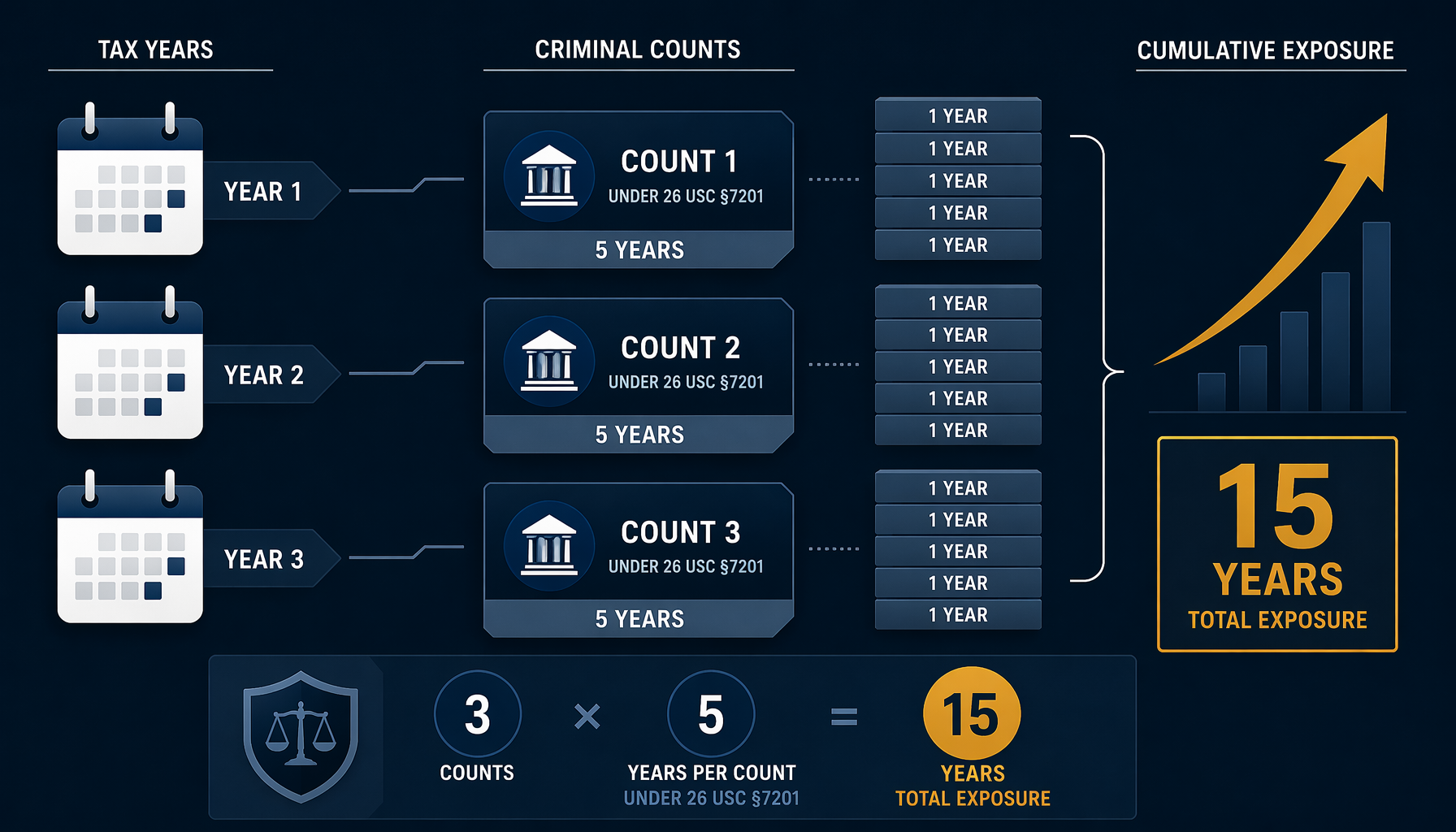
That does not mean every defendant receives a sentence anywhere near the arithmetic maximum. It does mean the maximum is the wrong starting point for triage. In the U.S. Sentencing Commission’s FY2025 tax fraud data, 324 offenders were sentenced, 68% received prison time, the average sentence was 17 months, and the median loss was $546,562. Those figures describe sentenced offenders, not every investigated person or every person whose case was declined, resolved civilly, or diverted before sentencing. Still, they are a useful antidote to casual reassurance: prison is not theoretical in this slice of the docket. [2]
IRS Criminal Investigation’s FY2025 report supplies the other half of the picture. IRS-CI reported $10.59 billion in identified financial crimes, a 15.7% year-over-year increase, and $4.5 billion in tax fraud specifically, a 111.8% increase. Those are identified investigative results across matters at different stages, not conviction amounts. They nonetheless show a large enforcement universe in which a client’s problem may already have moved well beyond a missed-form explanation by the time counsel is called. [3]
The five-year headline misses how counts multiply
A one-year filing issue and a five-year pattern are different legal events. The distinction matters before anyone reaches sentencing guidelines, plea negotiations, or restitution. A return filed for one year may generate one set of allegations. Similar returns filed over several years may allow prosecutors to charge separate counts for separate tax years, and other conduct around the filings—statements to agents, documents supplied during an audit, or entity-level records—may create additional exposure under statutes outside the tax code. [1]
For a generalist lawyer taking the first call, the safer question is not “What is the maximum for tax evasion?” It is “How many tax years, how many returns, how many statements, and how many agencies are already involved?” A client may describe the matter as “the 2023 return” because that is the document in front of them. The government may be looking at the same document as one entry in a multi-year pattern.
| Common charge or issue | Why it changes the exposure analysis |
|---|---|
| Tax evasion | A five-year maximum applies per count, so multiple years can create cumulative exposure. |
| False return | A three-year maximum per count may apply even where the government charges false filings rather than evasion. |
| Failure to file | A one-year count can still matter when repeated across tax years or paired with other charges. |
| False statement | A five-year non-tax count may enter when the investigation involves statements to federal officials. |
The point is not to assume the worst charge. It is to avoid giving advice based on the smallest possible unit of analysis. In tax fraud work, the unit is often not the return. It may be the pattern.
The civil fraud penalty is not an afterthought
The criminal case tends to dominate attention because it carries imprisonment and public stigma. The civil side is where many non-specialists underprice the matter. Under IRC § 6663, the civil fraud penalty is 75% of the underpayment attributable to fraud. Fraud-related assessments also sit outside the ordinary limitations comfort zone: IRC § 6501(c)(1) provides no statute of limitations for assessment in the case of a false or fraudulent return with intent to evade tax. [4]
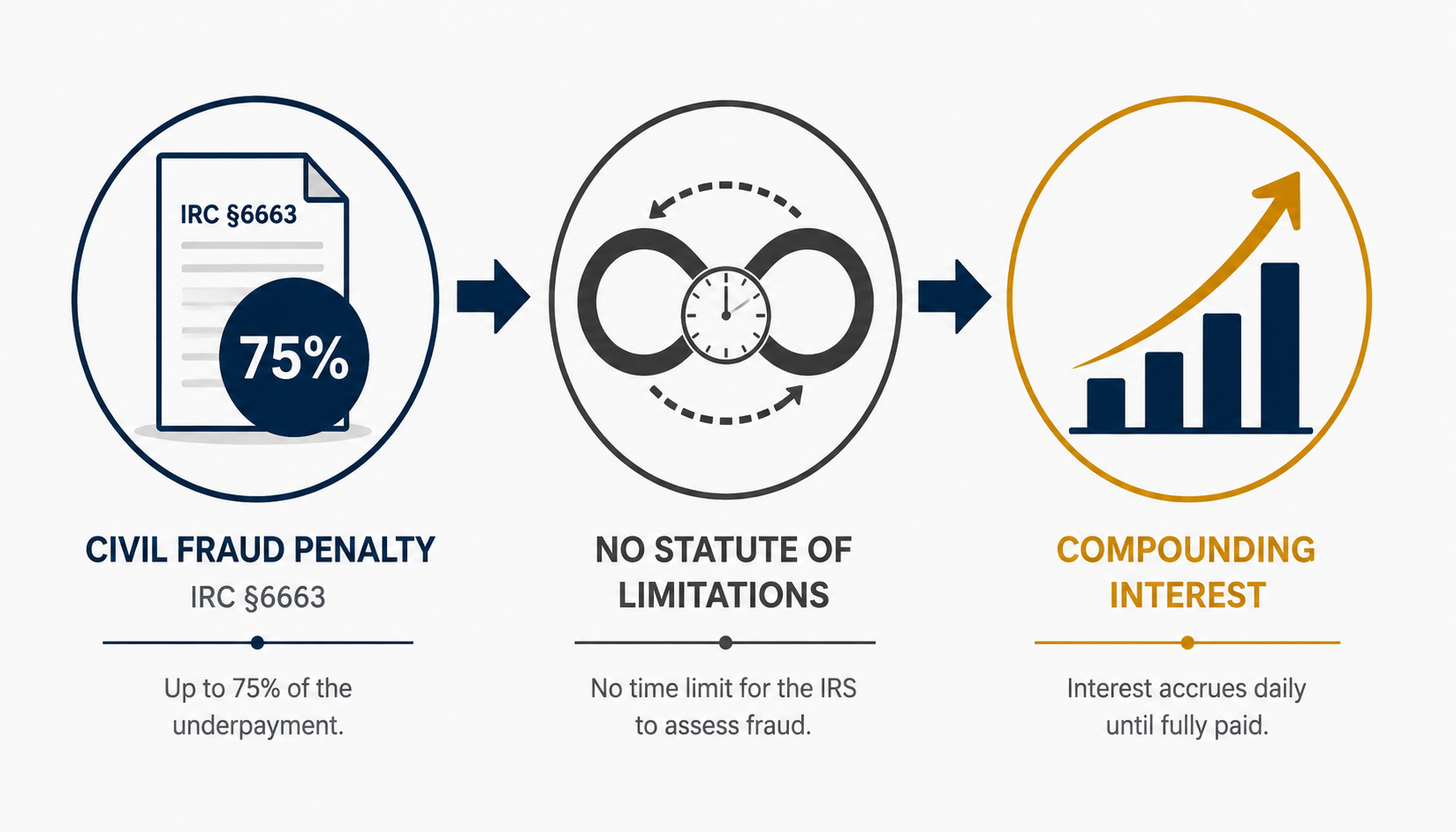
That pairing matters. A 75% penalty is already severe when applied to the underpayment. Add an open-ended assessment period for fraud and the file does not behave like an ordinary stale tax year. Add interest, and the final number can move far away from the original tax deficiency. The lawyer who focuses only on the indictment, or only on a plea range, may miss the bill that remains after the criminal case is over.
This is also where words like “only” become dangerous. A client might hear that the expected sentence is measured in months rather than decades and conclude the matter is contained. But the civil fraud penalty is not a sentencing enhancement. It is a separate financial consequence tied to the tax underpayment. It can arrive alongside restitution, fines, professional fees, and interest, and it can continue to matter after custody or supervision has ended.
One defense-firm illustration puts the issue in plain terms: a $200,000 tax evasion matter, after criminal fines, the 75% civil fraud penalty, interest, and legal fees, may produce more than $750,000 in total financial exposure before any lost career income from license consequences. That figure should be treated as an illustrative estimate, not as a dataset or a typical outcome. Its value is narrower but still useful: it shows how a tax loss can become a much larger practical liability once the layers are counted together. [1]
Criminal and civil consequences can move on different tracks
A tax fraud investigation may end without every feared outcome occurring. Charges may be narrowed. Civil penalties may be contested. Loss calculations may be disputed. But the existence of multiple tracks changes how counsel should frame the first conversation. The criminal case does not swallow the civil case, and a civil resolution does not necessarily erase criminal risk once willfulness and fraudulent intent are in the record.
The sequencing is often what blindsides people. A client may first encounter the matter as an audit, then as a document request, then as a grand jury or agent contact, then as a charging decision, and later as an assessment or collection problem. By the time each stage becomes visible, earlier statements and records may already have fixed positions that are difficult to unwind.
That is why the initial intake should separate at least four questions: what tax is allegedly unpaid, what conduct allegedly made it fraudulent, which years are implicated, and what the client has already said or produced. Without those answers, even an accurate statutory citation can be misleading.
The permanent consequences are not just reputational
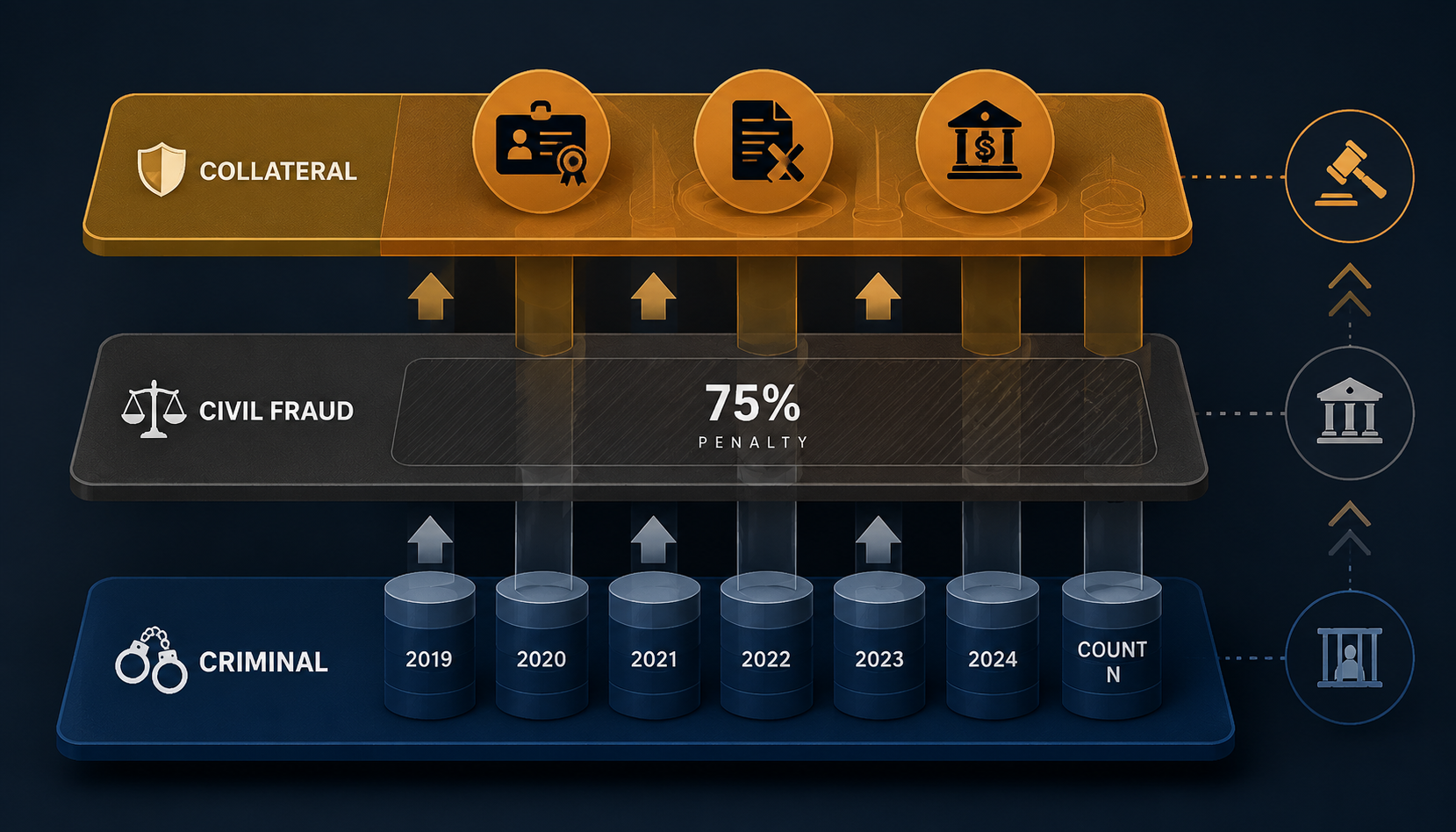
The collateral consequences of tax fraud charges are easy to mention and hard to live with. For licensed professionals, a conviction or fraud finding can become a licensing event. Source materials describe CPA license revocation, attorney discipline or disbarment, and FINRA disqualification as serious professional consequences, though the precise process and result depend on the state, board, and regulatory setting. [1]
That caveat is not cosmetic. Licensing consequences should not be described as identical in every jurisdiction. But a professional client does not need a 50-state survey to understand the immediate risk: the tax case may trigger a separate disciplinary proceeding in which the criminal disposition becomes evidence of unfitness, dishonesty, or disqualifying conduct. For attorneys, accountants, brokers, and other credentialed professionals, the loss of the credential may be the largest economic penalty in the case.
The federal record problem is similarly blunt. The cited defense source states that federal tax fraud convictions cannot be expunged because there is no general federal expungement statute, leaving the conviction to appear on background checks. [1]
Immigration consequences require special care because status, timing, offense elements, and sentence can matter. The available source describes tax fraud as a crime involving moral turpitude that can create deportation exposure for green card holders and bar naturalization. That should be treated as a red flag requiring immigration-specific review, not as a one-line answer for every noncitizen client. [1]
Bankruptcy will not necessarily clean up the tax debt
Bankruptcy is another area where a general answer can be worse than no answer. Tax debt arising from fraud is identified as non-dischargeable under 11 U.S.C. § 523(a)(1)(C). The cited source also notes that IRS collection tools can include liens, levies, garnishment, and seizure. [1]
The practical consequence is that the client may emerge from the criminal process with the tax obligation still attached. That affects plea evaluation, asset planning, settlement discussions, and professional licensing strategy. It also affects candor with spouses, business partners, and lenders. A sentence has an end date. A fraud-based tax debt may not behave that way.
What a first-response lawyer should be trying to learn
The early task is not to resolve the tax controversy on the first call. It is to avoid narrowing the problem before the facts justify it. A useful first pass should identify the years, returns, entities, preparers, communications with the IRS, prior audits, amended filings, document productions, professional licenses, immigration status, and bankruptcy or collection concerns. Some of those issues may prove irrelevant. Missing them at intake is the problem.
- Count the years before discussing the maximum penalty.
- Separate the alleged tax loss from the potential civil fraud penalty and interest.
- Ask what the client has already told agents, auditors, preparers, employers, or licensing bodies.
- Identify professional licenses, securities registrations, immigration status, and pending background checks.
- Do not assume bankruptcy will discharge the resulting tax debt.
None of that requires inflating the case. It requires resisting the opposite error: translating a multi-layer tax fraud matter into a single statutory maximum and calling that advice. The legal implications of tax fraud charges are cumulative. The criminal counts, civil fraud penalty, interest, licensing consequences, immigration issues, record permanence, and bankruptcy treatment interact. That interaction is where the real exposure often sits, and it is where non-specialist advice most often becomes too small for the problem.
References
- Tax Fraud Penalties, Fines, and Prison Time — Spodek Law Group.
- Tax Fraud — United States Sentencing Commission Quick Facts.
- IRS-CI issues fiscal year 2025 annual report showcasing banner investigative results — IRS newsroom.
- What is the Difference Between Criminal Tax Penalties and Civil Tax Penalties? — Brager Tax Law Group.
Comments
Join the discussion with an anonymous comment.