
Taylor Farms Cyclospora Outbreak Spurs Early Lawsuits
As of mid-July 2026, at least four lawsuits have been filed against Taco Bell and Taylor Farms in the multistate Cyclospora outbreak. This article identifies the filed legal theories, the defendants named, and the evidentiary hurdles — including the absence of retained product samples and the independent-farm defense — that will shape the trajectory toward potential MDL consolidation.
- Hallucination rate
- Not measured / undisclosed
By mid-July 2026, the Taylor Farms Cyclospora outbreak legal claims were already moving faster than the public-health narrative. Within 48 hours of CDC source confirmation, at least four federal lawsuits had been filed in Ohio and Michigan, with Taco Bell-related entities, Taylor Farms entities, and still-unidentified suppliers appearing across the early pleadings.[1]
That filing speed matters. Early complaints in foodborne-illness litigation rarely settle the merits, but they do show which plaintiff firms are willing to carry the cost of epidemiology, traceback discovery, supplier depositions, and expert causation work before the record is fully public. Here, the first wave is not a scattershot set of demand letters. It is a small but meaningful docket inventory built by food-safety firms with enough institutional memory to know where these cases usually break.
What Has Actually Been Filed
The first reported lawsuit was filed on July 16, 2026, by Marler Clark on behalf of plaintiff Laila Ayyad against Pacific Bells LLC, a Taco Bell operator, in the Northern District of Ohio.[1][2] The next day, Ron Simon & Associates announced a lawsuit naming Taco Bell Corp. and Taylor Farms directly in connection with the same outbreak.[3] Forbes’ July 17 inventory described at least four federal lawsuits by that point, filed in Ohio and Michigan, and identified negligence, warranty, and state consumer-protection theories among the claims being asserted.[1]
| Filed action or inventory point | Reported filing date | Jurisdiction noted in available materials | Named defendants or defendant categories | Plaintiff-side firm |
|---|---|---|---|---|
| Ayyad v. Pacific Bells LLC | July 16, 2026 | Northern District of Ohio | Pacific Bells LLC, a Taco Bell operator | Marler Clark |
| Ron Simon & Associates announced lawsuit | July 17, 2026 | Ohio filing associated with Mahoning County in available materials | Taco Bell Corp. and Taylor Farms | Ron Simon & Associates |
| Forbes inventory of early federal lawsuits | By July 17, 2026 | Ohio and Michigan | Taco Bell-related entities, Taylor Farms-related entities, and supplier defendants or placeholders | Marler Clark, Ron Simon & Associates, and other early filers identified in public reporting |
The distinction between “Taco Bell” and the entities actually named is not clerical. A restaurant brand may write specifications, approve suppliers, audit safety practices, or control menu execution, but a franchisee may have handled the actual sale to the plaintiff. The complaints’ choice to name both corporate and operator-level defendants in different configurations preserves the control question for discovery rather than assuming it away.
Taylor Farms is also not just a brand shorthand in this record. The public materials identify Taylor Farms or Taylor Fresh Foods in relation to the recalled iceberg lettuce, while some pleadings also leave room for John Doe suppliers. That drafting choice is important because produce cases often turn on where contamination occurred, who had custody at each stage, and which entity had a realistic ability to prevent, detect, reject, or warn.
The Pleaded Theories Are Broader Than Strict Product Liability
The early complaints do not appear to be betting everything on a single strict product-liability theory. Public reporting and firm announcements identify negligence, negligence per se, breach of implied warranty, and state deceptive or sales-practices claims among the theories being asserted.[1][2] That spread is predictable in a fresh-produce outbreak where the chain of distribution may be contested and where the contaminated item was likely consumed, discarded, or degraded before any plaintiff could preserve it.
Negligence claims give plaintiffs room to test what each defendant did or failed to do: supplier approval, incoming inspection, field-level controls, wash and processing procedures, restaurant handling, outbreak response, and customer warnings. Negligence per se theories, as described in the available materials, invoke food-safety statutory duties rather than asking a jury to invent the standard of care from scratch.[1][2] Warranty claims move differently; they focus on whether the food sold was fit for ordinary consumption. State consumer-protection claims may reach representations, omissions, or sales practices, but their utility will depend on the specific state statute and the plaintiff’s purchase facts.
For readers looking for the product-liability framework behind that pleading strategy, the related analysis of Product Liability in the Taylor Farms Lettuce Recall covers the chain-of-distribution issues in more doctrinal detail. The immediate litigation point is narrower: plaintiffs are pleading around uncertainty, not pretending it does not exist.
Claim Volume Is Real, But It Is Not the Same as Proof
The public-health numbers explain why the docket attracted experienced firms so quickly. CDC materials reported 1,645 confirmed Cyclospora illnesses and 94 hospitalizations in the outbreak.[4] NBC News reported nearly 7,000 suspected cases nationally, while Michigan alone reported more than 4,312 cases in the broader outbreak context.[5] Those figures suggest a claim pool large enough to support coordinated litigation if filings continue.
But claim volume does not answer causation. A large outbreak can make case-finding efficient, create settlement pressure, and justify centralized discovery. It does not by itself establish that a particular plaintiff ate the implicated lettuce, at the relevant restaurant, during the relevant exposure window, and developed cyclosporiasis from that exposure rather than from another source.
The suspected-to-confirmed gap also cuts in both directions. Plaintiffs will see a larger universe of potential clients whose illnesses may not have been lab-confirmed. Defendants will see screening problems: medical documentation, symptom timing, alternative exposures, and whether the plaintiff fits the outbreak profile used by public-health investigators. In an MDL, that gap can become a census problem before it becomes a settlement problem.
The Missing Product Sample Problem
The central evidentiary problem is not subtle: fresh lettuce does not sit in a plaintiff’s freezer like a contaminated frozen meal or a sealed packaged snack. By the time a Cyclospora cluster is recognized, the meal is gone, the produce has degraded, and the plaintiff usually cannot produce a retained sample from the food actually consumed.
That pushes the cases toward epidemiological and traceback proof. CDC’s health advisory and outbreak materials connect the investigation to cyclosporiasis cases and the implicated food vehicle, while FDA’s investigation page supplies the federal traceback frame for the iceberg lettuce investigation.[4][6][7] Those materials are useful. They may be indispensable. They are still different from a lab result tying a retained portion of a plaintiff’s specific meal to Cyclospora.
In practice, plaintiffs will need to build causation through overlapping proof rather than a single specimen. The likely record includes purchase or location evidence, menu-item evidence, symptom onset timing, medical diagnosis, public-health interviews, cluster analysis, distribution records, supplier invoices, restaurant receiving logs, and expert testimony explaining why the outbreak vehicle is the most probable source for the plaintiff’s illness.
That is enough to get serious litigation started, but it gives defendants obvious pressure points. They can challenge whether the plaintiff consumed the implicated item, whether the exposure occurred inside the outbreak window, whether symptoms match the incubation profile, and whether public-health conclusions about a population can be translated to specific causation for an individual claimant. The weaker the plaintiff’s medical and purchase documentation, the more important the epidemiology becomes.
Taylor Farms’ Independent-Farm Position Changes the Alignment
Taylor Farms’ July 17 voluntary recall and public statement give plaintiffs a document they will almost certainly use in framing notice, distribution, and product-identification issues.[8] CBS News also reported that Taylor Farms pulled iceberg lettuce in connection with the outbreak.[9] The same public record, however, contains the defense theme that may complicate the case: Taylor Farms has positioned the contamination as originating at an independent farm before the product reached its processing facility.[8]
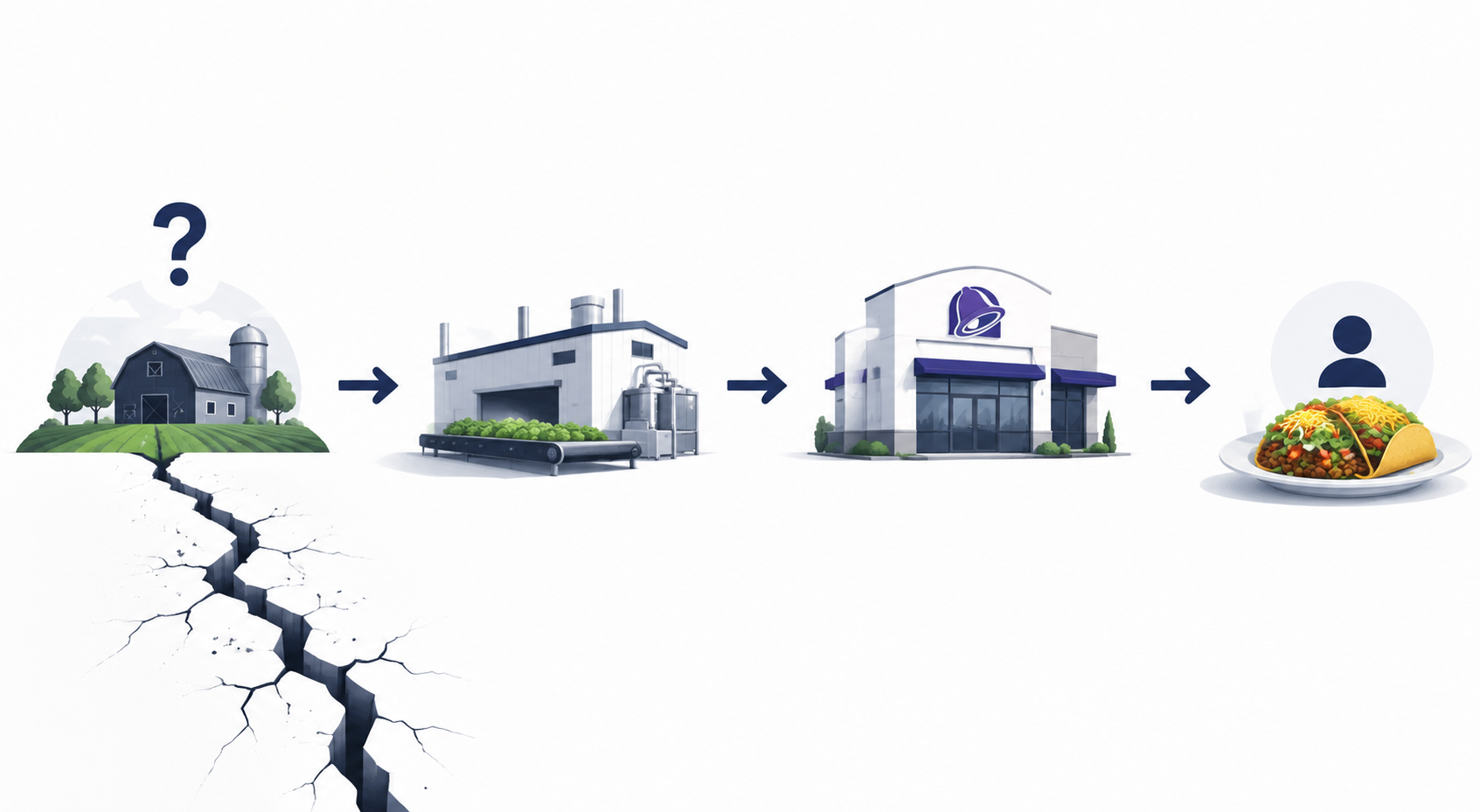
That position does not end the claims against Taylor Farms. A processor or distributor may still face questions about supplier qualification, agricultural-water verification, audit reliance, lot segregation, testing protocols, recall timing, and the adequacy of warnings or communications. But the independent-farm position changes where discovery goes first. Plaintiffs will want grower contracts, purchase orders, field-level records, harvest dates, ranch and lot identifiers, transportation records, commingling evidence, and any communications about prior quality or safety concerns.
It also changes defendant alignment. Taco Bell-related defendants may argue that they reasonably relied on approved suppliers. Taylor Farms may argue that contamination occurred upstream and outside its facility. Upstream growers, including possible foreign farm entities referenced only indirectly in the current public materials, may be harder to join, serve, depose, or collect from. The more persuasive the upstream-contamination theory becomes, the more the case shifts from a brand-and-processor narrative to a supply-chain-responsibility fight.
Settlement leverage will follow that fault line. Plaintiffs prefer a clean chain: implicated product, identified supplier, identified restaurant, documented illness. Defendants prefer gaps: no retained sample, uncertain lot matching, independent growers, franchise-level sales, and multiple entities with partial control. The early complaints preserve those issues rather than resolve them.
Why the Plaintiff Firms Matter
The names on the complaints are not incidental. Marler Clark states that it has recovered more than $900 million in food-safety litigation, and Ron Simon & Associates has announced more than $850 million in recoveries.[10][3] Those figures do not prove liability in this outbreak. They do signal that the early plaintiffs are represented by firms capable of funding expert-heavy causation work, pursuing supplier discovery, and screening a large inventory of potential claimants.
That matters more in Cyclospora litigation than it might in a simpler foreign-object case. The plaintiff-side burden will likely include medical causation experts, epidemiologists, food-safety experts, traceback analysis, and possibly agricultural-practices experts. Small individual damages claims can be difficult to litigate one by one when the proof structure is that expensive. Experienced firms make coordination more plausible because they can absorb the front-end cost before common discovery produces settlement value.
The MDL Question Is Open, Not Answered
The ingredients for MDL consideration are visible: multiple federal filings, overlapping factual allegations, a common outbreak investigation, repeat defendants, and a potentially large claimant pool. The Northern District of Ohio is an obvious venue candidate because the first reported lawsuit was filed there and early Ohio filings are already part of the public inventory.[1][2] That does not mean an MDL has been created, or even that a petition has been filed.
A future petition would likely argue that centralized discovery is needed for CDC and FDA materials, Taylor Farms supply-chain records, Taco Bell corporate and franchise documents, and expert causation issues common to the outbreak. Opponents could argue that individual causation, restaurant location, state-law differences, and franchisee-specific control questions will swamp common issues. Neither position is abstract; both are already embedded in the way the first complaints name defendants and plead theories.
Statute-of-limitations issues add another timing layer. Cyclospora has an incubation period that CDC describes as averaging about 7 days, with a range that can extend up to 14 days.[6] Illness onset, diagnosis, public-health notice, and the plaintiff’s recognition of a potential legal claim may not line up neatly. Counsel screening late-arriving claimants will need more than a positive memory of eating at Taco Bell; they will need dates, symptoms, medical records, and a plausible fit with the outbreak window.
For now, the safest procedural reading is conditional. Early filings by experienced food-safety firms make coordinated litigation plausible. Whether the Taylor Farms Cyclospora outbreak legal claims become an MDL, remain divided across districts, or fracture along supply-chain and franchise-control lines will depend less on the headline outbreak count than on epidemiological causation, product tracing, defendant responsibility, and whether a formal consolidation petition actually materializes.
References
- Taco Bell Hit With Federal Lawsuits Over Cyclosporiasis Infections, Forbes, July 17, 2026
- First Lawsuit in 2026 Multistate Cyclospora Outbreak Filed Against Taco Bell Operator in Ohio Federal Court, Marler Clark
- Ron Simon & Associates Files First Cyclospora Lawsuit Against Taco Bell and Taylor Farms in One of the Largest Food Poisoning Outbreaks in US History, PRNewswire
- Cyclosporiasis Outbreak, July 2026, CDC
- Nearly 7,000 cases suspected, NBC News
- CDC HAN-00531, CDC
- Investigation of 5-State Outbreak of Cyclospora Illnesses: Iceberg Lettuce, July 2026, FDA
- Taylor Fresh Foods Statement Regarding Cyclospora Outbreak, Taylor Farms
- Taylor Farms pulls iceberg lettuce, CBS News
- The Cyclospora Outbreak Now Has Two Names on It: Taylor Farms and Taco Bell. Both Have Been Here Before, and So Have I., Marler Blog
Chronological incident history
No sanction cases have named this tool in the tracked record set to date. This does not imply the tool is safe — see Risk Digest for ongoing monitoring.
← Compare peer toolsReport a correction or tip
Spotted an outdated figure, a misstated fact, or a ruling this tool profile should reflect? Public comments are disabled for this content given the professional cost of a misreported case outcome, penalty amount, or rule text — use the structured correction channel instead.
Report a correction or tip for this record →