
Product Liability in the Taylor Farms Lettuce Recall
The 2026 Cyclospora outbreak linked to Taylor Farms lettuce has triggered lawsuits testing strict liability and chain-of-distribution theories under Ohio law. This article examines the legal framework, the multi-defendant exposure, and the systemic factors—including Taylor Farms' outbreak history and CDC surveillance gaps—that shape the litigation.
- Hallucination rate
- Not measured / undisclosed
The Taylor Farms lettuce recall became a product-liability fight on July 16, 2026, when Ayyad v. Pacific Bells LLC was filed in the Northern District of Ohio. The complaint put a Taco Bell operator into court under the Ohio Product Liability Act, the Ohio Consumer Sales Practices Act, and breach-of-warranty theories after a Cyclospora outbreak tied to iceberg lettuce ingredients.[1] One day later, a second Ohio lawsuit filed in Mahoning County named Taco Bell Corp. and Taylor Farms directly.[2]
That two-day sequence matters because it shows the legal chain forming before the public facts are fully settled. The first case reaches the restaurant operator that sold the food. The second reaches the national restaurant company and the produce supplier. Together, they frame the question plaintiffs will press in Ohio and, likely, elsewhere: when contaminated lettuce moves through a commercial food chain, how much of that chain remains legally exposed even if the contamination began upstream?
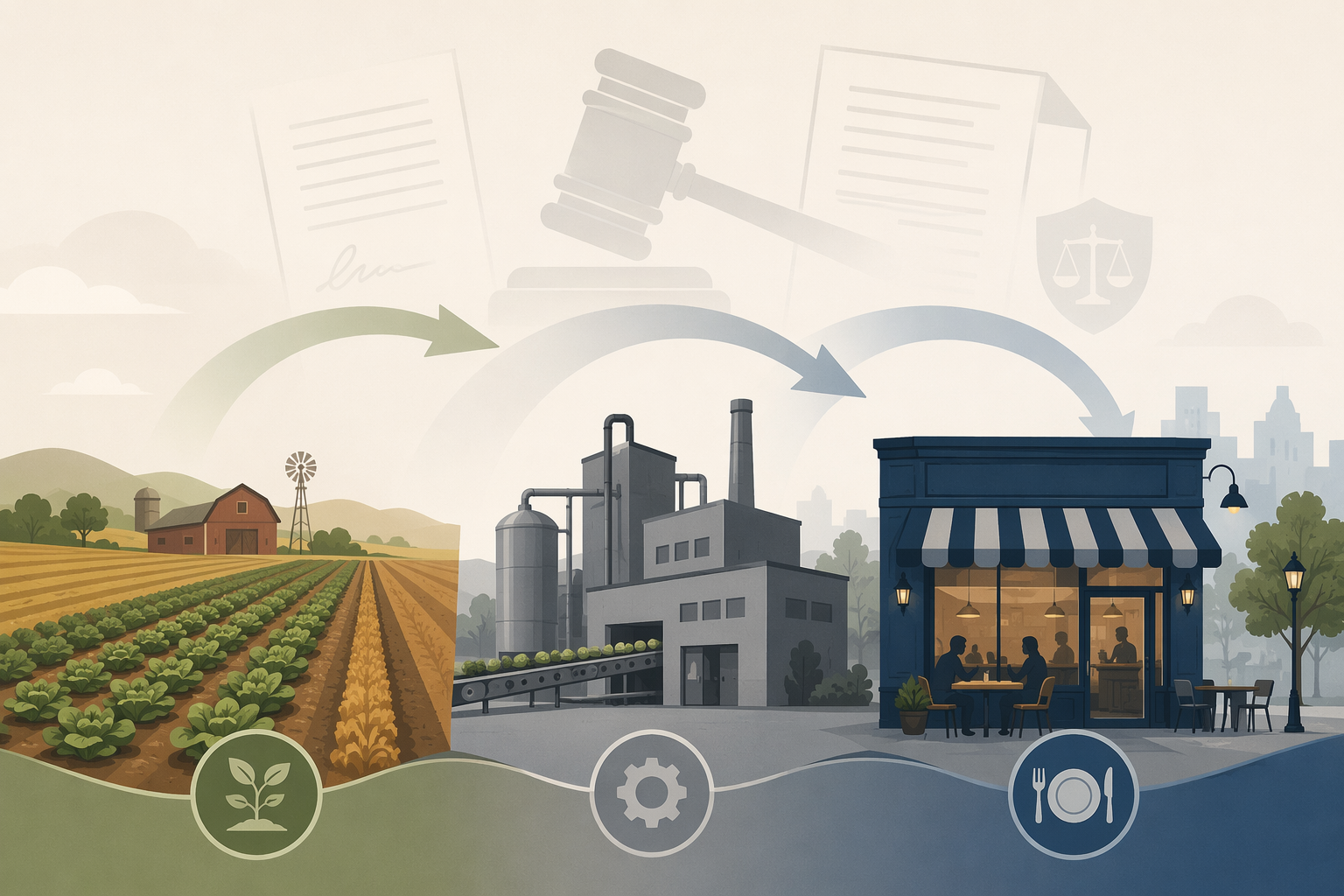
The Lawsuits Start With Sale, Not Just Contamination
A product-liability complaint does not have to begin where the parasite entered the lettuce. It can begin where the consumer bought and ate the finished product. That is why Pacific Bells, a Taco Bell operator, appears in the first complaint even though the public recall chronology points backward to iceberg lettuce from a supplier, not to a restaurant kitchen as the source of contamination.[1]
The FDA’s public investigation materials identify iceberg lettuce in a five-state Cyclospora illness investigation, while news reports have linked the recalled lettuce ingredients to Taylor Farms and central Mexico sourcing.[3][4] That distinction is not cosmetic. Official agency attribution, company statements, and reports citing unnamed sources do different jobs in litigation. A complaint can plead based on available facts; proof has to survive discovery.
Reuters reported that Taylor Farms and Sysco pulled iceberg lettuce from central Mexico tied to the U.S. parasite outbreak.[5] Bloomberg reported that Taylor Farms was recalling iceberg lettuce from a single supplier in central Mexico.[4] Those reports make the first Ohio pleadings easier to understand: plaintiffs are not simply suing the nearest brand name. They are trying to preserve claims against the commercial entities that allegedly placed, prepared, distributed, or sold the product before records, samples, and internal notice histories become harder to reconstruct.
Why Ohio Strict Liability Pulls Multiple Defendants Into the Same Room
The Ohio Product Liability Act framing is the load-bearing legal fact in the first complaint. The cited statutory range, ORC §2307.71 through §2307.80, is built for claims that a product was defective and caused injury, not only for morality plays about who was careless at the point of contamination.[1] In food cases, that difference can decide who stays in the case long enough to exchange documents.
Strict liability is uncomfortable for downstream defendants because it can attach to product status rather than personal fault. A restaurant operator can argue that it did not grow lettuce, irrigate a field, or operate a processing facility. That may matter to comparative fault, indemnity, cross-claims, or settlement allocation. It does not automatically answer whether the restaurant sold a defective food product to the consumer.
Food-safety plaintiff lawyers commonly describe chain-of-distribution liability this way: a manufacturer, distributor, or seller may face strict-liability exposure when it participates in placing a contaminated product into commerce, even without proof that the named defendant personally caused the contamination.[6] The practical result is that Taylor Farms, Taco Bell Corp., and franchise or operator entities can have different factual roles but still occupy the same liability conversation.
| Defendant category | Likely litigation role | Why the distinction matters |
|---|---|---|
| Produce supplier or processor | Alleged source, manufacturer, processor, or distributor of the lettuce ingredient | Discovery will focus on sourcing, sanitation, supplier controls, inspection history, testing, and recall timing |
| Restaurant brand | National system, menu, purchasing, supplier approval, and public-facing brand defendant | Plaintiffs may seek corporate documents on supplier selection, warnings, recall response, and control over affected menu items |
| Restaurant operator or franchisee | Entity that allegedly sold the finished food to the customer | Strict-liability and warranty theories can keep the seller in the case even if contamination was introduced earlier |
That architecture is also why “we did not contaminate it” is not the same as “we cannot be sued.” A downstream defendant may have strong evidence that it followed specifications, relied on approved suppliers, and had no realistic opportunity to detect Cyclospora before sale. Those facts may become important. They are not the same as a jurisdictional escape hatch from the chain of distribution.
Taylor Farms’ Narrowing Arguments Are Real, But Not Dispositive
Taylor Farms has a narrower story to tell than the headline version of the outbreak. Bloomberg reported the company’s position that the implicated independent farm represents less than 1% of U.S. iceberg lettuce supply.[4] NBC News reported Taylor Farms’ statement that no Taylor Farms-branded salads or salad kits contain iceberg lettuce.[7]
Those are defense-relevant facts. They push against the impression that every Taylor Farms product, facility, or branded salad line belongs in the same factual bucket. They also matter for consumer confusion, recall scope, reputational harm, and any attempt to turn one ingredient recall into a broader attack on the company’s entire product portfolio.
But the same facts do not end the product-liability analysis. A small share of national supply can still generate large legal exposure if the product moved through high-volume restaurant distribution. A branded-salad carveout can protect one product category while leaving questions about foodservice ingredients, supplier controls, and restaurant menu items untouched. The litigation will not ask whether all Taylor Farms products were unsafe. It will ask whether the implicated lettuce ingredient was defective, where it moved, what the defendants knew or should have known, and who sold it to sick customers.
The Case Count Problem Is a Litigation Problem Too
The CDC’s July 2026 health advisory reported 1,645 confirmed domestically acquired Cyclospora cases and more than 5,100 additional cases under analysis; Michigan alone reported 5,002 cases in the figures discussed in outbreak coverage.[8][2] The broader estimate circulating in the litigation and reporting context is roughly 7,000 illnesses across 34 states as of July 18, 2026.[2]
Those numbers do not measure the same thing. Confirmed cases are not the same as estimated illnesses. Cases under analysis are not confirmed causation against a defendant. A state count does not by itself prove common exposure to one restaurant chain, one supplier, or one farm. For claims teams, that is not a footnote. It affects plaintiff identification, medical-record review, exposure questionnaires, damages modeling, and the pressure to settle before the class of claimants is cleanly defined.
The reporting system itself adds another layer. Snopes, citing the outbreak reporting context, noted that CDC made Cyclospora reporting optional under FoodNet in July 2025, and other reports have emphasized that the illness is nationally notifiable in only 47 states.[9][2] That does not prove undercounting in any particular plaintiff’s file. It does mean the confirmed number may be a poor proxy for the eventual legal universe.
Repeat-Outbreak Evidence Changes the Temperature of the Case
The harder question for Taylor Farms is not simply whether this lettuce was contaminated. It is whether plaintiffs can use prior outbreak associations and inspection findings to argue that the company had repeated notice of food-safety risks and failed to respond adequately. Marler Blog identifies five prior Taylor Farms outbreak associations since 2013, including a 2013 Cyclospora outbreak, a 2015 E. coli outbreak at Costco, a 2018 romaine E. coli class action, and the 2024 E. coli O157:H7 outbreak linked to McDonald’s that sickened 104 people and caused one death.[2]
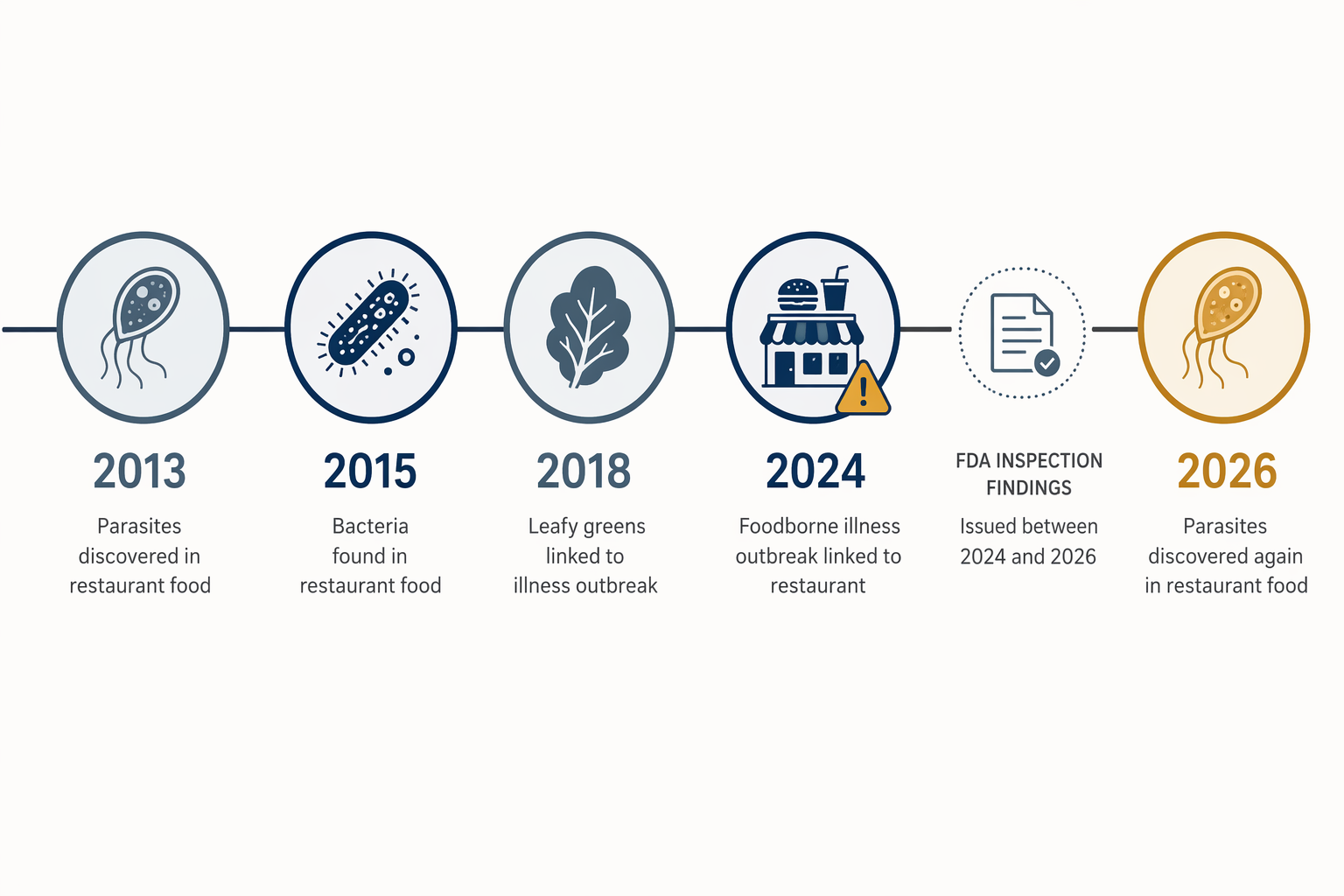
Prior outbreaks are not automatic proof of defect in the 2026 lettuce. Courts can limit evidence that is too remote, too dissimilar, or too prejudicial. But plaintiffs do not need that history to do every job. They may use it to press notice, reasonable-care, corporate-practice, and punitive-damages arguments, especially if discovery shows recurring problems in supplier oversight, sanitation controls, or response time.
The November 2024 FDA inspection findings at Taylor Farms’ Colorado facility may become part of that argument. Marler Blog reports that the inspection documented poor handwashing and dirty equipment.[2] That is not the same as proving the 2026 Cyclospora outbreak came from that facility, and the current public recall materials point to iceberg lettuce from central Mexico rather than Colorado.[3][4] The legal significance is narrower but still serious: inspection findings can shape the dispute over whether food-safety failures were isolated, unforeseeable, or part of a pattern defendants had reason to address.
For readers tracking this angle specifically, the related analysis on how Taylor Farms’ outbreak history strengthens the Cyclospora lawsuits goes deeper into the repeat-defendant record. In this product-liability frame, the point is more limited: the prior record may make it harder for a defendant to present the 2026 event as a one-off supply-chain accident with no bearing on corporate notice or deterrence.
Taco Bell’s Exposure Is Different From Taylor Farms’ Exposure
Taco Bell and Taylor Farms will not defend the same case in the same way. Taylor Farms’ position will likely turn on sourcing, supplier status, processing, testing, recall timing, inspection history, and whether the implicated lettuce can be traced to particular lots or customers. Taco Bell’s position will turn more heavily on purchasing systems, supplier approval, operator relationships, menu-item assembly, customer sale records, and what the brand or operator knew once the outbreak signal emerged.
Taco Bell also has its own outbreak history, including a 2006 E. coli outbreak that sickened 71 people and a 2010-2011 Salmonella outbreak.[2] That history is less central here than Taylor Farms’ documented repeat-supplier role because the current theory is built around lettuce ingredients and the supply chain carrying them into restaurants. Still, it gives plaintiffs an obvious reason to ask what the restaurant system learned from earlier foodborne-illness events and how those lessons affected supplier controls.
This is where food product liability starts to look familiar to lawyers who track other product categories. The same basic discipline used in automotive recall cases—identify the defect theory, map the distribution chain, separate notice from causation, and test each defendant’s control—also applies when the product is a lettuce ingredient rather than a vehicle component. The difference is that food evidence spoils, customers may not keep receipts, and exposure can turn on a meal assembled from multiple ingredients on a busy day.
What Will Still Matter After the Recall Cycle
As of July 18, 2026, the outbreak and litigation record are still developing. The FDA’s public page should not be treated as identical to news reports attributing the supplier to Taylor Farms de Mexico, and neither should be treated as a final judicial finding.[3][4] The first complaints are pleadings, not verdicts. Ohio law is the immediate frame because the first suits were filed there; other states may apply different product-liability rules.
The durable issues are already visible. Plaintiffs will try to keep the chain intact: supplier, processor, restaurant brand, and operator. Defendants will try to narrow it: one farm, one ingredient, one product category, one point of actual control. The confirmed-versus-estimated case gap will shape damages and settlement pressure. The prior-outbreak and inspection-history record will decide how far the case moves beyond compensatory recall litigation and into arguments about notice, deterrence, and punitive damages.
That is the legal significance of the Taylor Farms lettuce recall product liability litigation. It tests whether contaminated lettuce liability can travel through the food chain under Ohio strict-liability theories, and whether a repeat-risk record changes the defense from “we did not contaminate it” to the harder question of who had enough control, notice, and commercial benefit to bear responsibility.
References
- First lawsuit filed in multistate Cyclospora outbreak, Bluebook Services
- The Cyclospora Outbreak Now Has Two Names on It — Taylor Farms and Taco Bell. Both Have Been Here Before and So Have I, Marler Blog
- Investigation of 5-State Outbreak of Cyclospora Illnesses: Iceberg Lettuce (July 2026), FDA
- Taylor Farms to Recall Lettuce Ingredients Linked to Cyclospora Outbreak, Bloomberg
- Taylor Farms, Sysco pull iceberg lettuce from central Mexico linked to US parasite outbreak, Reuters
- Strict Liability and Negligence and when they apply and chain of distribution liability, Marler Clark
- Taylor Farms recalls iceberg lettuce amid cyclosporiasis outbreak, NBC News
- Domestically Acquired Cyclosporiasis Cases in Multiple U.S. States, 2026, CDC HAN-00531
- Is Taylor Farms produce source of cyclosporiasis outbreak? What we know, Snopes
Chronological incident history
No sanction cases have named this tool in the tracked record set to date. This does not imply the tool is safe — see Risk Digest for ongoing monitoring.
← Compare peer toolsReport a correction or tip
Spotted an outdated figure, a misstated fact, or a ruling this tool profile should reflect? Public comments are disabled for this content given the professional cost of a misreported case outcome, penalty amount, or rule text — use the structured correction channel instead.
Report a correction or tip for this record →