
The short legal answer is yes: Taylor Fresh Foods’ reported $1 million corporate treasury payment to MAGA Inc. was legal under federal campaign finance law because MAGA Inc. is an independent-expenditure-only committee, commonly called a super PAC, rather than Donald Trump’s candidate committee. WIRED reported that Taylor Fresh Foods made the $1 million donation on March 26, 2025, and Snopes separately treated the same payment as a corporate donation to a super PAC, not as a direct contribution to Trump’s campaign.[1][2]
That distinction is doing almost all of the work. Federal law still bars corporations from contributing directly to federal candidates. But after Citizens United and SpeechNow.org, corporations may spend corporate treasury money on independent political advocacy and may give unlimited amounts to committees that make only independent expenditures. MAGA Inc.’s FEC committee page identifies it as committee ID C00892471 and places it in the federal filing system as a committee separate from a candidate campaign.[3]
The confusion is understandable because the word “donation” hides the recipient. A corporate donation to a candidate committee is one thing. A corporate donation to a super PAC is another. The same dollar amount, same election, same political beneficiary, and same corporate source can produce different legal answers depending on which legal entity received the money and what that entity is allowed to do with it.
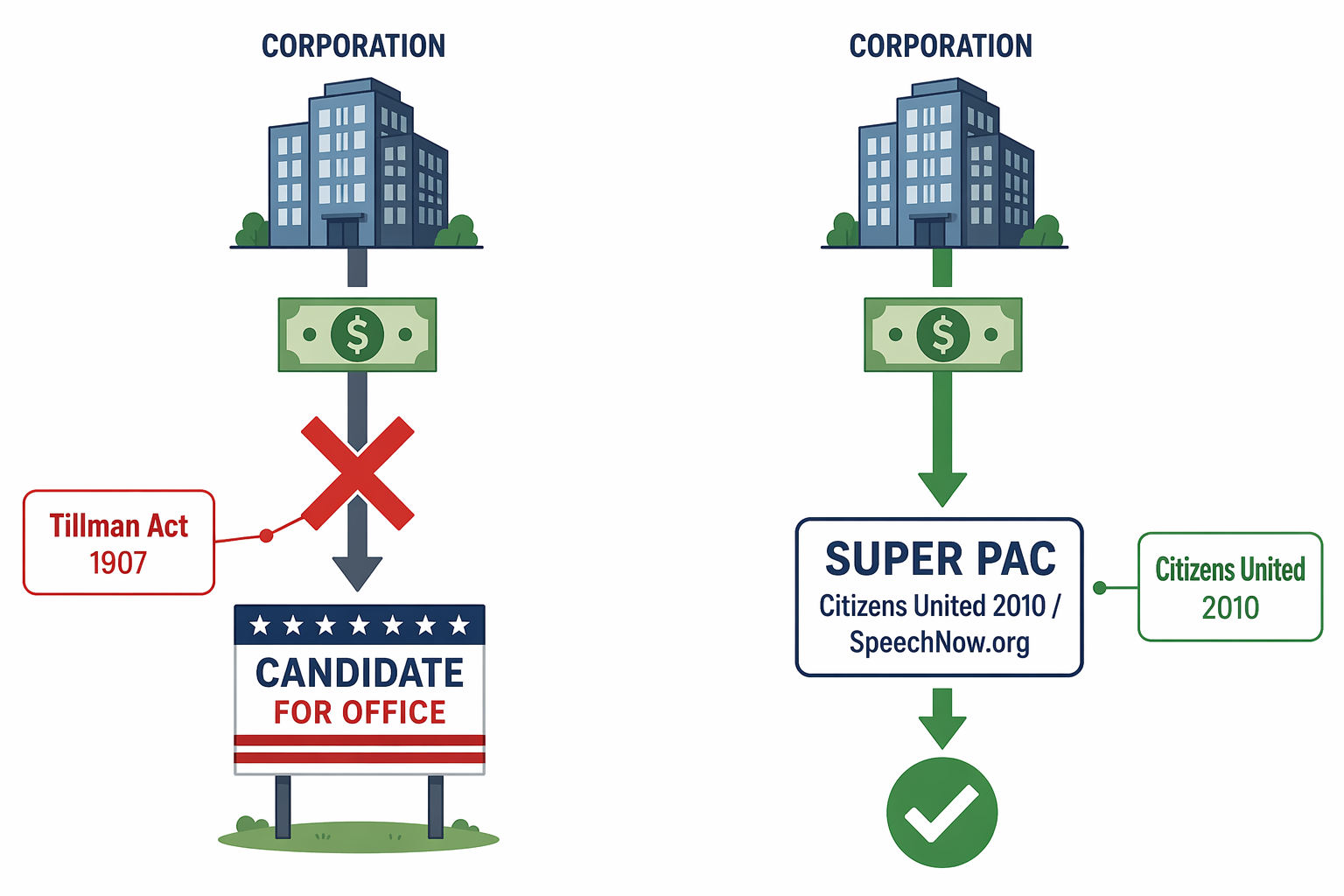
The Ban Still Exists, But It Does Not Reach This Recipient
The Tillman Act is not a dead letter. Its modern federal form, 52 U.S.C. § 30118, still bars corporations and labor organizations from making contributions directly to federal candidates. That is the rule people usually mean when they say corporations cannot donate to federal candidates.
But a super PAC is not a candidate committee. An independent-expenditure-only committee may raise unlimited funds, including from corporations, so long as it does not contribute to candidates and does not coordinate its spending with a candidate campaign in a way that would convert the activity into a regulated contribution. The legal theory is that independent spending does not create the same quid pro quo corruption risk as money placed directly under a candidate’s control.
Citizens United v. FEC supplied the constitutional premise in 2010 by holding that corporations have a First Amendment right to make independent expenditures. SpeechNow.org v. FEC, decided by the D.C. Circuit the same year, applied that logic to contributions made to committees that engage only in independent expenditures. If the recipient committee may not give money to candidates and may spend only independently, then limits on contributions to that committee were treated as constitutionally unjustified.
That is why the Taylor Farms donation to MAGA Inc. does not violate the corporate candidate-contribution ban on the facts presently reported. The money reportedly went from a corporation to a super PAC. It did not go from the corporation to Trump’s authorized campaign committee. The public controversy may be about Trump, but the campaign finance law question starts with the payee.
| Money path | General federal campaign finance treatment |
|---|---|
| Corporation to federal candidate committee | Prohibited under the corporate contribution ban |
| Corporate PAC to federal candidate committee | Permitted within contribution limits, using regulated PAC funds rather than corporate treasury funds |
| Corporation to independent-expenditure-only super PAC | Permitted in unlimited amounts, if the committee remains independent |
| Individual to federal candidate committee | Permitted within individual contribution limits |
Why Citizens United Did Not Erase the Tillman Act
A sloppy version of this story says Citizens United made corporate political money legal, full stop. That is too broad. Citizens United protected independent expenditures. It did not hold that corporations have a constitutional right to write checks directly to federal candidates.
The corporate contribution ban has survived a substantial amount of post-Citizens United litigation. The Chicago Business Law Review’s account of the doctrine notes that six federal circuits have continued to uphold the ban after Citizens United, and that the Supreme Court has denied certiorari in at least six cases challenging it.[4]
That does not mean the doctrine is perfectly tidy. The same article describes unresolved tension between the protection of corporate independent spending and the continued acceptance of limits on corporate contributions. Still, as of 2026, the operational rule remains clear enough for compliance purposes: corporate money may not go directly to federal candidates, but it may go to a super PAC that makes independent expenditures.[4]
So when the Taylor Farms question is framed as “How can this be legal if the Tillman Act bans corporate donations?” the answer is not that the Tillman Act vanished. The answer is that the Tillman Act’s candidate-contribution ban and the super PAC funding rule apply to different legal routes.
MAGA Inc. Is the Legally Important Recipient
MAGA Inc. is politically associated with Trump, but association is not the same as legal identity. The FEC committee page for MAGA Inc. is the relevant starting point because it identifies the committee and its filings. The page lists MAGA Inc. under committee ID C00892471 and reports $397.7 million raised and $400.6 million cash on hand as of June 30, 2026.[3]
The specific $1 million Taylor Fresh Foods entry was not independently reproduced from a raw filing in the materials available here. The figure and March 26, 2025 date are instead reported by WIRED and corroborated in Snopes’ treatment of the claim.[1][2] That is enough to analyze the legal structure, but it is worth being precise about the source chain: the committee’s existence and filing context are anchored in FEC data; the particular payment amount and date are being taken from reporting that cites or describes the filing.
If the same $1 million had been wired to Trump’s authorized campaign committee from Taylor Fresh Foods’ corporate treasury, the legal analysis would be very different. But that is not the reported transaction. The reported transaction was corporate treasury money to MAGA Inc., a super PAC.
Bruce Taylor’s Personal Donations Are a Separate Category
Snopes also reported that Bruce Taylor personally made maximum candidate donations of $3,500 per election.[2] That number matters because individual candidate contributions operate under a different rulebook from corporate super PAC contributions.
For the 2025-2026 cycle, the FEC lists the individual contribution limit to a federal candidate as $3,500 per election.[5] A primary and a general election are separate elections for this purpose. A lawful personal maximum contribution does not make a corporate contribution lawful, and a lawful corporate super PAC donation does not expand an individual’s candidate limit. They are separate channels with separate limits.
This is one reason viral shorthand tends to mislead. “Taylor gave to Trump” might be politically intelligible in casual speech, but it collapses at least three legally different possibilities: Bruce Taylor as an individual giving to a candidate, a corporate PAC giving regulated funds to a candidate, and Taylor Fresh Foods giving corporate treasury money to a super PAC.
What the Outbreak and Access Reporting Adds—and What It Does Not
The reason this campaign finance question resurfaced in 2026 is not just the legal oddity. It is the surrounding Taylor Farms reporting. WIRED linked the MAGA Inc. donation to broader reporting about Taylor Farms, anti-regulatory lobbying, and a cyclospora outbreak timeline.[1] Snopes separately examined claims that Taylor Farms executives met with White House and FDA officials, treating the meeting claim as supported by secondary confirmations while separating it from broader viral allegations.[2]
Those surrounding facts explain why people are asking whether the donation was legal. They do not, by themselves, prove that the donation violated campaign finance law. Campaign finance legality turns first on the statutory category of the spender, the recipient, the amount, the timing, the reporting, and any coordination evidence. A public health controversy can sharpen scrutiny, but it is not a substitute for those elements.
The outbreak numbers also need careful handling. The research materials note that the CDC reported 1,645 confirmed cyclospora cases as of July 20, 2026, while Michigan alone reported 6,148 cases by the same date, with the CDC figure described as a significant undercount. Those figures may be important to the public health story, but they do not change the campaign finance answer unless connected to a separate legal theory supported by evidence.
The same caution applies to access allegations. A meeting with officials, a lobbying program, and a super PAC donation may be politically salient in the same news cycle. They are not automatically the same legal claim. If the allegation is illegal coordination, bribery, false reporting, or some other violation, it needs its own facts and its own legal test.
The Donation Totals Are Not All Measuring the Same Thing
There is also a numbers problem in the public discussion. WIRED reported more than $2 million in Taylor Farms-related donations in 2025.[1] Other reporting summarized in the research materials refers to more than $3.8 million this decade, while Snopes itemizes specific PAC donations rather than presenting the same aggregate in the same way.[2]
Those figures should not be forced into a single total without matching the definitions. A total may include corporate treasury donations to super PACs, individual donations, affiliated-entity donations, donations across different years, or donations to different kinds of committees. For the narrow question in the title, the legally decisive reported payment is the March 26, 2025 $1 million corporate donation to MAGA Inc.[1][2]
The Broader Deregulatory Trend Is Real, But It Is Not the Rule Here
Campaign finance doctrine has continued to move in a deregulatory direction in important respects. On June 30, 2026, the Supreme Court decided NRSC v. FEC, a case SCOTUSblog described as striking down a campaign finance law.[6] That decision belongs in the background because it reflects the Court’s current posture toward some campaign finance restrictions.
But NRSC v. FEC does not appear to be the reason Taylor Fresh Foods could give $1 million to MAGA Inc. in March 2025. The legal pathway for that transaction was already built by Citizens United and SpeechNow.org. Treating the 2026 ruling as the cause would scramble the chronology and the doctrine.
There is also a separate disclosure debate. Campaign Legal Center’s 2026 discussion of Citizens United emphasizes that the decision continues to shape political spending and that dark-money nonprofits can obscure the original source of funds in some political spending structures.[7] That is an important concern, but it is not the same as the Taylor Fresh Foods payment as reported here, which is being discussed precisely because it appeared in the super PAC disclosure ecosystem.
Other examples of large corporate or industry-linked donations to MAGA Inc. have been reported alongside later favorable regulatory developments, including entries summarized on the Make America Great Again Inc. page involving Reynolds American, nursing home industry donors, and Extremity Care.[8] Those examples may support a broader inquiry into influence and access. They do not create a general rule that a disclosed corporate super PAC donation is illegal.
The Narrow Answer
On the available facts, Taylor Fresh Foods’ reported $1 million donation to MAGA Inc. was lawful under federal campaign finance law because it went to an independent-expenditure-only super PAC, not to a federal candidate committee. The Tillman Act’s corporate contribution ban remains valid law for direct corporate contributions to candidates, but it does not prohibit unlimited corporate donations to super PACs operating within the independent-expenditure framework.
That answer settles less than some defenders may want and more than some critics may imply. It does not resolve whether the public should be comfortable with corporate treasury money flowing into presidential super PACs. It does not answer questions about lobbying, food-safety oversight, regulatory access, or the coherence of a doctrine that preserves the old corporate candidate-contribution ban while allowing unlimited corporate spending through a formally independent vehicle. It answers the campaign finance law question presented by the reported transaction.
References
- Diarrhea Outbreak Taylor Farms MAGA Donations Lobbying, WIRED.
- Taylor Farms Trump Donations Meeting, Snopes, July 21, 2026.
- MAGA Inc. committee overview, Federal Election Commission.
- The Surprising Survival (So Far) of the Corporate Contribution Ban, Chicago Business Law Review.
- Contribution limits for 2025-2026, Federal Election Commission.
- Justices strike down campaign finance law, SCOTUSblog, June 30, 2026.
- How Does the Citizens United Decision Still Affect Us in 2026?, Campaign Legal Center.
- Make America Great Again Inc., Wikipedia.
Comments
Join the discussion with an anonymous comment.