
The most legally interesting reported term in the Taylor Swift wedding NDA is the one that apparently was not there. TMZ reported that guests at the Swift-Kelce celebration were asked to sign a confidentiality agreement with no stated monetary penalty and no explicit punishment attached to a violation.[1] That sounds, at first pass, like a soft NDA. It may instead be the cleaner design choice.
The caution comes first. The actual NDA has not been released publicly. The key accounts rely on unnamed sources. As of July 20, 2026, no public enforcement action over the reported agreement has been reported. Even the question of whether close friends and family were exempt is disputed. So the useful analysis is not a verdict on a document no one outside the transaction has seen; it is an analysis of the contract architecture the reporting describes.
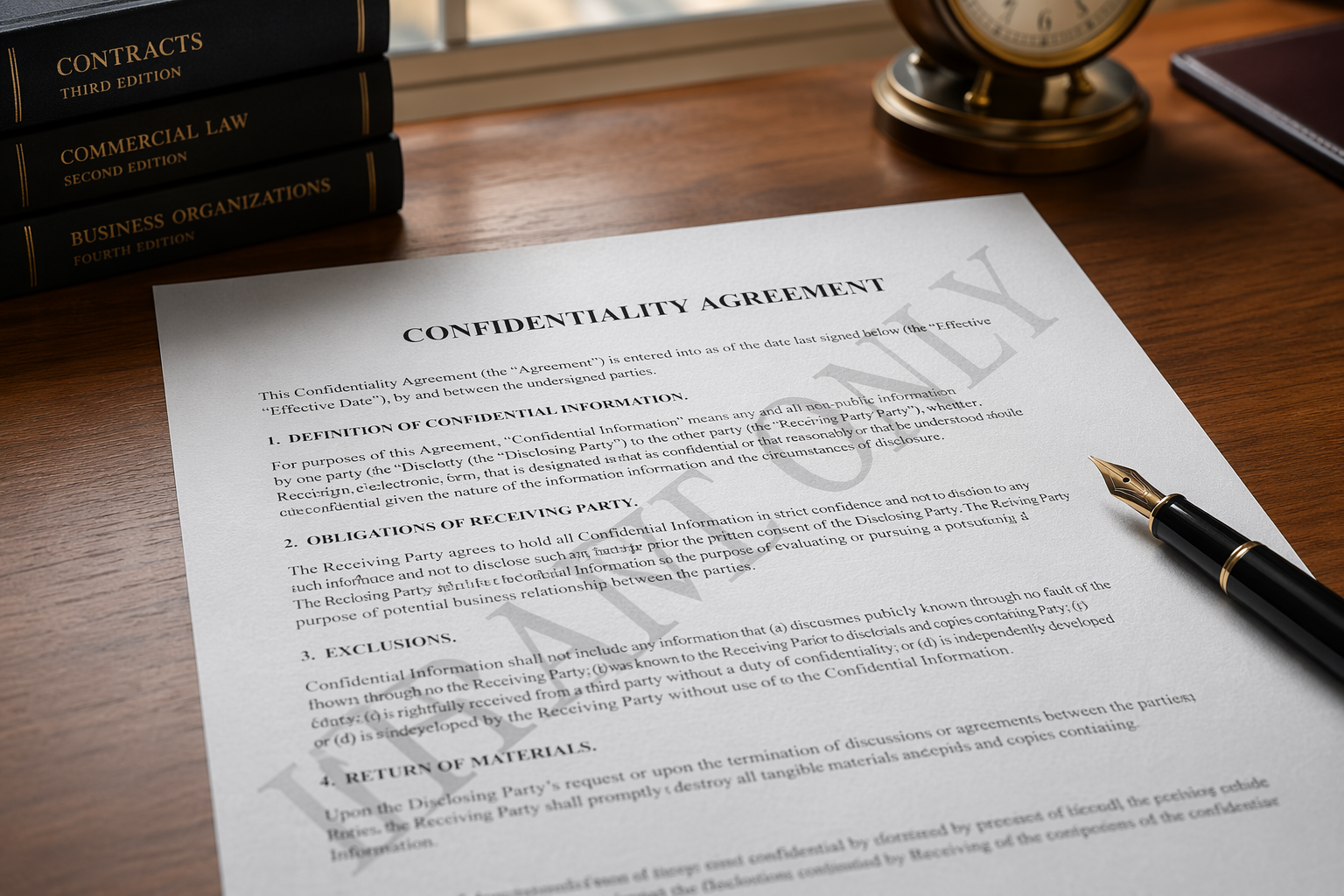
That architecture matters because a guest NDA without a fixed damages number is not automatically toothless. An unnamed legal expert quoted by AOL/Mirror made the basic point: “the absence of a fixed penalty does not give a guest permission to ignore the agreement.” The same report identified breach-of-contract claims and, more practically, injunctive relief or removal demands as available responses if confidential material is disclosed.[2] The anonymity of that expert limits how much weight the comment should carry, but the legal point is not exotic.
No Liquidated Damages Does Not Mean No Remedy
A liquidated damages clause is attractive in a celebrity NDA because it appears to solve the proof problem in advance. If a guest posts a photo, the contract says the guest owes a set amount. The number does the work. It also creates the litigation problem.
For a private wedding leak, probable damages are difficult to estimate honestly at the signing stage. One disclosure might be a blurry table photo seen by a few hundred people. Another might be a clean video of vows, décor, seating, security, or guests, pushed into a media market where exclusivity has value. A number high enough to deter the second case may look punitive in the first. A number modest enough to survive scrutiny may not deter much at all.
That is why omission can be strategic. Instead of defending a speculative penalty, the drafter preserves ordinary contract remedies and focuses on stopping publication, identifying the source, and creating a record. If the first call after a leak is to a platform, a publisher, or opposing counsel, a court-ready damages figure may be less useful than a clear obligation, proof of assent, and evidence tying the leaked item to a particular guest.
The reported agreement also did not include a film release, according to TMZ and Fox 5 NY.[1][4] That detail narrows the apparent purpose. This was not, on the available reporting, a mass rights-clearance instrument for a wedding documentary or streaming special. It reads more like an event-confidentiality tool: do not disclose, do not publish, and do not make the private event searchable by outsiders.
The Watermark Is the Enforcement Clause You Can See
The stronger reported design feature is not the missing money term. It is the invitation system. TMZ reported that each invitation was individually watermarked with the guest’s first and last name, and Fox 5 NY described the same basic security approach.[3][4] That changes the practical posture of the NDA.
A confidentiality agreement tells guests what they cannot do. A personalized watermark tells them that a breach may be attributable. The second piece supports the first by changing the expected sequence after a leak. Instead of beginning with broad suspicion across a large guest list, the enforcement team can compare the leaked image, invitation, or derivative content against individualized markers. The point is not that attribution becomes automatic in every case. Screenshots can be cropped, photos can be re-photographed, files can be forwarded, and watermarks can be obscured. The point is that the evidentiary inquiry starts somewhere.
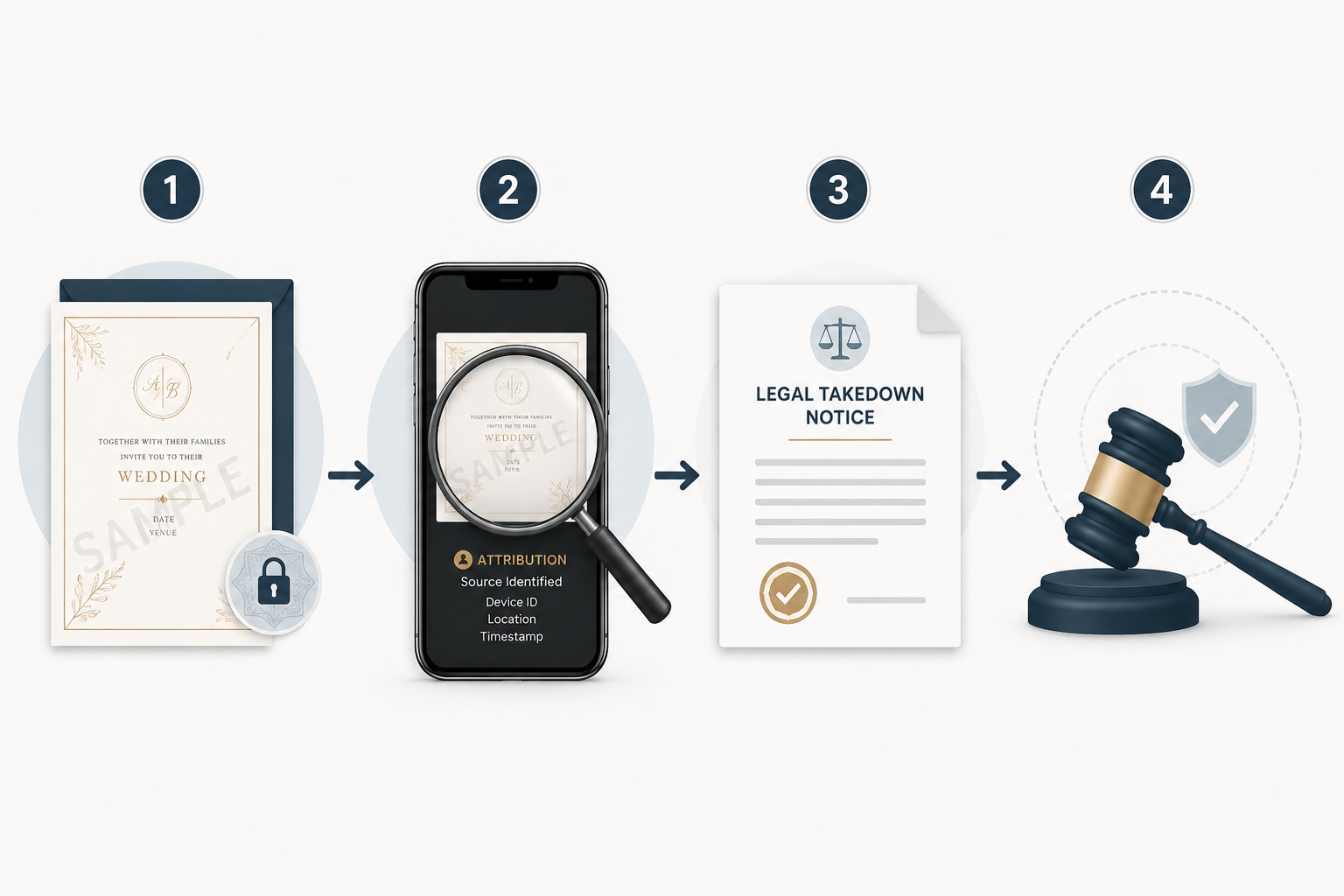
In a fast-moving leak, that starting point can be more valuable than a large contractual number. A crisis team needs to preserve the original post, capture metadata where available, send takedown or cease-and-desist notices, notify platforms, and decide whether to seek emergency relief. If the leaked item carries a traceable marker, the team can make a more concrete representation about source and breach. That improves the odds that a recipient treats the demand as more than a celebrity publicist’s objection.
It also creates social deterrence before anything happens. A guest who knows their invitation is personalized does not have to understand the remedial distinction between damages and injunctions. They only need to understand that leaking may point back to them. For a high-profile private event, embarrassment, exclusion, and reputational consequences may deter behavior as effectively as a clause few guests expect to litigate.
Scale Explains the System, but Does Not Prove the Terms
The reported scale makes the operational design easier to understand. TMZ described an NDA covering roughly 1,100 to 1,200 guests at Madison Square Garden on July 3, 2026, after a smaller ceremony of about 100 people on July 2; InStyle also reported the large-event and smaller-ceremony structure.[1][5] With that many invitees, confidentiality cannot rely only on personal trust or a reminder from staff at the door.
A mass guest agreement has to coordinate behavior among people who may have very different relationships to the couple: family, close friends, professional contacts, performers, staff-adjacent attendees, plus-ones, and people whose main legal education on NDAs may be a signature line on an iPad. In that setting, the paper obligation and the watermark do different jobs. The NDA establishes the rule. The watermark makes the rule administrable.
| Reported Design Choice | Practical Legal Function |
|---|---|
| No stated monetary penalty | Avoids making the agreement depend on a speculative fixed damages number |
| Individualized watermarked invitations | Supports attribution, preservation, takedown demands, and deterrence |
| No film release | Suggests the instrument was aimed at confidentiality rather than production rights clearance |
| Disputed inner-circle treatment | Changes the social logic of the agreement, but cannot be resolved from current reporting |
The Inner-Circle Exemption Is More Than a Gossip Detail
Page Six reported that certain close friends and family were not asked to sign NDAs.[6] A competing InTouch/Naughty But Nice account cited via Yahoo reportedly claimed there were “absolutely no exceptions,” including family. Both accounts rest on anonymous insiders. The conflict should not be smoothed over, because it affects how the agreement should be understood.
If the closest circle was exempt, the NDA looks more like perimeter control: the people presumed to have the strongest personal loyalty are outside the formal paper system, while the wider event population is brought under a uniform rule. If there were no exceptions, the agreement looks more like risk management across the entire room: no one is trusted so completely that they sit outside the process.
Neither version would be inherently surprising. Selective exemptions may reduce relational friction with family and close friends. Universal execution may reduce ambiguity and make enforcement cleaner. But without the agreement, the invitation process, and a reliable account of who signed what, the point remains a caveat rather than a conclusion.
New York and California Are Frames, Not Answers
Because the reported event was at Madison Square Garden, New York principles are an obvious reference point. New York NDAs are generally discussed in terms of a legitimate protectable interest and reasonable limits on scope and duration; open-ended confidentiality obligations can create enforceability problems.[7] That does not answer whether this particular guest agreement would be enforced. It identifies the questions a court or negotiating lawyer would ask after seeing the actual text.
California is also part of the practical frame because of the parties’ public ties to the state and the entertainment-industry context. California NDA guidance emphasizes purpose, specific identification of confidential information, a defined time period, and stated remedies; overly broad agreements are vulnerable.[8] Employment and settlement-specific restrictions, including California Civil Code section 1668 and the Silenced No More Act, are not the natural center of gravity for a private wedding guest NDA. Their relevance here would be indirect and fact-dependent, not a shortcut to invalidity.
The more immediate drafting question is scope. A tight agreement might cover nonpublic wedding details, photos, videos, security arrangements, guest identities, seating, vows, décor, and private conversations learned by attending. A sloppy one might purport to bar almost any future discussion of the couple or the event without time limits or subject-matter boundaries. The first version is easier to defend as protection of a private event. The second invites the usual overbreadth objections.
Celebrity Wedding Information Can Have Value
The privacy interest is obvious, but the commercial interest should not be dismissed. Douglas v. Hello! Ltd, the litigation over unauthorized publication of Michael Douglas and Catherine Zeta-Jones wedding photographs, is a useful analogy because it treated celebrity wedding information as capable of commercial protection.[9] It is not binding U.S. authority, and it should not be made to do more work than it can do. Still, it helps explain why a wedding NDA is not merely etiquette written in legal form.
For public figures, the value of wedding information may sit in several places at once: privacy, security, exclusive media control, brand management, and the ability to decide whether any images become public at all. A guest leak can injure interests that are hard to price but real enough to protect. That is precisely why injunctive relief may be the more sensible remedy to emphasize. The goal is to stop dissemination while the information still has confidentiality value, not to spend months converting a viral post into a damages model.
The Reported NDA Is Built for the First 48 Hours
The design described in the reporting is best understood from the perspective of the enforcement team after something goes wrong. A photo appears. Someone captures it before deletion. The watermark or other identifier is checked. The guest list is searched. A demand goes to the poster, the platform, a publisher, or all three. Counsel decides whether the facts justify a temporary restraining order or other emergency relief. Every hour matters because confidentiality, once lost at scale, is rarely restored by a later damages award.
A fixed penalty clause does not necessarily help with that sequence. It may frighten guests in advance, but after publication it still leaves counsel proving breach, confronting enforceability objections, and deciding whether the publicity of litigation is worse than the leak. Traceability helps earlier. It narrows the source inquiry, strengthens the factual basis for a demand, and gives the recipient a reason to act quickly.
That does not make the arrangement fail-safe. A watermark may identify the invitation used to access or leak material, not necessarily the human being who made the final disclosure. A guest can share with someone else. A cropped image can lose identifying marks. A court may still ask whether the NDA was reasonably scoped, supported by assent, and tied to a legitimate confidentiality interest. The reported system improves enforcement posture; it does not eliminate proof.
On the present record, that is as far as the analysis should go. The reported Taylor Swift wedding NDA legal terms suggest a modern confidentiality design optimized for deterrence, attribution, and fast equitable response rather than a punitive damages threat. Whether the actual agreement would survive a real challenge depends on the text, the governing law, the signing process, the leaked material, and the remedy sought.
References
- Taylor Swift & Travis Kelce Wedding Celebration NDA Details, TMZ, June 30, 2026
- Legal expert says Taylor Swift, AOL, July 19, 2026
- Taylor Swift & Travis Kelce Wedding Celebration Invitation Details, TMZ, June 29, 2026
- Taylor Swift, Travis Kelce rumored wedding security: NDAs, watermarked invitations, Fox 5 NY, June 30, 2026
- Taylor Swift and Travis Kelce’s Wedding Guests Reportedly Had to Sign NDAs—But There’s a Catch, InStyle, June 30, 2026
- Why Taylor Swift is letting certain guests off the hook with NDAs for MSG wedding, Page Six, July 1, 2026
- NDAs: What Employees in New York Need to Know, Bell Law Group
- Are Non-Disclosure Agreements Enforceable in California?, Wood Litigation, APC, 2020
- A wedding, pictures, and two legal systems: Douglas v Hello!, Entertainment & Sports Law Journal, 2006
Comments
Join the discussion with an anonymous comment.