
Telemundo’s new UEFA package is easy to describe as a broadcast change and harder to treat as a routine assignment of rights. The deal gives Telemundo exclusive U.S. Spanish-language rights to all UEFA men’s club competitions, including the Champions League, Europa League, Conference League, and Super Cup, from the 2027-28 season through 2032-33, with distribution across Telemundo, Universo, Peacock, and Telemundo Deportes Ahora.[1]
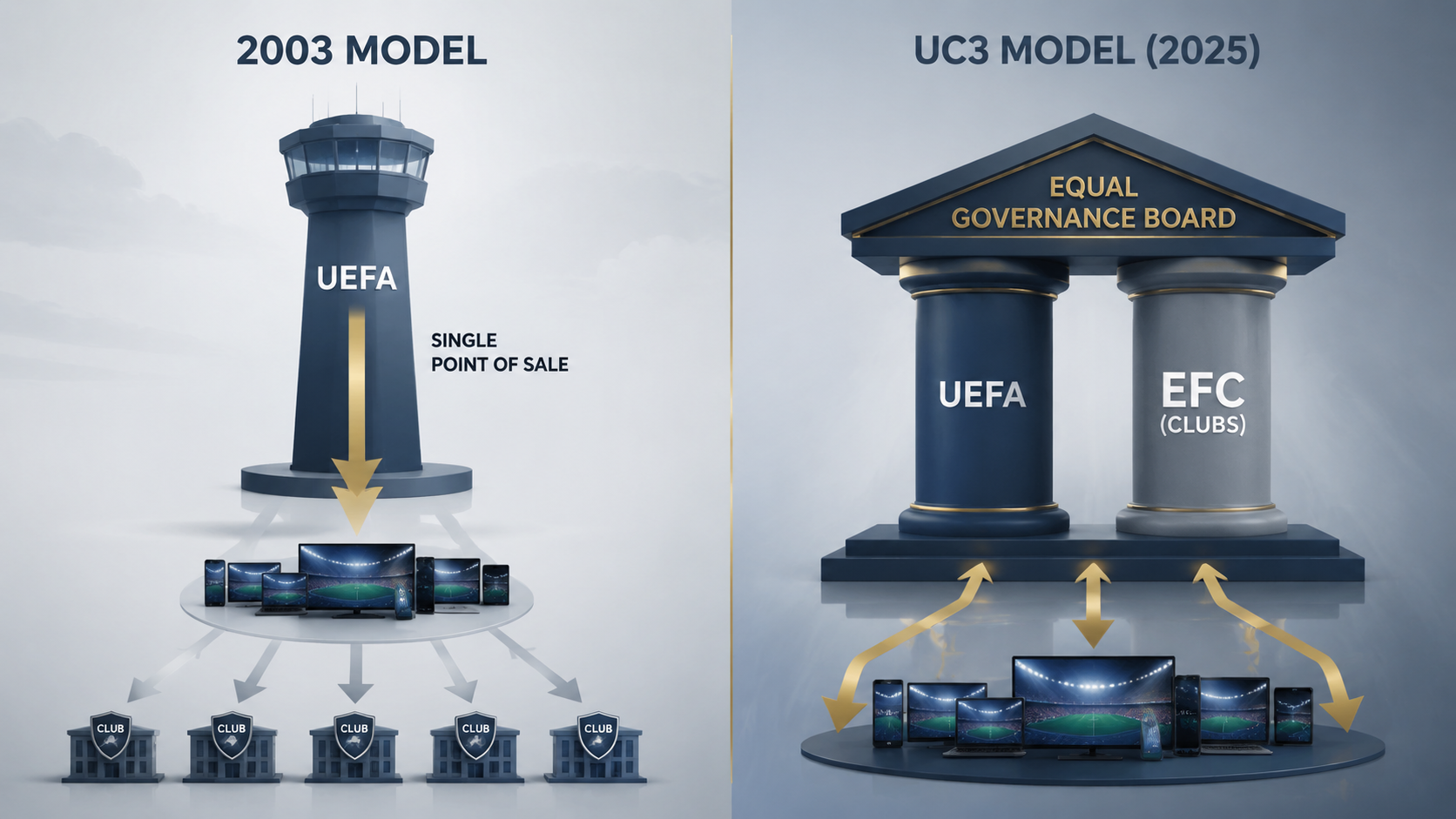
That makes the transaction a useful first stress test for a less visible change upstream. The rights are no longer being commercialized through the same practical architecture that existed when the European Commission accepted UEFA’s collective selling model in 2003. Since January 1, 2025, UEFA Club Competitions SA, or UC3, has sat at the center of that architecture, with equal board representation from UEFA and the European Football Clubs, offices in Nyon, and joint managing directors Guy-Laurent Epstein and Charlie Marshall.[2]
The legal analysis therefore cannot stop at whether Telemundo bought a valuable package for a growing audience. The more consequential question is whether the selling vehicle remains close enough to the model the Commission examined in Decision 2003/778/EC, or whether UC3’s shared UEFA-club governance alters the Article 101 TFEU analysis.
The 2003 Decision Was Not a Blank Check for Collective Selling
The 2003 Commission decision is often reduced to a convenient shorthand: UEFA joint selling was exempted. That shorthand loses the legal content. The Commission accepted a particular system for selling UEFA Champions League media rights after UEFA changed the notified arrangements and offered commitments around how the rights would be packaged, tendered, and limited.[3]
The baseline model had several moving parts. UEFA acted as the single point of sale. Rights were divided into separate packages rather than sold as one indivisible block. Tenders were to be open and non-discriminatory. Exclusivity was limited to three-year periods. Clubs retained certain residual rights, subject to field-of-use restrictions, so the central sale did not extinguish all independent exploitation by participating clubs.[3][4]
| 2003 safeguard | Why it mattered for Article 101 analysis |
|---|---|
| Single point of sale through UEFA | Reduced transaction complexity while keeping the Commission’s focus on UEFA’s centralized selling role |
| Unbundled rights packages | Limited the foreclosure risk that would arise if one buyer could lock up all commercially meaningful rights |
| Open tender process | Created a procedural check against opaque allocation or favoritism |
| Three-year exclusivity cycle | Prevented long lockups from freezing downstream media markets for extended periods |
| Residual club rights | Preserved some scope for clubs to exploit rights outside the central package |
Those safeguards explain why the old decision cannot be read as a general endorsement of every later commercial structure involving UEFA club competitions. The Commission was not blessing the abstract idea that competitors may always aggregate rights if the sport is popular enough. It was assessing a defined restraint, under a defined governance and selling model, with defined limits.
UC3 Changes the Position of the Clubs
UC3’s legal significance is not that clubs receive money from centralized rights sales. That was already true under the old framework. The change is that clubs, through EFC, now sit inside the commercial rights vehicle as equal governance participants with UEFA. UC3 describes itself as having a Board of Administration with equal representation from UEFA and EFC.[2]
That distinction matters because football clubs are not merely stakeholders in the abstract. They are actual or potential competitors in the commercial exploitation of content, brand value, sponsorship inventory, and media-related assets. A structure that gives their representative body formal co-decision-making authority over the central sale of rights deserves a different competition-law look from a structure in which UEFA centrally sells rights subject to limits and clubs retain residual exploitation possibilities.
EFC’s scale sharpens the point. UC3 identifies EFC as representing more than 700 clubs, while UC3 itself is presented as the joint venture responsible for managing commercial rights for UEFA men’s club competitions.[2] That is not proof of infringement. It is, however, a different horizontal aggregation fact pattern from the one most casual references to the 2003 exemption assume.
The revenue context also explains why clubs pushed toward a stronger commercial role. UC3 has claimed record club competition revenue of €4.4 billion for the 2024-27 cycle, described as a 25% increase from the prior cycle by EFC Chairman Nasser Al-Khelaifi.[5] A larger commercial estate naturally produces a harder governance question: who controls the selling strategy, package design, agency appointment, and downstream exclusivity?
The Agency Change Is Evidence of a Wider Restructuring
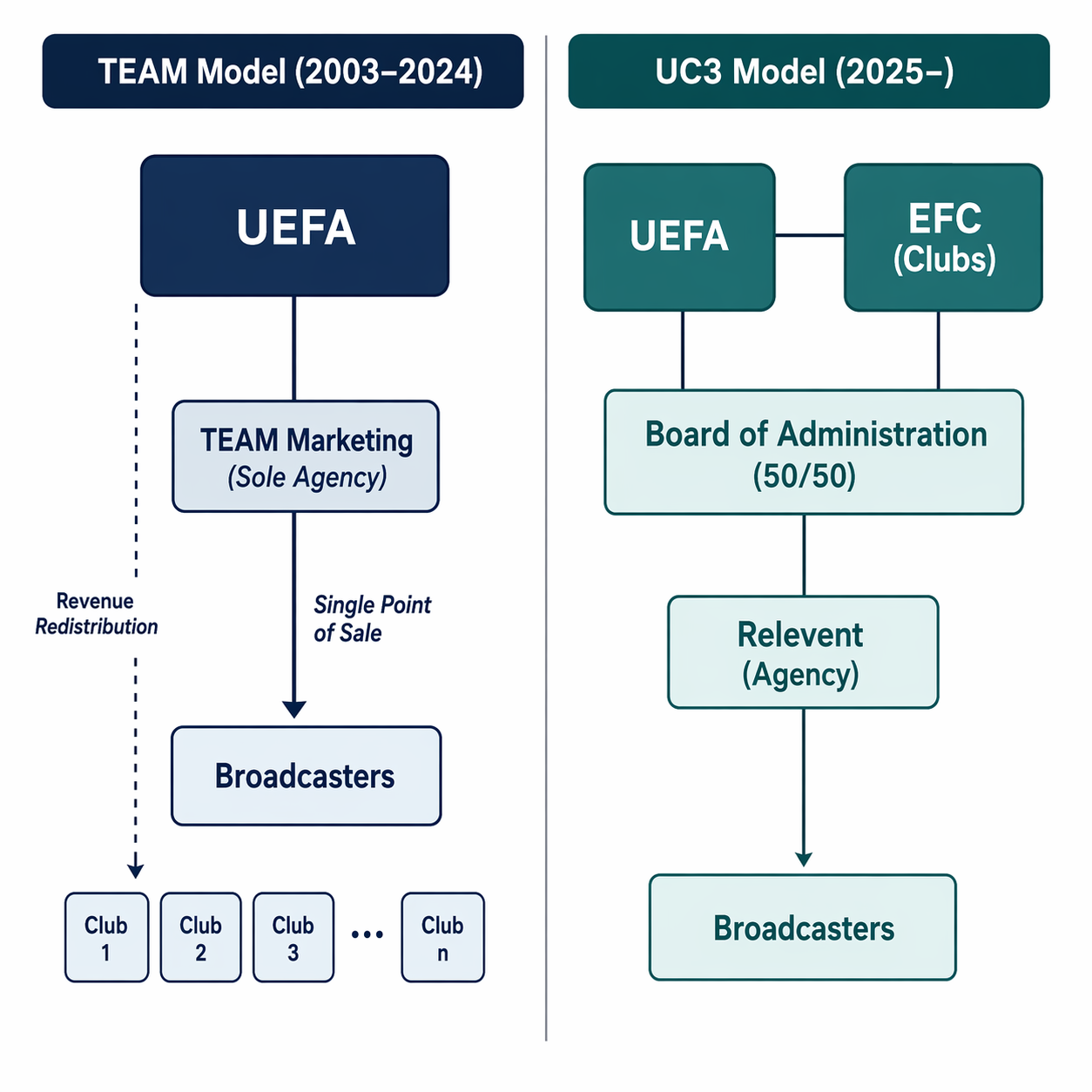
Relevent’s appointment is not the central Article 101 issue, but it is part of the documentary contrast. In March 2025, UEFA and the clubs selected Relevent through a competitive tender to sell commercial rights, displacing TEAM Marketing after roughly three decades and forming London-based Relevent Football Partners for the work.[6]
That change matters because it confirms that UC3 is not merely a new letterhead placed over an unchanged commercial machine. The post-2025 model combines a new joint venture, equal UEFA/EFC board representation, joint management, and a new global agency. None of those facts, standing alone, decides the competition-law question. Together, they make it difficult to treat 2003 as if it automatically covers the current structure.
Why the Telemundo Package Is the Practical Test
Telemundo’s package is long, exclusive, and multi-platform. It covers six seasons, multiple competitions, and distribution across broadcast television, cable, streaming, and FAST.[1] From the buyer’s side, that is a commercially coherent acquisition. From a competition-law perspective, it is also the kind of downstream arrangement whose comfort depends on the upstream seller’s authority being sound.
The contrast with the 2003 decision is immediate. The Commission’s earlier comfort depended in part on three-year contract cycles.[3] Telemundo’s deal runs from 2027-28 through 2032-33, a six-season term.[1] That does not automatically make the Telemundo deal unlawful; different markets, rights, and packages may justify different treatment. But it does mean the factual fit with the old exemption cannot be assumed without analysis.
The financial terms of the Telemundo deal have not been publicly disclosed. The prior Univision agreement, reported as a three-year, $225 million rights cycle ending in 2027, is useful only as market context, not as evidence of Telemundo’s price or as a valuation proxy for the new package.[7]
For Telemundo and similarly situated buyers, the risk is not that a rights contract becomes invalid merely because a new joint venture exists. The risk is that a long exclusive package may be negotiated and performed on the assumption that upstream collective selling has already been cleared, when the public record does not show that the Commission has assessed UC3’s post-2025 governance model.
The Article 101 Question Is Narrower Than the Super League Debate
It is tempting to pull every current European football governance dispute into one large antitrust narrative. That is not helpful here. UC3 is not a breakaway league. It operates within the existing UEFA club competition structure and concerns commercial exploitation of rights, not the creation of a rival competition format.
The relevant pressure point is more technical: whether competing clubs, through EFC, can sit as equal co-governors in the rights-selling vehicle without changing the competitive assessment that supported the 2003 exemption. The answer may depend on how decisions are actually made inside UC3, what vetoes exist, how packages are designed, whether residual club rights remain meaningful, and whether tenders preserve sufficient downstream rivalry.
Those details are not fully visible in the public materials. UC3’s public description confirms the equal governance architecture, but not the complete internal decision rules or the full competition-law file, if any, behind it.[2] That evidentiary gap is precisely why old comfort should not be overstated.
What Fresh Commission Review Would Need to Examine
A fresh review would not need to begin from the premise that collective selling is prohibited. The 2003 decision itself recognized that centralized selling can produce efficiencies, including a single point of sale and a more coherent media product, when accompanied by safeguards.[3] The question is whether those efficiencies still outweigh the restrictions under a materially different governance structure.
- Governance: whether equal UEFA/EFC board representation gives competing clubs influence over price, output, packaging, exclusivity, or tender design.
- Duration: whether six-season downstream deals can be reconciled with the shorter exclusivity assumptions embedded in the 2003 framework.
- Unbundling: whether broadcast, cable, streaming, and FAST rights are offered in a way that preserves real bidding opportunities.
- Residual rights: whether clubs retain commercially meaningful rights outside the central UC3 sale, or whether those rights have become formal rather than practical.
- Agency role: whether Relevent acts as an implementing agent under independent tender discipline or as part of a broader coordinated commercialization strategy shaped by club representatives.
Relevent’s separate U.S. Soccer litigation history should be handled carefully in that exercise. The available materials identify Relevent’s appointment by UEFA and the clubs, but any settlement terms from separate U.S. Soccer-related proceedings are not public. That limits how far one can responsibly take a conflict or policy argument based on that history.
A Bounded Legal Judgment
On the public record, UC3 looks materially different from the structure the Commission assessed in 2003. The difference is not cosmetic. Clubs, through EFC, appear to have moved from residual-rights holders and redistribution beneficiaries into a formal co-governance role inside the commercial rights vehicle.[2]
That does not establish an Article 101 infringement, and it does not mean Telemundo’s contract is unlawful. It means the compliance confidence surrounding post-2025 UEFA club competition rights deals is weaker if market participants rely only on Decision 2003/778/EC. The Commission accepted a specific UEFA-controlled single-point-of-sale model with safeguards; UC3 presents a new governance fact pattern that likely deserves its own review before buyers and sellers treat the old framework as settled coverage.
This is editorial analysis based on public materials, not legal advice and not a regulatory finding. The sensible legal stopping point is narrow: before Telemundo’s six-season exclusive U.S. Spanish-language package, or similar UC3-era transactions, are treated as safely insulated by the 2003 decision, the Commission should have the opportunity to examine whether the Article 101 balance has changed.
References
- Telemundo Acquires Exclusive U.S. Spanish-Language Rights to All UEFA Men’s Club Competitions, Including Champions League, NBCUniversal News Group, July 19, 2026.
- About Us, UC3.
- Commission Decision of 23 July 2003 relating to a proceeding pursuant to Article 81 of the EC Treaty and Article 53 of the EEA Agreement (COMP/C.2-37.398 — Joint selling of the commercial rights of the UEFA Champions League), EUR-Lex, July 23, 2003.
- Commission clears UEFA's new policy for selling the media rights to the Champions League, European Commission, July 24, 2003.
- Champions League TV rights, sponsorship and UEFA’s UC3-Relevent-Paramount strategy, SportsPro.
- UEFA, clubs tap Relevent to sell commercial rights, Sports Business Journal, March 14, 2025.
- Univision renew Champions League rights for 3 years for $225M, World Soccer Talk, May 19, 2023.
Comments
Join the discussion with an anonymous comment.