
The legal problem in the White House teleprompter betting scandal is not whether the alleged conduct looks fair. On the reported facts, it does not. Gabriel Perez, a White House teleprompter operator, allegedly used advance access to presidential speech content to make more than $100,000 betting on Trump-related prediction market contracts; Kalshi reportedly froze more than $90,000 before the funds could be withdrawn; the White House suspended him; the CFTC opened an investigation and pursued settlement discussions; and the Southern District of New York reportedly declined criminal prosecution.[1][2]
That sequence is the point. The money was stopped first by a platform. The civil regulator moved next. Criminal prosecutors, at least as reported by ABC News and Reuters, did not bring a case. There is no public DOJ declination letter or court filing that explains the decision, and any CFTC settlement terms remain provisional unless and until the agency publishes them. Still, the enforcement map is already visible: this is a case where the public label “insider trading” arrives faster than the law’s categories.
Why the usual insider-trading answer does not fit neatly
In a securities case, the instinctive legal question would be familiar: did someone trade a security while owing a duty not to use material nonpublic information? That route runs through Section 10(b), Rule 10b-5, and decades of case law about deception, materiality, scienter, and fiduciary or fiduciary-like duties.
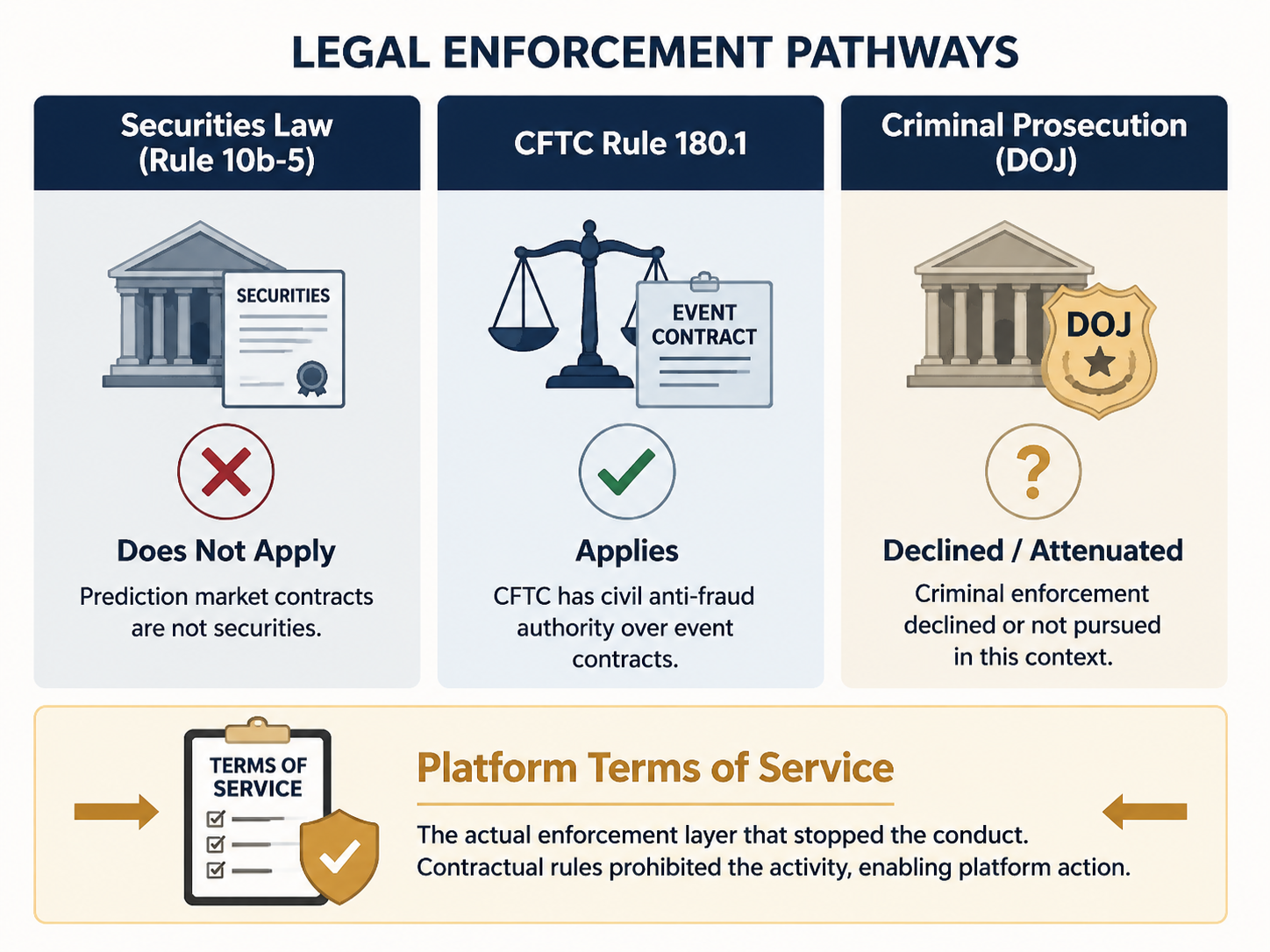
Prediction market contracts do not drop cleanly into that securities framework. The relevant contracts are event contracts, not shares of stock or conventional securities. MoFo’s March 2026 analysis frames the resulting gap directly: prediction-market insider trading raises familiar concepts from securities law, but the instrument is not itself a security, so Rule 10b-5 is not the natural statutory home.[3]
That distinction is not a technicality for law-school exam purposes. It changes the regulator, the statute, the elements, and the enforcement appetite. If a public company employee trades company stock before an earnings release, prosecutors and the SEC know the path. If a government-adjacent contractor or staffer bets on whether a phrase will appear in a speech, the market may be federally regulated, the information may be nonpublic, and the conduct may be abusive — but the legal hook has to be identified rather than assumed.
The CFTC’s hook: Section 6(c)(1) and Rule 180.1
The CFTC’s civil theory is easier to see. Commodity Exchange Act Section 6(c)(1) and CFTC Rule 180.1 prohibit manipulative or deceptive devices in connection with swaps, commodities in interstate commerce, or futures and derivatives markets under the agency’s jurisdiction. Hodder’s statutory analysis describes Rule 180.1 as modeled on SEC Rule 10b-5, while emphasizing that commodities insider-trading law has not developed with the same settled duty framework as securities law.[4]
Modeled on securities law does not mean identical to securities law. Rule 180.1 gives the CFTC a civil anti-fraud route when someone allegedly uses deception in connection with a covered market. It does not, by itself, answer every harder question that securities doctrine answers imperfectly but at least regularly: whose information was misappropriated, what duty was breached, whether the information was material to the contract, and whether the defendant acted with the required state of mind.
For Perez, the reported information advantage was speech content before public delivery. That may well be economically useful on a market that prices outcomes tied to what a president will say or do. It also may violate platform rules. But a criminal case needs more than an advantage. It needs a provable legal duty and a theory of deception that can survive the difference between securities markets and event contracts.
This is where the case becomes uncomfortable for compliance lawyers. A teleprompter operator can plainly receive information before the public receives it. The information can be confidential in an ordinary workplace sense. Yet criminal insider-trading doctrine usually asks a sharper question: confidential as against whom, under what duty, and in connection with which regulated market? A White House speech draft is not an issuer’s earnings release. It is not classified information merely because it is not yet public. It is not automatically a commodity-market secret because traders can bet on it.
What SDNY’s reported declination does — and does not — tell us
ABC News and Reuters both reported that SDNY declined to prosecute Perez.[1][2] That is an enforcement signal, not doctrine. It is not a holding. It does not bind another U.S. Attorney’s Office, the CFTC, a state regulator, or a future court. It also does not mean the conduct was lawful.
The better reading is narrower: prosecutors appear to have viewed this speech-information case as too attenuated for criminal charges on the available facts. The likely pressure points are materiality and duty. Materiality is not just whether a trader cared about the information; it is whether the information matters in a legally cognizable way to the market instrument at issue. Duty is not just whether the information was unavailable to the public; it is whether the defendant owed and breached a duty that can support a fraud theory.
The CFTC can tolerate more uncertainty than DOJ because civil enforcement occupies a different posture. Civil cases can settle. The agency can seek disgorgement, trading bans, and undertakings without proving guilt beyond a reasonable doubt. A settlement can deter the market while leaving the edges of Rule 180.1 unresolved. That is useful for market supervision and frustrating for lawyers who need to draft training that says more than “do not do anything that looks bad.”
The clearer criminal comparators
The Van Dyke case shows why Perez is not the easy version of the problem. DOJ charged a U.S. soldier with using classified information to profit from prediction market bets, alleging that he used information about future U.S. military activity before public confirmation.[5] Classified military information supplies a far stronger duty story than advance access to speech language. It also gives prosecutors facts that are easier to explain to a jury: the information was protected by national-security rules, the defendant allegedly knew that, and the market profit flowed from use of that protected information.
Spagnuolo is the more conventional internal-data comparator. Akin Gump’s alert discussing recent DOJ and CFTC prediction-market matters treats Van Dyke and Spagnuolo as examples of prosecutors entering the field where the information source and duty theory are more recognizable.[6] Internal business information looks more like the securities cases lawyers already know, even if the traded instrument is different. There is an organization, restricted data, a clearer expectation of nonuse, and a more familiar misappropriation narrative.
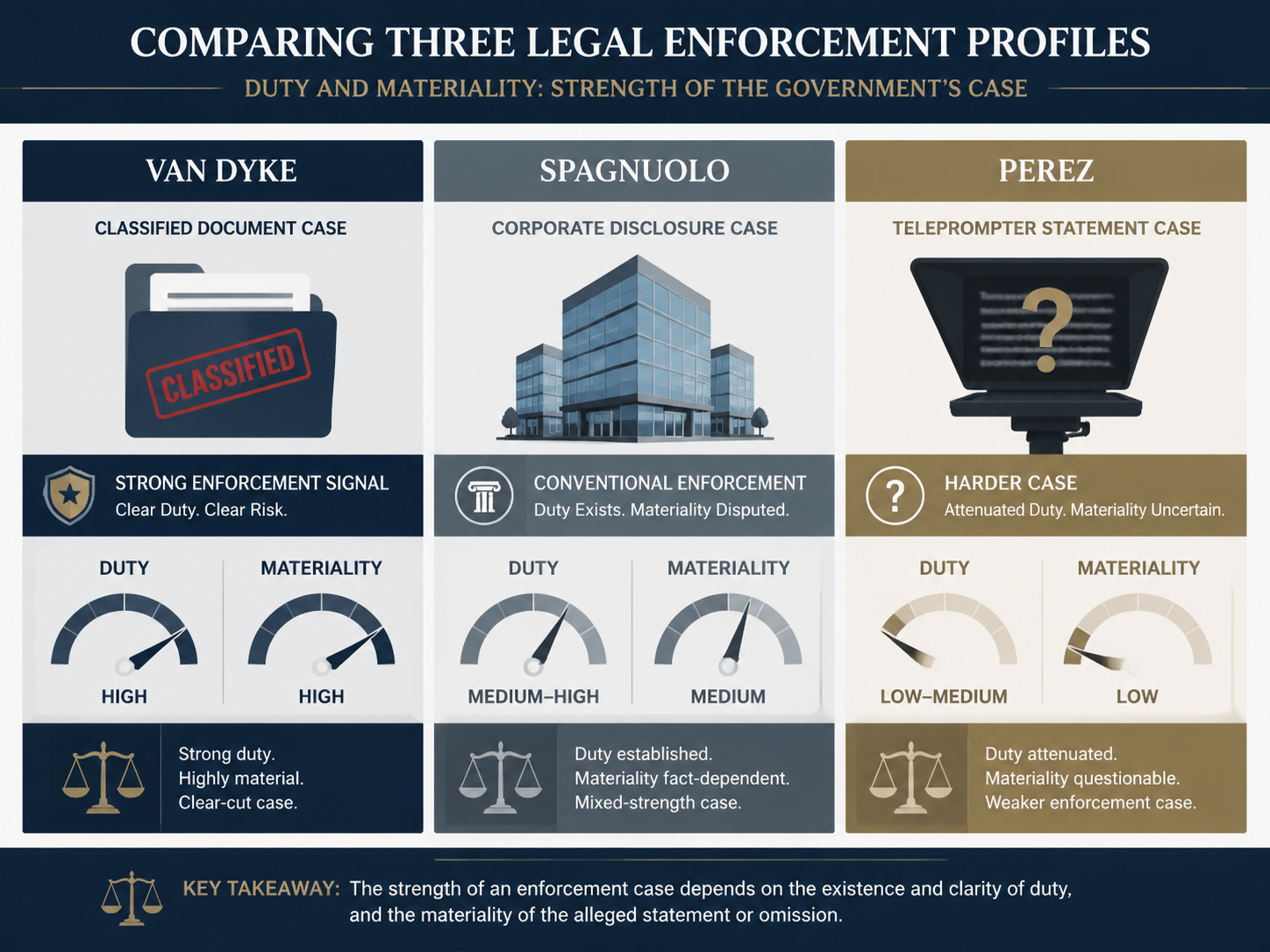
Perez sits farther from both poles. The alleged information was not public, and it apparently was tradable. But on the reported facts, it was not classified military information, and it was not ordinary corporate internal data. The more the prosecution theory depends on translating “access to a speech before delivery” into “criminal commodities fraud,” the more work prosecutors must do on duty, deception, and market connection.
The platform layer moved faster than the doctrine
Kalshi’s role matters because it was not just background fact. According to ABC News, the platform froze more than $90,000 connected to Perez before withdrawal.[1] That is immediate deterrence. It is also a reminder that platform terms and account controls may do more practical work than federal criminal law in the first hours of a prediction-market incident.
Kalshi’s market-integrity materials prohibit trading based on material nonpublic information and identify categories of prohibited insider trading on the platform.[7] Those rules do not need to solve the same problem DOJ must solve. A platform can suspend, freeze, investigate, and report under contract-based standards. It can act on suspicious conduct before a prosecutor is prepared to allege every element of a crime.
For compliance teams, that difference is not academic. Employees and contractors with access to government, corporate, litigation, regulatory, media, polling, or operational information may now be able to monetize that access through event contracts rather than securities trades. Existing insider-trading policies often name stocks, options, tender offers, earnings, mergers, and clients. They may not mention prediction markets at all. The Perez facts are a warning that the omission is no longer harmless.
What a policy has to cover now
A useful policy does not need to pretend every prediction-market trade is a securities trade. It should say, more directly, that personnel may not use confidential, embargoed, proprietary, governmental, client, litigation, regulatory, or operational information to trade event contracts, prediction-market contracts, derivatives, securities, crypto assets, or analogous instruments.
- Define covered markets by function, not by brand name: if the instrument pays based on a future event, public announcement, government action, business result, litigation outcome, or similar contingency, it belongs in the policy.
- Define restricted information by source and confidentiality, not by whether it is classified or securities-related.
- Treat contractors, vendors, temporary staff, communications personnel, technology support, and production staff as possible information-access points.
- Require preclearance or outright bans for event-contract trading by personnel who routinely see market-moving nonpublic information.
- Preserve escalation paths for platform inquiries, subpoenas, account freezes, and voluntary disclosures.
That language is broader than what DOJ may be able to charge in a marginal case. It should be. Internal controls are supposed to prevent the fact pattern before the government has to decide whether a novel prosecution is worth bringing.
The CFTC’s enforcement posture is real, even if the doctrine is still thin
Parker Poe’s April 2026 alert described the CFTC as highlighting insider trading in prediction markets as an enforcement focus, including public remarks from Enforcement Director Brian Young Miller.[8] That matters because agencies build law not only through litigated opinions but through complaints, orders, settlements, guidance, and staff posture. Market participants often change behavior long before an appellate court clarifies the theory.
But settlement-driven law has an obvious limitation. If Perez resolves with disgorgement, a trading bar, or other civil relief, the market will receive a warning rather than a fully tested rule. We may learn what the CFTC found unacceptable. We may not learn how far Rule 180.1 reaches when the information is nonpublic but not classified, confidential but not corporate, and valuable because prediction markets have created a price for it.
| Question | Current answer in the Perez matter |
|---|---|
| Did traditional securities insider-trading law directly apply? | Not neatly; prediction market event contracts are not conventional securities. |
| Did the CFTC have a civil route? | Yes, through commodities anti-fraud authority under Section 6(c)(1) and Rule 180.1, assuming the jurisdictional and fraud elements are met. |
| Did DOJ bring a criminal case? | Reportedly no; ABC News and Reuters reported an SDNY declination, but no public DOJ filing explains it. |
| Who stopped the money first? | Kalshi reportedly froze more than $90,000 before withdrawal. |
| Does a civil settlement answer the criminal-law question? | No; it may deter similar conduct without resolving the outer boundary of criminal liability. |
Where the legal issues stand in Q3 2026
As of Q3 2026, the White House teleprompter betting scandal is best understood as a layered enforcement problem. Perez may have violated Kalshi’s rules. He may face civil commodities-fraud consequences if the CFTC finalizes and publishes a settlement or brings an action. The reported facts do not, however, cleanly answer whether using nonpublic White House speech information to bet on event contracts is a federal crime.
The active regulatory environment only sharpens the uncertainty. CFTC rulemaking, congressional proposals, and state-federal preemption litigation involving prediction markets may change the operating rules. They do not retroactively supply a simple answer to the Perez fact pattern.
For now, the practical deterrent is clearest at the platform and compliance layer. The CFTC is the primary civil regulator to watch. DOJ appears selective, with stronger criminal cases emerging where the government can point to classified information, conventional internal data, or a cleaner duty theory. Perez’s alleged betting may have been improper and commercially abusive. It still leaves the harder legal question where it started: not whether the information was useful, but whether current federal criminal law clearly reaches this kind of speech-information trading in prediction markets.
References
- White House teleprompter operator made more than $100K betting on Trump's speeches, ABC News, July 16, 2026.
- Trump's teleprompter operator under CFTC probe over potential insider trading, Reuters, July 16, 2026.
- Prediction Markets and the Law of Insider Trading, MoFo, March 3, 2026.
- Insider Trading and Prediction Markets: What the Law Actually Says, Hodder Law.
- U.S. Soldier Charged With Using Classified Information To Profit From Prediction Market Bets, U.S. Department of Justice.
- DOJ and CFTC Bring New Insider Trading Cases in Prediction Markets, Akin Gump.
- Insider Trading Prohibitions, Kalshi.
- CFTC Highlights Enforcement Focus on Insider Trading in Prediction Markets, Parker Poe, April 2026.
Comments
Join the discussion with an anonymous comment.