
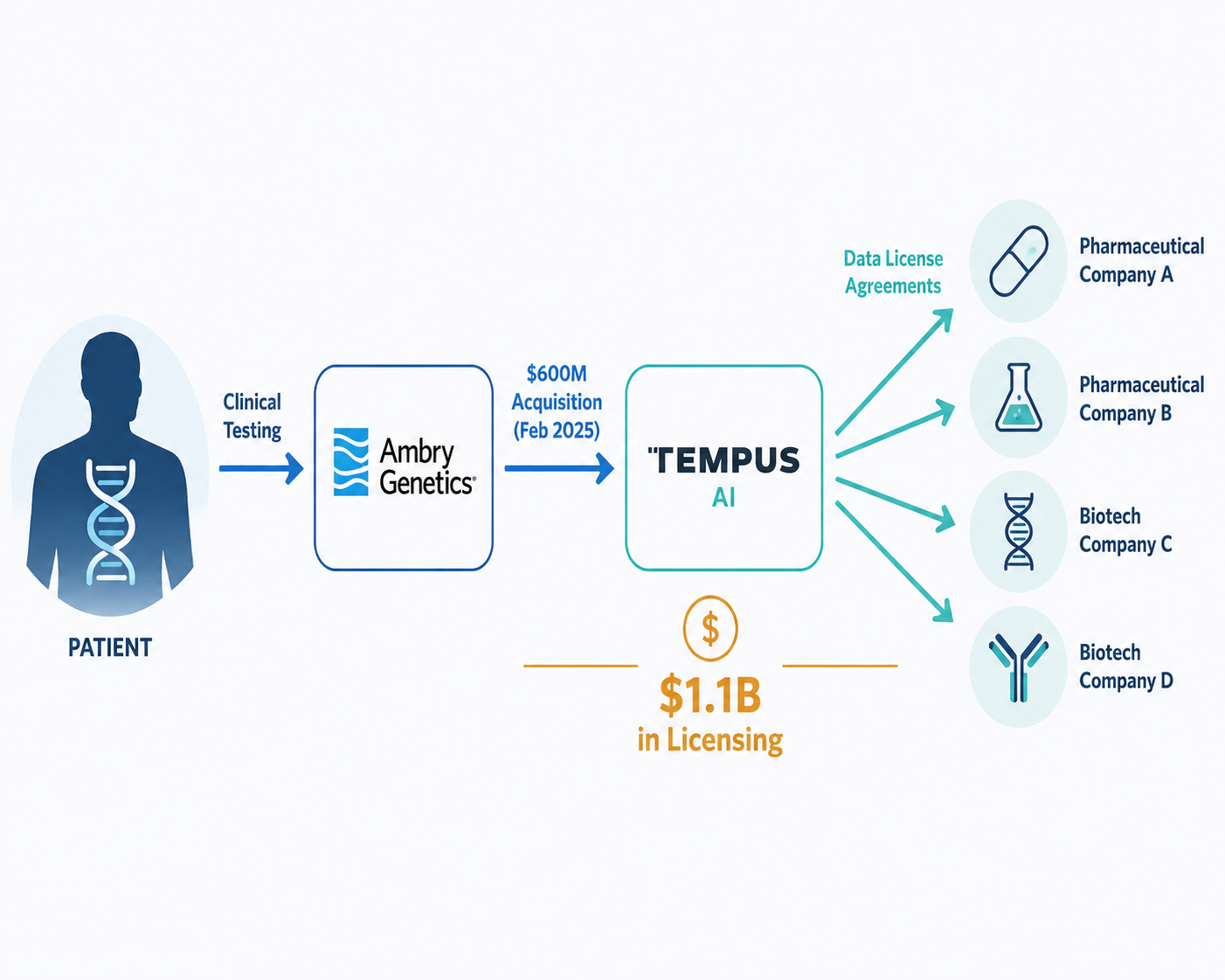
The legal significance of Tempus AI’s Ambry Genetics acquisition is not in the press-release verbs. It is in the asset that allegedly moved with the company: a genetic-testing database containing more than 1 million patient test results. Tempus acquired Ambry in February 2025 for $600 million; a little more than a year later, plaintiffs in a consolidated federal class action alleged that the deal transferred genetic information without patient notice or written consent, then positioned that information for commercial licensing and AI-related use. [1]
That is the point at which an acquisition story becomes a healthcare privacy story. If the allegations survive early procedural challenges, Farrier v. Tempus AI will test whether state genetic privacy laws can police patient-data flows that occur through corporate M&A, not only through the original clinical encounter.

The Asset Was the Legal Event
Healthcare M&A has always moved more than stock, contracts, leases, and employment files. It moves permissions. In a diagnostics acquisition, those permissions may be embedded in lab requisitions, patient authorizations, privacy notices, institutional agreements, research consents, data-use restrictions, and state-law genetic privacy obligations. The buyer does not merely inherit a database; it inherits whatever legal limits attach to the data inside it.
The Farrier complaint matters because it treats the Ambry database as a rights-limited asset, not ordinary inventory. Plaintiffs allege that genetic test results moved to Tempus through the acquisition and were then used in a broader data-commercialization strategy. Fisher Phillips reported that Tempus licensed the data to more than 70 pharmaceutical and biotechnology companies through agreements collectively valued at $1.1 billion. [1]
HIPAA Journal identified named licensing counterparties that include Pfizer, GSK, Genentech, Boehringer Ingelheim, and others, while also reporting the same $600 million acquisition figure and $1.1 billion licensing value. [2]
Those numbers do different legal work. The $600 million purchase price shows that this was not a marginal bolt-on. The more than 1 million test results show the sensitivity and scale of the alleged patient-data asset. The 70-plus licensees and $1.1 billion in licensing agreements show why the case is not confined to whether a buyer may possess acquired data; it also asks what downstream commercial uses remain lawful after a deal closes.
What the Consolidated Complaint Actually Tests
The consolidated complaint in Farrier et al. v. Tempus AI was filed on April 15, 2026, in the Northern District of Illinois. It asserts 21 counts, including claims under Illinois’ Genetic Information Privacy Act, California’s Confidentiality of Medical Information Act, seven state consumer protection statutes, and common law theories. [1]
The procedural posture matters. The case has not reached class certification. Tempus has not filed a substantive response in the materials provided, and no motion-to-dismiss ruling has tested the pleadings. Any damages discussion is therefore conditional: it depends on the court’s treatment of the statutes, class certification, proof of violations, available defenses, and the measure of damages.
Still, the structure of the complaint is already useful for healthcare deal lawyers because it refuses to keep genetic privacy in a narrow collection box. The plaintiffs’ theory reaches the acquisition transfer, alleged lack of patient notice or written consent, and downstream licensing of patient-derived genetic data. In practical terms, the complaint asks whether consent and notice obligations follow genetic information after the original testing company is sold.
| Issue in the Complaint | Why It Matters in Healthcare M&A |
|---|---|
| Alleged transfer of more than 1 million genetic test results | Makes the database itself a core transaction asset, not a background compliance item |
| Illinois GIPA claim | Creates a statutory damages theory that can become large if class certification and liability align |
| California CMIA claim | Shows that the case is not only an Illinois genetic privacy dispute |
| Consumer protection and common law claims across multiple states | Forces buyers to map patient-data rights by jurisdiction rather than rely on a single federal privacy lens |
| Alleged licensing to pharmaceutical and biotech companies | Moves the dispute from possession of acquired data to post-close commercial use |
| De-identification challenge | Questions whether DNA can be treated as safely anonymized in the same way as less unique data |
The Illinois GIPA Damages Theory Is the Pressure Point
Illinois GIPA is the claim that turns scale into litigation pressure. The statute provides for $15,000 per intentional violation and $2,500 per negligent violation, according to the case analysis summarized by Fisher Phillips. [1]
Those figures should not be multiplied against every alleged record as if judgment has already entered. That is the kind of arithmetic that makes a headline and ruins a risk memo. The exposure is hypothetical until the court addresses threshold questions: whether the statute applies to the alleged conduct, whether plaintiffs can certify a class, what counts as a violation, whether intent or negligence can be shown, and what defenses Tempus may raise.
But conditional does not mean irrelevant. A statutory damages regime changes diligence behavior before it changes verdict forms. If a buyer prices a genetic database into an acquisition model, and the rights analysis later turns on patient-by-patient consent provenance, the legal review cannot arrive after valuation has already treated the database as fully monetizable.
GIPA Is Not the Whole Case
The complaint’s California CMIA claim and multi-state consumer protection claims matter because they prevent an easy Illinois-only reading. State genetic privacy, medical confidentiality, consumer protection, and common law theories do not operate identically. A buyer that asks only whether HIPAA permits a transfer may miss state-law restrictions that attach to genetic or medical information in different ways.
The ComplianceHome summary likewise describes the consolidated case as asserting 21 claims, including Illinois GIPA, California CMIA, consumer protection statutes, and common law theories. [3]
That does not make every count equally strong. It does make the diligence lesson more uncomfortable: the governing risk map may be built around where patients reside, where tests were ordered, what notices and authorizations said, what state law protects, and how the buyer later uses the data.
The De-Identification Fight Is Not a Technical Footnote
The complaint’s most consequential allegation may be that genetic data cannot be meaningfully de-identified because DNA is inherently unique. Fisher Phillips describes plaintiffs as arguing that de-identification provides no safe harbor because DNA itself is an identifying biomarker. [1]
That allegation goes directly at a familiar diligence comfort. In many healthcare data deals, anonymization or de-identification is treated as the bridge between clinical collection and commercial analytics. It is the point in the checklist where lawyers and product teams often stop arguing. If the data is de-identified, the thinking goes, the buyer can use it for research, model development, licensing, or product improvement subject to the specific contractual and regulatory framework.
Genetic information complicates that comfort because its identifying quality is not just a name, address, account number, or obvious demographic tag. A DNA sequence can be clinically useful precisely because it is specific. Plaintiffs are asking the court to treat that specificity as legally significant for privacy purposes.
The court has not resolved that question. Nor should GIPA, CMIA, and every state consumer protection theory be collapsed into one generic rule about anonymization. The near-term significance is more modest and more practical: buyers cannot assume that a de-identification label will answer every genetic-data question at the transaction stage.
Why the Licensing Allegations Raise the Stakes
The lawsuit would matter even if the dispute stopped at the transfer of Ambry’s database to Tempus. The licensing allegations make it more commercially important. Plaintiffs are not describing a passive archive locked inside a post-close subsidiary. They allege that genetic information became part of a monetized data strategy involving pharmaceutical and biotech licensees.
Tempus’s own investor materials add business context. The company reported first-quarter 2026 revenue of $348.1 million, up 36% year over year; the materials provided attribute part of the growth to Ambry-sourced data. [4]
That revenue figure is not proof of liability. It does explain why plaintiffs, investors, and healthcare acquirers are watching the data rights question. If a buyer’s growth story depends in part on acquired patient-derived datasets, then the chain of consent, notice, assignment, and permitted use becomes a valuation issue, not merely a privacy-policy issue.
Law.com reported earlier-filed actions against Tempus challenging its alleged use of genetic data, and later coverage described the suits as testing legal lines for mining genetic data. [5][6]
The consolidation of those disputes into Farrier sharpens the record. Instead of a broad anxiety about AI companies and medical data, the case presents a concrete sequence: clinical genetic testing, acquisition, database transfer, alleged lack of patient notice or written consent, and alleged licensing to third parties.
The Diligence Questions Change Before the Law Is Settled
No careful buyer should treat Farrier as a final statement of the law. It is too early. There has been no motion-to-dismiss ruling in the materials provided, no class certification decision, and no merits finding. But a filed complaint can still expose the questions a deal team failed to ask early enough.
For healthcare and MedTech acquisitions where patient data is a material asset, the diligence file now needs to answer questions that are more specific than “Is the data de-identified?” or “Did the seller comply with HIPAA?”
- Consent provenance: What did patients sign, when did they sign it, and did the language cover transfer, licensing, AI development, research, commercial partnerships, or successor use?
- Notice history: What privacy notices or patient-facing disclosures were in effect when genetic tests were ordered and when data was later used?
- Assignability of data rights: Did the seller have rights that could travel through a merger, stock purchase, asset sale, or post-close reorganization?
- Downstream licensing: Which third parties received access, under what restrictions, for what purposes, and with what audit or revocation rights?
- State-law mapping: Which patients, specimens, ordering providers, labs, and data uses connect to states with genetic privacy, medical confidentiality, or consumer protection statutes?
- De-identification basis: What technical and legal analysis supports the claim that the data is de-identified, and does that analysis address the uniqueness of DNA?
- Valuation assumptions: How much of the purchase price depends on data uses that may require additional consent, notice, contractual amendment, or product controls?
- Post-close governance: Who can approve new uses of acquired genetic data, and what stops a commercial team from expanding use beyond the rights the buyer actually acquired?
These are not academic refinements. They change who needs to be in the room before the model is built. Privacy counsel, commercial contracting, product, data science, regulatory, and finance need a shared view of which data uses are clearly permitted, which are uncertain, and which should not be valued as available until additional rights are secured.
The Data Room Should Not Hide the Hard Part
The tempting diligence shortcut is to ask for a policy summary, a sample consent, and a representation that the seller complies with applicable privacy law. That approach is too thin when the acquisition thesis depends on patient-derived genetic data.
A better review traces the actual data pathway. It starts with the patient and the test order, moves through the lab and any research or commercial databases, identifies each consent or notice relied on, maps each transfer and license, and then tests whether the buyer’s intended post-close uses fit the permissions actually obtained. Where the answer is “probably,” the valuation model should know that it is probably.
What Farrier Does Not Prove
Farrier does not prove that Tempus violated genetic privacy law. It does not prove that every acquired genetic database requires new written consent. It does not prove that de-identification can never work for DNA under any statute or factual record. Those are litigation questions, and the case is still early.
It also should not be used as evidence that every other Tempus legal dispute strengthens the privacy claims. The research materials note parallel legal exposure, including a voluntarily dismissed securities action and patent conflict, but those matters are distinct. They may matter to investors assessing overall litigation risk; they do not establish the merits of the genetic privacy complaint.
The narrower lesson is stronger. A healthcare AI company can build impressive clinical, research, and drug-development infrastructure and still face a basic transaction-control question: did the acquired data come with the rights needed for the buyer’s intended use?
The Bellwether
Farrier is a bellwether because it asks whether genetic privacy obligations follow the data through acquisition. That is the question healthcare acquirers would rather leave implicit, especially when the dataset helps justify the purchase price.
Until courts clarify how state genetic privacy statutes apply to acquired patient datasets, prudent buyers should treat those assets as rights-limited and jurisdiction-sensitive. The database may close with the transaction. The permission to use it may not.
References
- AI Company's Acquisition of Genetic Testing Firm Sparks Landmark Privacy Lawsuit – What Employers and MedTech Should Know, Fisher Phillips
- Healthcare AI Firm Sued Over Alleged Unlawful Disclosures of Genetic Data, HIPAA Journal
- Tempus AI Faces Lawsuit for Disclosure of Genetic Data, ComplianceHome
- Tempus Reports First Quarter 2026 Results, Tempus AI Q1 2026 Earnings
- Healthcare Tech Firm Hit With Class Action for Allegedly Stealing Genetic Data to Train AI Models, Law.com, February 20, 2026
- Suits Against Tempus AI Test Legal Lines for Mining Genetic Data, Law.com Corporate Counsel
Comments
Join the discussion with an anonymous comment.