
The current enforcement problem around temporary flight restrictions is not merely that a pilot or drone operator may misread a NOTAM. In 2025 and 2026, the more important question is what happens after the aircraft is already inside the protected airspace: whether NORAD treats it as an air-defense event, whether the FAA opens civil or certificate enforcement, whether the matter is excluded from reduced-penalty handling, and whether the facts are serious enough to interest federal prosecutors.
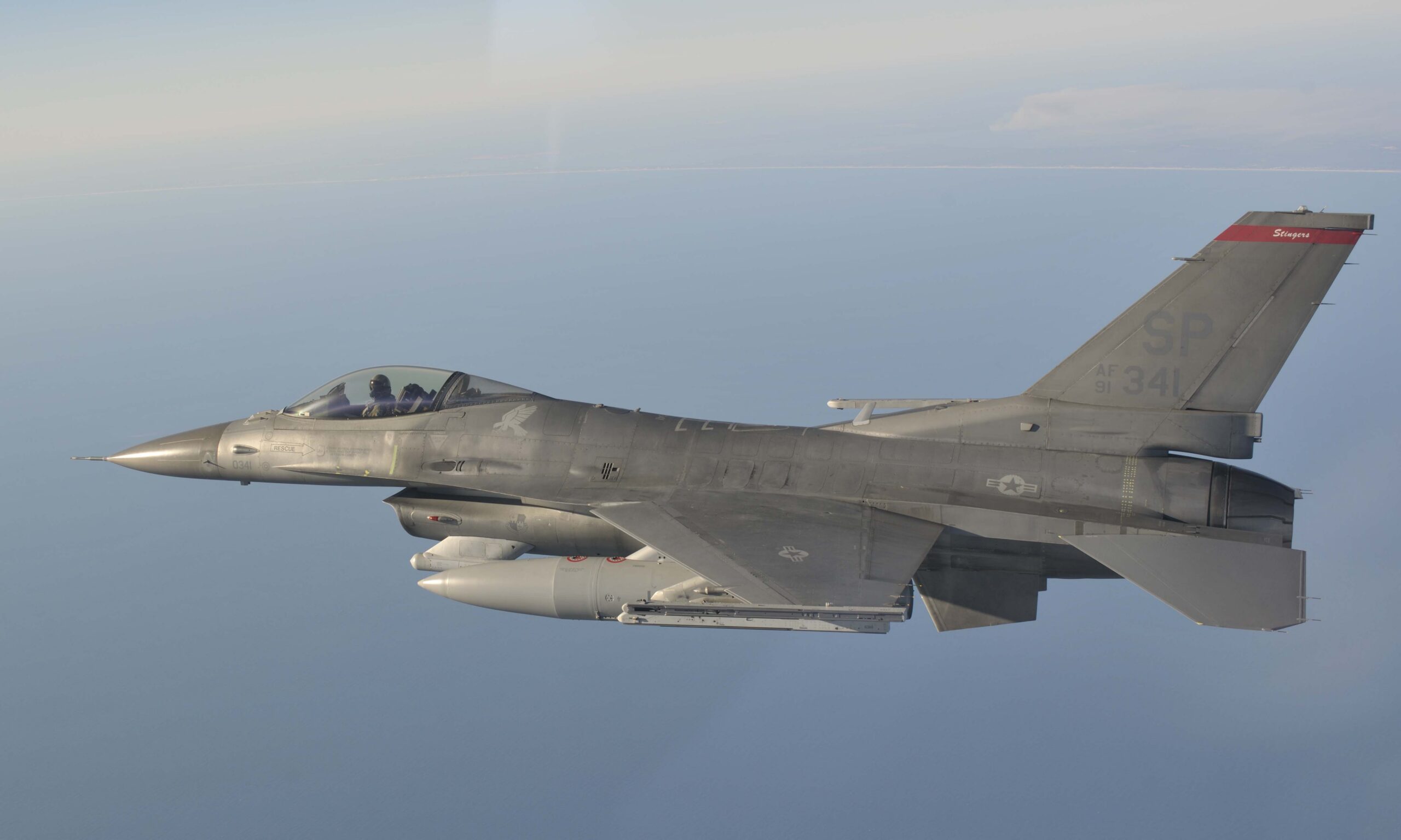
That is no longer a theoretical chain. NORAD publicly warned in June 2026 that it had responded to more than a dozen temporary flight restriction violations in the New York and New Jersey area that month, urging pilots to check presidential movement-related restrictions before flight.[1] A few months earlier, on March 29, 2026, NORAD intercepted an aircraft that violated a TFR over Palm Beach, Florida, using F-16 aircraft to identify and respond to the target.[2] General Aviation News reported in March 2025 that NORAD had already identified more than 20 “tracks of interest” near Mar-a-Lago since January 20, 2025.[3] E3 Aviation Association later synthesized the 2025–2026 presidential-location picture as more than 32 TFR incursions since January 2025, including 11 violations over the July 4 weekend at Bedminster, New Jersey; that “32+” figure should be treated as an attributed synthesis rather than a separately audited agency total.[4]

The operational point is simple enough: repeated TFR incursions near presidential locations consume air-defense resources before anyone gets to the FAA enforcement file. The legal point is less simple and more important for counsel and compliance staff. A TFR violation can move through several systems that do not share the same threshold, remedy, or institutional purpose.
This article is regulatory analysis, not legal advice for any particular pilot, operator, certificate holder, or enforcement matter.
The enforcement pipeline now matters more than the airspace definition
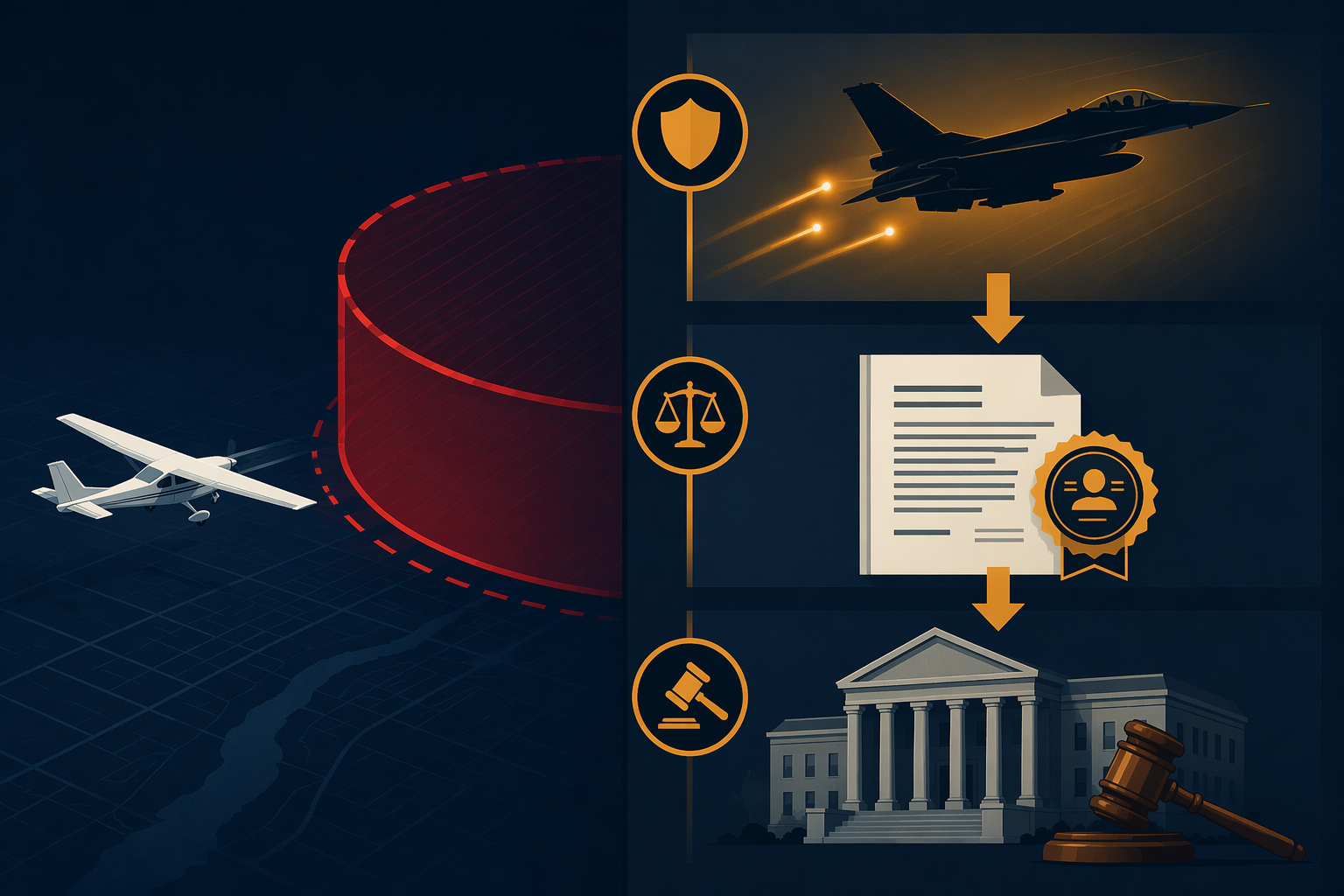
Most TFR explanations start with the categories of temporary flight restrictions. That is useful for training, but it is not where the 2026 risk sits. The current risk sits in the handoff: detection, air-defense response, FAA investigation, civil penalty assessment, certificate action, and, in the most serious cases, criminal referral or prosecution.
| Stage | What is being protected | Practical consequence for the operator or pilot |
|---|---|---|
| NORAD / air-defense response | Security airspace, presidential movement, special events, and other sensitive operations | Identification, radio contact attempts, possible fighter intercept, and an incident record that can later inform enforcement review |
| FAA civil enforcement | Compliance with airspace restrictions and operating rules | Civil penalty exposure, with materially higher maximums for drone operators after the FAA Reauthorization Act of 2024 |
| FAA certificate enforcement | Airman qualification and regulatory compliance | Suspension or revocation risk for certificated pilots, depending on facts and enforcement policy |
| DOJ / criminal exposure | Knowing or willful violation of security-related restrictions | Potential federal criminal penalties where the statutory elements and facts support prosecution |
These stages are often discussed as if they are interchangeable. They are not. NORAD’s job is not to calculate an appropriate civil penalty. The FAA’s civil penalty authority is not the same thing as a certificate suspension. A criminal statute does not become relevant merely because a violation occurred; it requires the statutory mental-state and security-related elements. But once a pilot or operator has created the incursion, the record can travel.
That is why the Palm Beach F-16 intercept matters without becoming the whole story. It is a visible example of the first tier activating. The later legal exposure depends on what the aircraft did, what the pilot knew or should have known, whether the airspace was security-related, whether the aircraft was manned or unmanned, and how the FAA applies its current enforcement policies.
NORAD response is not a penalty, but it changes the file
A fighter intercept is not itself an FAA sanction. It is an air-defense response to an aircraft that has entered, or appears to have entered, protected airspace. That distinction matters. A pilot does not receive a certificate suspension because an F-16 appeared. The enforcement consequences come later, through the FAA or another agency, if the facts support action.
Still, treating the intercept as legally irrelevant is a mistake. An intercept can establish that the event was serious enough to require military identification and response. It can generate records, communications, timelines, and agency attention. For an operator trying to explain the event later, the intercept is not background color. It is part of the factual environment in which the FAA will assess conduct.
The June 2026 NORAD warning is especially useful because it is not a one-off press release after a single dramatic incident. It described more than a dozen TFR violations in one region during one month.[1] That kind of volume is an operational strain signal. It also undercuts the casual assumption that TFR enforcement is sporadic enough to be treated as a low-probability administrative problem.
FAA civil penalties: actual 2025 cases versus maximum exposure
Civil penalty discussion tends to get sloppy in two opposite directions. Operators sometimes talk as if TFR violations usually resolve as modest paperwork. Enforcement summaries sometimes emphasize maximum penalties in a way that makes the ceiling sound routine. The useful view is in between: actual recent penalty amounts show real enforcement activity, while the statutory and policy changes show why old assumptions are unsafe.
The FAA’s 2025 drone enforcement roundup identified 18 proposed civil penalties against drone operators, with amounts ranging from $1,771 to $36,770. The cited operations included flights near the Super Bowl, Mar-a-Lago, wildfire response aircraft, and NFL games. The largest amount in that roundup, $36,770, involved operation near wildfire emergency response aircraft.[5]
Those numbers are not the same as the maximum. For drone operators, the FAA’s FIFA World Cup 2026 safety materials state that the FAA Reauthorization Act of 2024 increased civil penalties to as much as $75,000 per violation.[6] That matters because the $1,771-to-$36,770 range describes selected FAA actions announced in 2025, while $75,000 describes potential statutory exposure for drone violations. A compliance review that treats the 2025 roundup as a cap is reading the wrong number for the wrong purpose.
Manned aircraft should be separated from drones here. Rupprecht Law and E3 Aviation Association cite a figure of up to $1,414 per occurrence for certain manned-aircraft TFR civil penalty exposure, but that number should be handled cautiously unless counsel verifies the current inflation-adjusted FAA authority and applicable enforcement schedule for the date of violation.[7][4] The cleaner conclusion is not that every manned-aircraft TFR case is small. It is that the documented 2024–2026 maximum increase highlighted in the FAA’s current public safety materials is directed at drone civil penalties, while manned-aircraft cases may carry civil and certificate consequences under a different exposure profile.
DETER changes settlement risk for drone TFR cases
The procedural change that deserves more attention is the FAA’s Drone Expedited and Targeted Enforcement Response program, or DETER. The FAA’s FIFA World Cup 2026 page describes DETER as an expedited enforcement program for UAS operators and states that TFR violations are excluded from reduced-penalty settlements.[6]
That exclusion is not just a harsher tone. Reduced-penalty settlement programs are where many low-level enforcement matters become predictable, budgetable, and easier to close. If a category is excluded, the operator loses a settlement path that may otherwise have anchored early case valuation. For in-house counsel or a compliance manager, that changes the first conversation after a drone TFR event. The question is no longer only “what is the likely penalty?” It is also “what settlement mechanism is unavailable because this is a TFR case?”
The current public source for this DETER detail is the FAA’s FIFA World Cup 2026 safety page, not a full Federal Register record in the materials reviewed here.[6] That source is enough to take the exclusion seriously as an FAA-facing public position. It is not enough to answer every procedural question about effective dates, implementation mechanics, or edge cases. Those details should be verified against the governing FAA notice or order in an actual matter.
The February 2026 policy update narrows FAA discretion in dangerous drone cases
The FAA’s current World Cup safety materials also describe a February 2026 enforcement policy update requiring legal action when drone operations endanger the public, violate airspace restrictions, or are conducted in furtherance of another crime.[6] The important word is “requiring.” In the categories described by the FAA, this is framed as a mandatory legal-action policy rather than ordinary discretionary handling.
Again, this is primarily a drone point. It should not be casually imported into every manned-aircraft TFR analysis. But for UAS operators, the combination is severe: higher maximum civil penalties after the FAA Reauthorization Act of 2024, exclusion of TFR violations from reduced-penalty settlements under DETER, and a 2026 policy posture requiring legal action for drone operations that violate airspace restrictions or create specified dangers.[6]
The result is not that every drone TFR incursion will draw the statutory maximum. The FAA’s own 2025 roundup does not show that. It shows proposed penalties below the $75,000 maximum in the selected matters it publicized.[5][6] The result is that the operator’s downside is broader, and the procedural routes to a cheaper resolution may be narrower, than many pre-2024 drone enforcement assumptions would suggest.
Certificate action remains a separate exposure for certificated pilots
For certificated pilots, the FAA’s leverage is not limited to money. E3 Aviation Association, citing FAA enforcement materials, describes certificate-action baselines for TFR violations as a 30-to-90-day suspension, with revocation possible for egregious or repeat cases.[4] That is a different kind of consequence from a civil penalty, and it often matters more to the person whose income, insurance, or operator qualification depends on certificate status.
The certificate question also changes how the facts are evaluated. A civil penalty analysis may focus on the violation, the amount, and settlement posture. A certificate case asks whether the pilot’s conduct reflects the level of care expected of a certificate holder. If the file includes missed briefings, ignored NOTAMs, poor radio discipline, or entry into a high-security TFR, the argument that the aircraft caused no damage may not carry the weight the pilot expects.
Preflight duties become enforcement allegations
The basic preflight rule is not complicated, but it is often where the enforcement file becomes harder to defend. Rupprecht Law and Pilot Institute both note that TFR violations are commonly paired with alleged failure to review available preflight information under 14 CFR 91.103.[7][8] That pairing matters because the FAA is not merely saying the aircraft crossed a boundary. It is saying the pilot failed at the compliance step that should have prevented the crossing.
For a weekend general aviation pilot, that may mean the record turns on briefing history, route planning, NOTAM review, and communications. For a drone operator hired for an event job, it may mean the company’s launch approval process, airspace screening, crew assignment, and documentation. For an aviation operator, it may mean the compliance manager has to explain why a known recurring risk was not controlled.
This is also why generic “we checked the airspace” statements age badly in enforcement files. The useful evidence is usually more concrete: who checked, when they checked, which source they used, what restriction was displayed, who approved the operation, and whether anyone rechecked before launch or takeoff when the TFR was tied to a moving protectee or event schedule.
Special events are becoming enforcement stress tests
The FIFA World Cup 2026 materials are useful because they show how the FAA is presenting TFR compliance before a high-profile event cycle. The FAA states that restrictions will apply at 11 U.S. stadiums, with a 1-nautical-mile radius and a 1,000-foot AGL ceiling around stadiums, and warns that unauthorized drones may be confiscated by the FBI.[6] The same FAA page ties World Cup safety messaging to the $75,000 civil penalty maximum and possible $100,000 criminal penalties.[6]
Those stadium restrictions are not the center of TFR law. They are a current example of the enforcement posture: highly publicized restrictions, security partners, drone-specific penalty emphasis, and explicit warning that unauthorized flights may trigger serious consequences. The FAA’s Super Bowl LX general aviation guidance plays a similar role for manned aircraft by reminding pilots that major events generate temporary restrictions that must be checked before operation.[9]
Criminal exposure is narrower, but it is not imaginary
Criminal prosecution should not be treated as the ordinary consequence of every TFR mistake. The more defensible statement is narrower: knowing or willful violations of security-related TFRs can create criminal exposure. Rupprecht Law and E3 Aviation Association describe exposure under 49 U.S.C. 46307 as up to one year in federal prison and a $100,000 fine for knowing or willful violations of security-related restrictions.[7][4]
That distinction matters for both overstatement and understatement. A negligent airspace mistake is not automatically a federal criminal case. But an operator that knowingly flies into a protected event TFR, or a pilot who disregards a security restriction after notice, is not merely negotiating an administrative ticket. The criminal tier exists for a narrower class of facts, and those facts are exactly the ones security TFRs are designed to prevent.
What is actually different in 2026
The change from prior assumptions is cumulative. No single source proves that every TFR violator in 2026 will be intercepted, fined heavily, suspended, and prosecuted. That is not how enforcement works. The point is that each layer has become less forgiving or more visible in ways that matter to risk assessment.
- NORAD activity is visible and recurring near presidential locations, including the June 2026 New York/New Jersey warning and the March 2026 Palm Beach intercept.[1][2]
- FAA drone enforcement is producing public proposed penalties, with the 2025 roundup showing 18 matters between $1,771 and $36,770.[5]
- Drone civil penalty exposure can reach $75,000 per violation under the FAA Reauthorization Act of 2024, as described in FAA 2026 safety materials.[6]
- The DETER program excludes TFR violations from reduced-penalty settlements for UAS operators, according to the FAA’s World Cup 2026 page.[6]
- The February 2026 FAA policy described in those materials requires legal action for certain dangerous, airspace-restriction, or crime-facilitating drone operations.[6]
- Certificate-action exposure for pilots remains separate from civil penalties, with cited baselines of 30-to-90-day suspension and revocation for egregious or repeat cases.[4]
- Knowing or willful security-related violations can raise criminal exposure, including the penalties attributed to 49 U.S.C. 46307.[7][4]
The older mental model—an isolated airspace mistake followed by a modest administrative consequence—does not fit that stack of authorities and policies. It may still describe some minor, fact-specific outcomes. It should not be used as the default planning assumption.
Source limits that should stay in the analysis
Several numbers in this area deserve more caution than they usually receive. The “more than 32” presidential-location violation figure is best treated as an E3 Aviation Association synthesis that draws on NORAD-related reporting, not as a standalone NORAD statistical release.[4] It is consistent with NORAD’s June 2026 statement about more than a dozen New York/New Jersey violations that month and earlier reporting of more than 20 tracks of interest near Mar-a-Lago since January 20, 2025, but it should still be attributed carefully.[1][3]
The $1,414 manned-aircraft civil penalty figure also needs verification before it is used in an actual exposure memo. It appears in practitioner and aviation-association summaries, but the current enforceable amount may depend on inflation adjustments and the applicable FAA enforcement authority at the time of violation.[7][4] By contrast, the $75,000 drone civil penalty maximum appears in current FAA public safety materials tied to the FAA Reauthorization Act of 2024.[6]
The DETER discussion has a similar boundary. The FAA’s World Cup page is a current FAA source stating that TFR violations are excluded from reduced-penalty settlements under DETER.[6] For litigation, settlement strategy, or a formal compliance opinion, the next step would be to review the operative FAA order, notice, or Federal Register material governing the program’s scope.
The current risk assessment
A TFR violation in 2026 sits in a more aggressive enforcement environment than it did two years ago. The visible air-defense layer is active near presidential locations. The FAA is publicizing drone penalties. Drone maximums are higher. TFR violations are carved out of reduced-penalty DETER settlements. Certain dangerous or airspace-restriction drone operations are now described by the FAA as requiring legal action. Certificate consequences remain available for pilots, and knowing or willful security-related violations can move beyond FAA administration into criminal exposure.
That does not mean every violation receives the harshest available sanction. It means the compliance record matters before the aircraft moves. For pilots, drone operators, and the people who supervise them, TFR screening and documentation are no longer housekeeping tasks attached to flight planning. In the current enforcement cycle, they are legal-risk controls.
References
- NORAD Urges Pilot Vigilance After More Than a Dozen TFR Violations in New York/New Jersey Area This Month, NORAD, June 11, 2026.
- NORAD Intercepts Aircraft Violating Temporary Flight Restrictions Over Palm Beach, Florida, DVIDS / CONR-1AF, March 29, 2026.
- Uptick in busted TFRs leads to warning from NORAD, General Aviation News, March 20, 2025.
- Presidential TFR Violations: How GA Pilots Stay Safe, E3 Aviation Association, March 31, 2026.
- FAA Steps Up Drone Enforcement in 2025, FAA Newsroom.
- FAA FIFA World Cup 2026 Safety Plan, Federal Aviation Administration.
- FAA TFR Violation Punishments, Rupprecht Law.
- What are Temporary Flight Restrictions (TFR) and How to Find Them, Pilot Institute.
- Super Bowl LX: What General Aviation Pilots Need to Know, Federal Aviation Administration.
Comments
Join the discussion with an anonymous comment.