
The transaction came in the middle of Todd Blanche’s July 16 confirmation hearing: Sen. Thom Tillis would not move toward supporting the acting attorney general unless Blanche met that day with survivors of Jeffrey Epstein’s abuse. Within hours, the Justice Department arranged an approximately hour-long meeting at headquarters. Blanche later acknowledged that “it wasn’t all cordial.”[1]
That is the mechanical core of Tillis’ demand for an Epstein survivors meeting. It was not a courtesy meeting that happened to coincide with a nomination fight. It was a condition placed by a senator whose vote may be necessary to move Blanche out of the Senate Judiciary Committee. And by the next day, the people brought into that process were describing the encounter less as accountability than as another institutional performance.
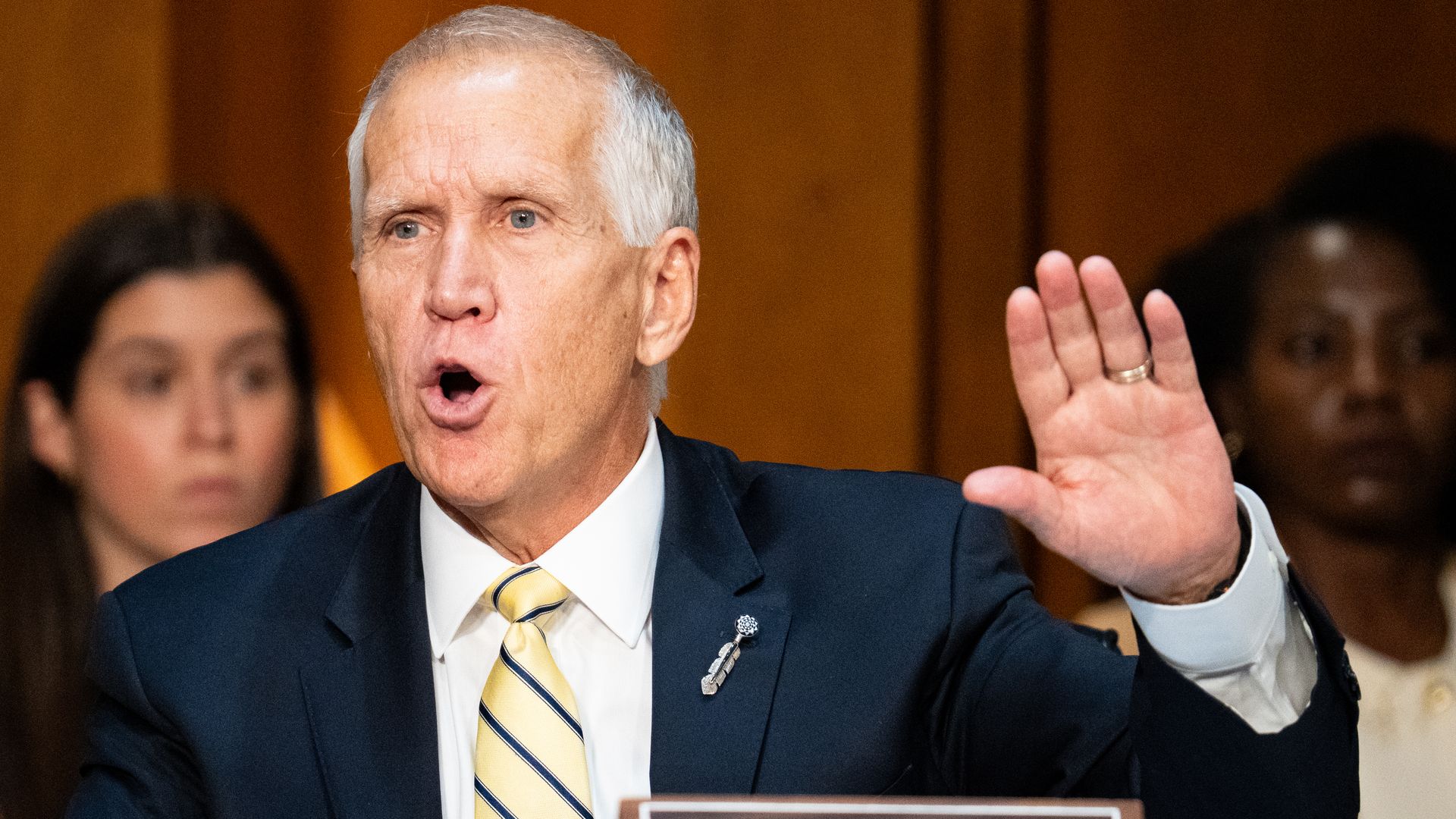
Annie Farmer called the meeting “abrasive, condescending, intentionally noncommittal.” Dani Bensky said, “We were gaslit.” Jess Michaels described a meeting that left survivors feeling patronized rather than answered.[2][3] Those descriptions matter because Tillis had framed the meeting as a prerequisite to confidence in Blanche. The meeting happened. The confidence did not plainly follow.
What Tillis Actually Forced
Tillis did not ask Blanche for a written policy memo, a future briefing, or a promise to review the Epstein files at some later date. He demanded a same-day meeting with survivors before Blanche’s nomination could proceed on Tillis’ terms. DOJ responded quickly enough to make clear that the demand had teeth.[1]
That speed is the first fact worth taking seriously. Confirmation hearings are built to absorb displays of displeasure. Nominees say they will look into something. Senators say they are troubled. Staff negotiate letters after the cameras leave. This was different because the requested act occurred before the hearing day was over, while Blanche’s vote count was still exposed.
Tillis’ public reaction after the meeting was careful. He said Blanche sitting down with survivors was “a very important part of getting to yes.”[4] The phrase did work for both sides. It let Tillis credit the meeting without declaring that Blanche had earned his vote. It let Blanche point to compliance without being able to claim that the condition had fully cleared.
The distinction is not semantic. On a committee with no easy spare vote, “getting to yes” is not yes. It is a holding pattern.
The Survivors Heard Evasion, Not Repair
The survivors entered the room after months of reasons to distrust DOJ’s handling of Epstein-related materials. The department had released roughly 3.5 million pages under the Epstein Files Transparency Act, then retracted approximately 9,500 documents after survivors’ identities were exposed; a federal judge found that Blanche conceded legal violations related to redactions.[5] The retraction figure comes from a legislative press release, not an independent audit, but even taken narrowly it explains why a meeting about accountability would be heard against a record of prior harm.
Farmer’s account was the bluntest procedural indictment. She said Blanche gave survivors no meaningful commitment and described him as “intentionally noncommittal.”[2] Bensky’s “gaslit” description went to the feel of the exchange, but it also captured something more concrete: survivors said they were being asked to accept DOJ’s posture without receiving a usable answer about what would happen next.[3]
Blanche did not publicly pretend the meeting repaired the relationship. His own account conceded friction. “It wasn’t all cordial,” he said afterward.[1] That phrasing is more useful than the usual vocabulary of listening sessions because it admits the room did not behave like a managed photo opportunity.
The problem is that the survivors’ accounts went beyond tone. They described a meeting in which the department still would not say what consequence would follow from the mishandling of their identities or whether additional prosecution decisions were likely to change. Blanche said he could not offer “some form of justice,” and further prosecutions remained uncertain.[3] That is a candid limitation. It is also a poor substitute for the assurance Tillis had asked the meeting to test.
The Redaction Argument Did Not Land Cleanly
Blanche has tried to frame the redaction failures through error-rate comparisons, including references to one percentage of redactions and a much smaller percentage of all materials. Those numbers measure different denominators, so they should not be treated as a direct contradiction. But the denominator shift also illustrates why survivors were unlikely to experience the explanation as responsive.
A population-wide error rate can make a release look statistically defensible while still doing little for the person whose name was exposed. Victim-treatment obligations do not operate only at the aggregate level. If the question in the room is what DOJ did after survivors’ identifying information appeared in files, a percentage of total pages released answers a different question.
The REDACT Act, introduced by Rep. Pramila Jayapal and Sen. Cory Booker on July 14, would allow Epstein survivors to seek at least $50,000 in damages for privacy violations and would strengthen accountability for DOJ redaction failures.[5] That bill is not the same thing as Blanche’s nomination fight. But its timing shows that Congress was not treating the redaction issue as a closed administrative mistake when Tillis made his demand two days later.
Why Tillis Could Make DOJ Move
Tillis’ leverage begins with arithmetic. The Judiciary Committee is split between 11 Republicans and 10 Democrats. Sen. Lindsey Graham’s death on July 12 left a Republican vacancy, which means the remaining GOP members have no room for a defection if Democrats oppose Blanche in committee.[6][7]
| Committee fact | Effect on Blanche nomination |
|---|---|
| 11 Republicans, 10 Democrats | A party-line vote can advance the nomination only if every remaining Republican supports it. |
| Graham vacancy after July 12 | The Republican side has no spare vote while the vacancy remains. |
| Tillis has not committed | His conditional praise of the meeting does not yet solve the vote count. |
| Cornyn has also raised concerns | The pressure is not limited to one senator, though Tillis’ demand produced the immediate meeting. |
The second source of leverage is personal political position. Tillis announced on June 29, 2025, that he would not seek reelection, saying he would have “the pure freedom to call the balls and strikes as I see fit.”[8] Senators say such things more often than they act on them. Here, the structure made the declaration operational. A retiring member on an 11-10 committee can impose conditions that a safer majority might ignore and a vulnerable incumbent might hesitate to make.
That does not make Tillis an independent actor on every question, and it does not make his demand altruistic by definition. It means his vote was positioned in a way that allowed a procedural demand to become an immediate institutional instruction. DOJ did not have to find the meeting morally persuasive to find it necessary.
The Epstein Meeting Was Not Tillis’ Only Condition
The survivors’ meeting drew the public attention, but Tillis had another unresolved demand. He wants verifiable “work product” to eliminate a $1.776 billion anti-weaponization fund.[9] Sen. John Cornyn has also expressed concerns about that fund, which means Blanche’s path through committee is not reducible to whether one meeting occurred.[7]
This is where ceremonial reassurance becomes especially thin. A nominee can satisfy the visible condition and still fail to close the file. Tillis can praise Blanche for meeting survivors and still withhold support over the fund. Cornyn’s concerns can compound the problem even if Tillis ultimately moves toward yes. The public act of compliance did not erase the private arithmetic.
As of July 21, the next Judiciary markup is roughly two weeks away, and Tillis has not made a firm public commitment. Reporting after the meeting suggested that Tillis might back Blanche, but that possibility remains short of a recorded vote.[10]
What the Demand Resolved, and What It Did Not
The July 16 demand resolved one immediate question: whether DOJ would make Blanche available to survivors before the committee moved further on his nomination. It did. The department arranged the meeting within hours, and Blanche sat across from people whose identities and privacy interests had already been mishandled by the institution he seeks to lead.[1][5]
It did not resolve whether survivors received answers they considered meaningful. Their descriptions were not mixed in any way that helps Blanche. Farmer heard condescension and noncommitment. Bensky described gaslighting. Michaels described a patronizing exchange. Blanche’s own statement that the meeting was not all cordial confirmed conflict without supplying the missing commitments.[1][2][3]
It also did not resolve the committee problem. Tillis forced a meeting because his vote mattered, and afterward his praise remained conditional for the same reason. With an 11-10 committee, a vacancy on the Republican side, and at least one other Republican raising concerns, Blanche still lacks the comfortable margin that would turn compliance into confirmation momentum.[6][7]
That is the clean endpoint for now. Tillis extracted a procedural concession from DOJ. Survivors described the concession as dismissive. Blanche gained at most a senator’s acknowledgment that one part of “getting to yes” had occurred. The committee still has no margin for a Republican no.
References
- Todd Blanche Senate hearing witnesses, CNN, July 16, 2026
- Epstein survivor says Blanche meeting was abrasive, condescending and noncommittal, The Hill
- Epstein victims describe meeting with Todd Blanche and DOJ, CNBC, July 17, 2026
- Tillis says Blanche meeting with Epstein survivors is important part of getting to yes, The Hill
- Jayapal, Booker Introduce REDACT Act to Protect Epstein Survivors and Strengthen Accountability for DOJ Privacy Violations, Office of Rep. Pramila Jayapal, July 14, 2026
- Todd Blanche meeting with Epstein accusers, CBS News
- Todd Blanche Senate confirmation attorney general takeaways, NPR, July 15, 2026
- Thom Tillis not seeking reelection, CNN, June 29, 2025
- Stepping back from Senate, Thom Tillis vows to call balls and strikes. What about his crucial Judiciary Committee vote?, Courthouse News
- Tillis Might Back Blanche As AG Pick Met Epstein Survivors, Law360
Comments
Join the discussion with an anonymous comment.