
The reason Thom Tillis opposes Pulte's intelligence nomination is not hard to locate. What is harder, and more important, is explaining why the nomination still mattered after Tillis declared it effectively dead.
On June 3, 2026, the North Carolina Republican told CNBC that Bill Pulte, President Trump's pick for Director of National Intelligence, had "no prayer" of Senate confirmation. Tillis called him an "incendiary attack dog," questioned his temperament, pointed to Pulte's lack of intelligence experience and reported lack of a security clearance, and raised the fact that Pulte had been removed from his family's company board and disavowed by family members. Those were not the usual calibrated reservations of a senator preserving room to negotiate. They were a public finding of unfitness from inside the president's own party. [1]

Three weeks later, after Pulte had been installed in an acting capacity, Tillis sharpened the charge. He told Roll Call that Pulte was an "incompetent sycophant" and described prospective firings as "another hot steaming pile of DOGE shit." The more consequential line was not the insult. It was Tillis's prediction that the next confirmed DNI would inherit "a mess left behind by Pulte." [2]
That is the point at which the dispute stops being a colorful episode of Republican infighting. Tillis was not merely saying that he would vote no. He was saying that a person he regarded as unconfirmable was already in position to alter the intelligence bureaucracy before the Senate could perform its constitutional function.
Nor was Tillis alone in expressing concern. The Hill reported broader Republican skepticism, including Senate Majority Leader John Thune's warning that "we don't need a weaponized DNI" and Sen. Bill Cassidy's view that Pulte was "not qualified," along with separate questioning from Sens. John Cornyn, Susan Collins, and Lisa Murkowski. [3] The breadth matters less as a head count than as evidence that Tillis's objection was not an isolated personality clash.
The Confirmation Fight Became A Vacancies Fight
A failed nomination ordinarily ends in a familiar way: the president withdraws the nominee, the Senate rejects the nominee, or the administration chooses a different candidate. The Pulte episode is harder because the disputed nominee did not need to be confirmed before exercising power. He could be placed in the job as acting DNI.
That shift moved the controversy into the space between two statutory regimes. The Federal Vacancies Reform Act permits acting service in many Senate-confirmed offices and, as legal commentators have noted, can allow a president to draw an acting officer from an unrelated agency rather than from the vacant office's internal line of succession. Lawfare described Pulte's appointment as illustrating a loophole in that framework. [4]
The DNI position also has its own succession statute. The relevant language in 50 U.S.C. Section 3026 provides that the Principal Deputy Director of National Intelligence "shall" act as DNI when the office is vacant, language that some scholars argue may displace the Vacancies Act for this office. The Atlantic reported that Protect Democracy attorneys have argued Pulte may lack authority to fire career employees if his appointment was invalid. [5]
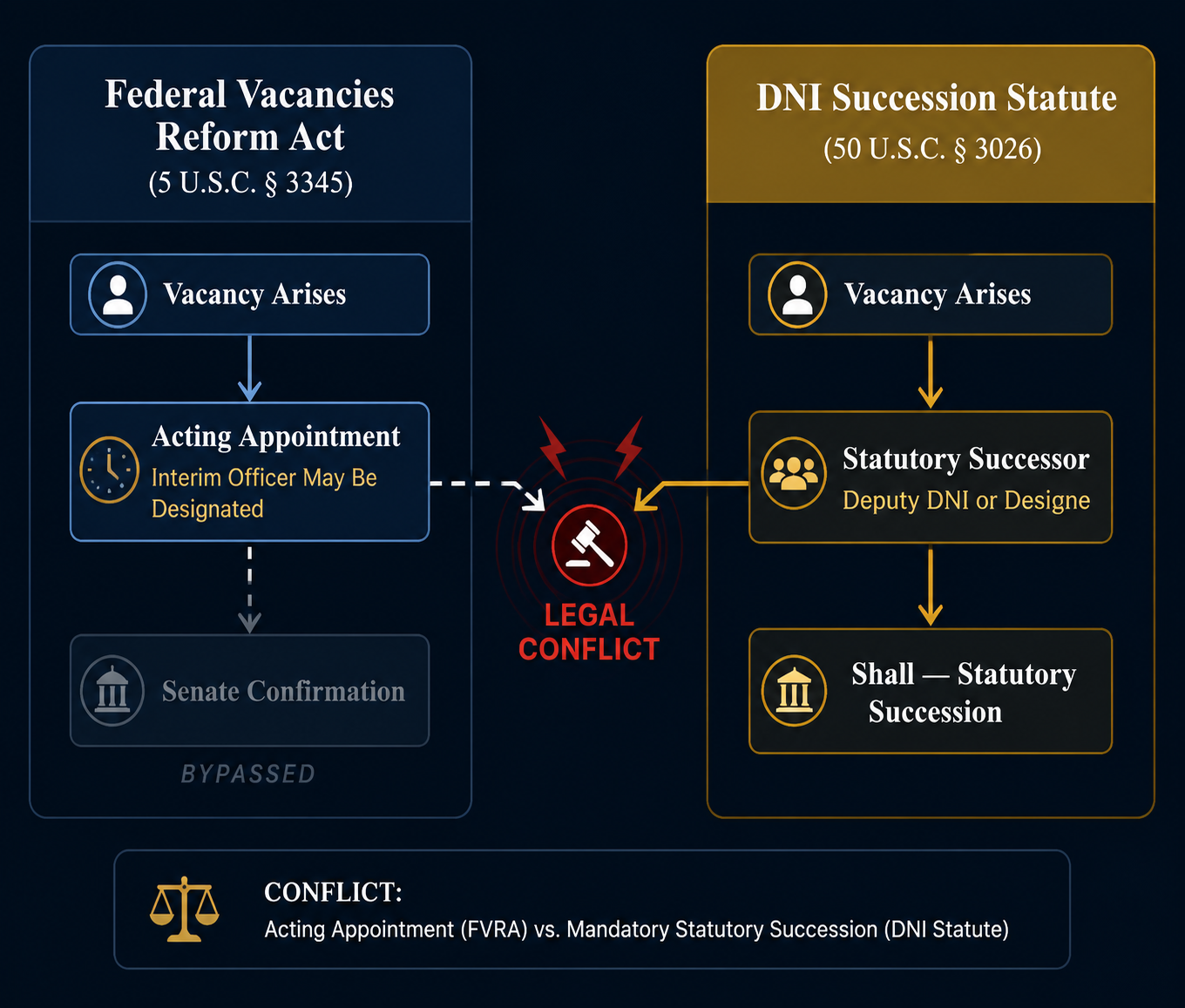
The legal issue should not be flattened into a confident answer either way. The materials cited here do not identify a judicial ruling resolving whether the DNI succession statute's mandatory language overrides the Vacancies Act. The uncertainty is itself part of the institutional problem. If the executive branch can rely on one statute while critics plausibly invoke another, an acting official may make decisions that later officials, courts, employees, and congressional overseers must sort through after the fact.
Why Qualifications And Clearance Norms Were Not Side Issues
No statute requires that every intelligence nominee come from a career intelligence background. Presidents have always used Senate-confirmed offices to import priorities, loyal advisers, and outside experience. But the DNI is not an ordinary policy post. It coordinates the intelligence community, interfaces with Congress on surveillance authorities, and sits close to national security information that depends on both legal authority and trust.
That is why Tillis's objections about experience, clearance, temperament, and Pulte's conduct at the Federal Housing Finance Agency carried institutional weight. CNBC and The Hill reported that Tillis criticized Pulte's lack of intelligence experience, lack of a security clearance, and alleged weaponization of FHFA against political opponents. [1][3] Those objections go to whether the Senate should entrust a nominee with intelligence authorities. They also go to whether the executive branch should be able to reach the same practical result through an acting designation.
The family-board episode belongs in that narrower frame. It does not prove anything about statutory authority, and it should not be inflated into a proxy trial of Pulte's private life. Tillis used it as evidence of judgment and credibility: Pulte had been removed from his family's company board and disavowed by relatives, according to CNBC's account of Tillis's remarks. [1] In a confirmation process, senators can test such facts openly. In an acting appointment, the same concerns may be aired only after authority has already been conferred.
Temporary Authority Produced Durable Personnel Consequences
The concern was not theoretical for long. CNN reported that, on June 22 and June 23, Pulte fired six political appointees and removed 45 career officials back to their home agencies. [6] Later reporting described dozens more intelligence officials being fired on July 3.
Personnel actions are often treated as the easiest acts to dismiss as internal management. In this context, they are the core of the dispute. Removing political appointees is one thing; moving career officials across the intelligence community while the legality of the acting officer's appointment is contested is another. The officials affected bear immediate consequences. The agencies receiving them must absorb the disruption. A later confirmed DNI inherits not merely a policy disagreement but a changed personnel map.
That is why Tillis's "mess left behind" formulation deserves more attention than the profanity around it. [2] It captures a familiar asymmetry in acting-service fights. The appointment may be temporary, but the resulting records, firings, reassignments, litigation risks, oversight demands, and morale effects are not automatically temporary.
The Clayton Off-Ramp Closed
There was, briefly, a conventional path out. Trump nominated former SEC Chair Jay Clayton as intelligence chief, and Tillis responded approvingly. The Hill reported on June 11 that Tillis called Clayton an "OUTSTANDING choice" and supported swift confirmation. [8]
That development matters because it separates Tillis's opposition to Pulte from generalized resistance to Trump's nominees. Tillis was not insisting that the Senate grind the process to a halt. He was embracing an alternative nominee and a return to advice and consent.
Then the off-ramp narrowed. Punchbowl News reported on June 17 that Trump delayed Clayton's hearing and tied the nomination to reauthorization of Section 702 of the Foreign Intelligence Surveillance Act and the SAVE America Act. [9] The same reporting placed the delay in a broader fight over FISA, where Section 702 had expired on June 12 after a House vote fell short and Democrats refused renewal while Pulte remained in line for DNI. [9]
This is the point at which the confirmation fight and the surveillance fight became mutually reinforcing. Senators who wanted a confirmed DNI had to deal with an acting DNI they questioned. Lawmakers who wanted Section 702 reauthorized had to confront Democratic refusal to move while Pulte remained in the chain of authority. The White House, by delaying Clayton, turned what could have been a personnel correction into a leverage crisis.
| Date | Event | Institutional Significance |
|---|---|---|
| June 3, 2026 | Tillis says Pulte has "no prayer" of confirmation. | A Republican senator publicly treats the nominee as unconfirmable. |
| June 11, 2026 | Trump nominates Jay Clayton; Tillis praises the choice. | The Senate appears to have a conventional confirmation path available. |
| June 17, 2026 | Trump delays Clayton's hearing and links the nomination to FISA and the SAVE America Act. | The off-ramp becomes entangled with surveillance and voting legislation. |
| June 22-23, 2026 | Pulte removes political appointees and career officials. | Acting authority produces personnel consequences before confirmation. |
| July 3, 2026 | Dozens more intelligence officials are reportedly fired. | The cleanup burden for a future confirmed DNI grows. |
The Senate's Power Is Harder To Use After The Work Is Done
The Senate's advice-and-consent power is most meaningful before an official acts. Once an acting officer has removed staff, reorganized reporting relationships, influenced FISA negotiations, or created reliance interests inside an agency, a later rejection or replacement does not restore the status quo. It starts a remedial process.
That remedial burden falls unevenly. Career officials may have to challenge or live with decisions made under disputed authority. Senators may have to conduct oversight into actions they never approved at the confirmation stage. A successor may have to decide whether to ratify, reverse, or defend decisions made before taking office. If litigation follows, courts may be asked to decide the validity of agency actions after the affected people and institutions have already absorbed the consequences.
The Vacancies Act exists because government cannot stop whenever a Senate-confirmed office becomes vacant. But an emergency bridge can become an appointments workaround when it is used to install a contested figure from outside the office's statutory succession structure and then permit that official to take consequential action. The question is not whether acting officials may ever act. They must. The question is whether acting service can be used to achieve what confirmation could not.
What Remains Unsettled
The legal status of Pulte's appointment, as described in the available reporting and commentary, remains unresolved. Lawfare identifies the Vacancies Act path; The Atlantic reports arguments that the DNI succession statute may make that path unavailable for this office. [4][5] Without a court ruling or a clear legislative correction, both the executive branch and its critics are operating in a zone where statutory text, administrative practice, and constitutional structure do not point cleanly in the same direction.
That is why Tillis's opposition matters beyond the day's political theater. He put a substantive objection on the record before the Senate had completed its work, and he tied that objection to the practical consequences of acting authority. His language was unusually personal, but the deeper claim was procedural: an unconfirmable nominee should not be able to exercise the powers of a confirmed intelligence chief simply because the statutory architecture can be read to permit a detour.
The episode does not prove that every acting appointment is suspect, or that every Senate objection is institutional rather than political. It does show how quickly the advice-and-consent function can be diminished when a president loses support for confirmation yet retains practical control through acting power. In the intelligence context, where statutory succession, clearance norms, congressional surveillance authorities, and career independence all converge, that is not a procedural footnote. It is the dispute itself.
References
- GOP Sen. Tillis: Trump intelligence pick Pulte has no path in Senate - CNBC, June 3, 2026
- Days into his new job, Pulte raises eyebrows in Senate - Roll Call, June 23, 2026
- GOP senators balk at Donald Trump's pick of Bill Pulte to head national intelligence - The Hill
- Pulte's Appointment Shows Flaws in the Vacancies Act - Lawfare
- Trump Has a Bill Pulte Problem - The Atlantic, June 2026
- Trump's acting chief of national intelligence fires 6 political appointees, removes dozens of career officials - CNN, June 23, 2026
- Housing official who targeted Trump's enemies is named director of intelligence - NBC News
- Trump nominates ex-SEC Chair Jay Clayton as intelligence chief - The Hill, June 11, 2026
- Trump blows up Clayton nom, FISA - Punchbowl News, June 17, 2026
Comments
Join the discussion with an anonymous comment.