
CNN, ABC, and NBC made the same visible choice on July 16: they declined to carry President Trump’s election-security speech live on their linear networks. CNN anchor Kaitlan Collins explained the decision as an editorial judgment, citing Trump’s “well-documented history” of false statements.[1] That shared newsroom decision, however, did not put the three companies in the same regulatory position.
The important legal divide is not whether the speech was newsworthy, whether the explanation sounded political, or whether a president disliked the refusal. It is whether the federal government has a lawful regulatory hook after the refusal. For CNN, ABC, and NBC, the answer runs through three different lanes: cable content, broadcast station licensing, and transaction review.

The category error starts with CNN
CNN is the cleanest way to see why a license-revocation threat can be legally imprecise before it is politically inflammatory. CNN is a cable network. The FCC licenses local broadcast stations; it does not issue CNN a broadcast license comparable to a local ABC or NBC station license. Former FCC Chairman Tom Wheeler put the point bluntly in a different cable-news context: “the FCC does not have jurisdiction over cable networks.”[2]
That distinction matters because the usual presidential threat is phrased as if there were a single thing called “the network’s license” sitting on a shelf at the FCC. There is not. Broadcast regulation is built around local station licenses. Cable programming networks occupy a different legal position, and direct FCC content punishment of CNN for refusing to carry a presidential address is not the same theory as scrutiny of a licensed broadcast station.
The FCC’s own public guidance draws the same constitutional boundary in less technical language. The Commission says it is “barred by law from trying to prevent the broadcast of any point of view,” and that protection cuts directly against a government effort to punish a programmer for declining to carry the president’s preferred speech.[3]
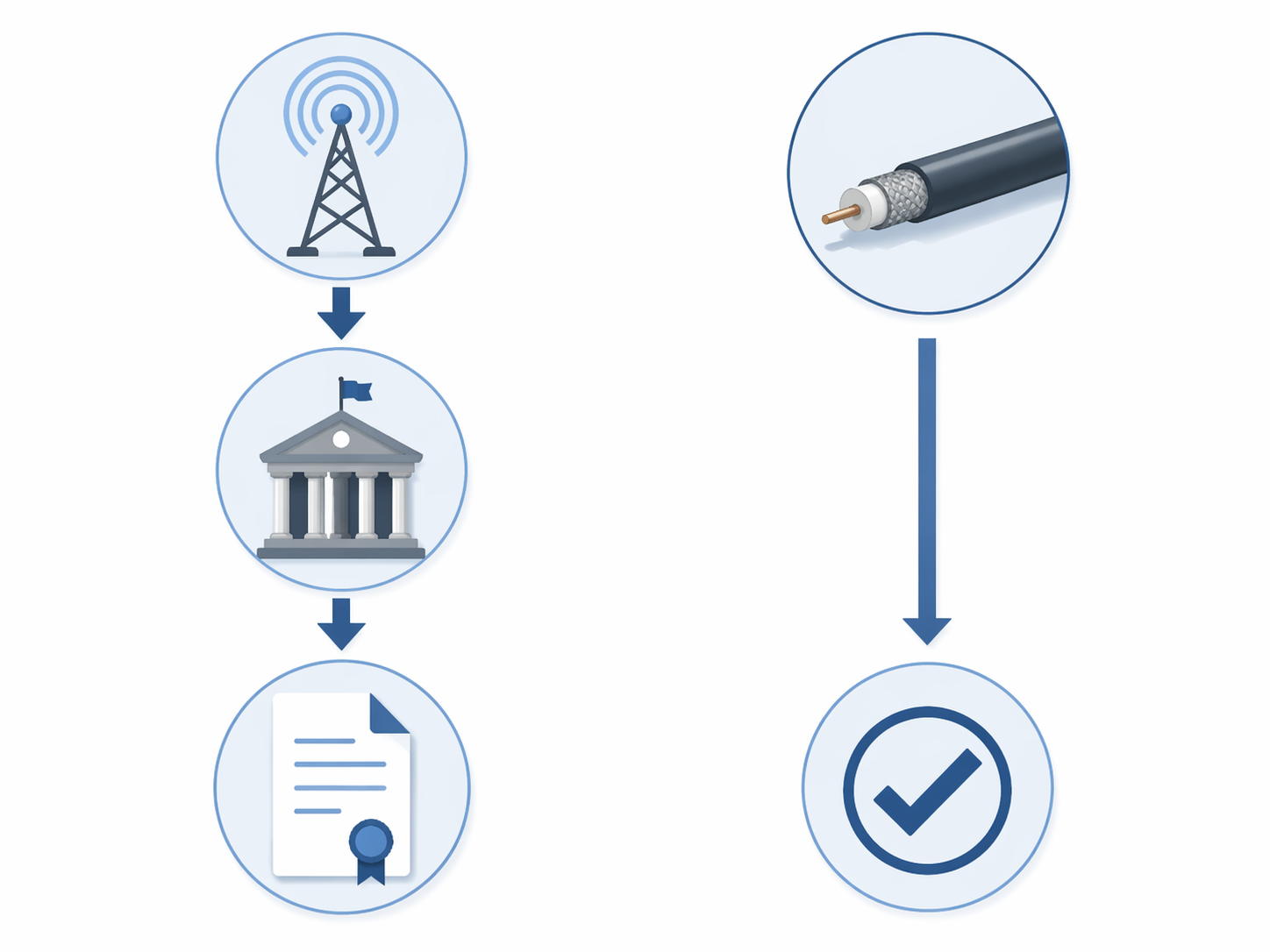
Same refusal, different FCC exposure
The comparison is easiest to state plainly:
| Outlet | What the FCC can directly reach | Why the Trump-speech theory is weak | What still creates pressure |
|---|---|---|---|
| CNN | Not CNN’s cable content through broadcast licensing | Cable networks fall outside the FCC’s direct broadcast-content licensing regime.[2] | Pending transaction review involving Warner Bros. Discovery creates a separate, indirect pressure point.[4] |
| ABC | Local Disney-owned ABC broadcast station licenses | A refusal to carry a political address is not a statutory revocation ground and runs into the First Amendment.[3] | Politico reported early renewal review of eight Disney-owned stations and a separate equal-time investigation involving The View.[4] |
| NBC | Local NBC owned-and-operated broadcast station licenses | There is no freestanding NBC network license to revoke for an editorial programming decision. | Broadcast station licenses are procedurally reachable, even if the ultimate revocation theory is weak. |
The table is not a ranking of editorial virtue. It is a map of legal machinery. CNN has the least direct FCC content exposure because the threatened remedy does not line up with the entity’s regulatory status. ABC and NBC sit closer to the FCC’s ordinary broadcast-licensing apparatus, but even there the hook attaches to stations, not to a network brand floating above them.
CNN is not license-proof; it is differently exposed
It would be too tidy to say CNN is simply safe. The direct content-regulation theory is weak because CNN is a cable network. But Politico reported a separate pressure point: David Ellison’s pending acquisition of Warner Bros. Discovery, CNN’s parent, requires FCC approval.[4] That is not a substitute for cable-content jurisdiction. It is a different regulatory doorway.
The difference matters in practice. If the government says, in substance, “CNN refused to air the speech, therefore revoke CNN’s license,” the problem is basic: CNN does not sit in the broadcast-license posture implied by the threat. If the government applies pressure through merger review, the legal theory changes. The question becomes whether transaction approval is being conditioned, delayed, or examined for reasons tied to the public-interest standard rather than retaliation for protected editorial judgment.
That is why CNN’s position is both stronger and not costless. A legally defective threat can still generate lawyers’ letters, board questions, investor anxiety, and months of regulatory friction. The weakness of the direct theory does not eliminate the burden of being in front of an agency on another matter.
ABC has the most concrete pending broadcast hooks
ABC’s situation is more procedurally exposed because there are actual station licenses and reported pending FCC actions. Politico reported that ABC faces an early license renewal review of eight Disney-owned stations and a separate equal-time investigation involving The View.[4] Those matters are distinct from the July 16 refusal, but they show why a broadcast company’s legal department cannot dismiss the threat merely because the end-state revocation theory is constitutionally frail.
The relevant object is not an “ABC license.” It is the license of a local station owned by Disney and affiliated with ABC. Broadcast licenses generally renew on an eight-year cycle, and renewal proceedings create a forum in which the Commission can ask questions, receive petitions, delay action, or impose conditions within lawful bounds.[2][4] That does not mean the FCC may punish a station because its network declined to carry a presidential address. It means the broadcast structure gives the agency a file number, a procedural vehicle, and a clock.
This is the distinction executives often find unsatisfying and lawyers have to keep repeating. “Unconstitutional” does not always mean “over by Friday.” It can mean the company has a strong eventual defense while still having to answer inquiries, preserve records, brief directors, and decide how much public confrontation it wants with the agency that controls pending applications.
NBC is reachable through stations, not through a mythical network license
NBC’s legal exposure resembles ABC’s in architecture but, on the available record, not in specificity. NBC programming reaches viewers through local broadcast stations, including owned-and-operated stations that hold FCC licenses. Those licenses can be renewed, challenged, or investigated under the Communications Act. But the July 16 refusal still does not create a freestanding “NBC license” that the FCC can revoke because the network declined to carry the president’s remarks.
That distinction is not pedantry. It identifies who is actually before the agency. A network programming decision may be made at the network level, while the legal license sits with a local station. To turn that into revocation, the government would need to connect the conduct to a statutory ground and survive First Amendment review. Refusal to air a political address is a poor fit for both.
The First Amendment problem is not close
FCC Commissioner Anna Gomez, the Commission’s sole Democrat, stated after Trump’s threat that the FCC “has no authority to punish a station for refusing to air a blatantly political speech” and called the demand “ridiculous.”[5] Her institutional position does not decide the legal question by itself, but the statement captures the basic barrier: a licensing agency cannot convert a broadcaster’s refusal to carry government-favored political speech into a punishable offense.
FIRE Chief Counsel Robert Corn-Revere made the same point in constitutional terms: “The First Amendment doesn’t permit the president to demand coverage by royal decree. This is First Amendment law 101.”[6] The phrasing is sharper than agency guidance, but the legal instinct is the same. A government demand for carriage is not just ordinary criticism of media coverage; when backed by licensing consequences, it starts to look like compelled speech.
Section 312(a) of the Communications Act supplies grounds for revoking a broadcast license, but the refusal to carry a presidential address is not among the grounds identified in the materials surrounding this dispute. The FCC’s public guidance also warns against exactly the kind of viewpoint control that a retaliatory revocation theory would require.[3]
Past refusals matter more than dramatic license analogies
The better precedent is not a spectacular license case. It is the mundane record of networks deciding not to carry presidential speeches live. Networks declined President Obama’s 2014 immigration address and President Biden’s September 2022 “Battle for the Soul of the Nation” speech without FCC license action.[7] That history does not create immunity by custom, but it reinforces the ordinary understanding that presidential airtime is an editorial decision, not a compulsory public utility service.
The RKO General comparison is much less useful if it is treated as proof that licenses can be pulled for disfavored news judgment. The RKO proceeding began in 1965, ran for 23 years, and was resolved in 1988; it involved bribery and other misconduct, not a refusal to air a political address.[8] The American Bar Association’s Legal Fact Check also noted that the FCC has revoked “few licenses for violations over its 83 years.”[8]
That history points in the opposite direction from the easy analogy. License revocation exists, but it is rare, procedurally heavy, and tied to statutory violations. It is not a quick executive remedy for a network’s refusal to surrender prime time.
The practical risk is process, not a clean revocation order
The strongest legal conclusion is also the least comforting operational one. Revoking licenses over the July 16 refusal would be constitutionally and statutorily implausible for all three networks. But the procedural pressure is unequal.
- CNN faces minimal direct FCC content exposure because it is a cable network, not a broadcast licensee in the relevant sense.
- CNN still faces an indirect regulatory pressure point because its parent company is involved in a pending transaction requiring FCC approval.
- ABC faces the clearest concrete broadcast-process exposure because reported FCC matters already involve Disney-owned stations and The View.
- NBC remains procedurally reachable through owned-and-operated station licenses, but the available record does not show the same specific pending hooks identified for ABC.
- None of the three becomes lawfully punishable merely because the president wanted live carriage and did not get it.
That is the asymmetry at the center of this dispute. The license-revocation threat has the least direct legal force against CNN because cable content sits outside the FCC’s direct broadcast-licensing regime. ABC and NBC are closer to the machinery of FCC licensing because their owned stations hold broadcast licenses, but the government still needs a statutory ground and a constitutionally permissible theory. Disliking an editorial refusal supplies neither.
References
- ABC, NBC And CNN Won't Carry Trump's Speech On Their Linear Networks, Deadline, 2026-07-16.
- Why there's little the government can do to police the truth on cable TV, NPR, 2023.
- The FCC and Speech, Federal Communications Commission.
- Trump's threats to revoke TV licenses get serious, Politico, 2026-07-17.
- FCC commissioner says Trump call to revoke ABC, NBC licenses is unconstitutional, Reuters, 2026-07-17.
- Broadcasters Should Not Lose Their Licenses Because They Don’t Broadcast the President’s Speech, Cato Institute.
- To air or not to air? TV networks struggle to find right balance for Trump speech, First Amendment Center at MTSU.
- ABA Legal Fact Check: Can television networks lose their licenses based on their news reports?, ABA Legal Fact Check.
Comments
Join the discussion with an anonymous comment.