
The practical antitrust law implications of the Ticketmaster DOJ settlement do not come from settlement terms alone. They come from what happened after the federal government chose those terms: 33 states and the District of Columbia refused to stop, tried the case, and won a unanimous jury verdict on every federal and state antitrust count, including Section 2 monopolization, unlawful tying, and state antitrust claims.[1]
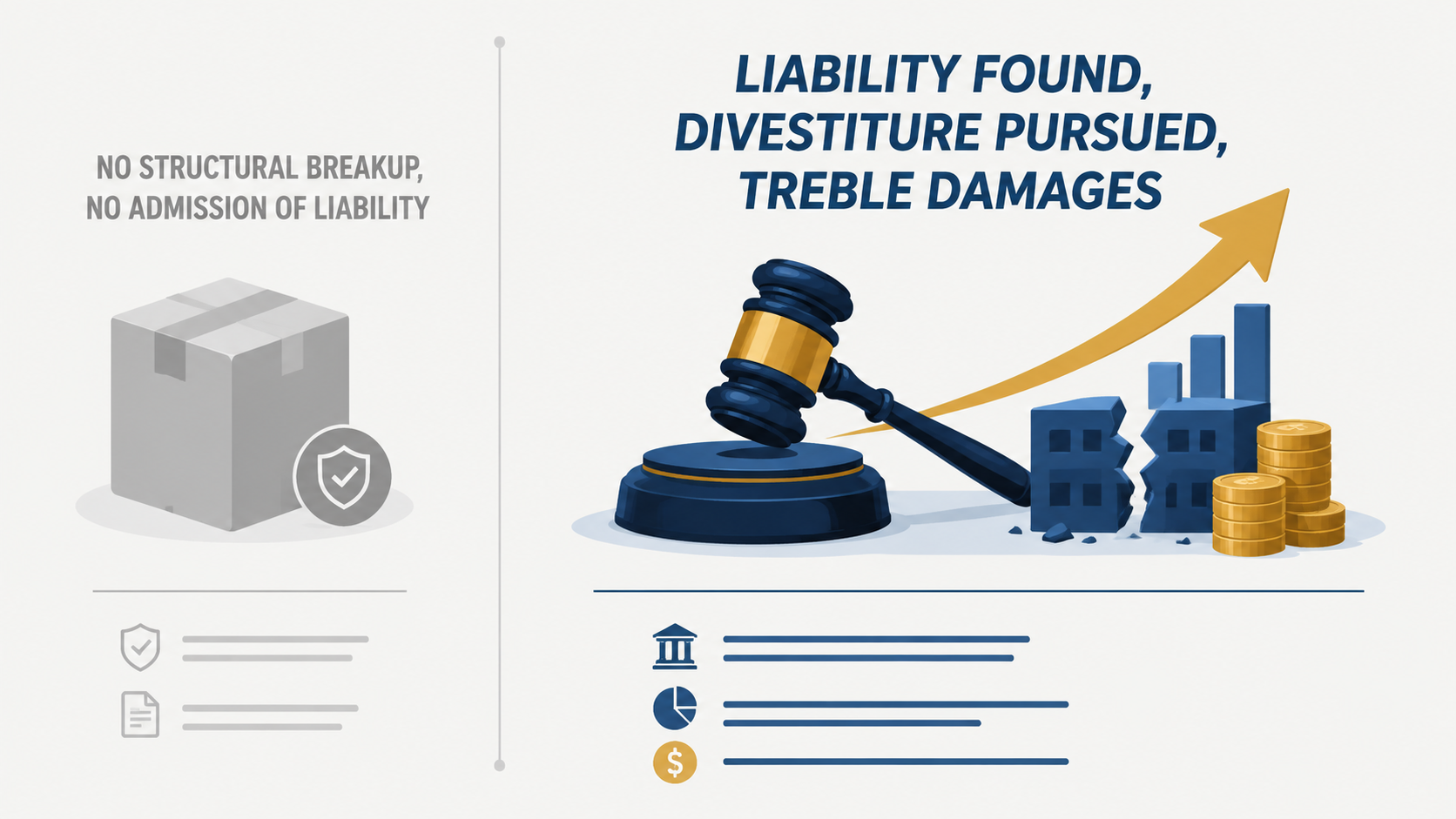
That sequence is the part counsel should not smooth over. The Department of Justice’s proposed resolution with Live Nation/Ticketmaster did not require a structural breakup and did not include an admission of liability. The state plaintiffs, by contrast, now hold adjudicated liability findings and continue to seek divestiture in a remedy phase that has not yet begun.[2] For any company treating federal clearance as the closing chapter of antitrust exposure, this case is already an uncomfortable file.

The settlement did not control the case
A mid-trial federal settlement usually has gravitational force. It gives defendants a business answer, gives agency leadership a public result, and often makes parallel claims look secondary. Here, the formal federal settlement did not extinguish the states’ leverage. It exposed the difference between resolving an agency case and resolving antitrust liability.
The DOJ’s proposed settlement created a $280 million settlement fund and left Live Nation/Ticketmaster intact as an integrated business. The state-led verdict, if it survives post-trial motions and appeal, has been estimated to support about $450 million in trebled damages.[2][3] Those numbers should not be treated as settled recoveries. They are better read as a map of institutional consequence: one path offers negotiated monetary relief without structural separation; the other carries liability findings, potential treble damages, and a still-live request for divestiture.
| Track | What it currently provides | What remains unresolved |
|---|---|---|
| DOJ proposed settlement | $280 million settlement fund; no structural breakup; no admission of liability | Tunney Act review and court approval |
| State-led verdict | Liability findings on federal and state antitrust counts; potential trebled damages estimated at about $450 million | Rule 50 and Rule 59 motions, remedy phase, possible appeal |
| State remedy request | Divestiture remains pursued by the states | No structural remedy has been ordered as of Q3 2026 |
The jury record also gave the states facts that a settlement would not have supplied in the same way. Trial materials included an 86% ticketing market share and a $1.72 per-ticket overcharge finding.[3] Market share alone does not prove the whole Section 2 theory, and a per-ticket overcharge finding does not answer every remedial question. But together they convert a market-structure dispute into something more concrete: a jury accepted both a monopoly theory and a measurable injury theory.
That matters because litigation risk is not only the probability of being sued. It is also the kind of record an opposing enforcer can build if it refuses to accept the negotiated federal endpoint.
The states now have more than protest value
State attorneys general are often described as supplemental actors in federal antitrust cases: important, politically visible, and capable of complicating a settlement, but not usually treated as the forum that will set the outer remedial boundary. The Live Nation/Ticketmaster litigation is hard to fit into that model. The states did not merely object from the sidelines. They preserved their claims, went to verdict, and obtained findings broader than the federal settlement required.[1][2]
This is not a reason to romanticize state enforcement. A verdict can be narrowed, vacated, remitted, or overtaken by a later settlement. State coalitions can fracture. Remedies that sound available in a complaint may become harder to justify after a judge weighs administrability, business disruption, and evidentiary fit. Still, the point for counsel is immediate: state participation is no longer safely modeled as a pressure campaign that disappears once the DOJ signs.
The distinction is especially important for vertically integrated companies. A federal agency may decide that conduct commitments, monitoring, or a fund are adequate. A state coalition may decide that the same facts support structural relief. If the states can credibly try that theory, the company does not have one antitrust settlement problem. It has competing remedial endpoints.
Why the verdict is powerful but not final
The cleanest mistake would be to say that divestiture is now inevitable. It is not. The remedy phase has not yet begun, and structural relief may not be determined until late 2026 or 2027.[2] A liability verdict changes the bargaining posture and the remedial record, but it does not itself decide what a final injunction will require.
There are also post-trial motions in front of Judge Subramanian. Rule 50 and Rule 59 motions are pending, with briefing completed July 2, 2026.[2] Those motions could affect the verdict, the damages theory, or the need for a new trial. Live Nation has also indicated it will appeal any unfavorable ruling, making final resolution unlikely before 2028.[2] A board presentation that describes the verdict as final would be as incomplete as one that describes the DOJ settlement as complete peace.
The DOJ settlement is also not finished. The proposed final judgment remains subject to Tunney Act review, and the 60-day public comment period runs through early September 2026.[2] The Tunney Act does not turn every consent decree into a trial, but it does mean the court has not yet entered the federal settlement as a final judgment. The federal track and the state track are both still moving.
That procedural posture is awkward for public messaging but useful for risk analysis. The case has already produced an enforcement lesson even though it has not produced a final remedial answer. State enforcers can preserve leverage after a federal settlement; a jury can validate theories the federal settlement did not require the defendant to admit; and structural relief can remain on the table after the federal agency has chosen a non-structural resolution.
Federal clearance is not the same as antitrust closure
The operational lesson is less dramatic than the word “landmark” and more useful than a press-release victory lap. Federal clearance, federal settlement, or federal non-opposition should no longer be treated as a sufficient stopping point where state enforcers have independent claims, political incentives, damages authority, or a plausible structural remedy.
That does not mean every major transaction or conduct investigation now faces a state trial after federal resolution. It means the risk file has to ask different questions before deal teams tell directors that the antitrust issue is closed:
- Which states have independent statutory claims, damages theories, or parens patriae standing that survive the federal resolution?
- Does the proposed federal remedy leave intact the business structure that state enforcers say caused the violation?
- Are state AGs aligned with the federal agency on remedy, or only on liability theory?
- Would a state trial create findings that change settlement leverage, private follow-on exposure, or board-level disclosure obligations?
- Does the transaction or platform involve local consumer impact that gives state enforcers a politically durable reason to keep going?
Those questions belong early in deal planning, not after the DOJ or FTC process has consumed the calendar. The Live Nation/Ticketmaster record is particularly sharp because the federal and state tracks separated in public view. But the same planning issue can arise more quietly, through state information demands, side settlements, threatened state complaints, or state demands for remedies broader than the federal agency is prepared to seek.
The divergence is not isolated
Live Nation/Ticketmaster is the most vivid current example because the split produced a jury verdict. It is not the only signal that federal-state divergence has become a recurring feature of antitrust practice. The Nexstar/Tegna mini-HSR process and the T-Mobile/Sprint consent decree have both been identified as examples in which federal and state enforcement positions did not move in a single line.[1][4]
Those comparisons should be used carefully. They do not prove that state AGs will routinely surpass federal agencies, and they do not make every consent decree fragile. They show something narrower: parties cannot assume that federal agency resolution will necessarily discipline state strategy. The state actors may have different remedies, different constituencies, and different tolerance for trial risk.
That difference changes negotiation sequencing. A defendant may settle with the DOJ to reduce uncertainty, only to discover that the settlement supplies state plaintiffs with a useful contrast: the federal government accepted conduct relief or money; the states are still asking whether the underlying structure should exist. In that posture, the federal settlement is not only a shield. It can become the benchmark the states argue is insufficient.
What counsel should change now
The immediate adjustment is not to predict a wave of divestitures. It is to stop treating state antitrust exposure as an appendix to federal review. In merger and conduct matters with meaningful state interest, counsel should build a separate state-enforcement assessment with its own remedy analysis, timing assumptions, and litigation-risk range.
That assessment should distinguish four things that too often get merged in client alerts and board decks: agency clearance, settlement approval, liability adjudication, and remedial finality. Live Nation/Ticketmaster now has different answers for each. The DOJ has proposed a settlement. The Tunney Act process remains open. The states have won liability findings. The remedy phase and appeal path remain unresolved.[1][2]
For boards, the practical consequence is a more cautious closing memo. If state AGs are still litigating, counsel should not describe federal settlement as global clearance unless the settlement actually binds the relevant state claims. If structural relief remains requested, the risk discussion should say so plainly, even if management believes the remedy is unlikely. If damages depend on post-trial motions, the damages number should be presented as contingent rather than booked as an inevitable outcome.
Sports ticketing is the obvious watch item because the Live Nation/Ticketmaster case concerns ticketing markets and because Crowell has flagged possible sports-ticketing exposure. But the boundary matters: as of July 2026, no parallel sports-ticketing cases have been filed.[2] The responsible conclusion is not that sports ticketing is next. It is that companies with similar integration, exclusivity, or ticketing-control features should expect lawyers and enforcers to read the Live Nation record closely.
A narrower but real shift
The Live Nation/Ticketmaster litigation has not completed a revolution in antitrust enforcement. The DOJ settlement may still be approved, modified, or rejected through the Tunney Act process. The state verdict still faces Rule 50 and Rule 59 motions, a remedy phase, and likely appeal. Divestiture remains requested, not ordered. The estimated trebled damages remain contingent, not collected.
But as of Q3 2026, the case has already changed the risk calculus. The important fact is not simply that state AGs disagreed with the DOJ. It is that they refused the federal endpoint, carried the case through trial, and obtained findings that keep stronger remedies alive. For antitrust counsel, that is enough to retire the comfortable sentence that government settlement means the risk file is closed.
References
- Live Nation/Ticketmaster Antitrust Verdict, Paul Weiss
- After the Verdict, Crowell & Moring
- States Win Antitrust Case Against Live Nation, Duane Morris, April 15, 2026
- Live Nation-Ticketmaster Antitrust Verdict, Altman & An
Comments
Join the discussion with an anonymous comment.