
The legal consequences in the Today Show intruder case turn less on the celebrity setting than on the way Manhattan prosecutors charged the encounter: Andrew Truelove was arraigned on burglary in the third degree as a hate crime and menacing in the third degree as a hate crime after the July 16, 2026 incident involving Craig Melvin at NBC’s studios in Manhattan.[1] That distinction matters. “Hate crime” is not a standalone moral caption in New York; under Penal Law Article 485, it is a charging and sentencing mechanism that attaches to an underlying specified offense when prosecutors can prove the required bias-selection element.[2]
At arraignment, prosecutors also obtained temporary orders of protection for Melvin and Al Roker, and NBC reported bail was set at $10,000 cash with the next court appearance scheduled for July 22.[1] Those facts place the case where it belongs procedurally: early, accusatory, and not yet tested by motions, hearings, plea litigation, or trial proof.
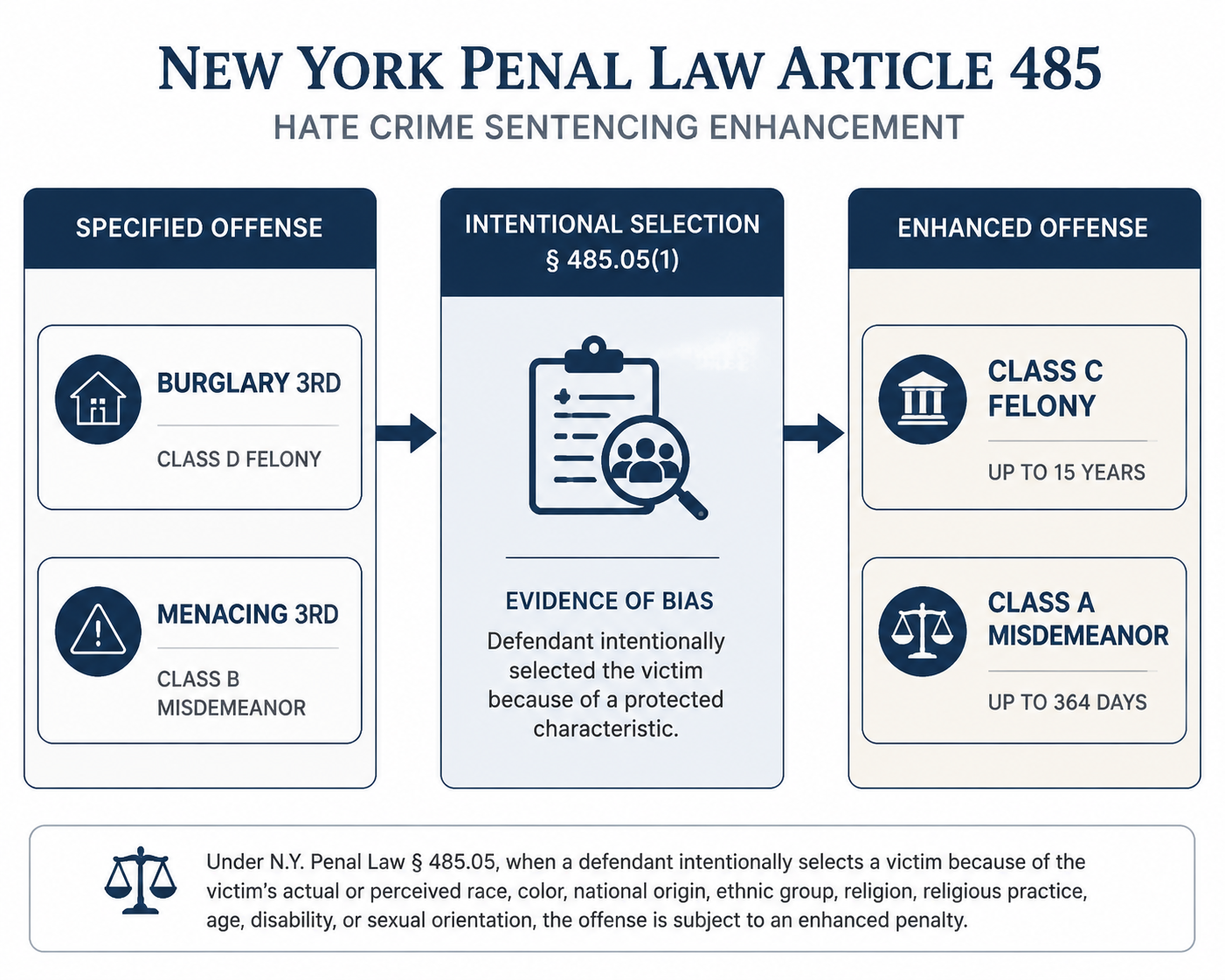
The Filed Charges Are Burglary and Menacing, Not a Free-Floating Hate Crime
The arraignment complaint, as publicly reported, charged two underlying offenses in hate-crime form: third-degree burglary and third-degree menacing.[1] The original police arrest report had referred to criminal trespass and harassment, but the public reporting does not make clear whether those original allegations were dropped, replaced, or effectively subsumed by the district attorney’s later arraignment charges. For legal analysis, the operative public frame is the DA’s complaint at arraignment.
Third-degree burglary under New York law is committed when a person knowingly enters or remains unlawfully in a building with intent to commit a crime there; it is a class D felony.[3] Third-degree menacing is committed when a person, by physical menace, intentionally places or attempts to place another person in fear of death, imminent serious physical injury, or physical injury; it is a class B misdemeanor.[4]
| Underlying charge | Ordinary classification | Hate-crime classification effect |
|---|---|---|
| Burglary in the third degree | Class D felony | Punished as a class C felony if Article 485 is proved |
| Menacing in the third degree | Class B misdemeanor | Punished as a class A misdemeanor if Article 485 is proved |
That is the legal frame before the studio narrative is replayed. The entry allegation matters because burglary requires unlawful entry or unlawful remaining. The lunge allegation matters because menacing requires physical menace. The alleged racial slur matters because Article 485 requires proof that the victim was intentionally selected, at least in substantial part, because of a protected characteristic.
How Article 485 Turns a Specified Offense Into a Hate Crime
New York Penal Law § 485.05 defines when a person commits a hate crime. The part most relevant here is § 485.05(1)(a): a person commits a hate crime when they commit a specified offense and intentionally select the person against whom the offense is committed, or intentionally select the property damaged or otherwise affected, in whole or in substantial part because of a belief or perception regarding protected characteristics including race, color, national origin, ancestry, gender, religion, religious practice, age, disability, or sexual orientation.[2]
The statute does not require the belief or perception to be accurate. It also does not require race, religion, or another protected characteristic to be the only reason for the conduct. The statutory phrase “in whole or in substantial part” is doing real work: mixed motives do not necessarily defeat the enhancement if the protected-characteristic selection was substantial enough to satisfy the statute.[2]
Section 485.10(2) then supplies the sentencing rule. When the underlying specified offense is a misdemeanor or a class C, D, or E felony, the hate-crime conviction is deemed one category higher than the specified offense the defendant committed or attempted to commit.[2] That is why the same conduct can carry different exposure once the Article 485 element is added and proved.

Count by Count, the Enhancement Is a One-Category Move
For the burglary count, the math is direct. Burglary in the third degree is ordinarily a class D felony.[3] If it is established as a hate crime under Article 485, § 485.10(2) moves the sentencing classification one category higher, so it is punished as a class C felony.[2] Public reporting has described the resulting exposure as up to 15 years, which tracks the class C felony maximum rather than a prediction that this defendant will receive that sentence.[5]
For the menacing count, the same statutory mechanism applies at misdemeanor scale. Menacing in the third degree is ordinarily a class B misdemeanor.[4] With the hate-crime enhancement, it is punished one category higher, as a class A misdemeanor.[2] A class A misdemeanor in New York carries a definite sentence of up to 364 days.[6]
The useful way to state the exposure is therefore narrow and mechanical: the enhanced burglary count carries class C felony exposure up to 15 years, and the enhanced menacing count carries class A misdemeanor exposure up to 364 days.[5][6] Loose language such as “faces 15 years” is tolerable only if it is understood as maximum statutory exposure on the enhanced burglary count, not as a sentencing forecast.
Why the Alleged Slur Changes the Legal Shape of the Case
The public allegations are not merely that an intruder got into a television studio and caused alarm. NBC reported that police said Truelove followed someone into the building, went to the second floor, shouted a racial slur at Melvin, and lunged toward him before security intervened.[7] CNN likewise reported that the breach occurred around 7:30 a.m. and that the person allegedly tailgated into the building behind an employee.[8]
That sequence is why the racial slur allegation is not an atmospheric detail. If credited, it gives prosecutors direct evidence that the encounter was not only targeted at a person who happened to be Black, but at least in substantial part selected because of race. In many Article 485 prosecutions, the selection element has to be built from surrounding conduct: prior statements, symbols, social media posts, victim-selection patterns, or the circumstances of the offense. A slur allegedly uttered during the confrontation is different. It is contemporaneous, directed, and tied to the same encounter that supplies the burglary and menacing allegations.
That does not eliminate proof problems. A defense lawyer can still challenge identification, intent, the exact words used, whether the alleged statement proves selection rather than insult after selection, and whether the prosecution has satisfied each element of the underlying offenses. But as Article 485 evidence goes, the alleged direct racial slur is stronger than a case in which prosecutors ask a factfinder to infer bias mainly from context.
The Entry Allegation Carries the Burglary Count
The security-breach facts matter because burglary is not just an aggravated trespass label. Prosecutors need unlawful entry or unlawful remaining, plus intent to commit a crime in the building.[3] The reported “tailgating” theory — following someone into the NBC building rather than entering through authorized access — is the public fact that supplies the unlawful-entry side of the analysis.[7][8]
The intent component is the harder part of burglary to read from public reporting alone. The arraignment charge indicates prosecutors believe they can plead and prove the required criminal intent, but an arraignment report is not a trial record. The alleged lunge and slur may be part of the DA’s theory of what crime Truelove intended to commit after entry, but the complaint and later litigation would matter more than headlines for assessing that element.
Reports that a security guard was fired, and that two guards were on duty, help explain how the entry allegedly happened; they do not decide the Penal Law questions.[9] Workplace discipline may matter to NBC’s internal security review. It is secondary to whether the DA can prove unlawful entry or remaining, criminal intent inside the building, physical menace, and intentional selection under Article 485.
The Menacing Count Depends on Physical Menace, Not Just Offensive Speech
The menacing charge also should not be flattened into the slur allegation alone. Third-degree menacing requires physical menace that intentionally places or attempts to place another person in fear of death, imminent serious physical injury, or physical injury.[4] The publicly reported lunge toward Melvin is the fact that maps onto that requirement.[7]
The racial slur then serves a different legal function. It does not substitute for physical menace; it supports the Article 485 selection element. Prosecutors still need both layers: the specified offense and the hate-crime element. If the factfinder rejected the physical-menace proof, the hate-crime enhancement would not rescue the menacing count because there would be no menacing offense to enhance.
Protective Orders and Bail Are Procedural Consequences, Not Proof
The temporary orders of protection for Melvin and Roker are important immediate consequences of the arraignment, especially in a workplace where the alleged conduct occurred near staff and on-air personnel.[1][5] New York Criminal Procedure Law § 530.13 permits criminal courts to issue temporary orders of protection in connection with criminal proceedings.[10] The orders do not prove the allegations; they regulate contact and safety while the case is pending.
The bail reporting should be handled with the same restraint. NBC and PEOPLE reported $10,000 cash bail.[1][5] Some public accounts have reported a different figure, but the better-corroborated number in the provided materials is $10,000. Either way, bail is a release-condition issue at this stage, not a finding on guilt.
What the DA Still Has to Prove
To secure the burglary hate-crime conviction as publicly charged, prosecutors would need to prove the underlying burglary elements and then prove the Article 485 intentional-selection element beyond a reasonable doubt. For the menacing hate-crime conviction, they would need to prove physical menace and the same bias-selection layer. The enhancement does not lower the burden on the underlying offense.
- For burglary: knowing unlawful entry or remaining, plus intent to commit a crime in the building.
- For menacing: physical menace that intentionally places or attempts to place the victim in fear of the required level of harm.
- For Article 485: intentional selection of the victim, in whole or in substantial part, because of a protected characteristic such as race.
- For sentencing enhancement: conviction of the specified offense as a hate crime, triggering the one-category increase under § 485.10(2).
The publicly reported slur gives the DA a clear route on intentional selection, but “clear” is not the same as “already proved.” Complaints preserve allegations; trials test them. Even plea negotiations would turn on what the parties believe can be proved, what evidence exists beyond the public narrative, and how the statutory exposure affects bargaining.
The Right Reading of the 15-Year Figure
The 15-year number is real, but it is easy to misuse. It comes from the enhanced burglary count being punished as a class C felony under Article 485’s one-category rule.[2][5] It does not mean a 15-year sentence is likely, required, or even the central prediction at this point in the case.
That distinction is more than stylistic caution. Sentencing exposure shapes plea leverage, defense risk assessment, and prosecutorial posture. Sentencing prediction requires additional information: criminal history, plea offers, evidentiary strength, judicial discretion, statutory sentencing ranges, and any negotiated disposition. The provided public record supports an exposure analysis, not a forecast.
On the current public facts, Article 485 gives prosecutors a straightforward one-category enhancement path because the alleged racial slur directly supports intentional selection. The burglary count therefore carries class C felony exposure up to 15 years, and the menacing count carries class A misdemeanor exposure up to 364 days. The case remains at the arraignment stage, and the statutory ceiling remains a ceiling.
References
- Today Show Intruder Arraigned on Hate Crime Charges, NBC News,
- New York Penal Law Article 485, YPDcrime.com,
- New York Penal Law § 140.20: Burglary in the Third Degree, YPDcrime.com,
- New York Penal Law § 120.15: Menacing in the Third Degree, YPDcrime.com,
- Today Show Intruder Updated Hate Crime Charges, Restraining Orders, PEOPLE,
- New York Penal Law § 70.15: Sentences of Imprisonment for Misdemeanors and Violation, YPDcrime.com,
- Police Arrest Man Who Shouted Racial Slur at Today Co-Anchor Craig Melvin, NBC News,
- Today Show Intruder Security Breach, CNN,
- Security Guard Fired After Today Show Intruder Incident, PEOPLE,
- New York Criminal Procedure Law § 530.13: Protection of Victims of Crimes, YPDcrime.com,
Comments
Join the discussion with an anonymous comment.