
As of July 20, 2026, the Justice Department’s sanctuary-city legal challenge to New York City is waiting on a threshold question that could end the case before anyone reaches the merits. The United States filed supplemental standing briefing on July 17; the city defendants’ response is due August 5; and Judge Reyes of the Eastern District of New York has already told the parties to address the recent Boston Trust Act dismissal, a pointed signal that Article III standing is doing real work in the case rather than serving as a formality. [1]
That procedural posture is easy to lose under the louder public frame around Tom Homan, ICE operations, and New York’s resistance to federal immigration demands. Homan said in June that he had reviewed an operational plan for a major ICE surge in New York City, after Governor Kathy Hochul signed a state immigration package in late May; Hochul answered that President Trump had told her he would not deploy ICE unless she asked, adding, “I’m not asking.” [2][3] Those statements explain why searches for a “sanctuary city legal challenge Tom Homan NYC” lead to this case. They do not decide whether the United States has alleged a concrete, redressable injury from New York City’s laws.
The First Fight Is Getting Into Court
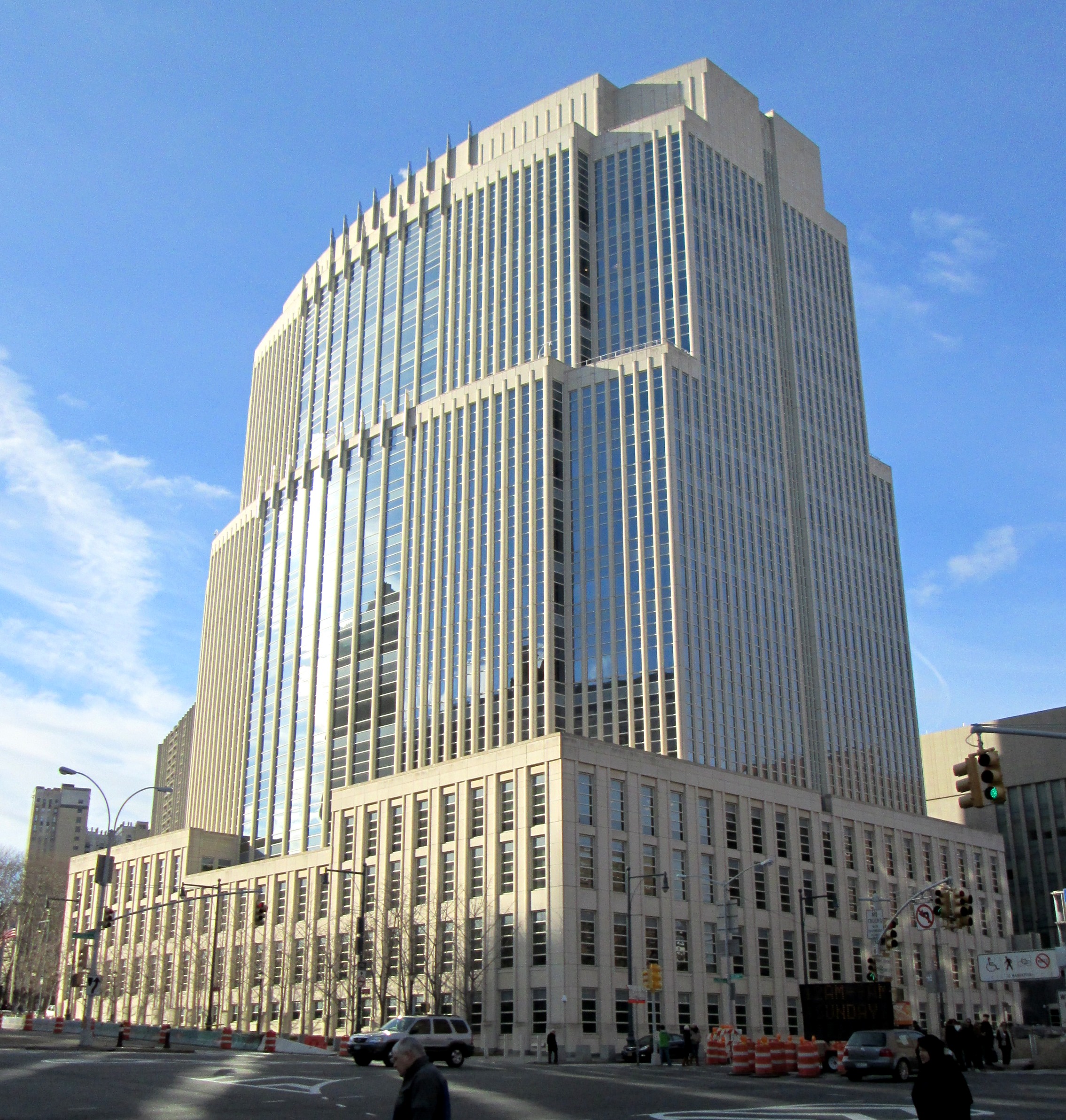
The DOJ filed United States v. City of New York on July 24, 2025, alleging that the city’s sanctuary laws violate the Supremacy Clause and 8 U.S.C. § 1373 by impeding federal immigration enforcement. The complaint originally named Mayor Eric Adams; after the November 2025 election, Mayor Mamdani was substituted as a defendant. The city moved to dismiss in February 2026, and the motion is still pending while the court works through standing. [1][4]
The legal fight is not simply over whether New York City must help ICE. Under anti-commandeering doctrine, the federal government cannot force state or local officials to administer a federal regulatory program. The city’s most comfortable argument is that its laws are a permissible refusal to provide voluntary help. The government’s stronger merits theory, if it ever gets there, is narrower: that New York City’s framework goes beyond non-cooperation and affirmatively obstructs federal enforcement in a way federal law preempts.
Standing comes first because federal courts do not issue advisory opinions on whether a municipal policy is irritating to Washington. The United States must show an injury that is concrete and particularized, fairly traceable to the challenged city laws, and likely to be redressed by a favorable court order. That is where the recent sanctuary dismissals matter most. They do not mechanically control the New York case, but they give Judge Reyes a ready-made question: what exactly happened in New York City, because of these laws, that a federal injunction would fix?
What DOJ Says New York City Did
The DOJ’s public description of the lawsuit framed New York City’s policies as an obstacle to federal immigration enforcement, arguing that the city restricts cooperation with immigration authorities and thereby frustrates federal law. The complaint invokes the Supremacy Clause and § 1373, the federal provision that addresses restrictions on sharing citizenship or immigration-status information with federal immigration authorities. [4]
That statutory choice is consequential. Section 1373 has been central to federal sanctuary litigation for years, but courts have been skeptical when the government tries to turn it into a broad preemption weapon. If a local law merely tells city employees not to volunteer time, jail access, office space, or discretionary assistance, the federal government runs into the anti-commandeering problem. If a local law bars officials from sharing information Congress validly protected, or requires conduct that frustrates federal operations, the preemption argument becomes more serious.
The city’s motion to dismiss therefore has two layers. One is jurisdictional: the United States has not pleaded the sort of injury that gives it standing. The other is merits-facing: even if the court can hear the case, New York City’s laws fall on the non-cooperation side of the line. The supplemental briefing order means the first layer may be enough.
The amicus lineup also shows the institutional stakes. New York Attorney General Letitia James filed in support of the city, and the defense side drew briefs from more than 75 cities and counties, former law enforcement officials, and advocacy organizations. [5] That does not make the city right. It does show why a ruling against New York would be read well beyond the five boroughs, especially by local governments that have written their immigration policies as operating rules for police, jails, schools, or social-service agencies.
The Standing Problem Is No Longer Hypothetical
The DOJ has pursued a broad sanctuary-litigation campaign since early 2025. The ILRC’s federal litigation tracker identifies suits against at least 14 jurisdictions since February 2025, and Stateline described the campaign on July 17, 2026, as the most aggressive sanctuary litigation push in U.S. history. [6][7] But volume is not the same thing as traction. The cases that have already produced dismissal orders have narrowed the path for the New York complaint.
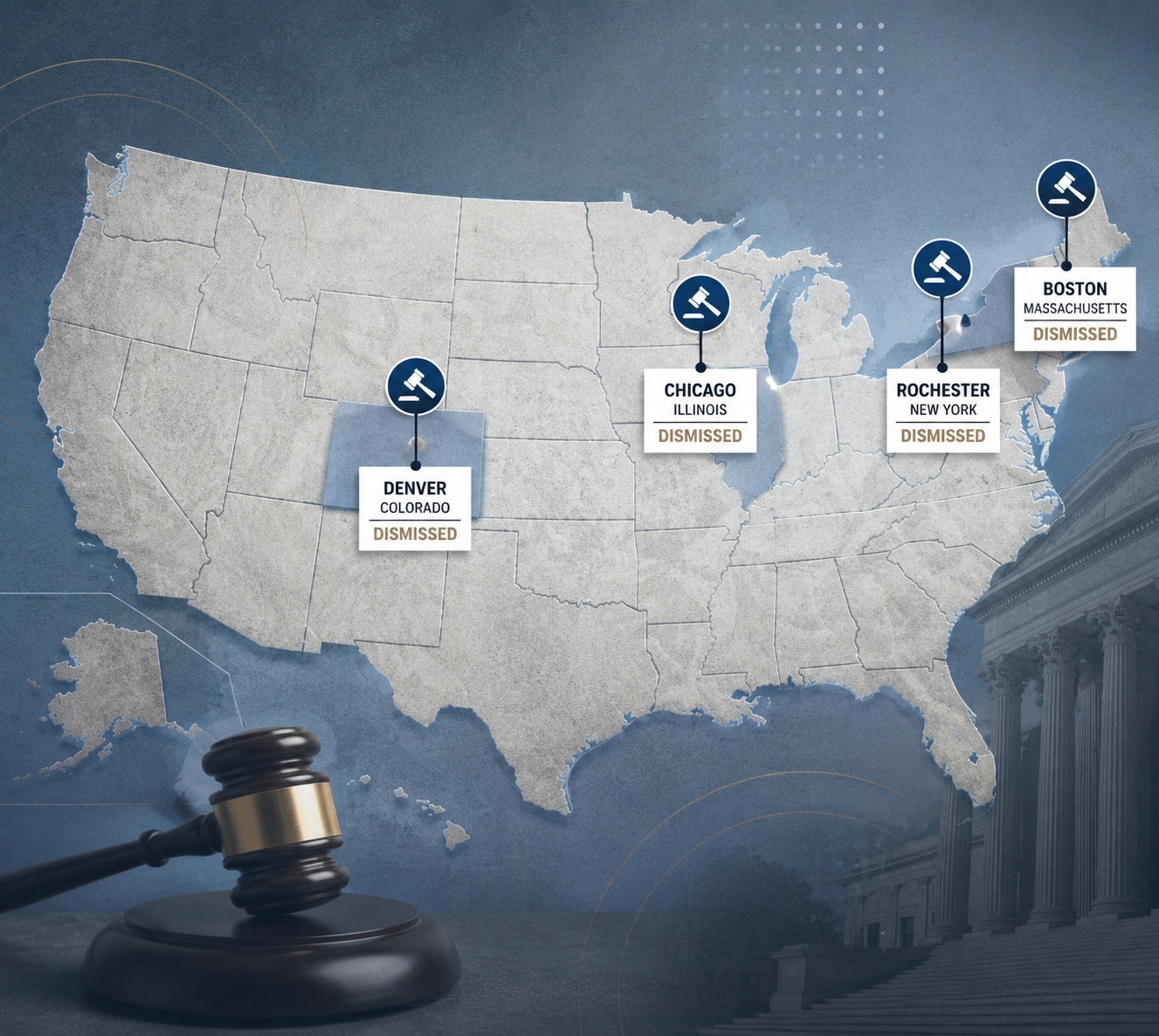
In the Illinois and Chicago litigation, the case was dismissed in July 2025 on standing grounds, and the court held that § 1373 has no preemptive power. The DOJ has appealed to the Seventh Circuit. In Colorado and Denver, the March 2026 dismissal emphasized that states cannot be compelled to enforce federal immigration schemes and noted the financial burden such compulsion would impose. The Rochester case was dismissed in November 2025 after the city amended its sanctuary laws, though the DOJ later filed an amended complaint and that litigation remains pending. [7]
Boston is the dismissal now sitting closest to the New York docket because Judge Reyes expressly asked the parties to brief standing in light of the Boston Trust Act decision. [1] That matters less as a binding precedent than as a procedural prompt. A judge does not order supplemental standing briefs after a comparable dismissal unless she wants the parties to confront whether the same jurisdictional defect is present.
| Case | Reported Posture | Why It Matters For NYC |
|---|---|---|
| Illinois / Chicago | Dismissed July 2025 on standing grounds; DOJ appealed | Raises the same basic problem of whether federal frustration with local non-cooperation is an Article III injury |
| Colorado / Denver | Dismissed March 2026 | Reinforces the anti-commandeering limit on forcing state or local participation in federal immigration enforcement |
| Rochester, NY | Dismissed November 2025 after amendments; amended complaint pending | Shows that statutory wording and later local revisions can change the litigation posture |
| Boston Trust Act | Dismissed May 2026 | Directly triggered Judge Reyes’s supplemental standing briefing order in the NYC case |
The government can still argue that New York City is different. The city is larger, its law-enforcement footprint is larger, and the federal complaint can try to identify operational consequences specific to local custody, communication, or access rules. But those differences have to do legal work. A generalized claim that sanctuary policies make immigration enforcement harder is not the same as a pleaded injury that is traceable to a particular New York City law and redressable by a judicial order.
The Merits Fight, If The Court Reaches It
If DOJ clears standing, the case becomes more interesting and less predictable. The merits question would not be whether federal immigration law is supreme in the abstract. It would be whether New York City’s sanctuary framework conflicts with federal law in a way that federal courts can enjoin without commandeering city officials.
That distinction is often flattened in public debate. A city may decline to hold someone beyond the time state or local law authorizes, decline to ask immigration-status questions in ordinary service settings, or decline to dedicate personnel to federal enforcement. Those choices may frustrate federal agents, but frustration is not automatically preemption. The harder case for a city would be a rule that blocks officials from sending immigration-status information Congress protected, punishes employees for lawful communication with federal authorities, or creates an affirmative shield against federal officers executing federal authority.
The DOJ’s § 1373 theory is aimed at that harder category. The city’s answer is that its laws regulate municipal priorities and employee conduct rather than federal officers, and that the federal government remains free to enforce federal immigration law with federal resources. If Judge Reyes reaches that line-drawing exercise, the opinion could become more useful than the standing ruling for other jurisdictions drafting or defending local policies.
But reaching the merits would itself be a notable development. The recent pattern has favored dismissal before the federal government obtains a broad declaration that a sanctuary framework is preempted. That is why the supplemental standing sequence is the case’s load-bearing event, not a scheduling footnote.
Where Homan’s Threats Fit, And Where They Do Not
Homan’s June 2026 statements are relevant because they changed the public stakes around New York’s immigration posture. Reports described him saying that ICE was preparing a major New York City operation after Hochul signed an immigration package, while state officials pushed back publicly. [2][3] That context helps explain why the lawsuit is being read as part of a broader confrontation rather than as a narrow municipal-preemption case.
Still, the threatened surge should not be written as an accomplished enforcement event at the threatened scale. The record described in the research materials identifies Operation Salvo, announced in January 2026, with 54 gang arrests and 30 deportations, and notes that Homan’s later threatened surge had not fully materialized as of mid-July 2026. Treating a threat, a plan, and completed enforcement as the same thing would overstate what is known.
The same boundary applies to New York’s mask-ban fight. New York and the DOJ filed dueling lawsuits on June 22 and June 23, 2026, over the state law barring federal agents from wearing masks during enforcement. [8] Those suits are politically and factually adjacent to the sanctuary case: both concern how immigration enforcement is conducted in New York, and both sharpen the confrontation between state officials and federal agencies. They are not the same lawsuit, and the mask-ban litigation does not answer whether the United States has standing to challenge New York City’s sanctuary laws.
What The Next Ruling Will Clarify
The most likely near-term ruling is on the motion to dismiss, with standing now at the center. If Judge Reyes dismisses for lack of standing, the DOJ can appeal to the Second Circuit, and the New York case would join a growing appellate fight over whether federal sanctuary challenges are justiciable when framed around enforcement friction and non-cooperation.
If the case survives, the court will have to examine the actual structure of New York City’s laws rather than the label “sanctuary.” That merits fight would test whether the city has merely refused to lend personnel and discretionary assistance, or whether it has enacted rules that affirmatively obstruct federal immigration enforcement under the Supremacy Clause and § 1373.
Either ruling will leave some questions unresolved. It will not determine whether Homan’s threatened ICE surge will occur, how federal agents will operate under the separate mask-ban litigation, or whether other cities’ differently worded laws survive future challenges. It will clarify something narrower and more immediate: whether DOJ has pleaded enough injury from New York City’s sanctuary laws to keep its flagship case alive.
References
- United States v. City of New York, CourtListener.
- ICE planning major New York City operation after clash with Hochul: Homan, The Hill.
- VIDEO, AUDIO & RUSH TRANSCRIPT: Governor Hochul Responds to Border Czar Tom Homan and Stands Firm, Governor Kathy Hochul.
- Justice Department Sues New York City Over Sanctuary Policies, U.S. Department of Justice.
- Attorney General James Defends Public Safety and Immigrant Communities in New York, New York State Attorney General.
- Federal Litigation, Immigrant Legal Resource Center.
- Feds sue cities and states to block sanctuary policies, Stateline, July 17, 2026.
- New York’s mask ban for ICE agents sparks dueling suits with DOJ, Courthouse News.
Comments
Join the discussion with an anonymous comment.