
The August 5 date in the TPS work permits injunction matters because Judge Nathaniel Gorton’s July 21 temporary stay did less, and more, than many headlines suggest. It temporarily blocked two OBBBA-related USCIS policies for Salvadoran, Ukrainian, and Sudanese TPS holders whose employment authorization was about to be cut off under a retroactive one-year cap, a group the plaintiffs described as roughly 310,000 people.[1][2] It also blocked termination of asylum applications and related work permits for failure to pay the annual asylum fee.[1] It did not freeze every TPS expiration date, did not decide the case on the merits, and did not erase the new fee structure.
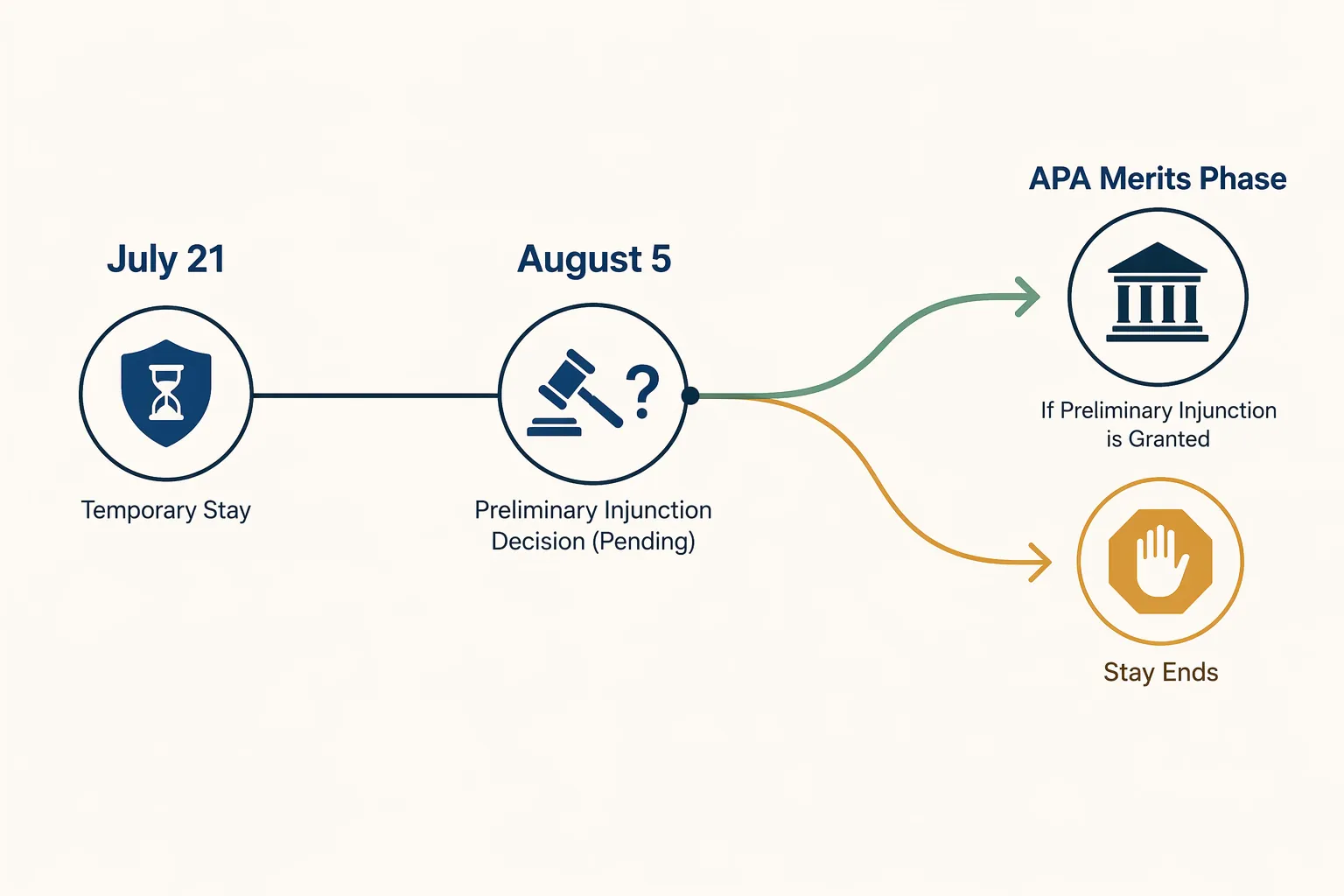
That distinction is not academic for an employer trying to complete I-9 reverification before scheduling next week’s shifts. The July 21 order gave immediate relief to a defined group facing July 22 consequences, but August 5 is the next procedural hinge. If the court grants a preliminary injunction, the blocked policies remain paused while the Administrative Procedure Act claims proceed. If the court denies it, the temporary stay dissolves and the blocked provisions can take effect.

What the July 21 stay actually blocked
The order was issued as a temporary stay under Section 705 of the Administrative Procedure Act, not as a final ruling that the challenged policies are unlawful.[1] Its immediate function was narrower: preserve the status quo long enough for the court to decide the preliminary injunction motion on August 5.
The first blocked policy was retroactive application of OBBBA’s one-year employment authorization document cap to TPS holders whose EADs were otherwise set to remain valid through the 540-day automatic extension framework until July 22.[1][3] In practice, that meant USCIS could not use the new one-year limit to pull back work authorization already operating under the prior extension regime for the covered Salvadoran, Ukrainian, and Sudanese TPS holders.
The second blocked policy concerned asylum applicants. The court temporarily barred USCIS from terminating asylum applications and associated work permits based on failure to pay the $100 annual asylum fee.[1][3] That piece matters for TPS holders who also have asylum filings, but it is not a general suspension of the annual fee itself.
| Policy or consequence | Status after July 21 stay |
|---|---|
| Retroactive one-year EAD cap for covered TPS holders facing July 22 cutoff | Temporarily blocked |
| Termination of asylum applications and related work permits for nonpayment of $100 annual asylum fee | Temporarily blocked |
| $100 annual asylum fee itself | Not blocked |
| OBBBA registration and renewal fee structure | Not blocked |
| 30-day initial processing rule | Not blocked |
| Fee-based rejection of certain initial applications | Not blocked |
The items left untouched are where operational errors begin. The stay did not block the fee provisions themselves, including the $500 registration fee, $275 renewal fee, and $100 asylum fee described in employer-side OBBBA analysis.[3] It also did not block the 30-day initial processing rule or the fee-based rejection of certain initial filings.[1][3] A covered worker may therefore be protected from immediate termination of work authorization under the two stayed policies while still being subject to other filing, fee, and processing rules.
The covered TPS populations are three countries, not TPS generally
For reverification purposes, the most important line is country coverage. The July 21 stay directly protects TPS holders from El Salvador, Ukraine, and Sudan who were within the challenged July 22 work authorization problem.[1][2] The plaintiffs’ complaint described the affected population as roughly 310,000 people.[2]
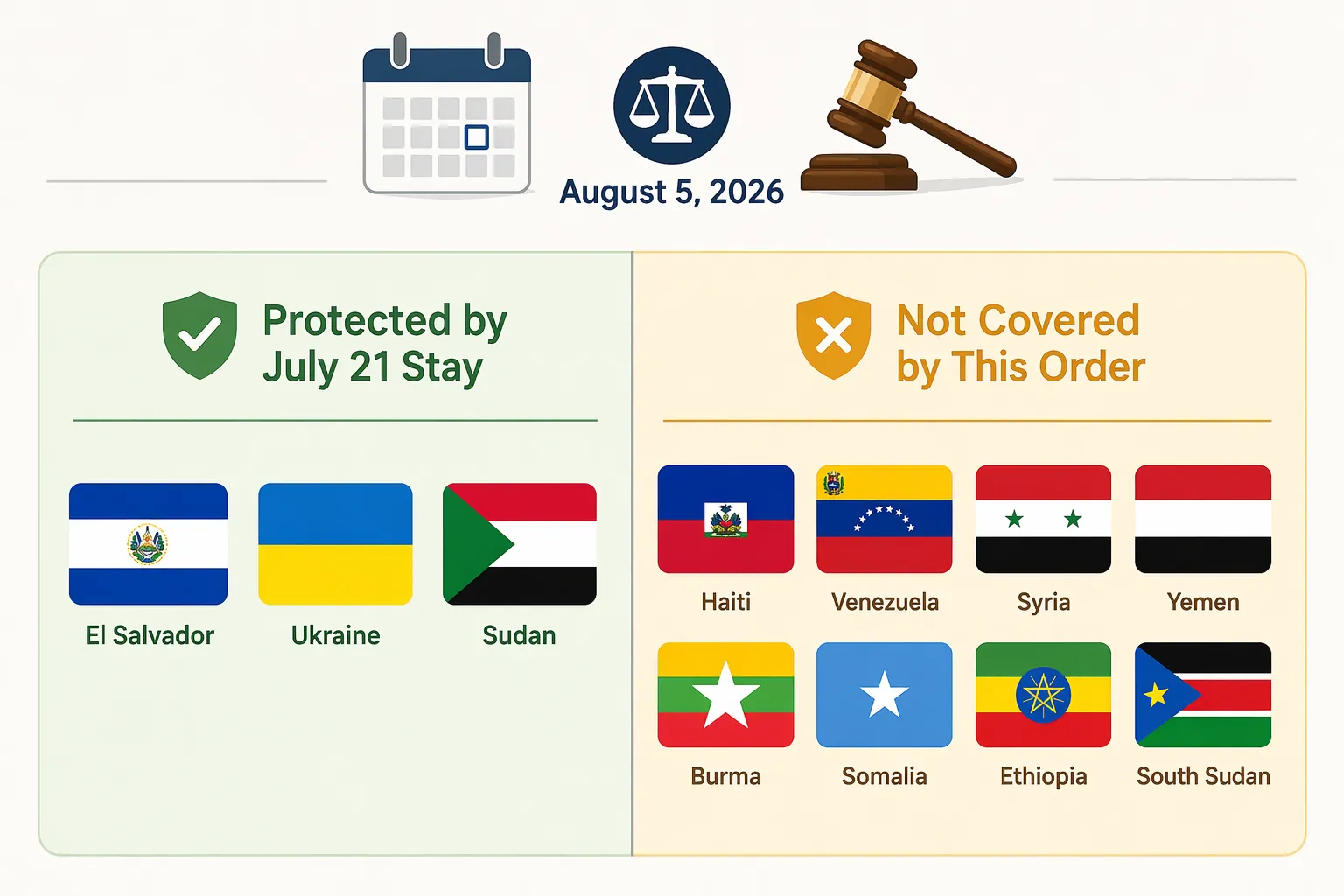
Within that protected set, the country designation dates are different. Salvadoran TPS was described as valid through September 9, 2026; Ukrainian TPS and Sudanese TPS were described as valid through October 19, 2026.[2] Those designation dates should not be confused with a universal EAD expiration date. In employment verification work, the correct document analysis still turns on the employee’s category, notices, auto-extension language, and the latest USCIS guidance.
- Covered by the July 21 stay: Salvadoran TPS holders in the affected July 22 group.
- Covered by the July 21 stay: Ukrainian TPS holders in the affected July 22 group.
- Covered by the July 21 stay: Sudanese TPS holders in the affected July 22 group.
- Not covered merely because they hold TPS: workers from other TPS-designated countries facing separate USCIS expiration dates or separate litigation tracks.
That last sentence is the one that should be taped to the spreadsheet. The stay is country- and policy-specific. It is not a general court order extending all TPS EADs, and it is not a substitute for reviewing the applicable Federal Register notice, USCIS page, or litigation order for a different nationality.
Haiti, Syria, Yemen, Burma, Somalia, Ethiopia, and South Sudan are on different tracks
The July 21 stay did not extend the July 24 expiration date described for Haitian and Syrian TPS-related EADs in separate USCIS updates, and it did not extend the July 17 expiration date described for Burmese, Somali, Yemeni, Ethiopian, and South Sudanese TPS-related EADs.[4] Those dates arise from different agency guidance and different litigation posture, not from Judge Gorton’s July 21 order.
For HR teams, the difference is consequential. A Salvadoran TPS employee whose work authorization falls inside the July 21 stay should not be treated the same as a Haitian TPS employee whose documents are governed by a separate July 24 USCIS update. A Sudanese TPS employee covered by the stay is not automatically in the same position as a South Sudanese TPS employee whose EAD issue is tied to a separate July 17 update. Similar country names do not merge legal categories.
The post-Mullin landscape adds another layer. In Mullin v. Doe, the Supreme Court’s June 25, 2026 decision barred non-constitutional judicial review of TPS terminations, leaving affected populations dependent on remaining district court stays or other live litigation for their specific countries.[5][6] That does not make every TPS termination immediately effective in the same way; it means the controlling question has to be asked country by country and order by order.
Venezuelan TPS should not be folded into the July 21 order
Venezuelan TPS work authorization is unusually complex and should be treated separately. Employer guidance after Mullin described three distinct Venezuelan TPS holder categories and noted that, for a defined class connected to the 2023 designation, separate litigation preserved work authorization through October 2, 2026.[5] That is not the same protection created by Judge Gorton’s July 21 stay, and using the July 21 order as the basis for a Venezuelan TPS reverification decision would collapse two different legal sources.
The practical consequence is simple enough even if the doctrine is not: Venezuelan TPS cases need a Venezuela-specific review. The answer may depend on the person’s designation category, the applicable class definition, the status of separate litigation, and the latest USCIS implementation language.
Why the APA claims matter before August 5
The lawsuit, Venezuelan Association of Massachusetts v. USCIS, is built on Administrative Procedure Act claims rather than a freestanding request for the court to rewrite TPS policy. The complaint alleges that the challenged policies were issued without required notice-and-comment rulemaking, were applied retroactively without statutory authorization, were arbitrary and capricious, and violated the APA’s anti-retroactivity principle.[2]
Those allegations explain why the August 5 preliminary injunction hearing is more than a scheduling event. At that stage, the court is not issuing a final merits judgment, but it is deciding whether the plaintiffs have shown enough to keep the disputed policies paused while the APA case proceeds. For a payroll department, that distinction may feel unsatisfying; for compliance purposes, it is the line between a temporary stay and an injunction that carries the case through the merits phase.
The lack-of-notice claim is particularly important in an employment authorization setting because agencies, employers, and workers rely on published rules and notices to determine whether someone may lawfully work. The retroactivity claim is equally practical: the challenged cap did not merely govern future applications; it allegedly reached back into work authorization that had been operating under the 540-day automatic extension framework.[1][2] The arbitrary-and-capricious claim asks whether the agency adequately explained what it was doing and accounted for the reliance interests at stake.
What changes if the preliminary injunction is granted or denied
If the court grants the preliminary injunction on August 5, the protections created by the July 21 stay continue through the APA merits phase. That would preserve the pause on retroactive application of the one-year EAD cap for the covered Salvadoran, Ukrainian, and Sudanese TPS holders, and it would keep USCIS from terminating asylum applications and related work permits for nonpayment of the annual asylum fee while the case proceeds.
A granted injunction would still have boundaries. It would not, by itself, bring Haitian, Syrian, Yemeni, Burmese, Somali, Ethiopian, South Sudanese, or Venezuelan TPS holders inside the July 21 order. It would not cancel the fee amounts that were not stayed. It would not convert provisional relief into a final merits ruling. It would give the covered group a longer litigation runway, not a permanent work authorization guarantee.
If the court denies the preliminary injunction, the July 21 temporary stay dissolves. The two blocked provisions can then take effect, subject to any further emergency motion, appeal, agency update, or later order. For the covered July 22 group, that is the scenario that revives the immediate work authorization problem the temporary stay was designed to prevent.
| August 5 outcome | Practical effect |
|---|---|
| Preliminary injunction granted | Stayed protections continue through the APA merits phase for the covered policies and covered populations. |
| Preliminary injunction denied | July 21 stay dissolves; the previously blocked provisions may take effect unless another order or agency action intervenes. |
| Separate TPS populations | Continue to depend on their own USCIS guidance, designation status, and litigation orders. |
The compliance posture between now and August 5
The safest reading of the order is disciplined and narrow. Confirm whether the worker is in the Salvadoran, Ukrainian, or Sudanese TPS group affected by the July 22 issue. Confirm whether the document question involves the retroactive one-year EAD cap or the asylum-fee termination policy that the court actually stayed. Then check whether a different TPS country is instead governed by a July 17 or July 24 USCIS update, a separate district court stay, or Venezuela-specific litigation.
Employers should also keep the fee point separate from the work authorization point. The July 21 order blocks certain consequences attached to nonpayment, but it does not wipe out the OBBBA fee structure. An employee can be protected from one stayed consequence and still face filing obligations under rules that were not stayed.
USCIS expiration guidance has already shifted during July 2026, including separate July 17 and July 24 updates for non-covered TPS populations.[4] That makes static summaries risky. A reverification decision made from a headline, or from a country list copied before the latest agency notice, can be wrong even when it began from a real court order.
As of July 23, 2026, the July 21 stay prevents immediate disruption for a defined group and two defined policies. It is not a general TPS work-permit shield. The August 5 ruling will decide whether that protection continues into the merits phase or disappears, and the employees outside the order remain governed by their own notices, stays, and litigation records.
References
- Judge Blocks Policies Disrupting Immigrants' Work Authorization, Bloomberg Law.
- Coalition Sues Trump-Vance Administration Over Unlawful Policies Threatening Work Authorization for Asylum Seekers and TPS Holders, Democracy Forward.
- One Big Beautiful Bill's Impact on TPS Work Permits, Littler.
- USCIS Issues Additional Updates on TPS-Related EAD Expirations, Littler.
- After Mullin: A Practical Guide for Employers with TPS Workers, Morgan Lewis, June 30, 2026.
- The ripple effects of the TPS ruling, SCOTUSblog.
Comments
Join the discussion with an anonymous comment.