
Andrew Truelove’s July 17 arraignment matters less for the Today Show setting than for the way the charges were filed. Prosecutors did not merely allege burglary in the third degree and menacing in the third degree. They charged burglary in the third degree as a hate crime under Penal Law §§ 140.20 and 485.05, and menacing in the third degree as a hate crime under Penal Law §§ 120.15 and 485.05.[1]
That charging choice changes the legal scale of the case. PEOPLE reported that the burglary count moves from a class D felony to a class C felony, increasing the maximum exposure from about seven years to up to 15 years, while the menacing count moves from a class B misdemeanor to a class A misdemeanor, increasing the misdemeanor exposure from up to three months to up to 364 days.[2] Those figures are exposure, not a forecast. They describe what the enhancement permits if the People prove the underlying offenses and the hate-crime element.
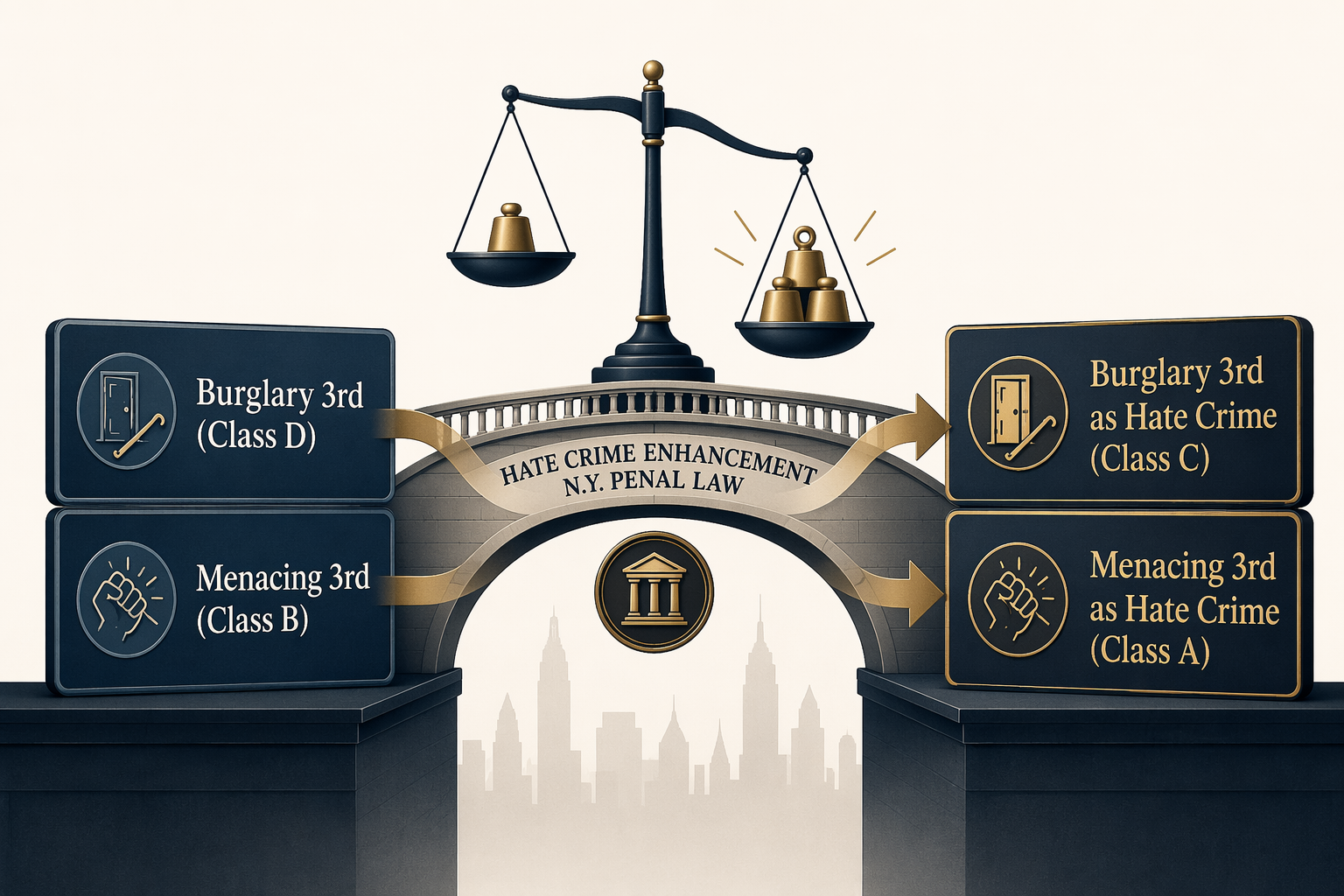
Article 485 Starts With an Underlying Crime
New York’s hate crime statute is not a free-standing accusation that replaces the underlying criminal law. Article 485 operates by attaching to a specified offense. Penal Law § 485.05 defines when a person commits a hate crime, and § 485.10 supplies the sentencing enhancement rule, under which the specified offense is generally treated as one category higher than it otherwise would be.[3]
That first step is often where public discussion gets sloppy. The hate-crime label does not do the work by itself. The People still have to prove the charged burglary and menacing counts. Only then does the Article 485 question become decisive: were those crimes committed in the statutory way that permits enhancement?
| Charge as reported | Underlying offense | Hate-crime effect reported |
|---|---|---|
| Burglary in the third degree as a hate crime | Penal Law § 140.20 | Class D felony elevated to class C felony; reported maximum exposure rises from about seven years to up to 15 years |
| Menacing in the third degree as a hate crime | Penal Law § 120.15 | Class B misdemeanor elevated to class A misdemeanor; reported maximum exposure rises from up to three months to up to 364 days |
The Second Element Is Bias-Based Selection
After the specified-offense requirement, the statute asks why the defendant selected the victim or committed the act. Article 485 covers conduct where the defendant intentionally selects the person against whom the offense is committed, or commits the act constituting the offense, in whole or in substantial part because of a belief or perception regarding a protected characteristic, including race.[3]
That phrase — “in whole or in substantial part” — is the hinge in the Truelove prosecution. It does not require public certainty that race was the only alleged motive. It does require proof that bias-based selection was at least a substantial part of the selection or conduct. In practical terms, the prosecution must connect the alleged behavior toward Craig Melvin to race in a way that satisfies the statute, not merely show that offensive language was used somewhere near the event.

The reported racial slur is therefore not a side detail. The New York Post reported that Truelove allegedly asked Melvin where Al Roker was, then said he “wanted to call a Black famous person the N-word.”[4] If that allegation appears in the complaint or is otherwise proved through admissible evidence, it is the kind of fact prosecutors would use to argue intentional selection based on race. If it is not proved, the hate-crime enhancement becomes harder to sustain, even if the underlying conduct remains separately charged.
The full Manhattan DA complaint was not publicly available in the materials reviewed for this article. That matters. Press accounts can identify the charge set and reported allegations, but the complaint is where a legal reader would expect to see the sworn factual basis, statutory counts, and the exact language prosecutors have chosen to plead.
What the Felony Upgrade Does
Burglary in the third degree is the major charge in the reported filing because it carries the larger sentencing consequence once Article 485 is attached. Without the hate-crime enhancement, PEOPLE described burglary in the third degree as a class D felony with a maximum sentence of about seven years. Charged as a hate crime, it becomes a class C felony with reported exposure of up to 15 years.[2]
That is not a cosmetic change in captioning. The felony class is the statutory mechanism that changes the sentencing range. The prosecution’s burden correspondingly has two parts: prove burglary in the third degree, then prove the Article 485 bias-selection element. A conviction on the enhanced count would reflect both findings; a failure on the hate-crime element could leave the underlying burglary theory in a different posture depending on how the case is charged and litigated.
What the Misdemeanor Upgrade Does
The menacing count shows the same statutory design at misdemeanor scale. PEOPLE reported that menacing in the third degree ordinarily carries class B misdemeanor exposure of up to three months. Charged as a hate crime, it is elevated to a class A misdemeanor, with exposure of up to 364 days.[2]
For legal professionals tracking Truelove’s criminal charges and legal proceedings, that misdemeanor enhancement is useful because it keeps the Article 485 analysis from becoming only a felony-sentencing discussion. The same statutory structure can raise a misdemeanor one level when the underlying offense appears on the specified-offense list and the intentional-selection element is proved.
The Evidence Question Comes After the Mechanics
Once the charge architecture is clear, the central proof question is narrower than much of the public commentary around the case: what admissible evidence will the Manhattan DA use to prove that Melvin was selected, in whole or in substantial part, because of race?
The reported statement supplies the most direct publicly reported answer. The New York Post’s account, if accurately reflected in the charging papers and later supported in court, gives prosecutors language tied to the alleged target and to race.[4] But because the case is active and the complaint was not publicly available in the reviewed materials, the safer formulation is still alleged. The statement has legal importance; it is not yet a judicial finding.
That distinction is not hedging for its own sake. Hate-crime enhancements often turn on exactly this type of evidentiary bridge between an ordinary criminal count and a bias-selection theory. The existence of a slur can be powerful evidence, but the filed record, witness testimony, video evidence if any, and admissibility rulings will determine how much of that reported account can actually carry weight in the prosecution.
Current Procedural Posture
PEOPLE reported that Truelove was arraigned on July 17, that the DA’s office said bail was set at $10,000 cash, and that he remained at Rikers Island as of that date.[1] Other press reporting identified in the research record has described a different bail amount, so the bail figure should be checked against official court records before being treated as settled.
Temporary orders of protection were reported for Melvin and Roker, and the next court date was reported as July 22, 2026.[2] Defense attorney Lawrence Gerzog was identified as representing Truelove and declined to comment in the available reporting.[2]
For background on the defendant’s prior record rather than the hate-crime enhancement itself, see our related coverage of Andrew Truelove’s criminal-history timeline. That history may explain why the case drew attention, but it does not prove the Article 485 element in the present prosecution.
The legal map is therefore straightforward, even if the facts remain provisional: prosecutors have charged specified underlying offenses, used Article 485 to elevate their classifications, and appear to be relying publicly on an alleged racial statement to support bias-based selection. Until the complaint and later court record are available, every fact beyond the filed charges and sourced reports should be treated as unsettled. This article is a legal-reference explainer, not legal advice.
References
- 'Today' Show Intruder, 41, Charged with Hate Crimes, PEOPLE, 2026-07-17.
- 'Today' Intruder Faces 15 Years, PEOPLE, 2026-07-18.
- Penal Law Article 485, ypdcrime.com.
- Exclusive | Craig Melvin Targeted, New York Post, 2026-07-16.
Comments
Join the discussion with an anonymous comment.