
For legal purposes, a Trump Account means the IRC §530A child investment account created by the One Big Beautiful Bill Act, signed on July 4, 2025, with accounts effective July 4, 2026. It does not mean a Trump-branded commercial investment product, a Truth.Fi offering, or any private account using the same political name. That distinction belongs at the front of the client file, because the legal analysis depends on the statutory account regime, not on branding.
The first legal question is not whether the account is attractive. It is who is authorized to open it for this child, and what election must be filed. The federal framework is unusually legible for a new account type: the child must be eligible, an authorized person must act in the proper order, and IRS Form 4547 must be submitted through an approved channel. Those details are enough to guide account establishment now, but not enough to resolve every later tax, financial-aid, or state-law consequence.

Start With Eligibility, Not Funding Strategy
A Trump Account is available for a minor child with a Social Security number. Treasury has also described a $1,000 pilot seed contribution for U.S. citizens born from 2025 through 2028, a feature that will draw attention from families but should not displace the threshold eligibility review.[1]
The pilot seed and any private contribution are separate questions. The account must first be validly elected and opened. A lawyer advising a parent, guardian, grandparent, or agency should document the child's identifying information, citizenship facts if the pilot seed is being requested, the child's date of birth, and the legal authority of the person seeking to act.
| Compliance point | Practical legal question |
|---|---|
| Child eligibility | Is the beneficiary under 18 and does the child have the required Social Security number? |
| Pilot seed eligibility | If the $1,000 federal pilot contribution is requested, was the child born in the covered 2025-2028 window and otherwise eligible? |
| Authorized opener | Is the person filing the election highest in the applicable federal priority order? |
| Election filing | Has IRS Form 4547 been submitted through IRS Online Account or TrumpAccounts.gov? |
| Growth-period limits | Has the client been told that ordinary distributions are not available while the child is a minor? |
| Future treatment | Has the file been caveated for gift tax, FAFSA, and state tax issues that remain unsettled? |
The Authorized-Opener Hierarchy Is a Filing Rule, Not a Family Preference
The proposed federal priority order for opening a Trump Account runs from legal guardian, to parent, to adult sibling, to grandparent.[2] That order matters because family enthusiasm does not itself confer authority. A grandparent may be ready to contribute; an adult sibling may be better organized; a noncustodial parent may be the first to call. None of that answers whether the person is the proper filer.
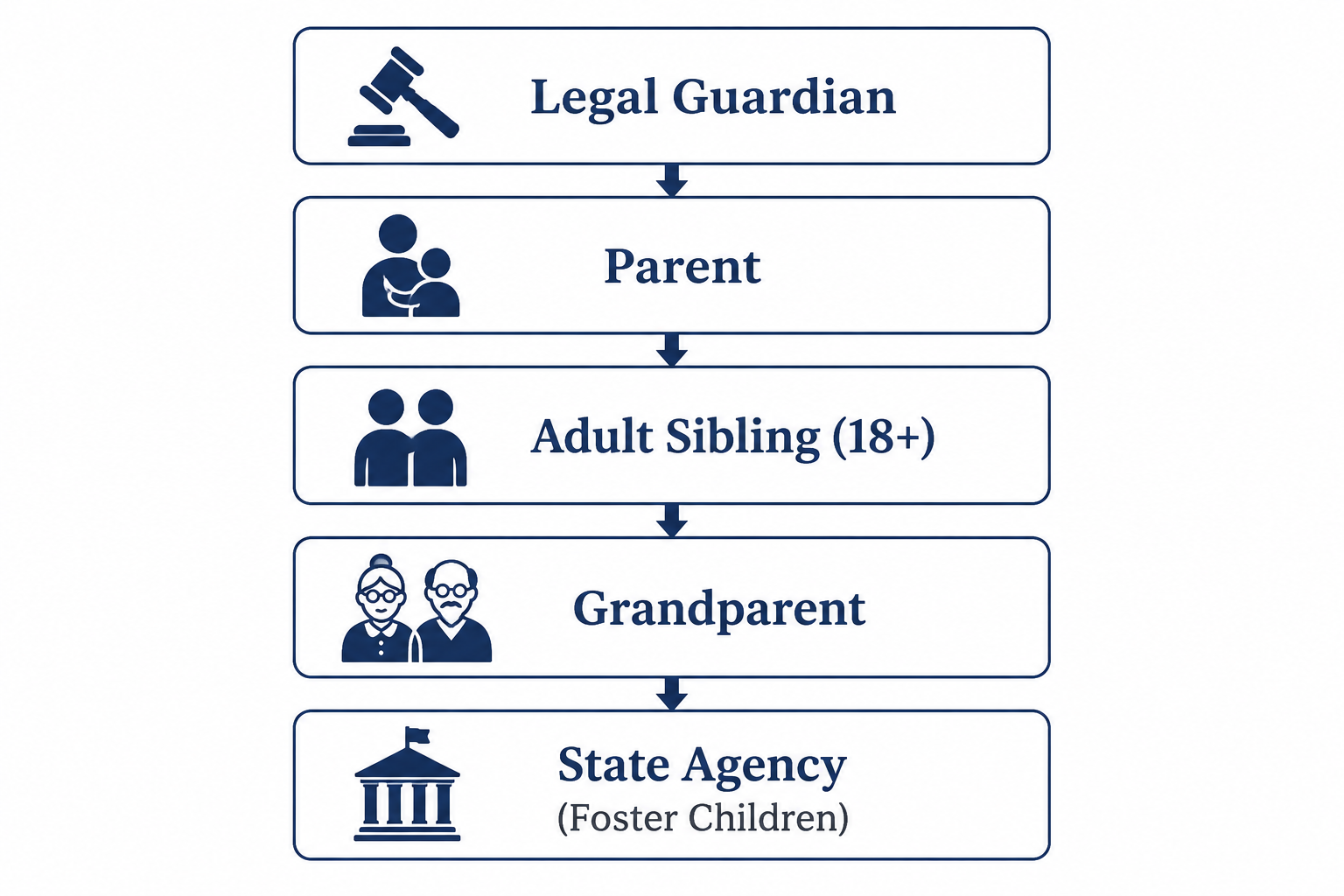
This is where defective openings are likely to arise. In an intact household, the identity of the filer may be easy. In a guardianship, blended family, foster placement, or relative-care arrangement, the lawyer should slow down before treating the first willing adult as the account opener. If a legal guardian exists, that fact may move the inquiry away from a parent. If no guardian or parent can act, the analysis may move to an adult sibling and then to a grandparent. The file should show why the selected opener falls at the proper level.
Foster children require a separate intake path. IRS materials describe state agencies as authorized to establish accounts for foster children under the Fostering the Future initiative.[3] A lawyer advising an agency should treat that as an institutional authorization question, not simply as another family-member hierarchy question. The agency file should identify the child, the agency authority, the person acting for the agency, and the election submitted.
For private clients, the practical drafting point is modest but important: engagement letters and advice memoranda should avoid saying only that a family member is "eligible" to open the account. They should identify the person's place in the priority order and the facts supporting that conclusion. That is the difference between recording a statutory analysis and memorializing a wish.
Common Intake Frictions
- A grandparent wants to open and fund the account before the parents respond.
- A parent and legal guardian both appear in the child's paperwork.
- A nonparent relative has day-to-day care but no clear legal authority.
- An adult sibling is available, but a parent may still be legally able to act.
- A foster-care agency needs an internal signoff process before filing.
Form 4547 Is the Election Mechanism
IRS Form 4547 is the required election mechanism for establishing the account and opting into the pilot program. IRS guidance identifies submission through IRS Online Account or TrumpAccounts.gov.[3] The form should therefore sit at the center of the opening file, not at the edge of it as an administrative afterthought.
The most useful professional habit is to separate the decision to open the account from the proof that the election was made. A client may believe the account exists because a family conversation occurred, because a contribution was planned, or because a website screen was started. For legal review, the question is narrower: was Form 4547 submitted by an authorized opener through an approved channel?
- Confirm the child's identity, date of birth, and Social Security number.
- Determine whether the $1,000 pilot seed is being requested and whether the child falls within the covered birth-year window.
- Identify the authorized opener using the federal priority order, or the agency authorization path for a foster child.
- Submit IRS Form 4547 through IRS Online Account or TrumpAccounts.gov.
- Retain confirmation of submission, the authority analysis, and any client caveats on contributions and later treatment.
BNY Mellon is serving as the initial financial agent for the program, and later trustee-to-trustee rollovers to other institutions are described as available operationally.[4] That fact may matter for client expectations about where the account initially sits, but it should not obscure the legal sequence. The election and authorized-opener analysis come first; investment platform preferences come later.
The Growth Period Defines the Account
During the child's growth period, the Trump Account is not an ordinary family liquidity tool. Distributions are barred except for death, correction of excess contributions, or an ABLE rollover at age 17.[4] That restriction should be explained before a client contributes, because it changes the planning conversation from "Can we put money in?" to "Can the family live with not taking it out?"
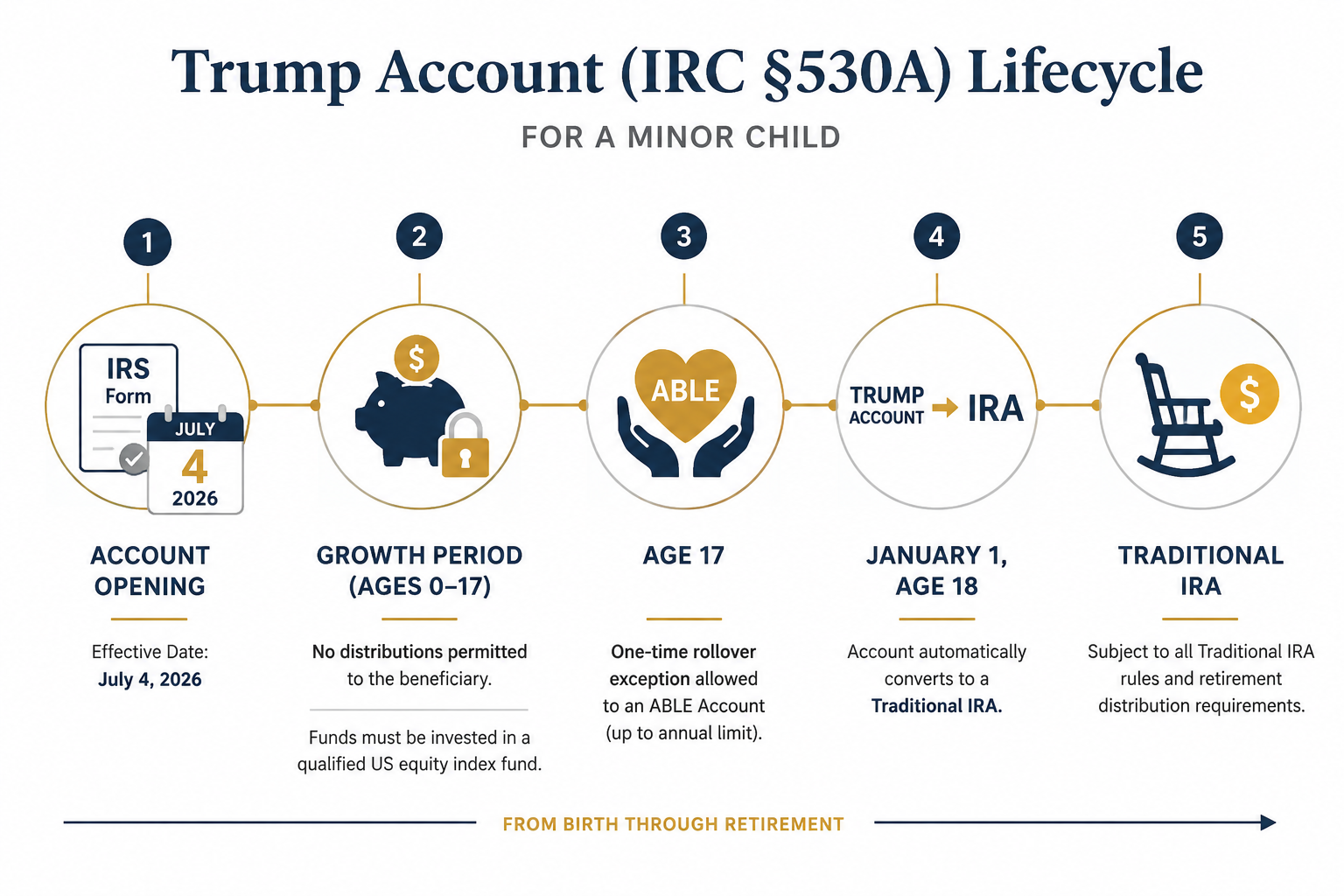
The investment rules also narrow the account's character. Available materials describe investment in broad U.S. equity index funds with fees of 0.10% or lower.[4] That is a constraint, not a menu recommendation. Lawyers do not need to select the fund, but they should make sure the client does not understand the account as a general-purpose custodial brokerage account.
The ABLE rollover rule deserves particular attention for families of children with disabilities. The available materials identify a narrow exception permitting an ABLE rollover at age 17.[4] That does not answer every disability-planning question, and it does not substitute for ABLE eligibility advice. It does mean that counsel should flag the issue early enough that the family is not trying to reconstruct options after the relevant age has arrived.
On January 1 of the year the child turns 18, the account automatically converts to a traditional IRA.[5] This date is administratively clean and legally consequential. Client letters should state it directly, because the conversion marks the end of the minor-account growth period and the beginning of ordinary IRA analysis.
| Growth-period feature | Legal consequence for advice |
|---|---|
| No ordinary distributions | Do not describe contributed funds as available for routine child expenses. |
| Death and excess-contribution exceptions | Treat exceptions as compliance events, not discretionary withdrawal planning. |
| ABLE rollover at age 17 | Coordinate with disability and benefits planning where relevant. |
| Broad U.S. equity index fund limits | Avoid presenting the account as a flexible brokerage product. |
| 0.10% fee cap | Confirm that fund selection stays within the statutory or agency-described limits. |
| Automatic traditional IRA conversion | Calendar January 1 of the year the child turns 18 for follow-up advice. |
Launch Scale Explains Urgency, Not Legal Sufficiency
Reported launch-week figures are large enough that lawyers should expect questions quickly: at least 6 million children were reported signed up within the first week after the July 4, 2026 launch, and BNY Mellon reportedly identified $50 million in direct family contributions.[6] Those numbers do not prove that the account is the right planning choice for a particular family. They do suggest that intake teams, estate-planning groups, family lawyers, and benefits counsel will be asked to opine before all downstream guidance is complete.
Comparisons with 529 plans are useful, but they should not take over the account-opening analysis. A 529 plan comparison belongs in a separate planning memo or a dedicated comparison such as Trump Accounts vs. 529 Plans: A Legal Comparison. The immediate legal work is narrower: determine whether this child can have this account, who may open it, how the election is filed, and what the family must not assume during the growth period.
Gift Tax Advice Still Needs a Caveat
ACTEC has flagged a technical concern with the statutory drafting of the gift tax treatment for Trump Account contributions and has sought a legislative correction.[7] That concern should not be brushed aside merely because many ordinary family contributions may fall below the annual exclusion in a given year.
For 2026, the annual gift tax exclusion is $19,000.[8] That figure may provide practical comfort for many single-donor contributions made during 2026, but it is inflation-adjusted and year-specific. It also does not itself cure a statutory ambiguity identified by ACTEC. The better advice is to document both points: the contribution may be within the applicable annual exclusion for the year, and federal technical guidance or a congressional correction may still be needed for a fully settled answer.
This matters in the very families most likely to use the account enthusiastically. Multiple grandparents, divorced parents, trusts, or other relatives may want to contribute for the same child. The legal issue is not whether the aggregate family plan feels generous. It is whether each donor's transfer is being analyzed under the gift tax rules that apply to that donor in that year.
FAFSA and State Tax Treatment Remain Unsettled
As of July 2026, Department of Education guidance on FAFSA treatment remains pending.[9] Expert commentary may be useful for issue spotting, but it is not the same thing as final agency treatment. A lawyer should not convert speculation about student-asset assessment into a firm financial-aid conclusion.
State tax treatment also varies and remains outside a clean federal answer. A federal account-opening memo should say what it is and is not covering. If the client needs state income tax, deduction, conformity, or creditor-protection advice, that work has to be tied to the relevant state rather than inferred from IRC §530A alone.
The safest client communication is therefore not a warning against opening the account. It is a boundary. Federal law supplies a workable account-opening framework. Gift tax treatment, FAFSA consequences, and state tax results require monitoring and, in some matters, supplemental advice.
A Workable Legal File for Q3 2026
A competent Trump Account file in Q3 2026 does not need to predict every future regulation. It should show that counsel answered the questions federal law currently makes answerable: the child is eligible, the opener is authorized, Form 4547 was filed through the correct channel, the family understands the growth-period restrictions, and the file identifies the unresolved issues that remain outside final guidance.
- Keep the statutory account distinct from commercial Trump-branded products.
- Record the child's eligibility facts and pilot-seed analysis, if applicable.
- Document the authorized opener's place in the priority order.
- Retain Form 4547 submission confirmation.
- Explain that ordinary distributions are unavailable during the growth period.
- Caveat gift tax, FAFSA, and state tax conclusions until controlling guidance fills the gaps.
That posture is neither launch-week enthusiasm nor paralysis. It is the ordinary discipline of advising under a new account regime: use the rules that are available, do not invent the ones that are not, and leave a file that another lawyer can understand three years from now.
References
- Trump Accounts and Baby Bonds in the One Big Beautiful Bill Act, Bipartisan Policy Center, citing Congressional Research Service R48910.
- Proposed Rule 26 FR 04533, Federal Register.
- IRS Announces Launch of Trump Accounts and Fostering the Future Initiative, Internal Revenue Service, IR-2026-80.
- Trump Accounts: Key Considerations for Families and Advisors, Skadden.
- Trump Accounts Resource Center, ACTEC.
- BNY Mellon Reports Launch-Week Trump Account Signups and Contributions, news reports, July 2026.
- ACTEC Legislative Comments on Trump Accounts, ACTEC.
- Revenue Procedure 2026-25, Internal Revenue Service, 2026.
- How Trump Accounts Could Affect College Financial Aid, CNBC, July 2026.
Comments
Join the discussion with an anonymous comment.