
The broadcast-license fight became materially different when the FCC ordered early renewal applications for all eight ABC-owned television stations, years before the stations’ ordinary renewal windows. The agency framed the demand as follow-up to a DEI-related investigation; ABC answered that the order was “unlawful, arbitrary, and unconstitutional,” and argued that forcing the stations into an early licensing posture chilled protected speech.[1][2]
That is the right entry point for the legal implications of Trump’s broadcast-license threats. The central question is no longer only whether the FCC can revoke a station license because a president dislikes coverage. As a matter of statutory and First Amendment law, that remains an exceptionally hard road. The more immediate question is how far a regulator can move a disfavored broadcaster into process — complaints, inquiries, early renewals, public warnings, affiliate anxiety, board-level risk analysis — before any final sanction exists for a court to review.
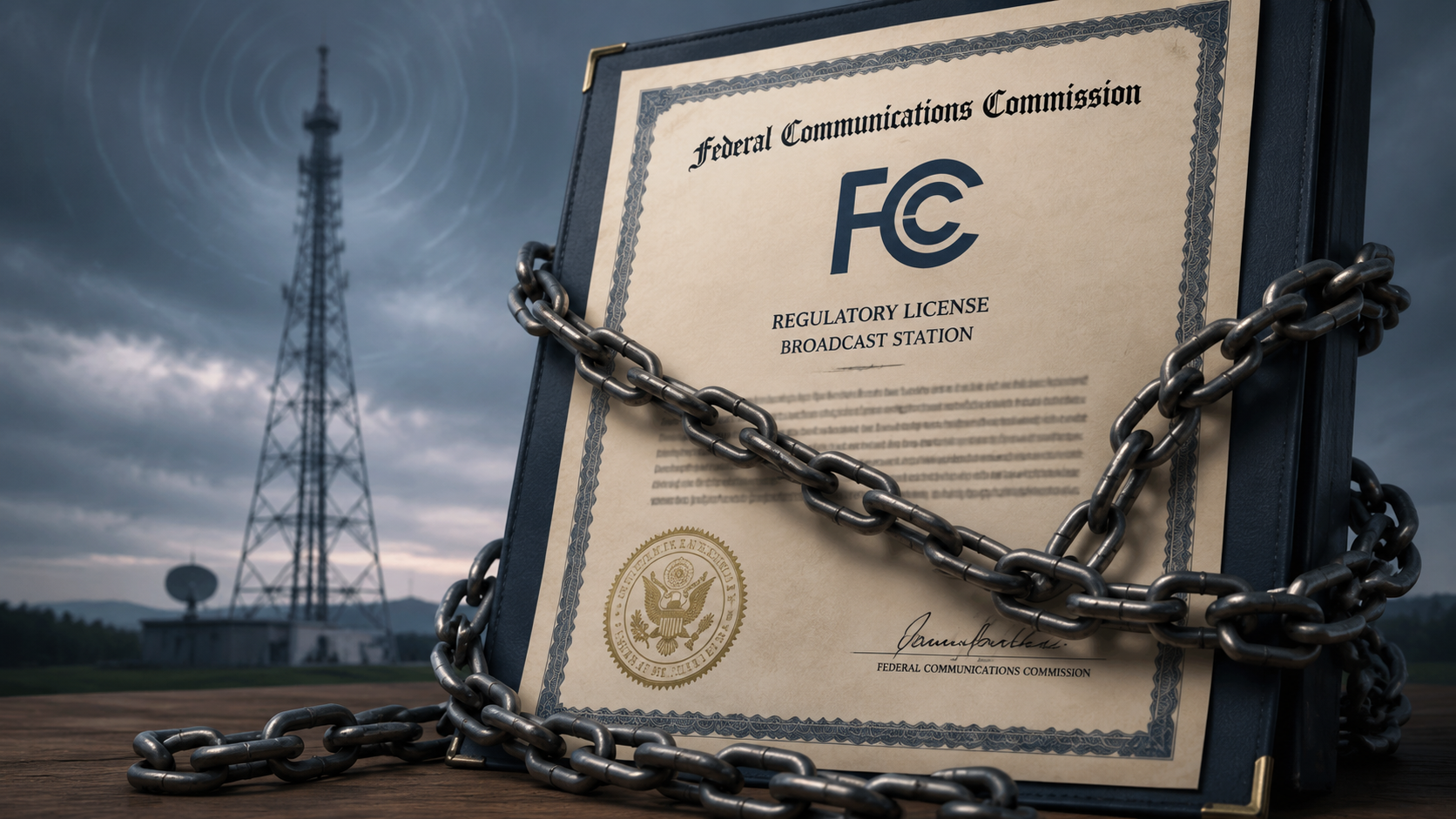
A companion analysis can handle the baseline proposition that Trump's FCC cannot legally revoke broadcast licenses merely for unfavorable news coverage. This article is about the escalation path: how rhetoric moved into FCC procedure, why that shift matters even if a final revocation remains unlikely, and why lawyers advising station groups should not confuse “probably unlawful as an ultimate penalty” with “operationally harmless while pending.”
The ABC Orders Changed The Posture
Ordinary broadcast renewal practice starts with the station. A licensee files when its renewal cycle arrives, the FCC evaluates the application under the Communications Act’s public-interest standard, and the modern renewal framework makes non-renewal a constrained remedy rather than an open-ended comparative beauty contest. The ABC orders inverted the usual tempo: the agency demanded early applications from all eight ABC-owned stations, even though their standard renewal deadlines were not due until 2028 through 2031.[1]
That distinction matters. Revocation is an action during the license term. Non-renewal is an action at the end of the term. Public threats tend to blur the two because “pull the license” sounds simple. In practice, they travel through different statutory channels, different evidentiary showings, and different procedural records. When the FCC orders early renewal filings, it is not literally revoking a license. It is, however, pulling the licensee into the licensing forum earlier than expected.
ABC’s objection, filed through former Solicitor General Paul Clement, treated that procedural move as the constitutional injury. The company argued that the FCC’s demand singled out ABC stations, departed from normal renewal timing, and imposed a chilling effect on speech before the agency had made any final licensing decision.[1][2] FCC Commissioner Anna Gomez called the early review “the most egregious action this FCC has taken in violation of the First Amendment to date.”[2]
That is not a small procedural complaint dressed up as a civil-liberties claim. Local broadcast licenses sit behind national network economics. ABC itself is not the licensee in the way many cable viewers imagine; local station licensees hold FCC authorizations. But the technicality does not make the pressure benign. A licensing cloud over owned stations can affect affiliate negotiations, advertising risk, transaction diligence, compliance budgets, and internal editorial review long before any administrative law judge or appellate court reaches the merits.
What Had Not Changed In 2017
The baseline was stated clearly during the first Trump administration. In 2017, after Trump attacked NBC over nuclear-arsenal reporting and raised the prospect of challenging broadcast licenses, then-FCC Chair Ajit Pai rejected the premise: “Under the law, the FCC does not have the authority to revoke a license of a broadcast station based on a particular newscast.”[4]
That answer was not a favor to NBC. It was a description of the FCC’s role. The Communications Act gives the agency licensing authority, but it also contains limits that are awkward for content-based retaliation. Section 309 governs licensing in the public interest. Section 312 addresses revocation and requires serious statutory footing, including willful or repeated violations in the relevant settings. Section 326 bars the Commission from exercising censorship over broadcast communications. The First Amendment sits over all of it.
That is why the 2017 episode was legally important but procedurally thin. The president’s language was aggressive; the agency did not convert it into a licensing action. For station counsel, the threat was worth documenting. It was not yet a docket, an order, a deadline, or a renewal record.
The 2023–2024 Threats Still Met Institutional Resistance
The next round followed a similar legal pattern. Trump used Truth Social posts to attack ABC debate moderators and later criticized CBS over an edit on 60 Minutes. Then-FCC Chair Jessica Rosenworcel responded in terms very close to Pai’s 2017 formulation: “The FCC does not and will not revoke licenses for broadcast stations simply because a political candidate disagrees with or dislikes content or coverage.”[4]
By late 2024, the expected incoming FCC posture looked different. Brendan Carr, then positioned to lead the agency under Trump, was reported as wanting to revisit broadcasters’ conduct, while First Amendment barriers remained the obvious obstacle to any direct license punishment for unfavorable coverage.[5] The legal environment had not changed in the sense that the First Amendment had become weaker or the Communications Act had become friendlier to political retaliation. What changed was the likely agency appetite for using available process.
Carr Revived Tools That Had Been Dormant Or Narrow
After Carr became FCC chair, the question stopped being whether presidential threats would be publicly disavowed. The agency revived news-distortion complaints brought by the Center for American Rights against ABC, NBC, and CBS.[5] That move mattered less because the complaints were obviously likely to produce final sanctions, and more because a historically narrow doctrine became an active pressure instrument.
The news-distortion doctrine is not a general fairness code for disliked journalism. In the FCC’s historical formulation, it has required more than claims that coverage was unfair, hostile, incomplete, or wrong. The doctrine has been associated with a demanding showing: deliberate distortion, involvement by station management, a significant factual issue, and extrinsic evidence rather than ordinary disagreement with editorial judgment. The available FCC history identifies only five precedent cases in the doctrine’s history, and none against a major network.
That narrowness cuts two ways. It makes the doctrine a weak vehicle for a clean, final license sanction against a national broadcaster. It also means the very act of reviving complaints can become the event: document demands, legal expense, public messaging, and uncertainty over how the Commission will characterize ordinary editorial choices. A doctrine can be weak at the end of the road and still costly at the beginning.
The Kimmel Episode Put Affiliate Leverage In View
The Jimmy Kimmel controversy supplied the next legal-significance point: regulatory pressure does not have to land only on the network whose talent speaks. After comments tied to Charlie Kirk, Carr warned that “we can do this the easy way or the hard way”; ABC suspended Kimmel; Nexstar and Sinclair preempted the show; and Trump later floated license revocation while speaking on Air Force One.[6][7][8]
For a lawyer looking at the broadcast structure, that sequence is more revealing than a presidential aside. Station groups operate with their own FCC exposure. Some have transactions, ownership issues, renewals, political-file obligations, children’s programming obligations, indecency risk, sponsorship-identification concerns, and public-interest files to manage. A network controversy can become a station problem if affiliate owners believe the regulator is watching who cooperates and who resists.
This is where the Supreme Court’s coercion logic in NRA v. Vullo becomes relevant. The problem is not only formal censorship. It is whether government officials use regulatory authority, or the credible shadow of that authority, to pressure third parties into suppressing speech the government disfavors. In the broadcast context, the third parties are not abstract. They are licensees, affiliate groups, advertisers, transaction counterparties, and boards that may react to regulatory signals before a formal order exists.
Iran-War Coverage Merged License Language With National-Security Messaging
The March 2026 Iran-war coverage threats widened the frame. Carr posted that “broadcasters that are running hoaxes and news distortions...will lose their licenses if they do not”; Trump said he was “thrilled” Carr was “looking at the licenses”; Defense Secretary Pete Hegseth singled out CNN; and Senator Elizabeth Warren called the pattern “straight out of the authoritarian playbook.”[9][10]
Legally, CNN is not a broadcast station licensee in the same way a local ABC, CBS, NBC, or Fox affiliate is. That is another technical distinction that public debate tends to flatten. But the political message did not depend on doctrinal tidiness. It tied coverage of military conflict to the threat of licensing consequences and placed the FCC chair’s enforcement posture inside a broader administration response to disfavored reporting.
National-security rhetoric can matter in a licensing record even if it does not create new statutory authority. It can change how regulated entities assess risk. A station group need not believe that license loss is probable to conclude that antagonizing the FCC may complicate pending business, draw document requests, or make routine approvals less routine.
The Early-Renewal Demand Is The Hardest Procedural Fact
The ABC early-renewal orders are therefore the central evidence of escalation. Unlike a tweet, a cable interview, or a public warning, an early renewal demand creates a procedural obligation. The licensee must decide whether to comply, object, litigate, negotiate, adjust internal practices, or do several of those things at once. Even a successful objection costs money and attention.
| Public shorthand | Legal posture | Why it matters |
|---|---|---|
| “Revoke the license” | Revocation during an existing license term | Requires statutory authority and would face severe First Amendment scrutiny |
| “Do not renew the license” | Non-renewal at the end of a license term | Constrained by modern renewal rules and ordinary renewal timing |
| “Order early renewal filings” | Procedural acceleration before ordinary deadlines | Creates immediate burden and licensing uncertainty before any final sanction |
| “Investigate news distortion” | Use of a narrow FCC doctrine | May be difficult to prove but still forces response and risk assessment |
Section 309 remains the central licensing provision. Section 309(k), as shaped by the 1996 Telecommunications Act, makes renewal less open-ended than the pre-1996 comparative system: the Commission asks whether the station served the public interest, whether there were serious violations, and whether any violations taken together show a pattern of abuse. Section 309(k)(4) eliminated the old comparative-renewal contest that once allowed challengers to compete against incumbent licensees as a routine renewal feature.
Those rules do not make renewal automatic in the colloquial sense. They do make denial a record-heavy act. A station facing ordinary renewal can contest allegations, submit evidence of compliance, and seek judicial review if the Commission denies renewal or imposes legally defective conditions. That is one reason “license revocation” threats often overstate the likelihood of a final agency victory.
The early-review move works differently. It does not need to win the final licensing fight to change behavior now. ABC described the order as chilling speech, and First Amendment advocates criticized the early review as a retaliatory use of licensing power.[1][3] The legal injury asserted is not merely speculative license loss; it is compelled participation in an unusual licensing process under the shadow of repeated content-based threats.
“All Options Remain On The Table” Is Not A Holding, But It Is A Signal
By June 2026, Carr told Reuters that “all options remain on the table” in the ABC license review.[11] That sentence does not answer the statutory questions. It does not identify a willful or repeated violation under Section 312. It does not solve Section 326. It does not make news distortion easier to prove. It does not erase the renewal protections Congress enacted.
But regulated entities do not hear that kind of sentence as a law-review conclusion. They hear it as a supervisory signal from the official who controls agency priorities, staff direction, and the timing of matters that can affect business planning. If a station group has a pending transaction, a renewal issue, or an ownership question, “all options remain on the table” becomes part of the risk memo even if outside counsel believes a final revocation order would be vulnerable.
ABC’s reported viewer-defense campaign fits that institutional reality.[11] It is not only a public-relations move. It is an attempt to build a record outside the agency’s preferred framing: local viewers, service obligations, public support, and the democratic cost of using license review as punishment for speech.
Congress Has A Narrow Fix On The Table, But Not Yet A Remedy
Senators Ben Ray Luján, Jacky Rosen, and Ed Markey introduced S.867, the Broadcast Freedom and Independence Act, to prevent political weaponization of the FCC and protect First Amendment interests.[12] As of Q3 2026, the bill remains stalled in committee.
That matters because the existing statutory scheme already contains substantial protections, but it was not written mainly for a world in which a chair publicly links disfavored network content, revived complaint theories, and accelerated license procedure. Congress can sharpen guardrails around retaliatory licensing tactics. Until it does, the first real tests are likely to come through agency objections, emergency litigation, and appellate review rather than legislation.
Where The Legal Risk Actually Sits
The cleanest defense for broadcasters is still the old one: the FCC cannot lawfully punish a station because the president, a candidate, or an administration dislikes its coverage. Pai said it in 2017; Rosenworcel said it again in the 2023–2024 cycle.[4] The First Amendment and the Communications Act remain formidable obstacles to any direct content-based revocation or non-renewal.
The harder advisory problem is that a broadcaster rarely waits for the final unlawful order before changing behavior. A station may soften language in a promo, delay a segment, route more editorial decisions through counsel, reconsider a late-night booking, ask affiliates how exposed they feel, or spend weeks preparing a response to an agency demand. Some of those steps are prudent compliance. Some are chill. The line is not always visible in the moment.
That is why the Vullo-style theory is likely to matter if the ABC fight moves into court. The record would not consist only of one FCC order. It could include the sequence: presidential license threats, revival of dormant complaints, public statements from the chair, third-party broadcaster reactions, national-security coverage warnings, and then an early renewal demand against ABC-owned stations. The legal question would be whether that sequence reflects legitimate regulation or coercive retaliation using licensing power as leverage.
The Timing Makes Final License Loss Unlikely And Process More Important
No standard television renewal cycle arrives until 2028 on the current record. Any serious denial or revocation would produce a developed administrative record and litigation likely to extend beyond immediate political usefulness. That timing problem is one reason the most dramatic public claim — that licenses are about to be pulled — remains a poor prediction.
It is also why the process cannot be dismissed. If the practical objective is to impose costs, unsettle affiliates, invite self-censorship, or warn station owners that unfavorable coverage has regulatory consequences, the administration may not need to win a revocation case. The relevant pressure occurs while the file is open.
The next trigger points are concrete: how the FCC disposes of ABC’s objection; whether Carr extends early-review tactics beyond ABC; whether S.867 remains stalled; and how courts treat a coercion claim if the licensing process becomes the forum for the First Amendment fight.
References
- ABC Tells FCC Its Early Review Of Broadcast Licenses Chills Free Speech, Deadline.
- ABC stations call FCC's early call for license renewal unconstitutional, First Amendment Center.
- First Amendment advocates blast the FCC's early review of ABC broadcast licenses, NBC News.
- Donald Trump has threatened to shut down broadcasters, but can he?, Brookings.
- Trump FCC chair wants to revoke broadcast licenses—the 1st Amendment might stop him, Ars Technica.
- FCC threatens ABC's licenses as Trump's call for Kimmel's firing, PBS NewsHour.
- Trump floats stripping networks critical of him of their broadcast licenses, Politico.
- Trump FCC revoke TV broadcast licenses over bad publicity, NBC News.
- Trump FCC chair broadcast license threat Iran war, The Guardian.
- FCC threatens broadcast licenses, The Hill.
- FCC chair says all options remain on table in ABC license review, Reuters, 2026-06-25.
- Luján, Rosen, Markey Introduce Legislation to Prevent the Political Weaponization of the FCC, Protect First Amendment, Office of Senator Ben Ray Luján.
Comments
Join the discussion with an anonymous comment.