
The practical question is not whether the July 20, 2026 executive order is ambitious. It is what a contractor can still put in a waiver file on January 1, 2027 and expect to survive review. The order answers that by taking routine convenience out of the equation under 10 U.S.C. § 4872(c)(1) and replacing it with a documented exception process that demands a mitigation plan, an exhaustive sourcing search, and a defensible record before the government will treat noncompliance as excusable [1][3].
What Changes On January 1, 2027
The order’s most important move is temporal and procedural. It sets January 1, 2027 as the cutoff for the old comfort that a buyer could lean on a convenience-based waiver under § 4872(c)(1). After that date, the file has to show more than a preference for a cheaper or easier source. It has to show why a noncompliant source remains necessary even after active, adequately funded efforts to qualify an alternative have been made and documented [1][4].
That matters because the order changes the proof burden before it changes anything else. The contractor is no longer just explaining why a domestic or allied source was inconvenient. It is being asked to prove the search was exhaustive, real, and funded, and to tie that proof to a mitigation plan that can be reviewed and enforced. Reuters described the move as a tightening of waiver rules that puts a much heavier documentation load on defense suppliers, and Defense News likewise reported that the waiver path is now conditioned on a more demanding showing rather than ordinary procurement preference [3][4].
The order’s language also leaves little room for casual reading. It uses the title “Secretary of War” in places where a defense lawyer would ordinarily expect “Secretary of Defense,” a drafting choice that should be read as a nomenclature issue rather than a substantive loophole. The important point is that the relevant authority is the defense secretary role that administers the procurement system, not the label on the page [1].
The New Waiver File
The order does not merely say “show your work.” It tells contractors what the work has to contain. The four-part mitigation plan must identify the noncompliant source, describe the exhaustive search for alternatives, explain the steps that will remove the noncompliant material or component, and set out a strict timeline for doing it [1][4]. That is a different animal from a conventional waiver memo. It is a performance plan, a sourcing narrative, and a remediation schedule rolled into one.

The hardest part is the search requirement. The order says a contractor cannot treat the absence of a qualified domestic source as proof that the source is unavailable unless it has shown active, adequately funded qualification efforts. That is a meaningful escalation. It pushes the contractor to preserve records of who was contacted, what technical requirements were shared, what samples or tests were requested, what funding was committed to the qualification effort, and why any candidate failed. A lawyer reviewing the file later will need evidence that the search was not a paper exercise built after the fact [1][4].
That shift lands where it usually does: on primes first, then downward through the supplier chain. The prime cannot plausibly certify a mitigation plan if it does not know which tier introduced the noncompliant material, and it cannot know that without force-multiplying the documentation burden across subcontractors. The order’s practical effect is to make tiered supplier attestations part of the waiver record, not an optional procurement hygiene exercise.
Supply-Chain Mapping Becomes The Core Duty
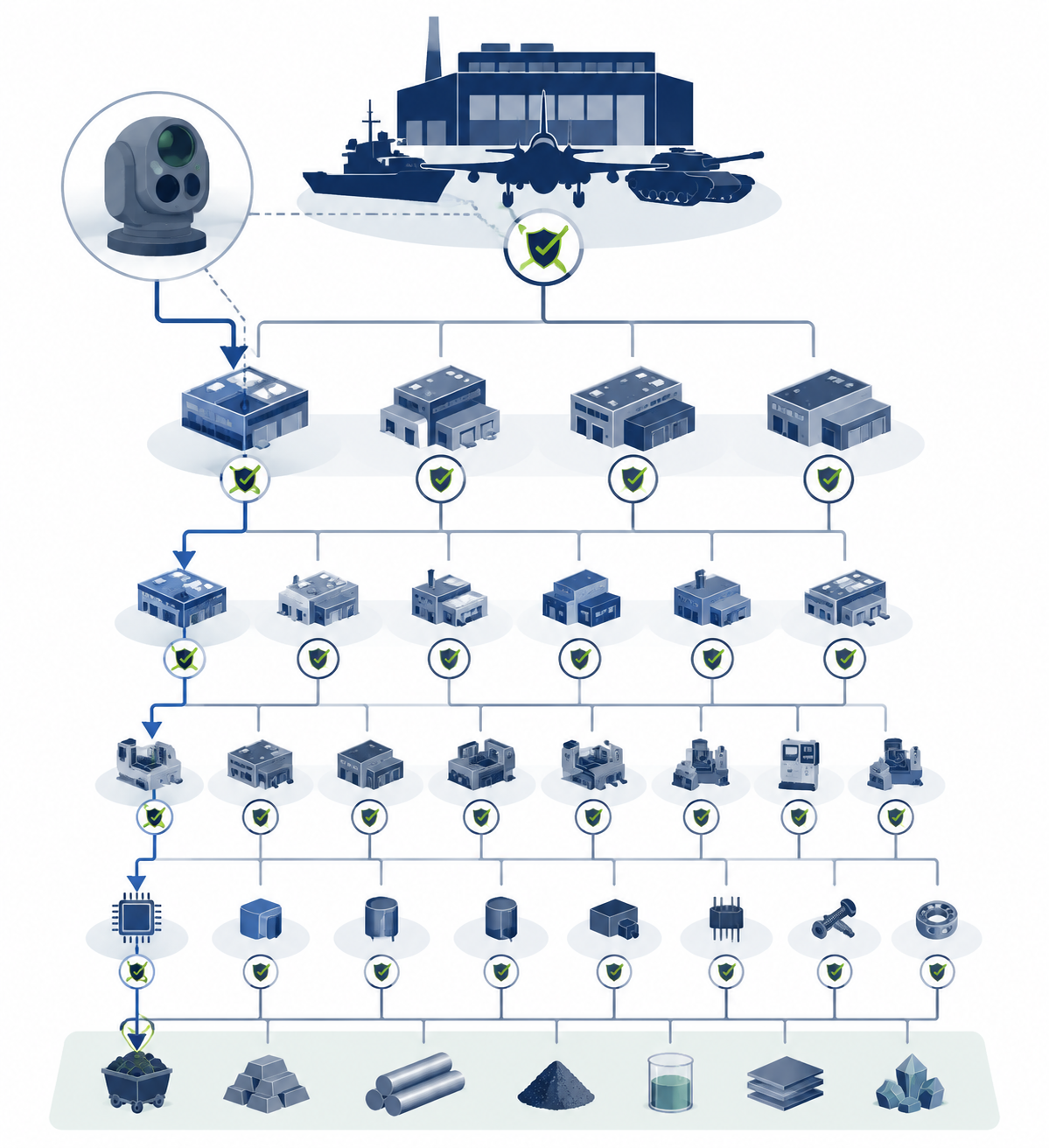
The most operationally demanding piece is the supply-chain mapping mandate. Within 180 days, the Pentagon must issue regulations requiring prime contractors and all tiers of subcontractors to produce what the order calls “indentured bills of materials” that trace each component back to raw material origin, along with tiered supplier vetting for financial, foreign ownership, control, or influence, and manufacturing risk [1][5]. This is where the order moves from waiver policy to production discipline.
“Indentured bills of materials” is an awkward phrase, but the meaning is plain enough: the government wants a record that does not stop at the part number on the invoice. It wants the component lineage all the way back to the source material, and it wants that lineage paired with vetting of the entities that touched the material along the way. CSIS reads the order as pushing defense companies toward deeper visibility into multi-tier sourcing, with a compliance burden that extends well below the prime’s direct vendors [5].
For counsel, the important point is not the terminology but the evidence architecture. If the rulemaking follows the order’s direction, the record will need to support at least three separate questions: where the material came from, who handled it, and whether the participants in the chain raise financial, FOCI, or manufacturing concerns. That is a much broader inquiry than a simple country-of-origin certification, and it will not be solved by a single supplier attestation dropped into the contract file.
What Happens If The Record Is Weak
The order is explicit about consequences. Deliberate misrepresentation in a mitigation plan can trigger contractual remedies and referral to the Department of Justice, while noncompliant contractors face suspension of task orders, declined options, and termination under Section 4 [1][3]. That enforcement stack matters because it closes off the idea that a weak file will simply be corrected later in the process.
A contractor that submits a mitigation plan without adequate factual support is not merely risking a disappointed contracting officer. It is exposing itself to a bad-faith finding that can spill into fraud referral territory. The order does not need to create a new criminal statute to change behavior; it only needs to make the mismatch between the record and the underlying sourcing reality costly enough that people stop treating waivers as a paperwork afterthought.
The reporting cadence reinforces that posture. The Secretaries of Defense and the Interior must report to the President every six months on waiver activity and domestic sourcing progress [1]. That creates a recurring government view of who is still relying on exceptions, which programs are moving, and which claims of unavailability are repeatedly appearing without resolution. For contractors, it means today’s waiver file is not just a local procurement artifact; it is part of a continuing executive-branch reporting loop.
How It Interacts With The FY 2026 NDAA
The executive order does not arrive in a vacuum. The FY 2026 NDAA had already expanded the covered materials list to include molybdenum, gallium, and germanium, with those additions taking effect on December 18, 2027, and had also added recycled-material exceptions and a temporary voluntary-disclosure waiver framework under § 4872(f) [6]. The order tightens the picture by placing a harder evidentiary burden on waiver requests and by accelerating the practical compliance pressure ahead of those later statutory dates [1][6].
That creates an overlap that counsel will want to map carefully. The NDAA’s temporary voluntary-disclosure framework and the order’s mitigation-plan regime are not explicitly harmonized in the materials available here, so the safest reading is that contractors should not assume one set of procedures quietly displaces the other. Where the scenarios overlap, the operative question is likely to be which record the contracting authority will actually demand at the point of award, modification, or waiver review.
The Carve-Out That Does Not Solve The Problem
The order does leave room for Project Vault, the administration’s strategic reserve effort, and treats it as outside the new restrictions [1]. That is a real carve-out, but it is not a substitute for a workable compliance program. The existence of a protected channel for one government initiative does not make the broader procurement process any more forgiving for programs that still have to source, qualify, document, and defend their critical materials choices.
The safer legal reading is to treat the carve-out as narrow and program-specific, not as evidence that the order has a mature alternate supply channel ready for general use. The order tells contractors what must be proven to obtain relief; it does not promise that the government’s own reserve architecture will be ready to absorb all of the burden elsewhere.
The Compliance Burden Has Moved
This is not just a tougher waiver standard. It is a reallocation of risk. The contractor now has to assemble a record that proves search, qualification, tracing, and mitigation before the government will accept the exception. If the record is thin, the burden does not disappear; it moves downstream to the subcontractors asked to fill the gaps, and sideways to the lawyers asked to sign off on the completeness of the file.
The right response is operational. Map suppliers tier by tier. Preserve the sourcing search. Document the funding and timeline behind any qualification effort. Pressure-test whether the mitigation plan actually removes the noncompliant material rather than just describing it. Treat January 1, 2027 as a hard deadline for the new proof standard, not as a policy date that can be absorbed into the next procurement cycle [1][3][4].
References
- “Securing America's Defense Supply Chains and Ensuring Domestic Acquisition of Critical Materials” — White House — https://www.whitehouse.gov/presidential-actions/2026/07/securing-americas-defense-supply-chains-and-ensuring-domestic-acquisition-of-critical-materials/
- “Trump orders tightening of defense supply-chain waiver rules” — Reuters — https://www.reuters.com/legal/government/trump-orders-tightening-defense-supply-chain-waiver-rules-2026-07-20/
- “New executive order tightens defense supply chain waiver rules” — Defense News — https://www.defensenews.com/news/pentagon-congress/2026/07/20/new-executive-order-tightens-defense-supply-chain-waiver-rules/
- “Unpacking Trump's New Critical Minerals Executive Order” — CSIS — https://www.csis.org/analysis/unpacking-trumps-new-critical-minerals-executive-order
- “The Fiscal Year 2026 National Defense Authorization Act Expands Defense Procurement Sourcing Restrictions” — Pillsbury Law — https://www.pillsburylaw.com/en/news-and-insights/fy2026-ndaa-sourcing-restrictions-critical-minerals-advanced-batteries.html
Comments
Join the discussion with an anonymous comment.