
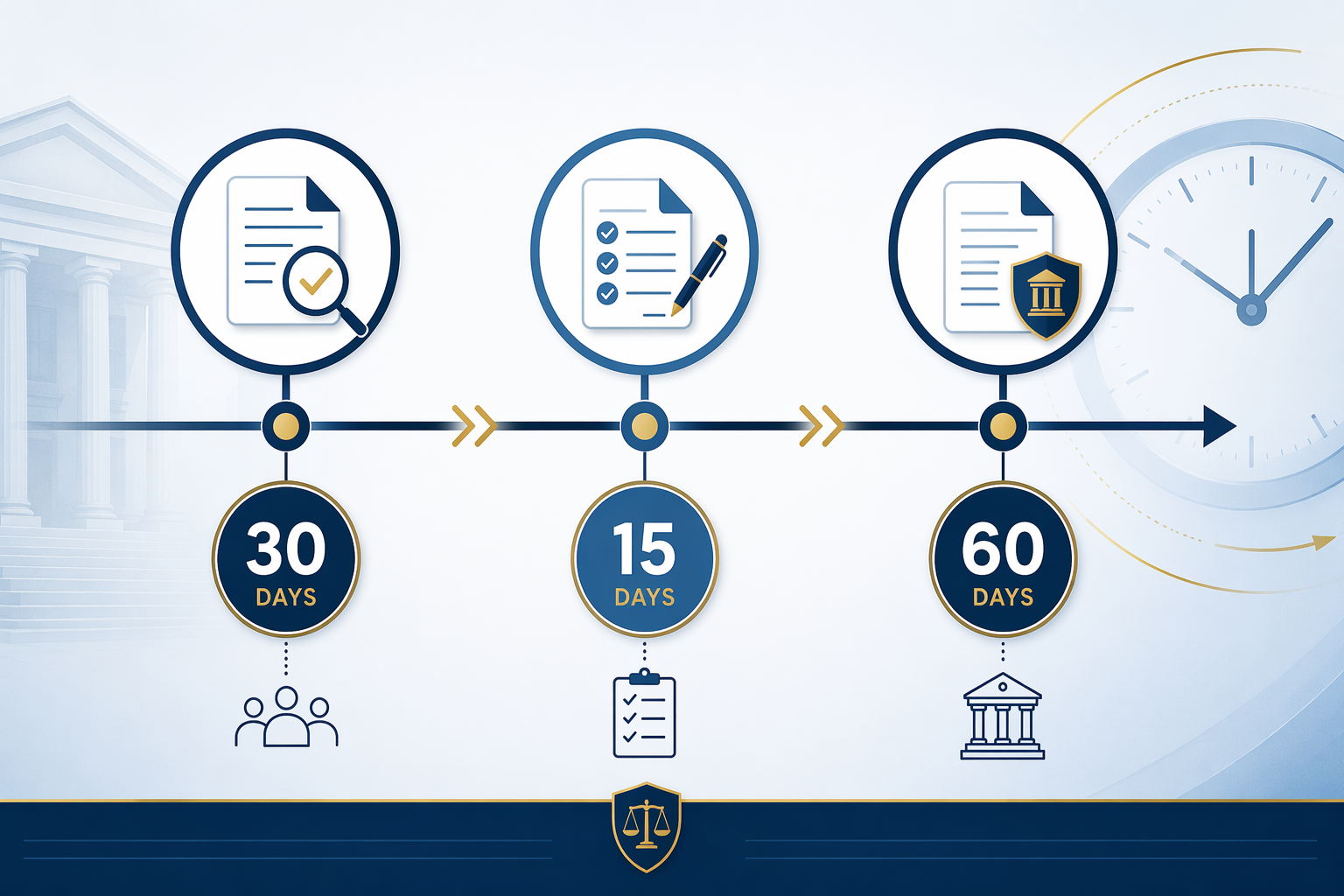
The first question for counsel is not whether Executive Order 14372 is aggressive. It is which part of it can be acted on today, which part needs a contracting instrument that does not yet exist, and which part gives the government leverage before any clause is written. The Order, signed January 7, 2026, sets out a compressed enforcement architecture for defense contractors: a 30-day review to identify underperforming contractors, a prohibition on stock buybacks and dividends for designated contractors, a 15-day window for board-approved corrective plans, a 60-day mandate to develop new DFARS and FAR clauses tying executive compensation to delivery and production metrics, and a referral to the SEC Chair to consider changes to Rule 10b-18.[1]
That architecture matters more than the rhetoric around it. A board can approve a remediation plan. A compensation committee can ask whether production metrics are already embedded in incentive pay. A securities-law team can assess buyback execution risk. A government-contracts team can map which programs are most exposed to designation. But none of those decisions becomes easier if the company treats the Order as either fully self-executing law or as a press release waiting for DFARS implementation.
The Order’s Compliance Machinery
EO 14372 works through layers, not through one clean prohibition. The strongest language concerns buybacks and dividends by designated underperforming contractors. The most operationally urgent language concerns the short deadlines. The most durable legal effect may come later, through contract clauses that have not yet been drafted.
| Mechanism | What the Order Says | Why It Matters Now |
|---|---|---|
| 30-day review | The Secretary of War must review major defense contractors for underperformance within 30 days.[1] | Companies may be evaluated before definitions, processes, or evidentiary standards are clarified. |
| Buyback and dividend prohibition | Designated underperforming contractors are prohibited from stock buybacks and dividends.[1] | The language is immediate, but practical enforcement depends on authority, designation, and contract machinery. |
| 15-day corrective plan | A designated contractor must submit a board-approved corrective plan within 15 days.[1] | The board approval requirement turns a contracting issue into a governance calendar problem. |
| 60-day clause mandate | The Secretary must develop DFARS and FAR clauses tying executive compensation to delivery and production metrics within 60 days.[1] | Future solicitations, modifications, or option negotiations may carry more concrete obligations. |
| SEC referral | The SEC Chair is asked to consider amending Rule 10b-18 for contractor buybacks.[1] | The securities-law consequence is not automatic illegality, but potential loss of safe-harbor comfort. |
The awkward feature is that the Order speaks in immediate terms while relying, for much of its practical bite, on instruments that require implementation. That is not a drafting footnote. It is the difference between a company stopping a capital-return program because a current legal bar exists and a company pausing one because designation risk, contracting pressure, broker caution, or public-company disclosure exposure has become too large to ignore.
What Is Enforceable Before the Clauses Arrive
The Order’s immediate buyback-and-dividend language is the part most likely to be overstated in public discussion. Holland & Knight’s analysis identifies the basic implementation problem: the current FAR and DFARS do not contain the new provisions contemplated by EO 14372, and the Order itself directs the development of those clauses on a 60-day timeline.[2] A contracting officer cannot enforce a clause that has not been incorporated into a contract. Nor can a company’s counsel responsibly pretend that this ends the inquiry.
The government has more than one form of leverage. Designation as an underperforming contractor could affect negotiations, option exercises, award discussions, program reviews, lender and investor questions, and board-level risk assessments even before the new clause language is standardized. In procurement disputes, the paperwork often arrives after the pressure has already changed behavior.
Holland & Knight also points to Defense Production Act authorities, including 50 U.S.C. § 4511 et seq., and notes the rarely invoked criminal provision at 50 U.S.C. § 4513.[2] That does not mean every delayed program suddenly creates criminal exposure. It does mean the Order is not floating entirely outside statutory authority. Counsel should separate three questions that are too easily collapsed: whether the President can direct agency action, whether a contractor has a presently enforceable contractual duty, and whether other statutory tools could be invoked in a more serious production-priority dispute.
For present purposes, the cleanest answer is also the least comforting one. EO 14372 is not fully self-executing in the ordinary contract-administration sense. But a contractor that waits for a final DFARS case before assembling a record of delivery performance, production constraints, capital-return decisions, and compensation metrics is choosing to enter the review process without a file.
The Undefined Terms Are Not Cosmetic
The Order leaves key terms undefined: “major defense contractor,” “underperformance,” and “insufficient production speed.” Latham & Watkins flags those omissions as central to the Order’s reach, including uncertainty over public and private companies, services and hardware contractors, and Foreign Military Sales contexts.[3]
Those gaps are not lawyerly quibbles. A public prime contractor with delayed missile production, a privately held supplier providing a constrained component, a services contractor supporting a major program office, and a contractor involved in a Foreign Military Sales case all present different risk profiles. The Order does not, on its face, provide a complete sorting rule for those categories. That gives the Secretary of War room to define the review population and to decide what evidence counts as underperformance.

The phrase “insufficient production speed” is especially important because it sounds like an engineering judgment but can become a governance judgment very quickly. If a production line is slow because of government-furnished information, late design changes, supplier insolvency, export-control review, testing failures, or workforce constraints, the company will want those causes documented before a designation letter arrives. If the delay instead reflects capital allocation choices, inadequate investment, or executive incentive structures that rewarded margins over delivery, the corrective-plan discussion will look different.
The board-approved corrective plan requirement sharpens the point. A 15-day window does not allow a company to discover its own program history from scratch.[1] It assumes someone already knows which contracts are late, which milestones moved, which causes are internal or external, which disclosures have been made, and which directors or committees can approve a plan on short notice.
The Board Problem Hidden Inside a Contracting Order
The fastest way to misread EO 14372 is to leave it inside the contracts department. The Order ties underperformance, capital returns, corrective planning, and executive compensation into one review structure. That combination reaches the general counsel’s office, the audit committee, the compensation committee, investor-relations staff, and disclosure controls.
For a public company, the buyback issue is not limited to whether the Order itself bans repurchases today. Counsel will need to know whether a repurchase plan is active, whether it depends on broker participation under Rule 10b-18 practices, whether any blackout or trading-plan procedures are implicated, and whether a possible underperformance designation would be material to investors. For a private company, the same issue may appear through dividend policy, credit agreements, sponsor distributions, or representations made during negotiations with the government.
The compensation piece is not yet a finished clause. The Order instructs the Secretary of War to develop DFARS and FAR clauses within 60 days that connect executive compensation to delivery and production metrics.[1] Until those clauses exist, counsel cannot quote final contract text. But compensation committees can still ask whether current incentive plans would be defensible if the company were designated as underperforming next month.
Rule 10b-18: Safe Harbor Risk, Not an Automatic Ban
The SEC referral is easy to overstate. EO 14372 asks the SEC Chair to consider amending Rule 10b-18 to exclude stock buybacks by certain defense contractors from the rule’s safe harbor.[1] Losing the safe harbor would not, by itself, make every buyback unlawful. Rule 10b-18 is a nonexclusive safe harbor; conduct outside it may still be lawful depending on the facts.
That distinction matters, but it is not a reason to dismiss the referral. Safe harbors affect how brokers, issuers, boards, and securities counsel price risk. If a defense contractor’s buybacks become harder to execute with customary comfort, the practical consequence may arrive before any enforcement action. Broker caution can be a regulatory effect even when no statute says the transaction is categorically prohibited.
The April 2025 Acquisition Order Adds Pressure, Not Clarity
EO 14372 also lands against an earlier acquisition-modernization effort. Arnold & Porter’s April 21, 2025 analysis describes a separate executive order requiring review of Major Defense Acquisition Programs for possible cancellation where programs are more than 15 percent behind schedule or more than 15 percent over budget.[4] That is not the same legal test as underperformance under EO 14372. It is, however, a nearby review process aimed at troubled defense programs.
The overlap creates a practical problem for contractors on delayed or over-budget programs. A company may be explaining schedule variance in one acquisition-review channel while preparing for a contractor-performance designation inquiry in another. The facts will not stay in separate binders simply because the executive orders have different titles.
What Counsel Should Have Ready During the 30-Day Review
This is not a substitute for legal advice, and no contractor should treat a general article as a designation response plan. But the Order’s deadlines are short enough that waiting for perfect guidance is itself a decision. The useful work now is to separate what the company knows, what it can document, and what it would need the board to approve if the Secretary’s review turns toward the company.
- Identify programs that are late, production-constrained, or under heightened government attention, and distinguish internal causes from government-caused or supplier-caused delays.
- Map current and planned buybacks, dividends, sponsor distributions, and related board authorizations against contracts and programs that may be exposed.
- Prepare a board-ready record of corrective measures already taken, including investment, staffing, supplier remediation, schedule recovery, and customer communications.
- Review executive compensation metrics for delivery, production, schedule, and program performance elements before the 60-day clause process produces proposed language.
- Coordinate government-contracts, securities, finance, and disclosure-control teams so that designation risk is not assessed in one office and reported differently in another.
The corrective-plan requirement deserves special attention because it requires board approval within 15 days after designation.[1] That is a poor moment to discover that the company has no committee calendar, no agreed factual record, and no internal owner for production-speed explanations. Even if a contractor ultimately disputes the designation, the early file will matter.
The Constitutional Questions Are Real, But Not the First Deadline
There are broader questions about executive authority, national-security contracting, capital allocation, and the limits of presidential control over contractor governance. A Georgetown Law national-security journal article published in October 2025 provides useful framing for those kinds of constitutional and structural questions.[5] They may matter in litigation or in a future rulemaking record.
They do not answer the immediate desk-level problem. A general counsel still has to advise whether the company is exposed to designation, whether its capital-return program should be revisited, whether the board can approve a corrective plan within 15 days, and whether current compensation structures will look misaligned once the DFARS and FAR clause process begins.
The Legal and Policy Impact Is Already Here
EO 14372 is best read as a staged instrument. It is not fully self-executing in the way its strongest buyback-and-dividend language may suggest. The absence of current FAR and DFARS clauses matters. The undefined terms matter. The difference between safe-harbor loss and securities-law illegality matters.
But the Order is already consequential. It creates designation risk inside a 30-day review window, demands board-level remediation readiness inside 15 days, sets up contract clauses within 60 days, and invites securities-market consequences through the Rule 10b-18 referral.[1] That is enough to change contractor behavior before the first clean test case appears.
Lex Machina Review has not previously treated defense acquisition and defense investment regulation as a standing coverage area. This article is a first entry in that thread: source-cited, non-advisory, and focused on the legal mechanics that matter before the politics settle.
References
- Executive Order 14372, “Prioritizing the Warfighter in Defense Contracting,” White House, January 7, 2026.
- Holland & Knight analysis of Executive Order 14372 and Defense Production Act authorities, Holland & Knight.
- Latham & Watkins analysis of Executive Order 14372, undefined contractor-performance terms, and Foreign Military Sales implications, Latham & Watkins.
- Arnold & Porter analysis of the April 2025 defense acquisition modernization executive order, Arnold & Porter, April 21, 2025.
- Georgetown Law national security journal article on constitutional framing for national-security contracting, Georgetown Law, October 2025.
Comments
Join the discussion with an anonymous comment.