
The legal implications of Trump’s election integrity claims are easiest to distort when every proceeding is collapsed into one political scorecard. The civil election suits did not produce substantive validation of the fraud and irregularity theories pressed after 2020: the Campaign Legal Center’s tracking counted 62 lawsuits and zero substantive victories for Trump and his allies.[1] A separate Brookings analysis of 194 judicial votes found only 14% favorable to Trump-side positions overall, and 2% in federal court.[2] The later criminal cases ended without trial, not with merits acquittals. The lawyer-discipline cases asked a different question again: whether attorneys had a defensible basis to say what they said in court, in official pressure campaigns, and to the public. By mid-2026, those same claims have also reappeared inside federal executive and Justice Department priorities.
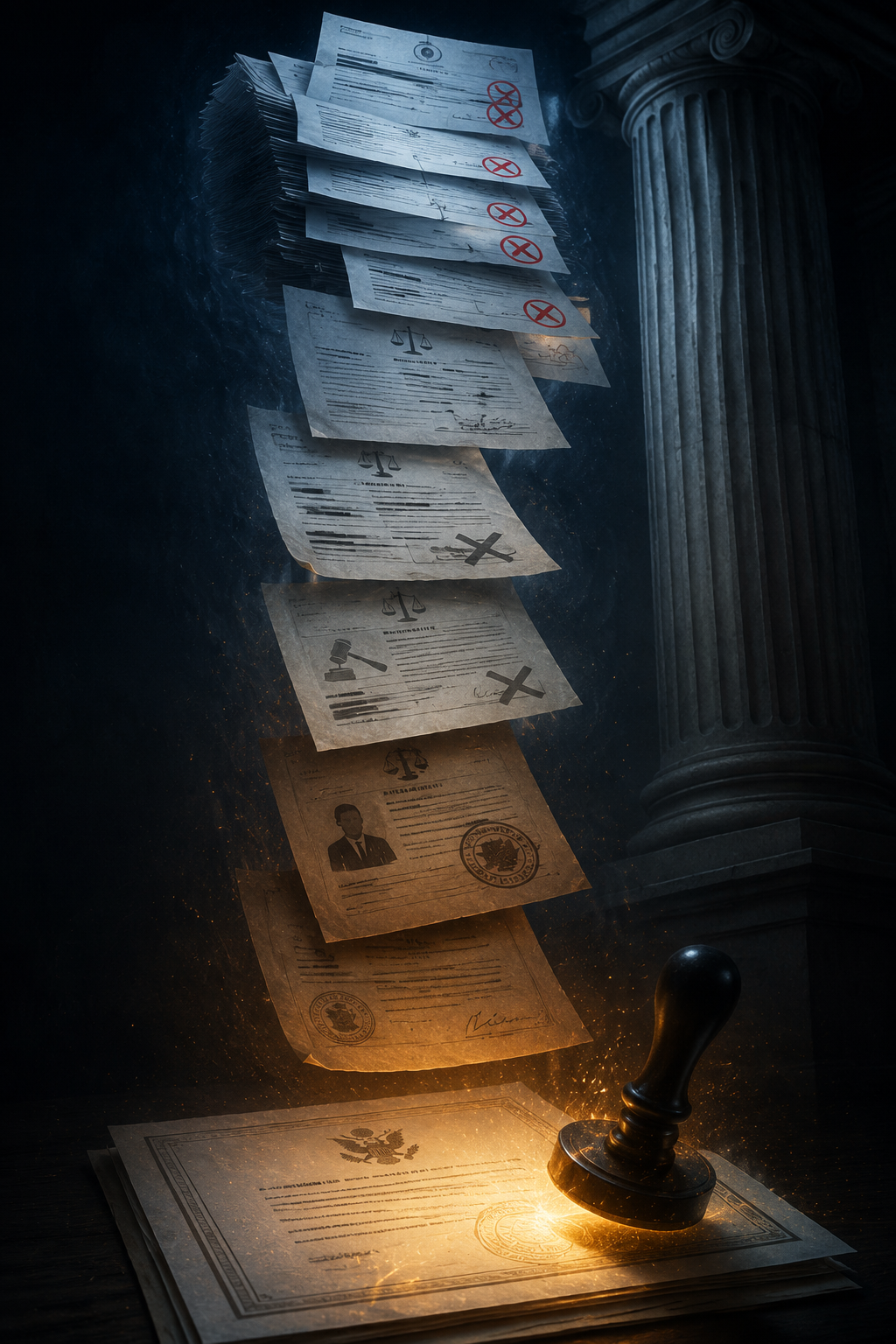
That sequence matters. A dismissed indictment is not a finding that the underlying conduct was lawful. A disciplinary sanction is not a substitute criminal conviction. A failed election complaint can fail for standing, laches, mootness, pleading defects, evidentiary insufficiency, or a merits ruling. But when dozens of suits across state and federal courts fail to generate a single substantive win, the cumulative record becomes harder to reframe as a mere technicality.
The Civil Record Did More Than Produce a Losing Streak
The post-2020 civil litigation record is the baseline for everything that followed. It is not just that Trump and allied plaintiffs lost. They lost in a volume and variety of forums that tested the claims against different judges, different procedural vehicles, different defendants, and different asserted remedies. The Campaign Legal Center’s count of 62 lawsuits with no substantive victories is useful because it separates legal validation from political repetition.[1]
Brookings adds a second layer by counting judicial votes rather than merely case outcomes. Its analysis examined 194 judicial votes in litigation over the 2020 election and found that Trump-side positions received favorable votes 14% of the time overall; in federal court, the figure was 2%.[2] That is a narrower and more careful measure than saying “judges rejected fraud.” It measures how judges voted on the positions presented to them, in the procedural posture in which those positions arrived.
| Civil-litigation measure | What it shows | What it does not show |
|---|---|---|
| 62 lawsuits, zero substantive victories | The litigation campaign did not obtain a court ruling validating the election-integrity theories as a basis to change the result. | It does not mean every case received the same depth of merits review. |
| 194 judicial votes, 14% favorable overall | Judges across the litigation record overwhelmingly rejected Trump-side legal positions. | It is not a criminal finding about Trump or any attorney. |
| 2% favorable judicial votes in federal court | Federal courts were especially unreceptive to the claims and requested remedies. | It does not decide state disciplinary or executive-policy questions. |
That distinction is not pedantry. Election litigation often moves under time pressure, with emergency motions, compressed records, and unusual requested relief. Some losses therefore mean only that a plaintiff used the wrong vehicle, waited too long, lacked standing, or asked for relief a court could not grant. But the post-2020 record was not one hurried complaint. It was a national litigation campaign. Its failure to secure a substantive victory is the legal system’s answer to the claims as litigation claims.
The answer was not confined to judges appointed by one party, or to one state’s procedures, or to one theory of vote counting. The Brookings judicial-vote analysis is valuable precisely because it resists the easy narrative that a single adverse ruling can be explained away as forum-shopping gone wrong or partisan judging in reverse. Across the record, the claims did not become stronger when they moved from press conference to complaint, from complaint to motion, or from motion to judicial order.[2]
What the Criminal Dismissals Can and Cannot Bear
The federal election-obstruction case against Trump, docketed as 23-cr-00257, occupies a much larger public space than its procedural ending can support. After Trump’s 2024 re-election, the case was dismissed without prejudice. Special Counsel Jack Smith’s final report, released in January 2025, nevertheless stated that the admissible evidence was sufficient to obtain and sustain a conviction at trial.[3]
Both halves of that sentence have to remain intact. The Special Counsel’s assessment is not a jury verdict. It did not subject the government’s theory to the full adversarial testing of trial, and it did not produce a conviction. But the dismissal also was not a judicial finding that the prosecution lacked evidence or that the conduct alleged was lawful. It was a procedural termination tied to the consequences of re-election and Justice Department policy, not a merits adjudication.
The Georgia RICO case followed a similarly unsatisfying path for anyone looking for a clean legal endpoint. It was part of the same legal lifecycle of the post-2020 claims, but its dismissal does not do the work that the civil election cases did. The civil record tells us what courts did when asked to validate the election-integrity claims as grounds for relief. The criminal record tells us that one accountability track was interrupted before trial.
Discipline Asked Whether Lawyers Had a Basis
Professional discipline entered where the election lawsuits left a different question unresolved. A complaint can fail without deciding whether the lawyer who filed it violated ethical rules. Bar proceedings ask what the lawyer knew, what the lawyer investigated, what the lawyer told a court or public official, and whether courtroom privilege was used as a license for unsupported political claims.

John Eastman’s April 2026 disbarment in California is the clearest late-stage example. The Guardian reported that the California Supreme Court disbarred Eastman after findings that included “gross negligence” in making false statements without proper investigation.[4] States United Democracy Center also identified Eastman’s disbarment as part of its broader accountability tracking for lawyers involved in efforts to overturn the 2020 election.[5]
Eastman’s case matters because it marks the profession catching up to conduct that had already done public work. The election suits had failed years earlier. The pressure campaign around alternate electors and vice-presidential authority had already shaped a national constitutional crisis. A 2026 disbarment could not undo that sequence, but it answered the professional question in a forum designed for that purpose: whether a lawyer may advance grave factual and legal claims without the investigation and candor the profession requires.
Eastman was not alone. Bloomberg Law’s 2024 overview described a wider disciplinary landscape involving Rudy Giuliani, Sidney Powell, Kenneth Chesebro, Jenna Ellis, and Jeffrey Clark, while also noting ethics experts’ concerns that bar systems were moving too slowly for election disputes that unfold on an emergency timetable.[6] By mid-2026, the visible sanctions included Giuliani’s disbarments in New York and the District of Columbia, Chesebro’s New York disbarment, Powell’s guilty plea in the Georgia RICO matter, Ellis’s Colorado censure, and Clark’s pending District of Columbia discipline track, as summarized in the research record.
Those outcomes should not be flattened into one category. A guilty plea, a censure, a disbarment, and a pending disciplinary case do not carry the same legal meaning. But they do show that the legal profession did not treat the post-2020 work as ordinary losing advocacy. The repeated issue was not merely that lawyers lost; it was whether they had a factual and legal foundation for claims that, once filed or broadcast, imposed costs on election administrators, courts, disciplinary counsel, and the public record.
The Claims Returned as Government Work
The most consequential development by Q3 2026 is not that the claims survived rhetorically. Political claims often outlive litigation. The more concrete development is that claims courts did not substantively validate have reentered federal practice through executive orders, election-fraud tasking, Justice Department priorities, and pressure on the election-administration infrastructure.
The Brennan Center’s 2025–2026 living tracker describes a second-administration election agenda that includes executive action, the dismantling or weakening of election-security functions, changes affecting the Justice Department’s civil-rights election work, and threats directed at election officials.[7] Its account includes a reduction in the DOJ Civil Rights Division’s voting-section attorney staffing from roughly 30 attorneys to roughly 6.[7] That figure measures institutional capacity, not proof of fraud; it is relevant because capacity determines who can investigate, sue, defend, and correct the record when election claims become government policy.
NBC News reported in June 2026 that the Justice Department was still struggling to produce evidence of widespread election fraud despite dedicating resources to the effort.[8] That reporting sits awkwardly beside the earlier litigation record. If courts were wrong because the claims were never properly investigated, one would expect executive power and DOJ tasking to sharpen the proof. The public record described in the available reporting instead shows an evidentiary struggle continuing inside the government.
The same pattern appeared in Trump’s July 16, 2026 election-related speech. FactCheck.org analyzed his assertion involving 278,000 noncitizens and reported that experts called the claim “wildly speculative.”[9] That analysis does not resolve every policy dispute over voter eligibility, and it does not preclude targeted enforcement where evidence exists. It does show that, even after years of litigation, investigation, and political repetition, some of the most prominent public assertions still struggle to meet evidentiary standards.
The Mid-2026 Legal Posture
As of July 2026, the record is uneven only if the proceedings are forced to answer the same question. They do not. The civil cases answer whether Trump’s post-2020 election-integrity claims won judicial validation as grounds for election relief. They did not. The federal criminal case answers whether one prosecution reached trial and verdict. It did not. The Special Counsel report answers whether the prosecutor assessed the evidence as sufficient to convict. It did. The disciplinary proceedings answer whether lawyers involved in the effort met professional obligations. In several prominent cases, disciplinary authorities concluded they did not.
The institutional record answers still another question: what happened when political power returned to the claimant. The claims failed as litigation, but they did not disappear. They now shape executive action, election-fraud assignments, Justice Department priorities, and public assertions that remain contested for want of substantiation. That is the narrow legal consequence the record supports: no substantive civil validation, interrupted criminal accountability, severe professional fallout for multiple lawyers, and an ongoing federal effort to operationalize claims courts did not accept.
References
- Results of Lawsuits Regarding the 2020 Elections, Campaign Legal Center, https://campaignlegal.org/results-lawsuits-regarding-2020-elections
- Trump’s Judicial Campaign to Upend the 2020 Election: A Failure, but Not a Wipe-Out, Brookings Institution, November 2021, https://www.brookings.edu/articles/trumps-judicial-campaign-to-upend-the-2020-election-a-failure-but-not-a-wipe-out/
- Final Report of the Special Counsel, U.S. Department of Justice, January 2025, https://www.justice.gov/storage/Report-of-Special-Counsel-Smith-Volume-1-January-2025.pdf
- Trump lawyer John Eastman disbarred in California over election subversion efforts, The Guardian, April 2026, https://www.theguardian.com/us-news/2026/apr/16/john-eastman-disbarred-california-trump
- Accountability Hub, States United Democracy Center, https://statesuniteddemocracy.org/resources/accountability-hub/
- Trump Election Lawyers Face Discipline Years After 2020 Cases, Bloomberg Law, April 2024, https://news.bloomberglaw.com/business-and-practice/trump-election-lawyers-face-discipline-years-after-2020-cases
- The Trump Administration’s Attacks on Elections, Brennan Center for Justice, 2025–2026, https://www.brennancenter.org/our-work/research-reports/trump-administrations-attacks-elections
- DOJ struggles to find evidence of widespread voter fraud despite Trump’s claims, NBC News, June 2026, https://www.nbcnews.com/politics/justice-department/doj-struggles-find-evidence-widespread-voter-fraud-trump-claims-rcna213479
- Trump’s Unsupported Claims About Noncitizen Voting, FactCheck.org, July 2026, https://www.factcheck.org/2026/07/trumps-unsupported-claims-about-noncitizen-voting/
Comments
Join the discussion with an anonymous comment.