
Roger Rogoff’s tenure as court-appointed U.S. Attorney for the Western District of Washington lasted less than an hour. On July 15, 2026, 17 federal district judges unanimously appointed him under the interim-appointment mechanism Congress gave the courts. Fifty-four minutes later, the White House sent an email saying President Trump had fired him. Acting Attorney General Todd Blanche defended the move as an exercise of Article II authority.[1][2]
That compressed sequence is why the legal implications of Trump firing a U.S. Attorney are not the familiar ones about whether a President may remove a Senate-confirmed prosecutor. The question is narrower, and harder: when judges appoint an interim U.S. Attorney under 28 U.S.C. § 546(d), does the President’s general removal power under 28 U.S.C. § 541(c) still attach, or does the removal power follow the appointment power Congress assigned to the court?
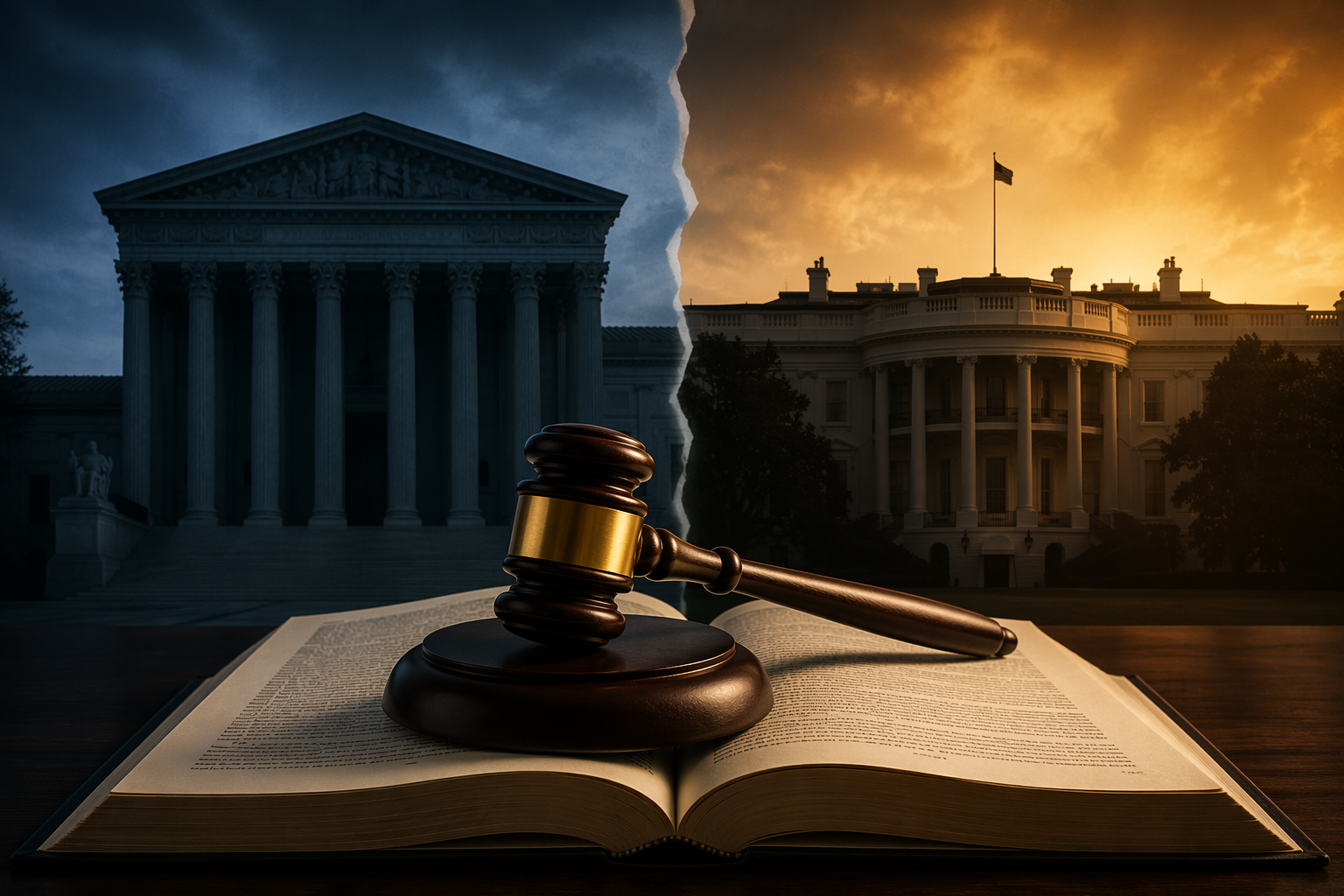
The Rogoff lawsuit is pending as of Q3 2026, so the honest answer is not that one side has already won. The better framing is that the case sits exactly where statutory appointment architecture and a newly strengthened Article II removal doctrine now collide.
The Statute Built More Than One Path Into the Office
The U.S. Attorney statutes do not describe a single pipeline. Section 541 covers presidential appointment, Senate confirmation, four-year terms, and presidential removal. Section 541(c) says U.S. Attorneys are “subject to removal by the President.” Section 546, by contrast, deals with vacancies and temporary service. Under § 546(d), if the Attorney General’s interim appointment expires and no presidential nominee has been confirmed, the district court for that district may appoint a U.S. Attorney to serve until the vacancy is filled.[3]
| Route into the office | Who acts | Why it matters in Rogoff |
|---|---|---|
| Presidential appointment under § 541 | President nominates; Senate confirms | Section 541(c) expressly gives the President removal authority |
| Attorney General interim appointment under § 546 | Attorney General fills a vacancy temporarily | Still sits inside the executive appointment chain |
| Court appointment under § 546(d) | Federal district judges appoint when the vacancy persists | Creates the disputed handoff: judicial appointment of an executive prosecutorial officer |
The hard part is not recognizing that U.S. Attorneys perform executive functions. They plainly prosecute federal crimes on behalf of the United States. The hard part is deciding whether Congress, after creating a special judicial stopgap for vacancies, also left the President free to terminate the court’s appointee immediately under the general removal clause in § 541(c).
A 2026 Brooklyn Law Review article by Professor Ronald J. Ross treats that question as a matter of statutory fit rather than executive-branch instinct. Ross reads § 541(c) as a general rule for U.S. Attorneys appointed through § 541, while § 546(d) supplies a distinct appointment mechanism for court-appointed interim officers. His conclusion is that Congress did not intend § 541(c)’s presidential removal provision to reach U.S. Attorneys appointed by district courts under § 546(d).[3]
That conclusion matters because it refuses to treat § 546(d) as ceremonial. If the President may remove a court appointee moments after the judges act, the judicial appointment mechanism remains on the books, but its practical force depends entirely on presidential tolerance. That may be constitutionally required, as the administration argues. It is not, however, the most natural way to describe a statutory backup mechanism designed to solve a vacancy when the executive appointment process has not produced a confirmed replacement.
Two Serious Theories, Neither of Them Decorative
Peter Shane’s position starts from the Appointments Clause and from the statutory choice Congress made. If Congress allows courts of law to appoint inferior officers, the argument goes, the removal power should track that appointing authority unless Congress says otherwise. On that view, the President’s ordinary supervisory interest in prosecution does not automatically erase the court’s § 546(d) role once the statutory conditions for judicial appointment have been met.[4]
John Yoo’s position starts somewhere else: with Article II and the President’s duty to control executive power. In Yoo’s view, a prosecutor exercises executive authority, and Congress cannot insulate such an officer from presidential removal by routing the appointment through judges. Fox News reported Yoo’s view that Article II leaves “no doubt” about the President’s authority to remove the judge-installed prosecutor.[5]
Those theories do not merely disagree about Rogoff. They disagree about what § 546(d) is allowed to accomplish. Shane’s theory treats the court appointment as a constitutionally authorized interbranch appointment with consequences. Yoo’s theory treats the appointment as permissible only so long as it does not interfere with the President’s continuing control over executive officers.
The difference is easy to blur in headlines about “firing U.S. Attorneys.” It should not be blurred in legal analysis. An acting official chosen inside DOJ, an interim official appointed by the Attorney General, a court-appointed interim U.S. Attorney, and a Senate-confirmed U.S. Attorney do not all present the same appointment-and-removal problem. Rogoff’s claim depends on that distinction.
Why Slaughter Helps the Administration, But Does Not End the Case
The administration’s argument is stronger in July 2026 than it would have been earlier because of Trump v. Slaughter. On June 29, 2026, the Supreme Court overruled Humphrey’s Executor and held that the President may remove Federal Trade Commission commissioners at will, a major shift toward presidential control over executive-branch personnel.[6][7]
For the White House, Slaughter supplies the broad music: when an officer exercises executive power, removal restrictions are suspect. Prosecutors are not FTC commissioners, and U.S. Attorneys are closer to core executive enforcement than multi-member regulatory commissioners ever were. If the Court has rejected removal protection even for the FTC, the administration will argue, a district court cannot use § 546(d) to create a prosecutor beyond the President’s reach.
But the most important part of Slaughter for Rogoff may be the part Chief Justice Roberts did not decide. According to SCOTUSblog and Dentons analyses of the decision, Roberts expressly reserved the question of officers appointed by a different branch.[6][7] That reservation is not a courtesy footnote. It is the doctrinal hinge Rogoff needs.
Slaughter dealt with presidential removal of officers within the executive appointment framework. Rogoff concerns an inferior officer appointed by Article III judges under a statute Congress enacted for vacancies. A court could decide that Slaughter’s unitary-executive logic sweeps across that boundary. It could also decide that the Court deliberately left that boundary for another day because different-branch appointment raises a separate Appointments Clause and statutory question.
Nor did the Court in late June describe presidential removal as absolute in every setting. The same day, in Trump v. Cook, the Court carved out the Federal Reserve, with analysis turning on historical practice and institutional structure rather than a single all-purpose removal rule.[7] That does not decide Rogoff either; a U.S. Attorney is not a Federal Reserve governor. It does, however, caution against treating Slaughter as if it silently answered every removal question involving the President.
The 1979 OLC Problem
One awkward feature for the administration is that the issue was not always treated as obvious inside the executive branch. Ross describes a 1979 Office of Legal Counsel memorandum as equivocal on whether § 541(c) authorizes presidential removal of court-appointed interim U.S. Attorneys, and relies on that history in discussing the unsettled nature of the question.[3]
That does not bind the current Justice Department. OLC views change, and the Supreme Court’s removal doctrine has moved substantially since 1979. But the earlier equivocation weakens the claim that the statutory answer was always self-evident. If DOJ’s own lawyers once saw ambiguity in the § 541(c)/§ 546(d) relationship, a court is unlikely to dismiss the statutory argument as merely tactical.
Rogoff Is Part of a Wider Appointment Breakdown, But Counts Matter
Rogoff is not the only court-appointed U.S. Attorney removed after judges declined to keep an administration-preferred acting official in place. Reporting identifies at least three court-appointed U.S. Attorneys fired in this pattern: Rogoff in Washington, Donald Kinsella in New York, and Hundley in Virginia.[2][4][8]
There is also a related but distinct line of cases involving Trump-appointed acting U.S. Attorneys whom federal courts have ruled were unlawfully serving. Democracy Docket reports that at least five such acting U.S. Attorneys have been found unlawfully serving by federal courts.[4] Those rulings help explain why the § 546(d) mechanism has become more visible: when courts reject an acting official’s continued service, the vacancy statute stops being background machinery and starts deciding who signs indictments, appears in court, and supervises federal prosecutions.
The count should be handled carefully. Some sources discuss three fired court-appointed U.S. Attorneys, while other descriptions refer to a higher number that may include different categories of acting, interim, or court-appointed officials. Until the methodology is pinned down, the safer legal point is recurrence, not a precise nationwide total.
That recurrence still matters. Congress wrote § 546(d) for a practical reason: districts cannot suspend federal prosecution while the political branches fail to install a confirmed U.S. Attorney. Judges are not eager personnel managers for DOJ. They are the institution left with the vacancy problem when the statutory clock runs out.
What a Court Actually Has To Decide
The first question is statutory. Does § 541(c)’s statement that U.S. Attorneys are removable by the President apply to every person serving as a U.S. Attorney, regardless of how that person entered the office? Or is § 541(c) tied to the § 541 appointment process, leaving § 546(d) court appointees governed by the vacancy provision until a presidentially appointed and Senate-confirmed successor appears?
The second question is constitutional. If Congress did intend to protect a court-appointed interim U.S. Attorney from presidential removal, may it do so? The Appointments Clause permits Congress to vest appointment of inferior officers in “the President alone,” “the Courts of Law,” or “the Heads of Departments.” The administration’s answer is that appointment flexibility does not include removal insulation for an officer exercising prosecutorial power. Rogoff’s answer is that court appointment under the Appointments Clause would be hollow if the President could instantly nullify it whenever the court selected someone he did not want.
The third question is remedial and practical. If Rogoff’s firing was unlawful, what follows for the office, for decisions taken after the firing, and for pending matters in the district? Because the complaint text is not before readers here, those remedial claims should be treated through reporting rather than assumed. But in a U.S. Attorney’s Office, uncertainty over lawful authority is not abstract. It can affect supervision, charging approvals, appearances, plea negotiations, and the defense bar’s incentives to challenge government action.
That is the institutional awkwardness behind the litigation. The President claims a direct constitutional line to every federal prosecutor. The judges claim the statute gave them a defined role once the ordinary appointment process failed. Lawyers can make either position sound inevitable only by sanding down the other half of the structure.
The Narrow Issue Slaughter Left Behind
Rogoff is a clean vehicle for a question Slaughter strengthened but did not resolve. The administration now has a newly fortified Article II removal argument. Rogoff has a statutory and Appointments Clause argument that remains serious precisely because Congress gave courts a specific appointment role under § 546(d), and because the Supreme Court reportedly reserved the different-branch appointment question in Slaughter.
The legal implication of Trump firing a court-appointed U.S. Attorney is therefore not simply whether this President can replace this prosecutor. It is whether § 546(d) still operates as a real vacancy solution when the executive branch objects to the court’s choice, or whether Article II removal power makes that judicial appointment provisional from the moment it is made.
That is enough of a contest without pretending the outcome is obvious. Rogoff will test whether the Supreme Court’s new removal doctrine extends into a statutory handoff the Court has not yet squarely addressed.
References
- Seattle US attorney fired by Trump, AP News, July 15, 2026.
- Roger Rogoff, U.S. attorney in Seattle, sues Trump over firing, CBS News, July 2026.
- Brooklyn Law Review, Volume 91, Issue 3, Article 3, Brooklyn Law Review, 2026.
- White House, Justice Department Fires Court-Appointed New York U.S. Attorney, Democracy Docket.
- Trump ousts judge-installed prosecutor, constitutional expert says Article II leaves no doubt, Fox News.
- Court allows Trump to fire FTC commissioner and overturns major restraint on presidential power, SCOTUSblog, June 2026.
- Trump v. Slaughter, Dentons, July 7, 2026.
- White House fires US attorney Donald Kinsella after judges replace Trump pick, NBC News.
Comments
Join the discussion with an anonymous comment.