
The hard legal problem in the Trump Iran deal announcement is not the word “MOU.” It is what happened on June 22, 2026, when Treasury issued General License X and gave parties a 60-day window of oil sanctions relief while the Iran Nuclear Agreement Review Act was supposed to be doing its work.[1]
For a sanctions lawyer, that is the moment the political story becomes operational. A license is not a cable-news talking point. It is a document that banks, traders, insurers, shippers, and internal compliance teams may be asked to rely on before money moves or cargo changes hands. If the license rests on an agreement that INARA required the administration to submit to Congress, and if the statute barred sanctions relief during the review period, then the reliance question does not disappear because the White House calls the instrument a memorandum of understanding.
The License Is Where The Statute Bites
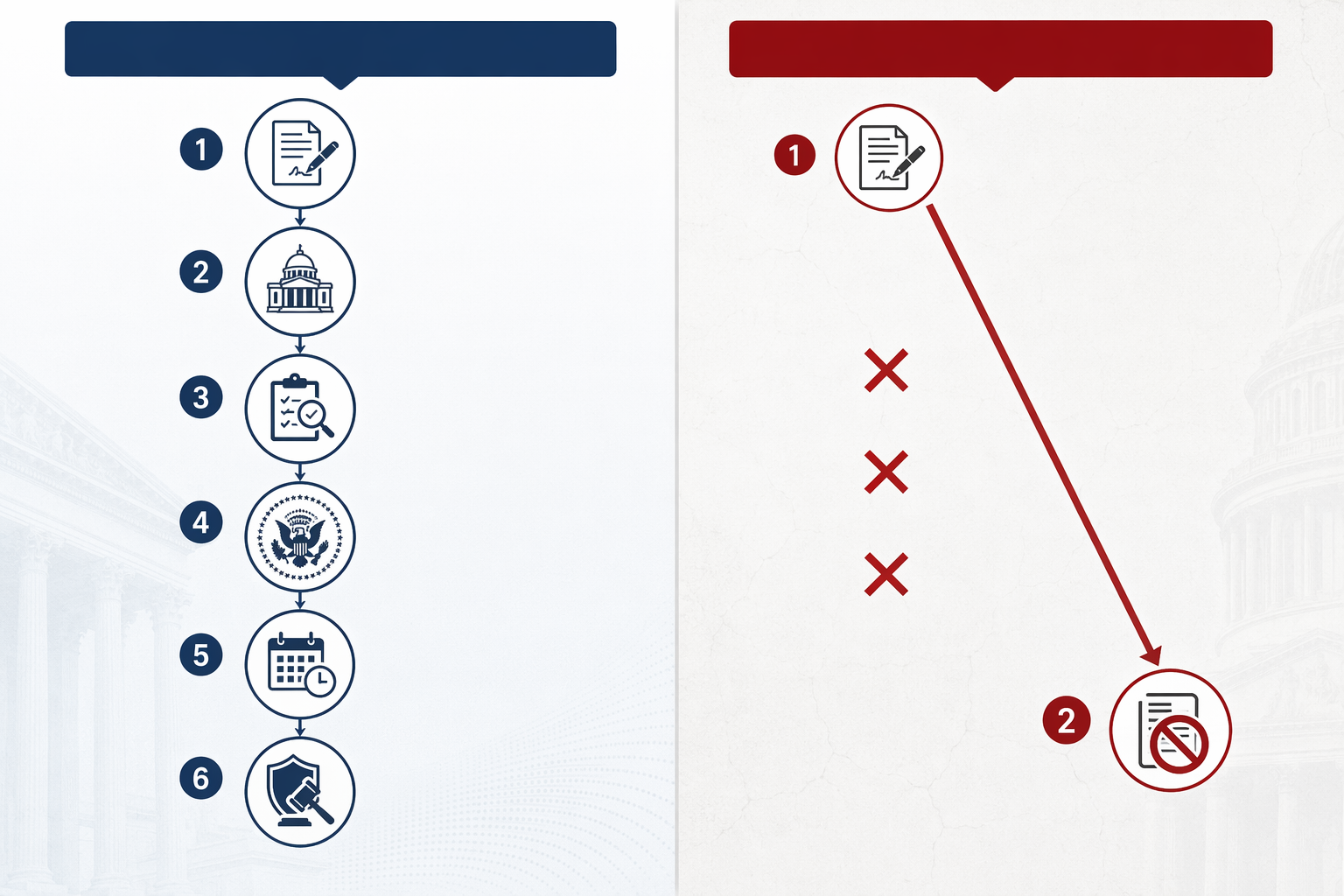
INARA does not merely give Congress a chance to complain about an Iran nuclear arrangement after the fact. It imposes a sequence. The executive must transmit the agreement and required related materials. The State Department must provide a verification assessment report. The president must submit a certification. During the applicable review period, the statute bars the president from waiving, suspending, reducing, providing relief from, or otherwise limiting the application of statutory sanctions on Iran under the covered agreement.[1][2]
That is why General License X matters. Goldsmith and Bridgeman’s analysis treats the June 22 license as the clearest practical consequence of the administration’s INARA problem: Treasury appears to have granted sanctions relief before the statutory review process had been completed, and indeed while the statute’s bar on sanctions waivers was still operative.[1] The point is domestic law, not whether Iran, oil purchasers, or foreign intermediaries find the MOU diplomatically useful.
The reported 60-day relief window also creates a timing problem that cannot be brushed away as procedural housekeeping. The negotiation period would extend to approximately August 17, 2026, while the June 22 license took effect at the front end of that period.[1] If INARA applies, the legal order is reversed: Congress receives the agreement and the required materials first; sanctions relief comes only after the statutory process permits it.
Why “MOU” Does Not Solve The INARA Question
The administration’s best instinct, if it wants to avoid INARA, is obvious: describe the Iran arrangement as something less than an agreement. Memorandum. Understanding. Framework. Political commitment. Nonbinding diplomatic instrument. Those labels may matter for some constitutional and international-law questions. They do not do the work here.
INARA defines the covered “agreement” broadly. The statute reaches any agreement related to Iran’s nuclear program, including arrangements that are formal or informal, written or oral, and regardless of whether they are legally binding.[1][2] That drafting choice was not accidental. Congress wrote INARA after the JCPOA fight precisely to prevent the executive from avoiding review through form, nomenclature, or diplomatic packaging.
On the materials reported so far, the June 2026 MOU is related to Iran’s nuclear program in the most direct way. Paragraph 8 states that Iran reaffirms it shall not develop nuclear weapons, and Paragraph 9 addresses the status quo on Iran’s nuclear program.[1][2] Those provisions are not incidental foreign-policy scenery. They are nuclear-program terms.
That matters because INARA’s trigger does not depend on whether the document looks like a treaty, a contract, or a traditional executive agreement. A compliance officer does not get a safe answer by asking only, “Is it binding under international law?” The statutory question is more prosaic and more dangerous: is there an arrangement, however styled, related to Iran’s nuclear program? On the reported text, yes.
The same point applies to alleged side arrangements. Vice President Vance reportedly acknowledged “gentlemen’s agreements” and a possible side letter concerning IAEA inspections.[2] If such materials exist and relate to the nuclear program, they are not exempt because they sit outside the main MOU or because officials prefer a softer label. INARA’s breadth is designed to pull those materials into the submission package, not leave them in a diplomatic drawer.
The INARA Violations That Follow
If the MOU is a covered agreement, the administration’s problem is not one generalized failure to respect Congress. It is a set of concrete statutory failures, each with different consequences for lawyers trying to assess whether the license can be relied on.
| INARA requirement | Reported gap | Compliance consequence |
|---|---|---|
| Transmit the agreement and related materials | The full MOU and alleged side letters or gentlemen’s agreements have not been fully transmitted | Counsel cannot evaluate the actual scope of nuclear commitments or sanctions relief |
| Provide the State Department verification assessment report | No required verification assessment has been provided | Congress lacks the statutory assessment of whether Iran can be verified under the arrangement |
| Submit presidential certification | No presidential certification has been submitted | The executive has not supplied the certification INARA requires before the review process can properly run |
| Observe the statutory sanctions-relief bar | Treasury issued General License X on June 22, 2026 | Parties relying on the license face a domestic-law cloud over the waiver |
The first violation is incomplete transmittal. INARA requires more than sending Congress whatever document the executive wants to identify as the deal. The reporting obligation extends to additional materials associated with the agreement. That is why the alleged side letter on IAEA inspections and the “gentlemen’s agreements” matter.[2] If they are real and connected to the nuclear arrangement, the executive cannot make them legally irrelevant by declining to place them in the same packet as the MOU.
The second violation is the missing verification assessment. INARA requires a State Department assessment of the ability to verify Iran’s compliance.[2] This is not a ceremonial attachment. In a nuclear arrangement, verification is the line between a political aspiration and an enforceable risk judgment. Congress may still misuse or ignore the assessment, but the statute does not let the executive skip it.
The third violation is the missing presidential certification. Again, this is not paperwork for its own sake. Certification allocates responsibility. It forces the president to put a formal judgment behind the proposition that the arrangement satisfies the statutory predicates for review and any subsequent sanctions action.[2] Without that certification, the process has not merely been delayed; a required legal condition has not been met.
General License X then adds the fourth and most immediately consequential problem: sanctions relief during the review period. INARA Section 135(b)(3), as analyzed by Goldsmith and Bridgeman, bars the president from waiving or otherwise providing sanctions relief during the statutory review period for a covered agreement.[1] A Treasury license that opens a 60-day oil-sanctions channel is exactly the kind of executive action that sanctions practitioners are trained to treat as operative. It is also exactly the kind of action INARA appears to suspend until Congress has received the required materials and the review period has run.
The Unknown DOJ Opinion Does Not Cure The Problem
There are reports that the administration is relying on a Justice Department legal opinion, but that opinion has not been made public.[1] That leaves outside counsel in an unsatisfactory position: the executive appears to be acting as if INARA does not apply, while the strongest available public analysis says that it does.
A nonpublic DOJ view may be important inside the executive branch. It may explain why Treasury was willing to issue General License X. It does not give regulated parties the text of the argument, the limiting principle, or the assumptions on which the conclusion depends. If the theory is that a nonbinding MOU is outside INARA, it runs into the statute’s broad definition. If the theory is that only the main document counts, it runs into INARA’s treatment of related materials. If the theory is that sanctions relief is permissible before review, it runs into the statutory bar that Goldsmith and Bridgeman identify.[1]
The honest answer is that the administration’s defense cannot be assessed confidently until the opinion, or at least its reasoning, is public. But uncertainty about the executive’s rationale is not the same as uncertainty about the statutory trigger. On the publicly reported MOU language and the June 22 license, the INARA issue is not marginal.
Bad Policy And Binding Law Are Different Questions
There is a serious policy argument that INARA has outlived its usefulness. The Just Security repeal argument treats the statute as a poor fit for current diplomacy and urges Congress to repeal it rather than use it to obstruct movement on the Iran MOU.[3] That argument deserves to be taken on its own terms. A review statute can be clumsy, politicized, and strategically counterproductive.
But repeal is a legislative act, not an interpretive mood. Until Congress changes INARA, the executive does not get to treat the statute as expired because it is inconvenient. For lawyers advising on sanctions exposure, the relevant distinction is simple: a statute may be bad policy and still bind the executive branch today.
That distinction is easy to lose in the politics of the Trump Iran MOU. Supporters may see INARA as a trap Congress laid for diplomacy. Opponents may see the MOU as an executive end-run around statutory review. Both descriptions can be politically useful. Neither answers whether Treasury had domestic-law authority to provide relief on June 22 before the required transmittal, assessment, certification, and review process had been satisfied.
Congress Has Tools, But Not Easy Ones
Once INARA applies, Congress is not powerless. It can insist on transmittal. It can hold hearings. It can introduce a resolution of disapproval. Senators have already argued that Congress must review the Iran arrangement under INARA.[4] But a legal entitlement to review is not the same as a practical capacity to reverse the administration’s policy.
The central practical obstacle is the veto. A disapproval resolution that the president opposes would need veto-proof supermajorities, and the current composition of the House and Senate makes that unlikely.[5] That does not make INARA irrelevant. It means the statute may operate more as a legal constraint and political reporting mechanism than as a realistic path to nullifying the MOU.
Litigation is not a clean substitute. Standing is weak for members of Congress, and private parties would face their own injury and causation problems. Traditional justiciability doctrines make courts cautious when asked to police inter-branch disputes over foreign-affairs reporting obligations. The research record flags INS v. Chadha as the closest reference point, but even that does not supply an easy template for forcing the executive to transmit an Iran agreement or unwind a sanctions license.
This is the uncomfortable middle ground: the administration may be violating INARA, while the most obvious enforcement mechanisms remain weak. That combination is familiar in sanctions practice. Not every domestic-law defect produces an immediate injunction. Not every unlawful waiver is promptly withdrawn. But the absence of a quick remedy does not remove the defect from the risk analysis.
What Sanctions Counsel Should Take From General License X
The most dangerous advice would be the most confident advice: treat General License X as ordinary relief because OFAC issued it. OFAC licenses matter, and parties are generally entitled to take them seriously. But this one sits inside a visible domestic-law dispute over whether the executive had authority to provide the relief when it did.
That does not mean every transaction under the license is automatically sanctionable, void, or indefensible. The available materials do not support that broader conclusion. The narrower and better conclusion is that reliance on General License X should be documented as reliance on a license subject to a live INARA challenge, with attention to revocation risk, wind-down exposure, counterparty representations, financing terms, insurance exclusions, and board-level disclosure where the transaction is material.
A bank considering a payment route, an energy company reviewing a cargo, or an insurer assessing cover should ask a sequence closer to the statute than to the press release: What exact activity does General License X authorize? Does the transaction close inside the 60-day window? What happens if the license is withdrawn or narrowed after congressional pressure? Is the counterparty relying on side assurances not contained in the public license? Has the client preserved a record showing good-faith reliance on OFAC’s published authorization while recognizing the INARA issue?
The unresolved MOU text and possible side arrangements make that diligence harder. If the full agreement and related materials have not been transmitted or released, regulated parties cannot fully map the connection between the diplomatic commitments and the sanctions relief. That is not an abstract separation-of-powers concern. It affects deal timing, financing conditions, sanctions representations, and whether a board can be told that the legal risk is ordinary-course OFAC risk rather than a statutory-authority problem.
The Legal Implication Is A Cloud Over Reliance
The core legal implication of the Trump Iran MOU is therefore narrower than some public commentary suggests, but sharper than the administration’s posture allows. The MOU appears to trigger INARA because it is an agreement related to Iran’s nuclear program, regardless of whether it is styled as nonbinding, informal, or only an MOU. The administration appears not to have transmitted all required materials, not to have supplied the required verification assessment, and not to have submitted the required presidential certification. Treasury then issued General License X during the period when INARA appears to bar sanctions relief.[1][2]
Congress may not be able to force a reversal. Courts may decline to become the referee. The DOJ opinion may eventually reveal an argument that narrows or contests the public analysis. None of that gives compliance teams the luxury of pretending the problem is only political. A domestic-law cloud over a sanctions license is still a cloud over transactions that depend on it.
References
- The President is Legally Barred from Waiving Iranian Sanctions as Pledged in the Iran MOU, ExecFunctions.org
- Why Hasn't the Trump Administration Complied with the Law on Reporting Iran Agreements to Congress?, Small Wars Journal / Arizona State University
- Time to Repeal INARA and Move Forward with the Iran MoU, Just Security
- Congress must review Iran agreement, senators say, Roll Call
- Could Congress Scuttle Trump's Iran Deal?, The Dispatch
Comments
Join the discussion with an anonymous comment.