
The important point in the offshore wind cases is narrower than the politics around them. Federal courts did not decide that national security can never justify restrictions on offshore wind projects. They decided that the Trump administration had not supplied the reasoned explanation the Administrative Procedure Act requires before federal agencies reverse course, suspend leases, and stop work on projects that already held government approvals. The first major ruling, New York v. Trump, vacated the administration’s wind-energy authorization pause on Dec. 8, 2025, as arbitrary and capricious under the APA.[1][2]
That distinction matters for anyone reading the cases for their legal effect rather than their campaign value. The government did not lose because judges treated turbines as immune from military concern. It lost because “national security” was presented as a conclusion where the record needed an explanation: what changed, what authority allowed the agency action, why existing approvals no longer sufficed, and how the asserted risks justified the particular suspension imposed.

The claimed path from presidential order to lease suspension
The administration’s legal route had several links. The president directed a pause in wind-energy authorizations. Agencies then treated that direction as a basis for stopping or suspending offshore wind activity. In later lease-suspension disputes, the government pointed to the Outer Continental Shelf Lands Act and to BOEM’s offshore renewable-energy regulations, including the provision allowing suspension when continued activities threaten national security or defense.[1][3]
On paper, that is not a frivolous category of authority. Offshore energy development takes place in federal waters, often near military, aviation, radar, shipping, and communications interests. A serious national security record could matter. But administrative law does not let an agency skip the intermediate work because the subject is sensitive. If an agency changes position, especially after prior approvals and private reliance, it must explain why. If it invokes a regulation, it must connect the facts it has found to the condition the regulation requires. If it relies on presidential direction, it still must act within its own statutory and regulatory obligations.
That is where the litigation turned. The District of Massachusetts rejected the idea that OCSLA gave the president authority to dictate permitting outcomes in a way that relieved agencies of their own legal duties. Commentary on the ruling has described the court’s point bluntly: agencies could not hide behind a presidential directive to justify unlawful action.[1][3]
What the Massachusetts ruling did, and did not, decide
The Massachusetts decision is the cleanest place to start because it addressed the wind authorization pause itself. The court vacated the Wind Order after finding that the administration failed to provide a reasoned explanation for an abrupt reversal of prior federal policy toward wind authorizations.[1][2] The opinion did not require the government to maintain the prior administration’s energy policy. It required the government to explain its own.
That is ordinary APA terrain. Agencies may change policy, but they must acknowledge the change, account for serious reliance interests when they are present, and give reasons that fit the record. A bare assertion that a new administration prefers a different result is not the same thing as an agency explanation for why already-issued approvals or pending authorizations must be frozen.
The point is not sentimental solicitude for developers. It is the consequence of administrative records. A leaseholder that has passed through years of federal review occupies a different legal position from an applicant at the start of a speculative process. When the government reverses direction late, the explanation has to do more work because the government is not writing on a blank page.
The suspension cases made the defect harder to dismiss
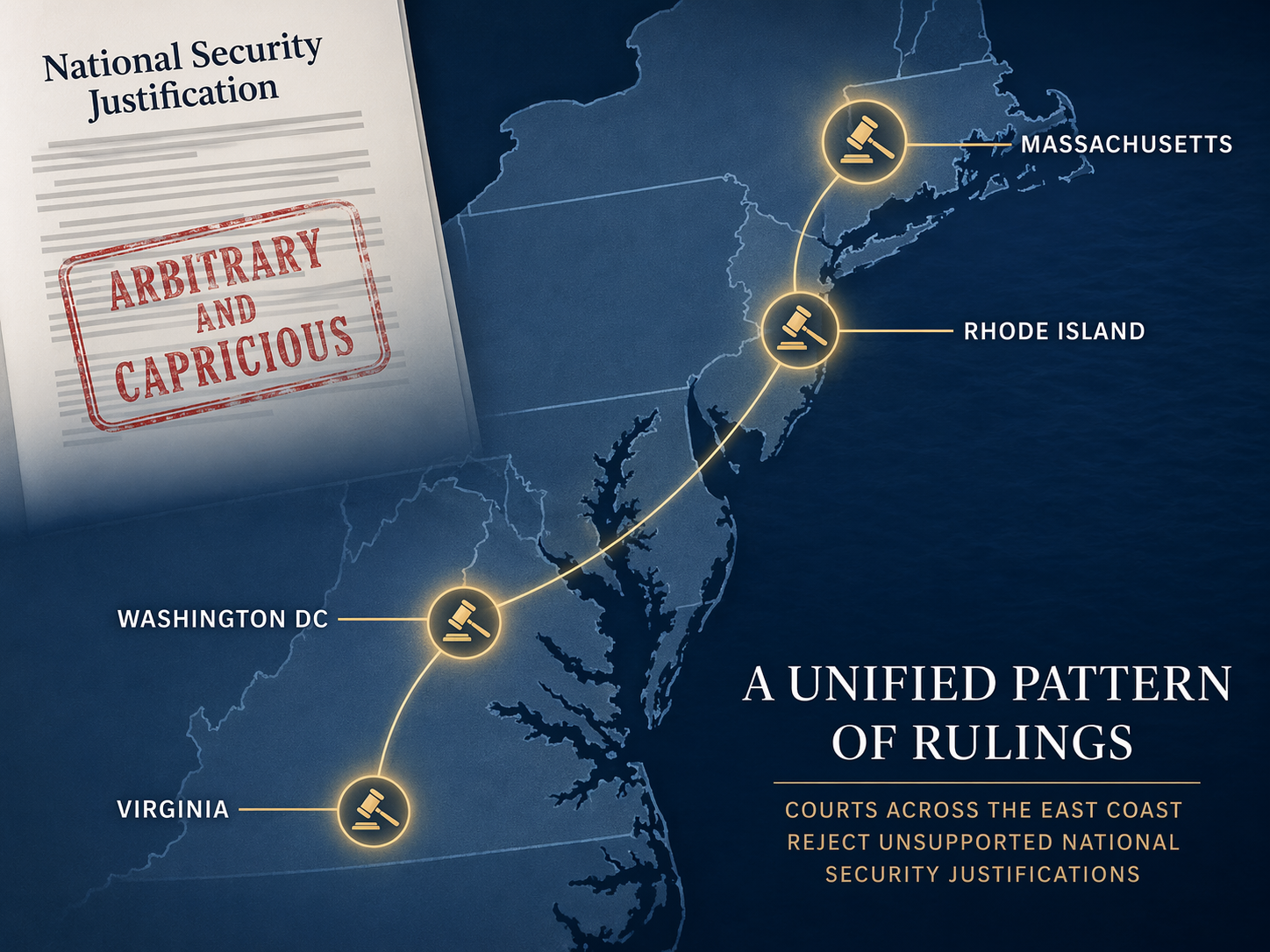
After the Massachusetts ruling, BOEM issued lease suspensions on Dec. 22, 2025, citing a classified Department of War report. Developers behind Vineyard Wind, Revolution Wind, Coastal Virginia Offshore Wind, Sunrise Wind, and Empire Wind challenged those suspensions. By February 2026, they had secured preliminary injunctions in four federal district courts: the District of Massachusetts, the District of Rhode Island, the District of Columbia, and the Eastern District of Virginia. No court reviewing those suspensions ruled for the government.[4]
| Project | Court | Reported posture |
|---|---|---|
| Vineyard Wind | D. Mass. | Preliminary injunction against BOEM suspension |
| Revolution Wind | D.R.I. | Preliminary injunction; court criticized the abrupt unexplained change |
| Sunrise Wind | D.D.C. | Preliminary injunction after in camera review of classified material |
| Empire Wind | D.D.C. | Preliminary injunction; due process concerns over lack of notice and opportunity to respond |
| Coastal Virginia Offshore Wind | E.D. Va. | Preliminary injunction against BOEM suspension |
Preliminary injunctions are not final merits judgments. They are, however, revealing when several courts confront the same basic government explanation and find it likely unlawful. The pattern across the cases was not judicial indifference to defense concerns. It was impatience with an administrative record that did not explain the leap from a classified report and general assertions to immediate project stoppages.
Revolution Wind made the abruptness concrete. The project was reported to be 87% complete, with 58 of 65 turbines installed, when the suspension landed. The District of Rhode Island ruling said the government had “failed to rationalize its abrupt change in position.”[4] A court does not need to admire offshore wind finance to see why that posture sharpens the APA problem. The farther a project has proceeded under government approvals, the less plausible it is for the agency to offer only a generic explanation when it orders work to stop.
Why “classified report” did not solve the APA problem
The government’s strongest practical difficulty was obvious: if the report was classified, it could not be litigated like an ordinary technical memorandum. Courts are generally cautious around military judgments and classified materials. But that caution does not convert secrecy into an exemption from reasoned decision-making.
The Sunrise Wind proceeding is the useful corrective to an easy but wrong account of the litigation. The problem was not simply that judges never saw the evidence. Judge Royce Lamberth of the District of Columbia reviewed the classified Department of War report in camera and still said it did “not constitute a sufficient explanation” for the stop-work order.[4] That matters because it removes one common refuge for the government’s argument: that the explanation only looked thin because the real basis was hidden from public view.
In camera review also shows the asymmetry the government was asking courts to tolerate. The developers could not test the classified material in the normal adversarial way, yet the government wanted the material to carry the agency’s burden. Courts can accommodate secrecy in appropriate cases, but they still need something reviewable: a bridge between the asserted security concern and the legal consequence imposed. In these cases, the public explanation and, at least in Sunrise Wind, the court-reviewed classified material did not supply that bridge.
That is why the rulings are best read as APA decisions rather than radar decisions. The courts were not conducting an engineering trial over every possible interaction between turbines and defense systems. They were asking whether BOEM and the administration had explained why the known or asserted risks justified suspending these leases, at this time, in this manner, after prior federal action had allowed the projects to proceed.
Due process was a separate failure in Empire Wind
The Empire Wind case added a related but distinct defect. The District of Columbia court found that the suspension likely violated due process because the project received no notice and no opportunity to respond before the government acted.[4] That holding should not be collapsed into the arbitrary-and-capricious analysis, even though the two failures came from the same administrative posture.
APA review asks whether the agency’s decision was reasoned and lawful on the record. Due process asks, in this setting, whether the affected party had a fair chance to be heard before the government interfered with protected interests. A government can fail either requirement without necessarily failing both. Here, the courts saw both an unexplained substantive turn and, in Empire Wind, a procedural deprivation in the way that turn was imposed.
The public radar record made the explanation look thinner, not stronger
The national security theory was publicly associated with radar interference. That concern is not invented; wind turbines can create radar issues. The question is what follows from that general fact. Public reporting quoted three former Defense Department energy-siting directors—Len Lippold, John Conger, and David Belote—describing the issue as known, manageable, and in some circumstances already addressed through existing mitigation programs.[5][4]
The Department of Energy’s 2024 report to Congress, as quoted in public reporting, stated that “thoughtful wind farm site selection, planning, and other mitigations have resolved conflicts and allow wind power projects to coexist effectively with radar missions.”[4] That statement does not prove that every offshore wind project is compatible with every defense mission. It does undermine any public-facing suggestion that the mere existence of radar concerns supplies a self-executing reason to stop all affected projects.
This is where the administration’s record problem and the technical context reinforce each other. If the public expert record had shown a newly discovered, unmitigable class of risk, a terse explanation might still have faced APA problems, but the factual premise would have looked different. Instead, the public materials described a long-known siting issue that agencies had previously handled through coordination and mitigation. A sudden suspension therefore required a more specific explanation, not less.
The litigation pattern narrowed the administration’s room to maneuver
One district court ruling can be written off as case-specific. Four district courts rejecting the same national security rationale in related lease-suspension disputes are harder to treat that way. The courts did not use identical formulations, and the cases were not all in the same procedural condition. But the recurring defect was stable: the government asserted a grave category of concern without adequately explaining how the record supported the action taken.
The administration’s later conduct confirms the practical force of those rulings, though it should not be overstated as a formal concession on every issue. In June 2026, the administration withdrew its appeal of the Massachusetts ruling, leaving the wind-energy leasing and permitting freeze vacated. Around the same period, it offered a $928 million buyout to one leaseholder.[6] The status of every individual appeal from the preliminary injunctions was not fully clear from the public materials as of July 2026, but the government’s retreat from the Massachusetts appeal removed the cleanest vehicle for defending the broad authorization pause.
For future energy regulation, the lesson is not that national security is a weak argument. It is often a powerful one. The lesson is that its power does not relieve agencies of the obligation to identify their authority, explain their factual basis, account for reliance where the law requires it, and produce a record that permits judicial review. In these offshore wind cases, invocation did the work that explanation was supposed to do. The courts refused to accept the substitution.
References
- Federal Court Vacates Wind Energy Authorization Pause, Harvard Environmental & Energy Law Program.
- Trump wind farm injunction, The Hill.
- White House Efforts To Kill The Offshore Wind Industry Fare Poorly In Court, Mondaq.
- Judges aren’t buying claims that wind farms threaten national security—for good reason, Bulletin of the Atomic Scientists, March 2026.
- Trump administration cites national security as it halts offshore wind. Some experts aren’t convinced, Los Angeles Times, Dec. 22, 2025.
- Trump Administration Withdraws Appeal, Leaving Wind Energy Leasing and Permitting Freeze Vacated, offshoreWIND.biz, June 16, 2026.
Comments
Join the discussion with an anonymous comment.