
The legal implications of the Tucson police shooting on July 19, 2026 begin with a narrow but consequential set of reported facts: downtown Tucson, near 6th Avenue and Congress Street, at about 2 a.m.; 10 people hospitalized, including the suspect; and police reporting that the suspect fired into a crowd before a Tucson Police Department officer shot him.[1][2] Those facts do not answer the legal questions. They determine where the questions start.
An officer-involved shooting update in Tucson can sound deceptively simple if it is reduced to one question: was the shooting justified? In practice, that question splits almost immediately. A criminal investigation moves outside TPD through the Pima Regional Critical Incident Team. TPD runs its own internal force and critical-incident review. The Pima County Attorney’s Office separately screens for possible criminal charges. Civil litigation, if it comes, arrives later and asks different questions under different burdens.
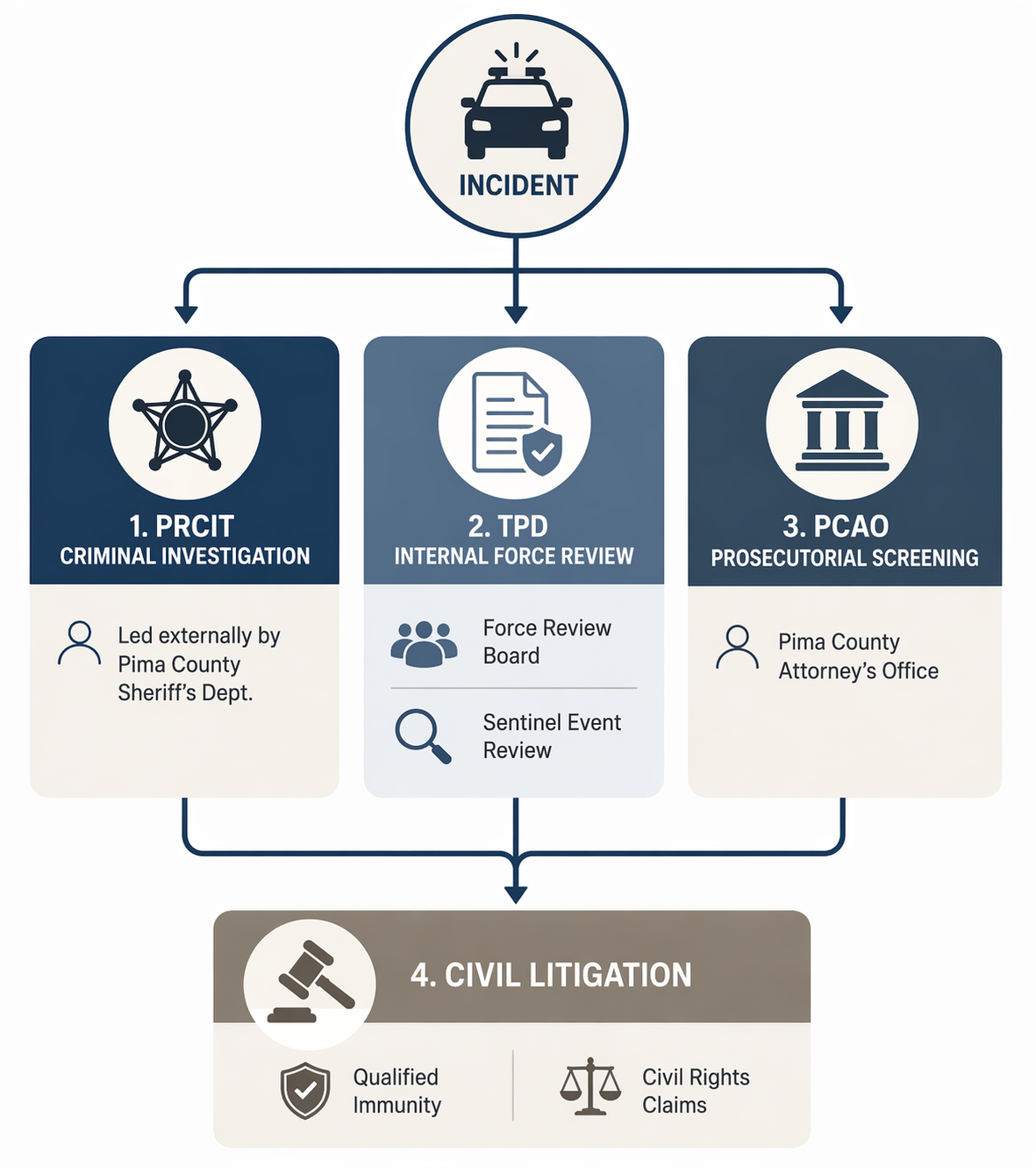
That separation matters for everyone waiting on an answer: the wounded victims, the suspect, the officer, city lawyers, prosecutors, and reporters trying to describe a still-developing record without turning early police statements into final findings. This article is informational, not legal advice, and the current public record remains incomplete.
The first legal branch is PRCIT, not an internal TPD investigation
Tucson’s published critical-incident process says officer-involved shootings and certain other serious incidents are investigated by the Pima Regional Critical Incident Team, commonly called PRCIT. For a TPD shooting, the criminal investigation is led by the Pima County Sheriff’s Department rather than by TPD itself.[3]
That is the first gate. PRCIT is not a civil-rights lawsuit, not a city settlement process, and not the same thing as TPD deciding whether an officer followed department policy. It is the fact-gathering track that can feed later prosecutorial decisions. Investigators will be concerned with physical evidence, witness accounts, body-worn camera footage if available, dispatch information, medical evidence, and the sequence between the reported crowd shooting and the officer’s gunfire.
The allegation that the suspect fired into a crowd before being shot is not a side detail. If supported by evidence, it may shape the reasonableness analysis, the suspect’s criminal exposure, and the way prosecutors assess the officer’s perception of an immediate threat. If later evidence complicates that sequence, the legal analysis changes with it. The point is not to assume either version; it is to notice which factual hinge is doing the work.
PRCIT’s structure can reassure the public that TPD is not simply investigating itself. It should not be mistaken for a guaranteed outcome. An outside-led investigation may support prosecution, decline prosecution, support administrative discipline, or leave enough factual dispute that civil litigation becomes the forum where records are tested years later.
The 2026 count adds pressure, but not proof
As of July 19, reporting identified this as the 10th officer-involved shooting in the Tucson area in 2026 and the 52nd statewide. Earlier in the year, AZPM reported an April cluster of four police shootings in eight days, which a county supervisor described as “unusual.”[4]
Those numbers are important context, especially for policymakers and the public. They are not, by themselves, evidence that this officer acted lawfully or unlawfully. The available 2026 counts come from journalistic tracking rather than an official real-time dashboard, and TPD’s public officer-involved shooting open-data portal does not appear to provide a live 2026 dataset. The count can support concern about frequency. It cannot substitute for incident-level proof.
PCAO screening is separate from both PRCIT and public pressure
Once the criminal investigation is developed, the Pima County Attorney’s Office has its own role. Prosecutors may consider potential charges against the suspect, potential charges against the officer, or both, depending on the evidence. The same event can contain a strong criminal case against a suspect and still require a separate legal assessment of police force.
That distinction often gets blurred after a public shooting. If investigators conclude that the suspect fired into a crowd, prosecutors may focus first on offenses tied to the mass shooting. But that does not automatically end the officer-force inquiry. Conversely, a decision not to charge an officer would not decide every administrative or civil question. Criminal law asks whether the evidence supports prosecution under a high burden. Department policy and civil-rights law can turn on related but not identical standards.
Grand jury review, if used, is another gate rather than an explanation in itself. Tucson’s recent record gives a concrete warning against treating a grand jury outcome as the entire accountability story.
Recent Tucson outcomes point in different directions
Tucson’s police-accountability record does not support a clean prediction for July 19. It supports a more careful expectation: legal outcomes in officer-involved shooting and in-custody death cases have varied sharply depending on the facts, the forum, and the legal claim.
| Matter | Forum or process | Reported outcome | What it shows |
|---|---|---|---|
| Alvarado wrongful-death suit | Federal civil jury trial | Jury rejected claims against five TPD officers after about two hours of deliberation in March 2026 | Civil claims can fail even after years of litigation |
| Carlos Ingram-Lopez matter | Municipal settlement | $2.9 million settlement | City exposure can be resolved without a trial judgment |
| Ryan Remington matter | Grand jury and civil litigation | Three grand juries declined to indict; a civil excessive-force claim survived summary judgment, with a defense appeal reported pending | Criminal declination and civil viability can coexist |
| Kisela v. Hughes | U.S. Supreme Court qualified-immunity ruling | Qualified immunity granted to a Tucson officer under a demanding clearly established law standard | Federal civil claims face doctrine separate from factual sympathy |
In March 2026, a federal jury rejected a wrongful-death lawsuit against five Tucson police officers in the Alvarado matter after roughly two hours of deliberation, according to Tucson Sentinel reporting.[5] That result is a reminder that a case can reach a public trial and still end in a defense verdict. A filed complaint, public outrage, or years of procedural survival do not guarantee plaintiff recovery.
The Ingram-Lopez matter points to a different municipal risk: settlement. Tucson’s reported $2.9 million settlement in that case is not proof of liability in every future case, and settlement terms do not carry the same legal meaning as a verdict. But for city lawyers and insurers, it is part of the local exposure history. Some cases are resolved because trial risk, evidentiary risk, policy failures, damages, and public costs converge before a jury ever decides liability.
The Remington matter is especially useful because it shows how one incident can produce different answers in different forums. KOLD reported in January 2025 that a third grand jury declined to indict former Tucson police officer Ryan Remington.[6] Separately, plaintiffs’ counsel reported that an excessive-force claim survived summary judgment in civil litigation, with a defense appeal to the Ninth Circuit pending at the time of that reporting.[7]
That split is not unusual. Criminal prosecution, administrative review, and civil litigation do not ask the same question in the same way. A prosecutor may decide there is not enough evidence to seek or sustain a conviction. A civil court may still find that a reasonable jury could decide whether excessive force occurred. Or a civil defendant may win later on qualified immunity even if the underlying facts remain troubling.
TPD’s internal review asks a different question than prosecutors do
TPD’s critical-incident page describes internal review through the Force Review Board and the Sentinel Event Review Board.[3] Those bodies do not perform the same function as PRCIT or PCAO. They are concerned with policy, tactics, training, supervision, and systems lessons.
For the July 19 shooting, internal review may examine the officer’s use of force, but it may also examine the surrounding system: how officers were deployed downtown, how dispatch information reached responding officers, whether supervisors had enough information, whether medical aid was coordinated promptly, and whether any tactical or communication changes are needed for future crowded-setting shootings. Those are not minor questions simply because they sound administrative. Policy findings can affect discipline, training, public reporting, and future civil litigation.
The Sentinel Event Review Board label is worth reading carefully. Sentinel-event review often looks for preventable system failures rather than assigning blame in the way a criminal case does. That can produce useful reforms. It can also disappoint people who expect a single declaration of guilt or innocence. A process built to identify lessons may not produce the moral or legal closure that victims and families are waiting for.
Civil litigation will depend on timing, injury, proof, and immunity
Civil claims are downstream, but they are already part of the legal landscape. Potential plaintiffs could include the suspect, bystanders, or families depending on injury outcomes and later evidence. Claims might be framed under federal civil-rights law, state tort law, or both. The viability of those claims would depend on who was injured by whose gunfire, what the officer knew at the moment force was used, whether the suspect presented an immediate threat, and whether municipal policy or training can be tied to the harm.
The most difficult federal doctrine for many plaintiffs remains qualified immunity. In Kisela v. Hughes, the U.S. Supreme Court granted qualified immunity to a Tucson officer and emphasized that existing precedent must place the unlawfulness of the officer’s conduct “beyond debate” before damages liability can proceed against the officer.[8] That standard does not mean officers always win. It means plaintiffs must do more than argue that the shooting was tragic, mistaken, or even arguably unreasonable. They must confront whether clearly established law governed the specific circumstances.
For the July 19 incident, that inquiry could become intensely fact-specific. A suspect reportedly firing into a crowd presents a different constitutional setting from an unarmed person, a person holding a toy gun, or a person whose threat had ended before police fired. If civil litigation develops, lawyers will likely fight over the precise moment of the officer’s decision: what the officer saw, what other officers reported, where bystanders were located, whether the suspect still had the firearm, and whether less-lethal or delayed tactics were realistically available in that moment.
Municipal liability is a separate problem. A city is not automatically liable because an officer is sued. Plaintiffs usually need to connect the alleged constitutional violation to policy, custom, training, supervision, or ratification. That is where internal-review records, prior incidents, discipline history, and training materials can become more important than the first public narrative.
The Armenta video release shows why records timing matters
Tucson’s 2026 officer-involved shooting record was already under scrutiny before July 19. In June, KOLD reported the release of video from the April 6, 2026 shooting that left 15-year-old Jahmar Armenta dead; the reporting described the object involved as a toy gun.[9] The Armenta matter is not a template for the downtown mass-shooting facts. It is a timing lesson.
Video releases, critical-incident briefings, and investigative updates rarely arrive at the same pace as public attention. Early descriptions may be incomplete. Later footage may clarify some points and leave others unresolved. Attorneys know this; grieving families and injured victims still have to live through the delay. That lag is one reason careful wording matters in the first week after an officer-involved shooting.
What to watch next
The July 19 case is unlikely to produce one decisive legal answer on one timetable. The more realistic expectation is staggered movement across separate tracks. Some updates will concern the suspect’s criminal status. Others will concern the officer’s administrative status. Others may come from PRCIT, PCAO, civil filings, public-records releases, or medical updates about the victims.
- PRCIT findings: which agency releases the investigative summary, what evidence is described, and whether the reported sequence of the suspect firing before police gunfire is supported.
- PCAO posture: whether prosecutors screen charges against the suspect, the officer, or both, and whether any grand jury process is disclosed.
- TPD internal conclusions: whether the Force Review Board or Sentinel Event Review Board identifies policy compliance, policy violations, training issues, or system changes.
- Victim outcomes: whether injuries become fatal, whether bystanders were struck by the suspect or police fire, and how damages evidence develops.
- Civil filings: whether claims target the officer, the city, supervisors, or training and policy practices, and whether qualified immunity becomes an early defense.
Tucson has formal mechanisms that separate investigation from TPD, route charging decisions through PCAO, and review force internally. Its recent record also shows that those mechanisms can end in no indictment, a defense verdict, a multimillion-dollar settlement, a surviving civil claim, or an immunity ruling. The July 19 shooting now moves through that machinery with facts still developing. The useful posture is not prediction. It is watching the right gates in the right order.
References
- 10 critically hurt, including suspect, in downtown Tucson mass shooting, AZFamily, July 19, 2026
- Multiple people shot in downtown Tucson officer-involved shooting, KOLD, July 19, 2026
- Critical Incident Review, City of Tucson
- Police shooting spike is 'unusual,' county supervisor says, AZPM, April 15, 2026
- Jury rejects wrongful death claims against Tucson cops in Alvarado case, Tucson Sentinel, March 27, 2026
- Grand jury refuses to indict former Tucson police officer Ryan Remington, KOLD, January 9, 2025
- Media, Strang Bradley
- Supreme Court Holds Officer Shooting Lawful, Poyner Spruill
- Video released in OIS that left Tucson teen dead, KOLD, June 5, 2026
Comments
Join the discussion with an anonymous comment.