
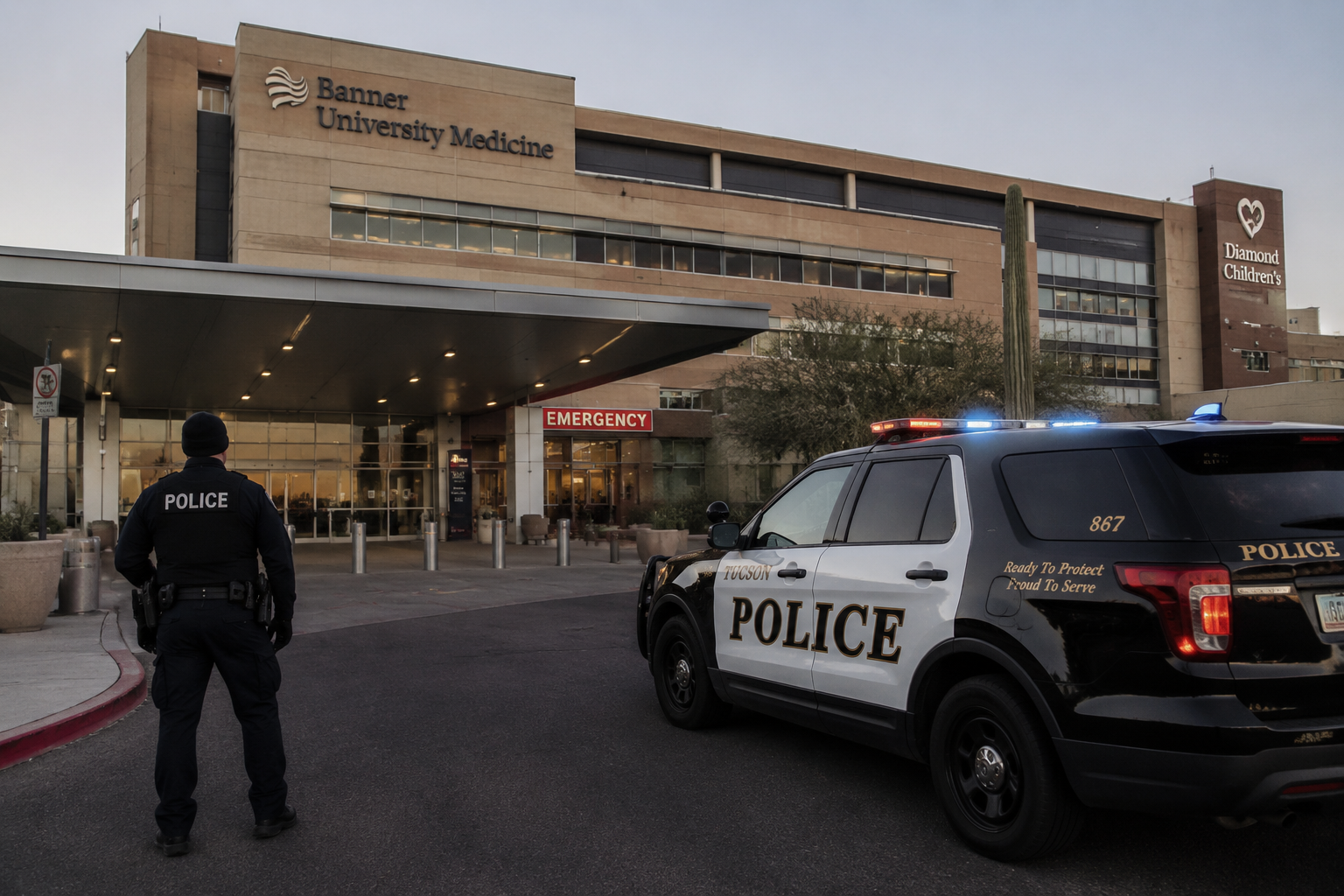
As of July 20, 2026, the Tucson shooting suspect is not in the ordinary posture of a defendant waiting for a first appearance. The confirmed posture is narrower: police say a suspect was shot while fleeing after nine civilians were wounded in downtown Tucson early Sunday; the suspect was taken to a hospital in life-threatening condition; no officers were injured; and the suspect has not been publicly identified or formally charged.[1][2]
That distinction matters for anyone searching for a Tucson police shooting suspect custody legal update. “In custody” in this case does not yet mean booked into jail, assigned a cause number, and placed into the usual arrest-to-initial-appearance sequence. It means the suspect is alive, hospitalized, and under police control while the criminal and officer-involved shooting investigations move on separate tracks.
The Known Custody Status Is Medical, Not Yet Courtroom-Ready
The shooting was reported around 1:30 a.m. Sunday, July 19, on Congress Street in downtown Tucson. Reporting from the scene and official statements identify nine civilian victims and a tenth hospitalized person: the suspect, who was shot by Tucson police while fleeing.[1][2]
For court purposes, that is not the same thing as a completed arrest process. A hospitalized suspect can be guarded. A hospitalized suspect can be the focus of a criminal investigation. A hospitalized suspect can be treated by police and prosecutors as the person they expect to bring before the system when medically possible. But until medical clearance and booking occur, the machinery that produces a jail record, an initial appearance, release conditions, appointed counsel questions, and a public charging document has not started in the familiar way.
That is why the absence of a public name or filed charges by July 20 is not, by itself, a procedural anomaly. Tucson police have not released the suspect’s identity while medical treatment and the investigation remain active, and the reported custody description is hospital custody rather than a formal booking event.[2]
The usual 24-hour initial appearance expectation is a poor measuring stick at this stage. It becomes useful once there is an arrest that can be processed through the jail and court system. Here, the immediate threshold question is more basic: whether and when the suspect becomes medically able to be booked. Until then, the court calendar will not look like the calendar that follows a street arrest, transport to jail, and overnight appearance setting.
There is also a factual caveat that should stay visible. Public reporting treats the hospitalized person shot by police as the suspect, but the full investigative record has not been released. If investigators later identify additional actors, narrow the suspect’s role, or revise the sequence of events, the charging analysis would have to follow the evidence rather than the first-day shorthand.
Why Charges Have Not Appeared Yet
A prosecutor can be alerted immediately without filing immediately. That appears to be exactly what happened here. Pima County Attorney Laura Conover said both the “homicide phone” and the “officer-involved shooting phone” were activated, and senior prosecutors were on scene within hours, including Criminal Chief Josh Moser, Deputy Criminal Chief Rachel Stiles, and Deputy Mario Gonzalez.[3]
That early presence does not convert the matter into a completed charging package. It means prosecutors were positioned to observe, advise, and preserve the path toward review. In a case with multiple civilian victims, a suspect wounded by police, and an officer-involved shooting component, the record has to do more than establish that a violent event occurred. It has to identify the legally chargeable conduct, connect it to the proper person, account for officer use of force, and separate evidence useful for criminal prosecution from material relevant mainly to internal review.
The medical status also affects practical charging choices. A complaint filed against a critically injured person who cannot be transported, booked, interviewed if appropriate, or brought before a judge does not move the case through the normal first-appearance sequence. Prosecutors may still act when they have a legal and strategic reason to do so, but nothing in the public record as of July 20 shows that a charging decision has been announced.
| Question | Status as of July 20, 2026 | Why it matters |
|---|---|---|
| Has the suspect been publicly identified? | No public identity has been released. | Identity release is separate from investigative identification and may lag while treatment and investigation continue. |
| Has the suspect been formally charged? | No formal charges have been reported. | Without filed charges, there is no ordinary defendant-facing court track to follow. |
| Has the suspect been booked? | No public report shows medical clearance and booking. | Booking is the practical gateway to the familiar initial appearance process. |
| Who is leading the criminal investigation? | Pima County Sheriff’s Department through PRCIT. | The involved department is not simply investigating itself for criminal charging purposes. |
| Is TPD still reviewing officer conduct? | Yes, through a separate administrative process. | Administrative review and criminal charging review answer different questions. |
The Criminal Investigation Is Outside TPD’s Direct Lead
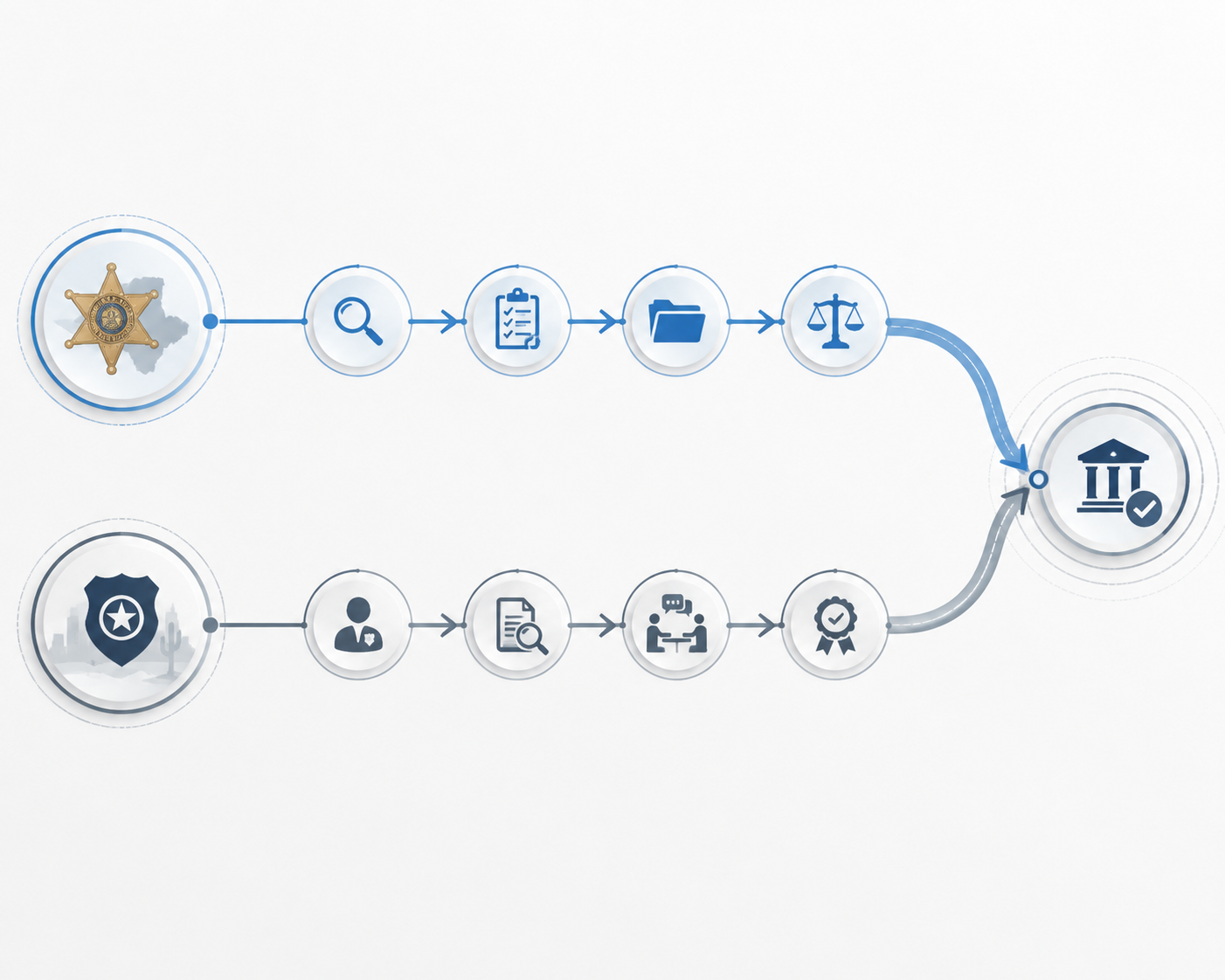
The criminal investigation is being handled by the Pima County Sheriff’s Department as the lead agency under the Pima Regional Critical Incident Team, commonly referred to as PRCIT.[4] That is the first institutional fact to keep separate from the scene narrative.
PRCIT was formed in March 2022 by nine Pima County law enforcement agencies to investigate officer-involved incidents, with the structure designed to address conflict-of-interest concerns by keeping the involved department’s detectives from leading the criminal investigation.[5] In this case, Tucson police officers fired at the suspect, so the criminal review of the shooting is not simply a TPD self-investigation.
That framework affects timing. PRCIT-style officer-involved shooting investigations in Pima County are not built for same-day public completeness. They require witness work, physical evidence review, medical evidence, officer statements if obtained under applicable rules, video collection where available, and coordination with prosecutors. Prior complex PRCIT matters have taken weeks to months before public charging or declination decisions became clear; that history is a caution against expecting a standard arrest-case pace, not a promise of a particular number of days.
The July 19 case also contains two overlapping criminal questions. One concerns the mass shooting of civilians. The other concerns the police shooting of the fleeing suspect. Those are related in evidence, but they are not identical in legal posture. The first asks what crimes can be proved against the suspect. The second asks whether the officers’ use of deadly force was legally justified and administratively compliant. A single public phrase, “suspect in custody,” does not answer either question.
TPD’s Administrative Review Is a Separate Track
Tucson Police Department still has its own work to do. TPD’s use-of-force framework is governed by General Order 2000, which addresses reporting and investigation of force incidents.[6] That administrative review is not a substitute for the PRCIT criminal investigation, and it is not a competing prosecution.
The administrative track looks inward at department policy, tactics, supervision, reporting, and officer conduct. It may use some of the same evidence that matters to prosecutors, but its endpoint is different. A policy finding does not by itself file a criminal charge, and a criminal charging decision does not by itself answer every administrative question.
That separation is easy to blur in the first forty-eight hours after a public shooting. It should not be blurred. If PCSD and PRCIT are building the criminal investigative record, TPD’s internal process is reviewing its officers’ actions under department rules. PCAO then receives the material relevant to charging decisions.
PCAO’s Role Begins Before the File Is Finished
The Pima County Attorney’s Office was not waiting passively for a final binder. Conover’s statement that both the homicide and officer-involved shooting channels were activated, with senior prosecutors at the scene within hours, signals early prosecutor involvement in two lanes at once.[3]
That early activation is important, but it should be read carefully. Prosecutors can help protect the integrity of an investigation before they are ready to file. They can identify legal issues, coordinate with detectives, preserve evidentiary options, and prepare for charging review. They can also decline to rush a complaint if the suspect’s medical condition, identity confirmation, witness record, or officer-involved shooting review remains incomplete.
PCAO also has its own Detectives Division, and Conover indicated that the office can investigate independently.[3] That does not mean every fact will be reinvestigated from scratch by prosecutors. It means the charging authority is not limited to passively accepting a police summary if the case requires additional work.
The practical sequence to watch is therefore not “shooting, arrest, charges” in a straight line. It is closer to this: medical stabilization if possible, identity confirmation and release if approved, continued PRCIT evidence development, TPD administrative review, prosecutor review of civilian-shooting allegations, prosecutor review of officer use of force, and then any charging, declination, or public disclosure decision the record supports.
Body Camera Questions Are Relevant, but Still Unanswered
Arizona’s 2026 body-camera environment makes video an obvious evidentiary question. SB 1640 requires officers to wear and activate body-worn cameras during calls for service.[7] TPD’s use-of-force materials also make video and reporting part of the broader review environment under General Order 2000.[6]
But obvious is not the same as confirmed. As of July 20, there is no official public confirmation in the reviewed materials of what footage exists, what it shows, which officers’ cameras were active, whether other surveillance video has been collected, or when any video might be released. A lawyer can reasonably expect video to be a major evidence category; a lawyer should not describe the contents or release timing as known.
The same caution applies to officer identity and administrative status. No public source reviewed here identifies the officer or officers who fired. Standard post-shooting procedures may include administrative leave or reassignment, but unless an agency confirms that step in this case, it remains an assumption rather than a reportable fact.
The Scale Is Serious, but It Does Not Shorten the Process
The scale of the event is not a footnote. Nine civilians were wounded, and the suspect was critically injured after police fired during the flight from the scene.[1][2] AZFamily’s tracking placed the incident as the tenth officer-involved shooting in the Tucson area in 2026 and the fifty-second statewide.[8]
Those numbers explain why the case drew immediate institutional attention. They do not make the charging record simpler. More victims can mean more medical records, more witness interviews, more ballistic questions, more surveillance sources, and more charging permutations. The fact that police also shot the suspect adds another review obligation rather than a shortcut.
Recent Tucson-area officer-involved shooting activity also gives the public a reason to watch the review structure closely. KOLD reported another officer-involved shooting tied to an armed carjacking on July 1, 2026, less than three weeks before the downtown mass shooting.[9] That proximity may heighten scrutiny, but each file still turns on its own evidence, its own officer conduct, and its own prosecutorial review.
What Legal Professionals Should Watch Next
The next meaningful developments are procedural, not rhetorical. The first is medical status. If the suspect dies, the charging question changes into a death investigation and officer-involved shooting review. If the suspect survives and is medically cleared, booking becomes possible, and only then does the ordinary initial-appearance frame become useful.
- Medical clearance: whether the suspect is stable enough to be transported, booked, and brought into the court process.
- Public identification: whether authorities release the suspect’s name and any age or residence details supported by the investigation.
- PRCIT findings: whether PCSD-led investigators complete the criminal officer-involved shooting review and forward findings to PCAO.
- PCAO charging decisions: whether prosecutors file charges, decline charges, or announce further investigative steps.
- TPD administrative disclosures: whether the department confirms officer status, policy review milestones, or use-of-force findings.
- Video confirmation: whether body-camera, surveillance, or other footage is officially acknowledged and placed on a release schedule.
None of those developments requires guessing at charges, motive, or discipline now. The public record supports a more restrained conclusion: the suspect is hospitalized in life-threatening condition, not publicly identified, not formally charged, and not yet in the standard booked-defendant posture. The case is moving through a PCSD-led PRCIT criminal investigation, a separate TPD administrative review, and PCAO charging oversight. Until medical clearance and booking occur, this case will not follow the ordinary arrest-to-initial-appearance rhythm.
References
- Leaders respond after nine shot in downtown Tucson — KOLD.com, July 19, 2026.
- 9 victims wounded, suspect shot & in custody after Downtown Tucson shooting — TucsonSentinel.com, July 19, 2026.
- 9 injured in Tucson mass shooting, police shoot suspect fleeing scene — KTAR.com, July 19, 2026.
- Independent agency to investigate Tucson mass shooting — Tucson.com, July 20, 2026.
- Law enforcement agencies create team to investigate officer-involved incidents — KOLD.com, March 2, 2022.
- Police Use of Force - Tucson Police Data and Analysis — Tucson Police Data and Analysis.
- Body cameras protect police and the public in Arizona's new public safety reality — AZCapitolTimes.com, Feb 20, 2026.
- 10 hospitalized, including suspect, in downtown Tucson mass shooting — AZFamily.com, July 19, 2026.
- Armed carjacking leads to Tucson officer-involved shooting — KOLD.com, July 1, 2026.
Comments
Join the discussion with an anonymous comment.