
The Turtle Bay restaurants that closed under the approved CVA were Solihull, Walthamstow, York, and Middlesbrough. The closures took effect on 16 July 2026, the same day creditors approved the company voluntary arrangement, and 76 employees across those four sites were made redundant. Swansea is sometimes mentioned in the same coverage, but it was not one of the four CVA-day closures; it had closed separately in April 2026.[1]
| Location | CVA treatment | Effective date |
|---|---|---|
| Solihull | Closed under the approved CVA | 16 July 2026 |
| Walthamstow | Closed under the approved CVA | 16 July 2026 |
| York | Closed under the approved CVA | 16 July 2026 |
| Middlesbrough | Closed under the approved CVA | 16 July 2026 |
| Swansea | Closed separately before the CVA approval | April 2026 |
That list answers the search query, but it does not explain the legal event. Turtle Bay did not merely announce a round of closures. It put a lease-heavy restaurant estate through a UK company voluntary arrangement, obtained creditor approval by value, left most sites outside the immediate compromise, and pushed a defined group of locations into either closure or rent renegotiation.

What The Approved CVA Did
Turtle Bay’s creditors approved the CVA with 92% support by value. Interpath, whose Gareth Slater and Will Wright were appointed joint supervisors, said 29 of the company’s 48 sites were unaffected, four sites closed, and 15 sites moved into lease renegotiations.[1] That is portfolio triage, not a liquidation of the brand.
The financial backdrop explains why a restructuring was on the table without proving, by itself, that any particular lease compromise was fair. Turtle Bay’s latest reported accounts showed revenue falling 10% to £84.3 million for the year to 30 March 2025, with the company moving from a £1.9 million pre-tax profit to a £10.2 million pre-tax loss. Reporting on the proposal also cited rising operating costs, reduced consumer spending, changing footfall patterns, and legacy lease commitments as pressures on the business.[2]
The decisive CVA fact is the alternative offered to creditors. According to Interpath, the estimated return in the relevant alternative of administration or liquidation was 0-3%. Against that comparator, unsecured creditors were asked to accept a restructuring that preserved the bulk of the trading estate while closing or renegotiating the more burdensome sites.[1]
Why A CVA Could Carry The Closures
A company voluntary arrangement is a statutory compromise procedure under Part I of the Insolvency Act 1986. In broad terms, the company proposes an arrangement with its creditors, a nominee reports on the proposal, and creditors vote. Approval requires at least 75% in value of creditors voting, subject to a separate majority test among unconnected creditors.[3]
For a US bankruptcy lawyer, the important feature is not that a CVA feels “like Chapter 11.” It does not. A CVA does not require the company to commence a court-supervised bankruptcy case. It does not bring with it a Chapter 11-style automatic stay. It does not require the court to confirm a plan. It also does not allow the company to cram down secured creditors without their consent.[3]
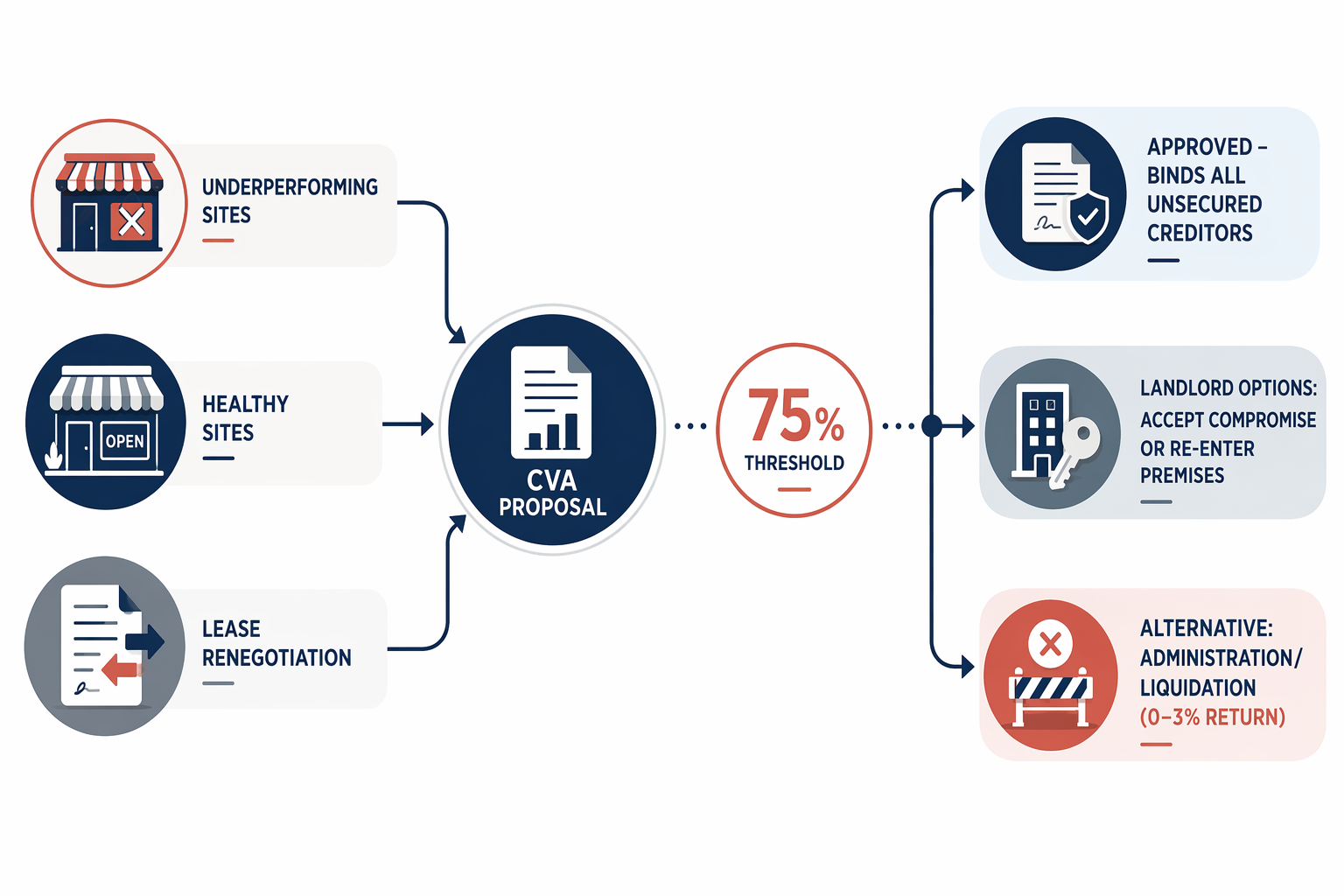
That court-light structure is exactly why the vote matters so much. Once the required creditor majorities approve the proposal, the arrangement binds unsecured creditors within its scope, subject to any challenge rights and the limits of what the statute and case law permit. In Turtle Bay, the 92% approval figure is therefore not decorative. It is the procedural hinge that allowed the company to move from proposal to implementation.[1][3]
The “relevant alternative” does some of the economic work that US lawyers may associate with a best-interests analysis, but the institutional setting is different. In Chapter 11, plan confirmation takes place in court and creditor treatment is tested through a judicial process. In a CVA, the relevant alternative is presented through the nominee’s assessment and the creditors’ vote; the court is not routinely approving the commercial bargain at the front end.[3]
The Burden Falls Where The Leases Are
The Turtle Bay CVA is easiest to misunderstand if it is treated as a generic creditor compromise. In a multi-site restaurant business, rent is not just another line item. A restaurant estate is a bundle of local premises, local footfall, local labor, and landlord relationships. The CVA’s practical force lies in sorting those premises: some continue untouched, some close, and some become the subject of renegotiated lease economics.
Interpath’s breakdown makes that allocation visible. Twenty-nine Turtle Bay sites were unaffected. Four closed immediately. Fifteen entered lease renegotiations.[1] For employees at the closed sites, the consequence was redundancy. For landlords in the renegotiation group, the consequence was a creditor-approved process that used the company’s insolvency position and the poor administration-or-liquidation comparator to press for altered lease terms.
That is not an idiosyncratic feature of this one case. Insolvency Service research covering CVAs from 2011 to 2020 found that landlords were compromised in 93% of comparable large retail and hospitality CVAs, with an average 43% compromise across landlord categories.[4] The vintage of that dataset matters; it does not fully capture every post-pandemic development in UK restructuring practice. But it does document what practitioners already recognize: in retail and hospitality CVAs, landlord treatment is often the center of the instrument.
The legal boundary is equally important. Post-Debenhams case law, as discussed in the Insolvency Service report, distinguishes between changing the economic terms of a lease through a CVA and overriding the landlord’s proprietary right to re-enter. A CVA can vary rent obligations and other lease economics if the landlord is given a termination right, but it cannot simply erase the proprietary right of re-entry.[4]
That distinction is not technical fussing. It determines who has to make the next move. A landlord may accept the compromised terms and keep the tenant trading, or exercise the offered termination right and recover the premises. The CVA does not make the landlord whole; it changes the bargaining position and gives the landlord an exit from the compromised lease relationship.
The Chapter 11 Analogy Only Goes So Far
American readers naturally reach for Chapter 11 because both procedures can preserve a distressed operating business. That comparison is useful only if it is kept on a short leash. Turtle Bay’s CVA did not require the company to operate under the continuing supervision of a bankruptcy judge, did not create an automatic stay equivalent, and did not depend on a court-confirmed plan binding dissenting classes through cramdown.
The absence of a general automatic stay changes the risk profile before approval. A CVA proposal may be paired in some circumstances with other tools, but the CVA itself is not the same kind of breathing-space filing that a Chapter 11 petition creates. Creditors are being asked to vote on a compromise, not being drawn into a court case that immediately centralizes enforcement against the debtor.[3]
The absence of required court sanction also changes the way objections are framed. In Chapter 11, confirmation is the main adjudicative event. In a CVA, the commercial bargain is primarily creditor-approved, with challenges available on narrower statutory grounds such as unfair prejudice or material irregularity. That makes the quality of the proposal, the relevant-alternative analysis, and the creditor constituency doing the voting especially important.
Secured-creditor treatment is another reason not to over-translate. A CVA is principally a mechanism for compromising unsecured creditor claims. It cannot impose a compromise on secured creditors without their consent.[3] For lease-heavy hospitality companies, that limitation may still leave plenty of room to restructure the estate, because the pressure point is often landlord claims and rent obligations rather than a fully court-supervised balance-sheet recapitalization.
What The Turtle Bay Vote Shows
The 92% approval result is striking, but it should be read with the 0-3% alternative in view. Creditors were not choosing between full payment and a haircut. They were choosing between a supervised CVA outcome for a continuing business and an estimated administration-or-liquidation return that Interpath placed at the bottom end of recovery.[1]
That does not make landlord compromise painless or legally inevitable. It makes the commercial vote intelligible. A restaurant chain with 48 sites did not need every lease to be equally viable for the CVA to pass. It needed enough creditor support for a plan that left 29 sites unaffected, put 15 into negotiation, and removed four from the estate.[1]
Wider hospitality distress may explain why this type of case keeps appearing, but it should not blur the legal analysis. PKF Smith Cooper reported that UK insolvencies rose 7% year over year in Q1 2026 and identified hospitality as a leading area of distress.[5] That is useful context. It is not the reason Turtle Bay’s CVA bound creditors. The reason was the statutory voting mechanism, the creditor majorities achieved, and the relevant alternative put before them.
For cross-border counsel, the lesson is restrained but concrete. Turtle Bay shows how a UK CVA can preserve most of a multi-site hospitality business through a creditor-approved, court-light process. It also shows where the efficiency comes from: pressure is allocated differently than in Chapter 11, especially onto landlords and lease economics, and the absence of routine court confirmation makes the vote and the relevant-alternative analysis do a great deal of work.
References
- CVA proposal approved for Turtle Bay Hospitality Limited, Interpath.
- Turtle Bay to close three sites as part of CVA proposal, Restaurant Online.
- Company voluntary arrangements (CVAs): quick guide, Practical Law.
- Company Voluntary Arrangement research report, Insolvency Service.
- UK Insolvency report Q1 2026, PKF Smith Cooper.
Comments
Join the discussion with an anonymous comment.