
TV Azteca is not yet a Chapter 15 case. That is the point worth keeping clear. The Mexican broadcaster has entered concurso mercantil in Mexico, but it has not asked a U.S. bankruptcy court to recognize a foreign proceeding or enforce a foreign plan. The creditor-rights problem is prospective: if a Mexican plan eventually releases claims against TV Azteca’s 34 U.S. subsidiary guarantors, U.S. noteholders may be asked to accept in Chapter 15 what they could not be forced to accept in an ordinary domestic Chapter 11 after Purdue Pharma.[1]
That is why the case is already drawing attention outside Mexico. TV Azteca’s concurso was granted in early July 2026, at the beginning of a conciliation phase that normally runs 185 days and can be extended. The company has no confirmed restructuring agreement, no final plan, and no U.S. recognition order. What it does have is a capital structure with U.S. note claims, 34 U.S. subsidiary guarantors, active SDNY litigation, and creditors who have already tried and failed to force the company into Chapter 11.[1][2]

The release route is plausible, but not automatic
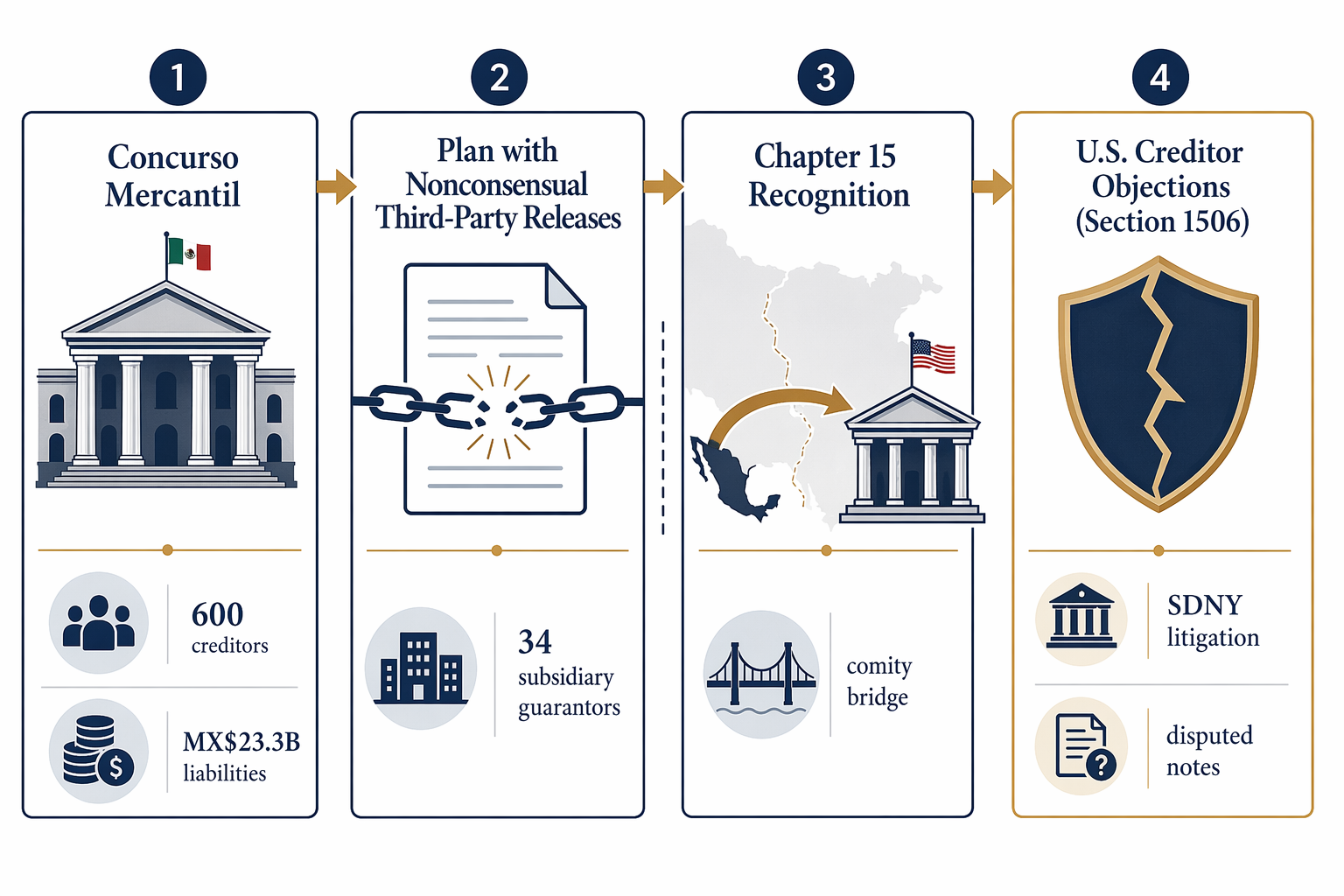
The possible path is straightforward enough to describe and difficult enough to litigate. TV Azteca would use its Mexican concurso to reach a restructuring agreement. That agreement could include releases of claims against non-debtor affiliates, including the U.S. subsidiary guarantors. If approved in Mexico, TV Azteca or a foreign representative could seek Chapter 15 recognition and ask a U.S. court to give effect to the Mexican plan, including the releases.
| Stage | Why U.S. creditors care |
|---|---|
| Mexican concurso conciliation | Creditors must monitor claim recognition, plan negotiations, tax priority issues, and any release language before a U.S. court sees the matter. |
| Plan with guarantor releases | A release of 34 U.S. subsidiary guarantors would affect claims against U.S. entities, not only claims against the Mexican parent. |
| Possible Chapter 15 recognition | The U.S. court would decide whether to recognize and enforce foreign relief under Chapter 15 rather than apply domestic Chapter 11 confirmation rules directly. |
| Creditor objection | Objecting noteholders would likely focus on procedural fairness, comity, section 1506 public policy, and the status of parallel SDNY litigation. |
The doctrinal opening exists because recent Chapter 15 decisions have not treated Purdue Pharma as a simple veto on foreign-plan releases. In Crédito Real, a Delaware district court confirmed enforcement of a Mexican restructuring plan with nonconsensual third-party releases and held that Purdue’s domestic Chapter 11 rule did not extend automatically to Chapter 15. The court looked to sections 1521(a) and 1507, and to the traditional Chapter 15 concerns of procedural fairness and comity.[3]
Odebrecht points in the same general direction. In that case, an SDNY district court enforced nonconsensual releases approved in a Brazilian restructuring and rejected a public policy objection under section 1506.[4] Read together, Crédito Real and Odebrecht give TV Azteca a serious argument that Chapter 15 can still recognize foreign releases even after Purdue.
They do not, however, end the analysis. A foreign representative cannot make U.S. creditor resistance disappear by citing comity in the abstract. Chapter 15 is deliberately hospitable to foreign insolvency proceedings, but it is not a rubber stamp. The harder question is whether the particular foreign relief being imported is sufficiently tied to the foreign restructuring and sufficiently fair to affected U.S. creditors.
Why Crédito Real and Odebrecht help TV Azteca
The strongest point for TV Azteca is statutory posture. Purdue was a Chapter 11 case about whether the Bankruptcy Code authorizes a domestic plan to release direct claims against non-debtors without consent. Chapter 15 asks a different question: whether a U.S. court should assist and give effect to a foreign insolvency proceeding, subject to the limits built into Chapter 15 itself.
That difference matters. Section 1521 allows a court to grant appropriate relief after recognition. Section 1507 preserves broader discretionary assistance, provided the court considers, among other things, just treatment of claim holders, protection against prejudice and inconvenience, distribution substantially in accordance with U.S. bankruptcy principles, comity, and a fresh start where appropriate. Crédito Real treated those provisions as an independent basis for enforcing a Mexican plan’s releases notwithstanding Purdue.[3]
TV Azteca can also point to the practical logic of cross-border restructuring. A multinational debtor may have obligations, guarantors, litigation claims, and assets scattered across jurisdictions. If each jurisdiction reserves the right to preserve local claims after the foreign main proceeding has reorganized the debtor group, the bargain achieved abroad may be worth much less than it appears on paper.
That is the comity argument in its cleanest form. It does not require a U.S. court to admire every feature of foreign insolvency law. It asks the court to respect a foreign proceeding that gave creditors a fair chance to participate and produced relief that is integral to the restructuring. Crédito Real and Odebrecht are useful to TV Azteca because they show that, after Purdue, at least some U.S. courts remain willing to draw that distinction in Chapter 15.[3][4]
Why this case may be harder
TV Azteca’s facts are not clean. The disputed notes exceed $400 million, the U.S. notes are guaranteed by 34 U.S. subsidiaries, and creditors have active civil litigation in SDNY.[1][5] If a Mexican plan later releases those guarantor claims, the affected creditors will not be complaining about a distant foreign adjustment to purely Mexican obligations. They will be losing claims they say they hold against U.S. entities in a U.S. forum.
The procedural history also matters. In November 2023, Judge Lisa Beckerman dismissed involuntary Chapter 11 petitions against TV Azteca entities after finding a bona fide dispute under section 303(b)(1), including disputes over fees and premiums. The attempted U.S. pressure campaign did not end in a Chapter 11 case; it ended with dismissal.[5]
The failed mediation is another pressure mark on the record. The mediation ran 67 days without settlement. TV Azteca proposed $45 million upfront with later tranches, while bondholders countered with about $105 million in past-due interest plus a single $400 million tranche.[5][6] Those proposals do not prove who was reasonable. They do show that the parties were already fighting over payment architecture before the Mexican concurso began.
That history gives creditors a more concrete objection than generalized dislike of third-party releases. They can argue that the Mexican proceeding, if later used to release U.S. guarantors, would function as an end-run around active U.S. litigation and a failed involuntary Chapter 11 attempt. TV Azteca would answer that the dismissal of the involuntary petitions confirms that the creditors were not entitled to drag the dispute into Chapter 11, and that the proper restructuring forum is now Mexico.
Neither answer is frivolous. That is what separates this from the easy post-Purdue commentary. The U.S. court would not be deciding whether Purdue permits these releases in Chapter 11. It would be deciding whether Chapter 15 should recognize foreign relief that affects U.S. guarantors while U.S. creditor litigation is already pending.
The Mexican proceeding supplies distress, not a release entitlement
The Mexican record appears to show a company in serious financial distress. Reported figures include roughly 600 creditors, MX$23.345 billion in liabilities, a 7.07% asset-to-liability ratio, 228 invoices overdue by at least one month, and 64.73% of debt in arrears.[2][7] Those numbers explain why a court would allow a concurso process to begin. They do not answer whether U.S. guarantor releases should later be enforced in the United States.
This distinction is easy to blur. Financial distress supports collective process. It does not, by itself, justify extinguishing direct claims against non-debtor entities. The release question turns on the structure of the eventual plan, the creditor vote and notice record, the treatment of objecting creditors, and the relationship between the guarantor releases and the restructuring of the Mexican debtor.
The timing is also early. The conciliation phase began in July 2026 and normally runs 185 days, with possible extension to 365 days.[2] U.S. creditors also face Mexican proof-of-claim timing rules, including a 45-day window to file claims in the concurso process.[8] A creditor that wants to object later in Chapter 15 will be in a better position if it has already preserved its place in Mexico.
The tax context complicates priority but should not be allowed to swallow the release issue. Grupo Salinas reached a 2026 tax settlement involving a MX$32 billion payment to Mexico’s SAT, and tax claims may affect relative priority in Mexico’s multi-tier payment hierarchy.[9] That may matter for recoveries and plan negotiations. It does not tell a U.S. court whether nonconsensual releases of U.S. subsidiary guarantors are consistent with Chapter 15 standards.
What the U.S. creditor objection would likely look like
The obvious objection is section 1506, the public policy exception. After Purdue, U.S. noteholders can argue that enforcing a foreign nonconsensual third-party release would violate a fundamental domestic policy against extinguishing direct claims against non-debtors without consent. But section 1506 is narrow, and courts have historically used it sparingly. Odebrecht’s rejection of a section 1506 challenge is a warning against treating the exception as a broad merits appeal from foreign insolvency law.[4]
A stronger objection may sound less dramatic: inadequate procedural fairness. Creditors will ask whether they had meaningful notice in Mexico, whether they could file and contest claims, whether they could vote or object to the plan, whether the releases were disclosed clearly, and whether the releases are necessary to the restructuring rather than merely valuable to affiliates.
The active SDNY litigation gives that objection a sharper edge. If creditors are already litigating defaulted note claims against U.S. obligors or guarantors, a later foreign release does more than centralize claims administration. It may terminate a live U.S. lawsuit. That does not make enforcement impossible, but it gives a U.S. court a factual distinction from cases where the release arrived without the same pending domestic litigation conflict.
Creditors will also have to resist overclaiming. Purdue does not automatically control Chapter 15. A U.S. bankruptcy court can recognize foreign relief that would not be available in a domestic case, provided Chapter 15’s safeguards are satisfied. The better creditor argument is not that Purdue mechanically bars recognition. It is that Purdue changes the public-policy atmosphere and makes procedural scrutiny more important when foreign relief would erase claims against U.S. non-debtors.
The watchpoints during conciliation
For now, the most important work is not in a U.S. Chapter 15 docket. It is in the Mexican record that a U.S. court may later be asked to respect. If creditors want to preserve a serious objection, the factual record of participation, notice, claim treatment, and release drafting will matter more than broad statements about fairness.
- Release scope: whether the plan releases only claims tied to the notes and restructuring, or sweeps more broadly across direct creditor claims against affiliates.
- Guarantor identity: whether each of the 34 U.S. subsidiary guarantors contributes value, needs protection for the reorganization, or is simply receiving a litigation benefit.
- Creditor process: whether U.S. noteholders receive notice, claim recognition, voting rights, and a meaningful chance to object in Mexico.
- SDNY coordination: whether the Mexican proceeding is presented as a collective restructuring or as a device to shut down existing U.S. litigation.
- Plan evidence: whether the record explains why guarantor releases are necessary to preserve enterprise value rather than merely helpful to the debtor group.
Those are not formal elements in a single statutory test. They are the facts likely to shape how a U.S. court understands comity, prejudice, and public policy if Chapter 15 recognition is sought.
The likely fight is narrower than the headlines
TV Azteca’s media profile and the broader Grupo Salinas tax disputes may keep the case visible, but they are not the center of the U.S. creditor-rights question. The harder legal issue is more technical and more consequential: whether Chapter 15 comity can carry nonconsensual third-party releases into the United States when the released parties include U.S. guarantors and the objecting creditors are already active in SDNY.
Crédito Real and Odebrecht give TV Azteca a path. Purdue gives creditors a reason to demand closer scrutiny. The Mexican concurso record will decide how much room the U.S. court has to view the releases as part of a fair foreign restructuring rather than as the imported defeat of domestic claims.
The disciplined answer, at this stage, is limited. TV Azteca is not yet a Chapter 15 release case. If it becomes one, it may be the first major post-Purdue test of whether Chapter 15 can still enforce nonconsensual third-party releases over active U.S. creditor resistance.
References
- Mexico's TV Azteca Files for Bankruptcy Amid Major Tax Settlement and Escalating U.S. Creditor Disputes, Snell & Wilmer.
- Bankruptcy proceedings in Mexico: key aspects of the process and lessons from the TV Azteca case, Santamarina + Steta.
- District Court Confirms Nonconsensual Third-Party Releases Survive Purdue Pharma in Chapter 15, Mayer Brown, Mar. 31, 2026.
- Recent Developments in Cross-Border Restructuring Under Chapter 15 of the Bankruptcy Code, Arnold & Porter.
- Involuntary Chapter 11 Petitions Dismissed in TV Azteca Case, Cleary Gottlieb.
- Bloomberg Law articles on TV Azteca involuntary dismissal and restructuring proposals, Bloomberg Law.
- Mexico Solidarity Media / La Jornada coverage of TV Azteca concurso filings, Mexico Solidarity Media / La Jornada.
- The U.S. Creditor's Guide to Mexican Bankruptcy and Insolvency, HMH Legal.
- Grupo Salinas tax settlement coverage, Mexico Business News, 2026.
Comments
Join the discussion with an anonymous comment.