
The UFC’s $375 million antitrust settlement is real money, and by April 2026 more than $237 million had been distributed to 984 fighters and their representatives under the Le settlement process.[1] It is also a narrow legal event. The settlement resolved claims for a defined group of fighters from 2010 through 2017, after final approval in February 2025, without rewriting UFC promotional agreements, arbitration language, class-action waivers, exclusive negotiation rights, right-to-match provisions, or the compensation structure challenged by later plaintiffs.[2]
That is the first correction any serious legal analysis of UFC fighter pay disputes has to make. The paid settlement closed one damages window. It did not end the antitrust litigation ecosystem surrounding the UFC. As of this Q3 2026 cutoff, Johnson v. Zuffa, Cirkunovs v. Zuffa, and Davis v. Zuffa remain the live vehicles pressing different forms of structural pressure, and no public ruling was found on the Johnson spoliation sanctions motion after the court-ordered April 2026 accounting deadline described by plaintiffs’ counsel.[3]
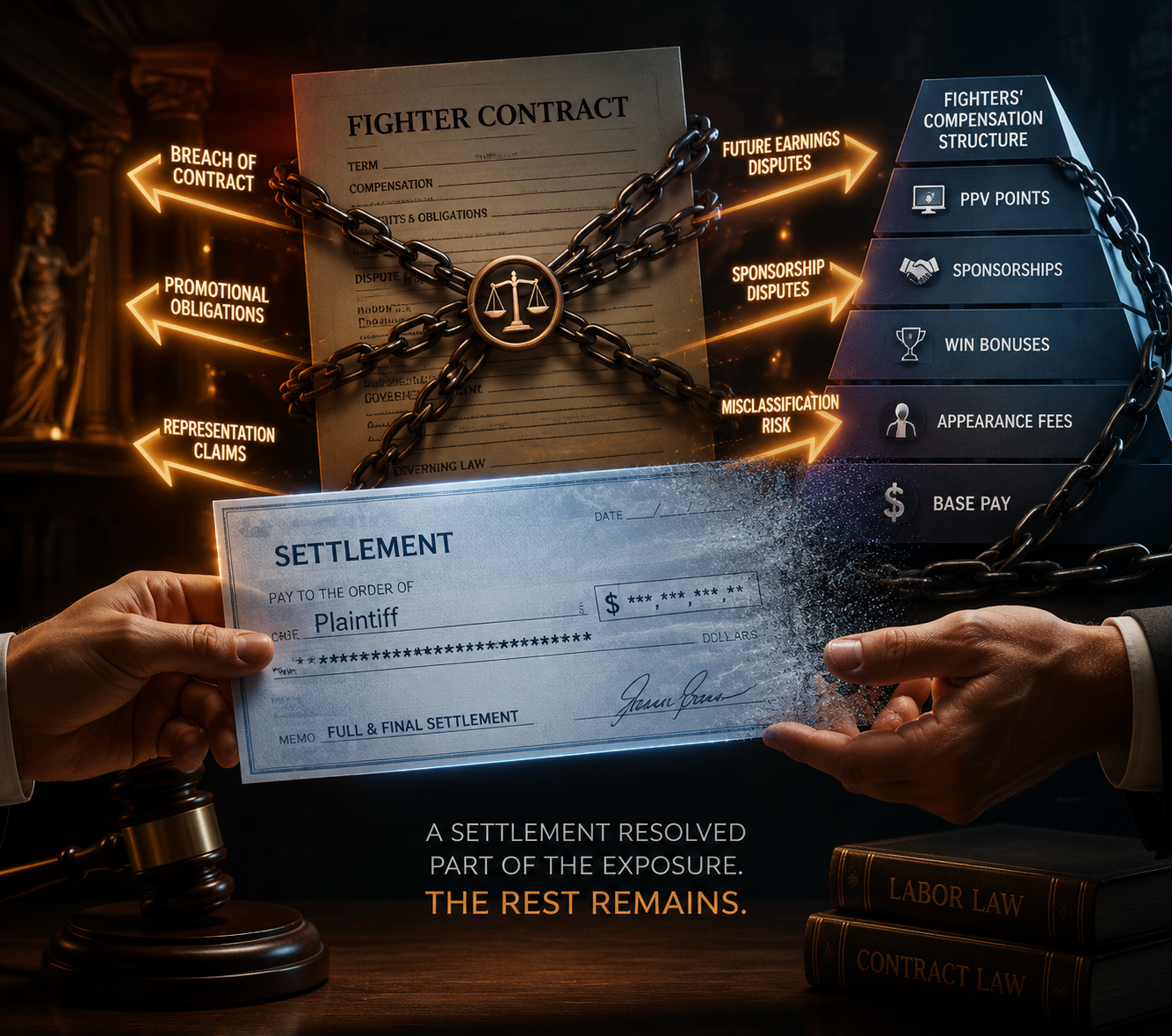
The settlement paid past claims, not future leverage
Judge Richard Boulware’s handling of the first proposed settlement is the procedural fact that keeps the headline number in perspective. In July 2024, he rejected an earlier $335 million global settlement as insufficient and as lacking injunctive relief, forcing the Le damages case and the Johnson injunctive-relief case apart rather than allowing one payment to extinguish both tracks.[4]
The final Le deal was still historically large. Cohen Milstein, one of the plaintiffs’ firms, describes it as the largest worker-side monopsonization settlement in antitrust class-action history, and the American Antitrust Institute gave it a 2025 Enforcement Award.[5] But that characterization comes from adversarial source material and should be read for what it proves procedurally: the case survived long enough, and at sufficient certified-class scale, to command a major payment. It does not prove that the UFC’s current contract model is unlawful, and it did not require the UFC to change that model.
The damages evidence that made Le dangerous also has a time boundary. Court-admitted expert reports by Dr. Hal Singer and Dr. Joshua Lustig showed that UFC fighters received 19% to 20% of event revenue for 11 consecutive years from 2007 through 2017, compared with revenue shares around 48% to 50% in unionized major North American leagues.[6] That comparison is useful because it frames the scale of the alleged monopsony effect. It is not a judicial order importing NFL, NBA, MLB, or NHL labor economics into MMA, and post-2017 UFC wage-share figures remain redacted in the public record.
Four cases, four pressure points
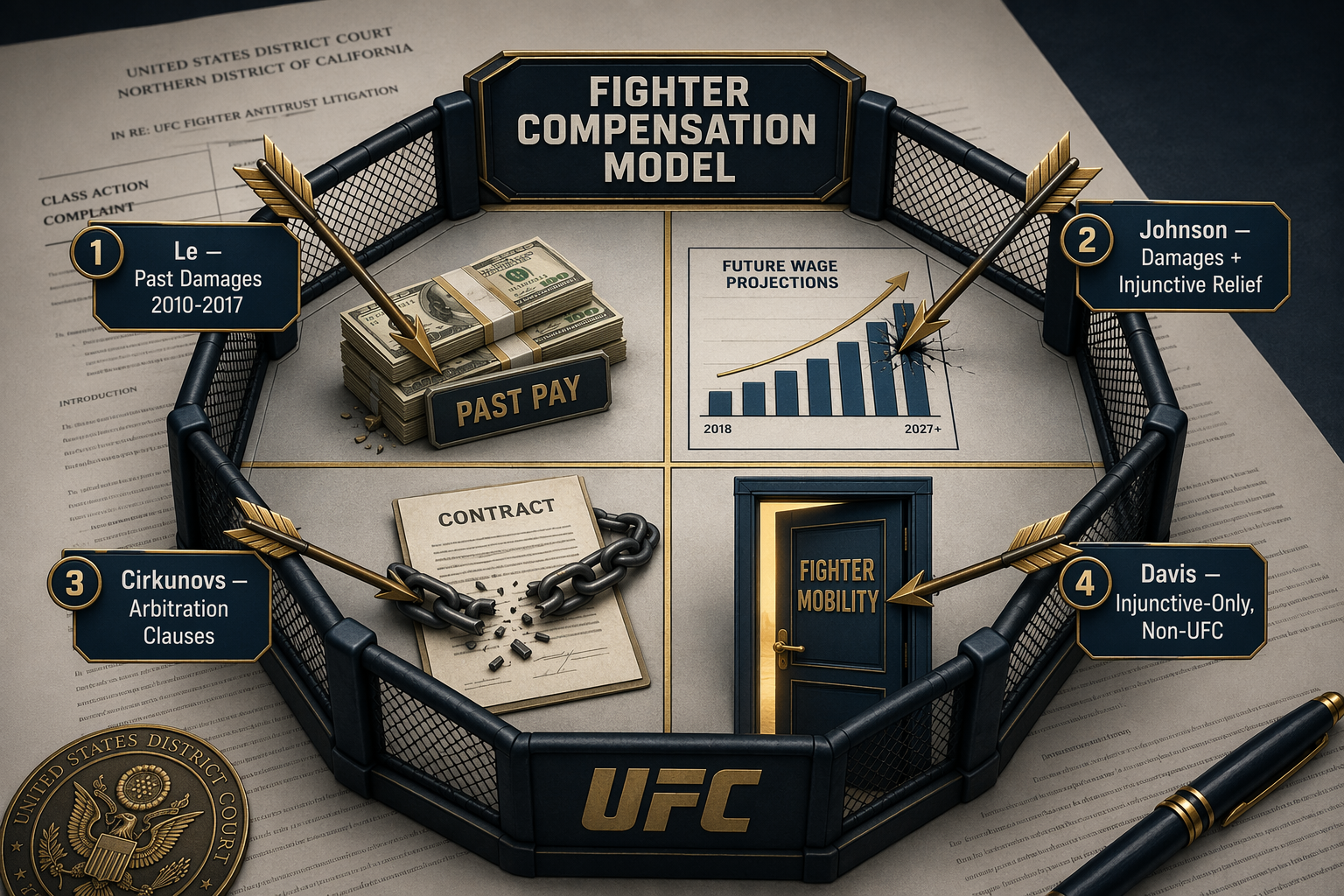
The active litigation map is easier to understand if it is not treated as a pile of fighter-pay complaints. Each case aims at a different part of the UFC’s legal and economic machinery.
| Case | Who it concerns | Primary legal pressure | Remedy posture |
|---|---|---|---|
| Le v. Zuffa | UFC fighters in the 2010-2017 class window | Past alleged wage suppression through monopsony power | $375 million settlement; no contract reform |
| Johnson v. Zuffa | UFC fighters from July 2017 onward | Continuing Section 2 monopsony theory and alleged wage suppression | Damages and injunctive relief |
| Cirkunovs v. Zuffa | Fighters challenging contract-enforcement architecture | Arbitration clauses and class-action waivers | Structural challenge to dispute-resolution terms |
| Davis v. Zuffa | Non-UFC fighters allegedly affected by UFC market power | Market foreclosure and fighter mobility | Injunctive-only; one-year contract termination remedy sought |
John S. Nash’s Yahoo Sports analysis of the post-settlement cases captures the important development: Cirkunovs and Davis are not merely attempts to rerun Le with new names. They extend the dispute from compensation history into the enforceability of contract terms and the ability of fighters outside the UFC to access a competitive market.[7]
Johnson is where the forward-looking exposure sits
Le became the payment case. Johnson is the case that still asks whether the court should change future conduct. It covers fighters from July 2017 onward and keeps alive claims for damages and injunctive relief under a Section 2 monopsony theory.[5] That matters because the legal question is no longer only how much fighters in an earlier class period should receive. It is whether the UFC allegedly maintained buyer-side market power through contracts, acquisitions, and exclusionary practices in a way that continues to suppress fighter compensation.
The market-power allegation is large but still an allegation: plaintiffs have asserted that the UFC controlled roughly 90% of the relevant MMA market.[6] If that premise survives the usual fights over market definition, the court is not simply looking at a tough negotiator in an entertainment business. It is looking at whether a dominant buyer of elite MMA labor used contractual restraints and business conduct to keep fighters from receiving competitive alternatives.
This is where damages and structural relief part company. A damages judgment or settlement compensates a past class for a measured injury. An injunction can reach the mechanisms that allegedly produce the injury: exclusivity periods, tolling provisions, matching rights, exclusive negotiation windows, or other restraints that affect when and how fighters can test the market. The first remedy prices the past. The second interferes with the machine.
The court would not need to set fighter wages directly for an injunction to matter. If contract terms that delay mobility or blunt rival bids are restricted, compensation can change through bargaining conditions rather than through a judicial wage table. That distinction is important because antitrust law is comfortable policing exclusionary conduct; it is far less comfortable becoming a general wage-setting code for non-union labor markets.
The spoliation motion could change posture before merits
Johnson also carries a procedural issue that could matter before the case is fully resolved on the merits. Plaintiffs have sought sanctions over missing text messages and communications involving Dana White, Hunter Campbell, and others, with a February 2026 hearing addressing alleged gaps in preservation and production.[3] Plaintiffs’ counsel says they are seeking consequences that include default judgment, while public coverage has also discussed adverse-inference-type consequences under Federal Rule of Civil Procedure 37(e).[3][8]
Rule 37(e) does not convert missing messages into automatic liability. For the harshest sanctions, the moving party must show more than loss of electronically stored information; the court has to address whether the information should have been preserved, whether it was lost because reasonable steps were not taken, whether it can be restored or replaced, and, for severe measures, whether there was intent to deprive another party of the information’s use in litigation.[8] That is why the sanctions motion is best understood as a potential accelerator or destabilizer, not as proof of the underlying Section 2 claim.
As of the current Q3 2026 publication cutoff, the key public status point is unresolved: Judge Boulware ordered the UFC to provide a full accounting by the end of April 2026, and no public sanctions ruling was found after that deadline.[3] If sanctions are denied or limited, Johnson still proceeds as the central forward-looking fighter-pay case. If severe sanctions are granted, the evidentiary and settlement leverage could change sharply before a jury ever prices the post-2017 period.
Cirkunovs attacks the waiver machinery
Cirkunovs v. Zuffa, filed in May 2025, belongs in the same ecosystem but not in the same remedial box. Its target is the litigation architecture around fighter contracts: arbitration clauses and class-action waivers that can determine whether future fighters are able to bring collective antitrust claims at all.[7]
That makes Cirkunovs less dramatic on wage numbers and more important on enforcement capacity. A compensation model can be vulnerable in theory and still durable in practice if claims are fragmented into individual arbitration, if class treatment is unavailable, or if contract language makes coordinated litigation prohibitively expensive. The legal fight is therefore not only over what fighters were paid. It is over whether fighters can aggregate the kind of claim that made Le expensive in the first place.
This is also where the settlement’s lack of injunctive relief becomes visible. Le distributed money to a past class, but it did not publicly strip the UFC of arbitration clauses or class-action waivers in future agreements. Cirkunovs asks whether those dispute-resolution mechanisms are themselves part of an anticompetitive system.
Davis may matter because it does not ask for money
Davis v. Zuffa is easy to underplay because it does not offer the familiar spectacle of a giant damages number. That is the wrong instinct. Filed in May 2025 on behalf of non-UFC fighters, Davis seeks only injunctive relief and proposes a one-year contract termination right, with no monetary damages and no jury demand.[7]
The absence of damages changes the litigation’s center of gravity. A damages class has to fight over classwide injury, measurement, models, and distribution. An injunctive-only case can focus more directly on whether current practices unlawfully restrict market access or fighter mobility. That does not make Davis easy to win. It does make it a cleaner procedural vehicle for structural relief than a case that must simultaneously prove and allocate past monetary harm.
The non-UFC posture also matters. Fighter-pay disputes are usually narrated from inside the promotion: what contracted UFC athletes earned, what bonuses they received, what leverage they had when negotiating new bouts. Davis looks at the market from the outside. If rival opportunities are constrained because the dominant promoter’s contracts, acquisitions, or matching practices allegedly reduce competitive openings, then the injury is not limited to athletes already under UFC agreement.
The revenue backdrop raises the stakes without deciding the law
The UFC’s media-rights economics give the wage-share evidence business significance, but they do not answer the antitrust questions by themselves. The company’s $7.7 billion Paramount+ rights deal, signed in 2024, is the kind of revenue backdrop against which a 19% to 20% fighter share attracts attention.[7] Still, antitrust liability does not follow from a low labor share alone. Plaintiffs have to tie compensation outcomes to unlawful maintenance of monopsony power, not merely to profitable ownership or hard bargaining.
That limitation cuts both ways. The UFC does not defeat a Section 2 monopsony theory simply by pointing to voluntary contracts or the entertainment value of its brand. If the challenged provisions operate together to reduce fighter mobility, deter rival promoters, or suppress competing bids for elite MMA labor, the question becomes conduct-based rather than taste-based. The court’s job is not to decide what fighters deserve as a moral matter. It is to decide whether the market for their services was unlawfully restrained.
Sportico’s Michael McCann warned in 2024 that an antitrust ruling requiring a business to pay workers a revenue percentage would mark a profound interpretive shift, with implications for the large share of U.S. workers who are not unionized.[9] That warning is useful precisely because it defines the judicial hesitation. Courts may be more willing to limit exclusionary contract practices than to announce a de facto revenue-share entitlement through antitrust doctrine.
What each remedy would actually touch
The remaining exposure is easier to measure by remedy than by complaint count. A post-2017 damages award in Johnson would put a price on alleged injury after the Le class period. Injunctive relief in Johnson could alter contract terms that affect bargaining windows and rival bids. Cirkunovs could determine whether fighters are forced into individualized dispute paths that reduce collective enforcement. Davis could create a mobility remedy for non-UFC fighters without waiting for a jury to calculate damages.
Those are different intrusions into the UFC model. One writes checks. One changes future bargaining conditions. One changes how fighters can sue. One changes how quickly fighters can escape or test contractual restraints. Treating them as one “fighter pay lawsuit” loses the legal anatomy that makes the situation dangerous.
Professor Eric Posner’s observation about Le explains why the docket has attracted attention beyond MMA: he described it as the first labor-side Section 2 monopsony claim ever to survive summary judgment, reach class certification, or survive a motion to dismiss.[4] That does not mean later plaintiffs automatically inherit victory. It means the UFC litigation has already crossed procedural thresholds that labor-side monopsony theories often do not reach.
The remaining cases now test how much follows from that crossing. A court can compensate past harm without redesigning a market. It can also find that a dominant buyer’s contract system requires prospective limits. The difference between those outcomes is the difference between a large settlement and a changed business model.
The dispute is not over because the release was narrow
The safest reading of the UFC antitrust docket is neither triumphalist nor dismissive. The $375 million Le settlement was a major worker-side antitrust recovery, and the disbursement to hundreds of fighters made the result concrete.[1][2] But the settlement’s power is bounded by the claims it released and the remedies it omitted.
Post-July 2017 fighters still have Johnson. Fighters challenging waiver and arbitration barriers have Cirkunovs. Non-UFC fighters seeking mobility-based injunctive relief have Davis. Plaintiffs seeking evidentiary sanctions in Johnson still await a public ruling, at least as of the Q3 2026 cutoff used here.[3][7]
That is why the exposure remains structural. Not because a court is certain to impose a revenue-share model, and not because missing communications prove liability. The unresolved question is narrower and more consequential: whether the contracts, waiver mechanisms, acquisition strategy, and fighter-mobility restrictions alleged to support the UFC’s compensation model can survive Section 2 scrutiny after the damages settlement that made the public think the dispute had ended.
References
- UFC antitrust lawsuit payments totalling over $237 million paid, MMA Fighting.
- Judge grants final approval of $375 million UFC antitrust settlement, Courthouse News Service.
- UFC, Joseph Saveri Law Firm.
- Explained: why the UFC is set to pay $260m to fighters, The Guardian, October 23, 2024.
- Mixed Martial Arts Antitrust Litigation, Cohen Milstein.
- UFC Fighter Wage Share Held Steady At 19-20% For 11 Straight Years, Forbes, April 19, 2022.
- UFC's antitrust threat returns: Explaining the 2 new cases, Yahoo Sports.
- Sanctions against UFC over missing messages depend on intent to deprive, MMA Mania.
- UFC Class Action Settlement Legal and Business Analysis, Sportico.
Comments
Join the discussion with an anonymous comment.