
A drone attack in Ukraine does not cross the legal line because the weapon is a drone. It crosses the line when the operation violates the same international humanitarian law rules that govern artillery, missiles, aircraft, and other means of attack: distinction, proportionality, precaution, and the prohibition on terrorizing the civilian population. The International Committee of the Red Cross states the point plainly: drones are not unlawful as such, but their use must comply with IHL in armed conflict.[1]
That starting point matters because “drone warfare” now covers very different conduct. A cheap first-person-view drone sent toward a civilian car on a road, a Shahed-type one-way attack drone launched into a city, and a long-range Ukrainian strike against a Russian oil facility do not present the same legal problem. The relevant questions are not whether a rotor, camera, or remote operator was involved. They are who or what was targeted, what the attacker knew or should have known, what civilian harm was foreseeable, what military advantage was anticipated, and what precautions were feasible before launch.
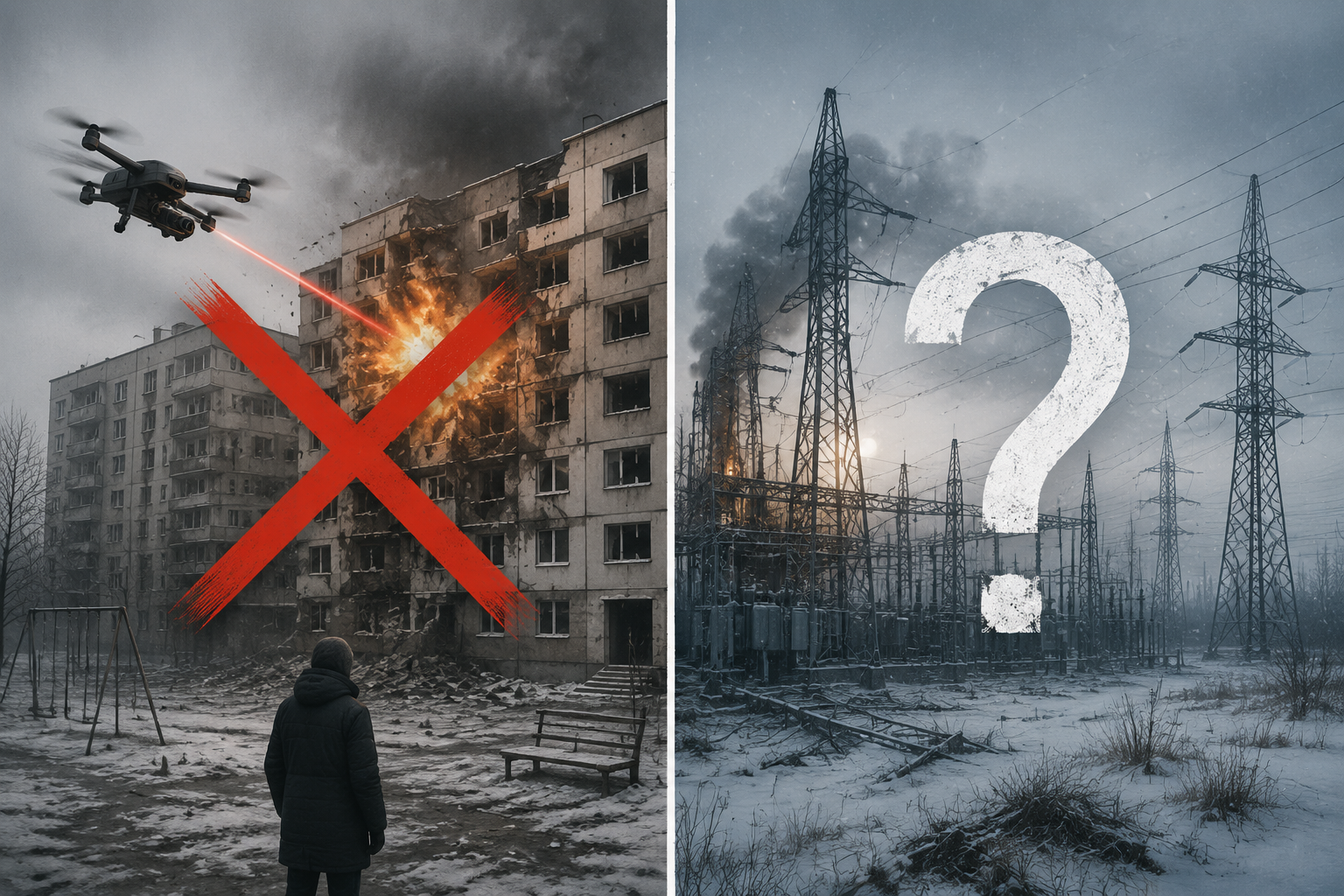
The legal test is weapon-neutral
IHL does not treat “drone” as a legal category that decides the case. A drone may be used against a lawful military objective. It may also be used to commit murder, to spread terror among civilians, or to conduct an attack expected to cause civilian harm that is clearly excessive in relation to the concrete and direct military advantage anticipated. The same device can sit on either side of the line depending on the target, context, information available to the attacker, and pattern of use.
The camera feed does not relieve the operator of legal responsibility. If anything, it can sharpen the inquiry. FPV systems may provide a direct view of the target area, but the ICRC has warned that camera limitations can compromise compliance with distinction obligations, particularly where image quality, field of view, speed, stress, or loss of contextual awareness affects target identification.[1] A poor feed may explain uncertainty; it does not create permission to fire at civilians.
Nor does remoteness cleanse intent. If an operator tracks a person, follows a civilian vehicle, waits until people gather, or repeatedly selects visible noncombatants, the distance between the operator and the blast is legally uninteresting. The evidence problem may be different from a ground shooting, but the rule is familiar: civilians may not be made the object of attack.
Russia’s short-range drone pattern is the clearest legal crossing
The strongest legal conclusion in the public record concerns Russian drone attacks on Ukrainian civilians. In October 2025, the UN Independent International Commission of Inquiry concluded that Russian drone attacks on civilians in Ukraine constituted war crimes, including murder, and crimes against humanity connected to forcible transfer.[2] That finding is not a generalized complaint about drones. It is a conclusion about conduct: repeated attacks on civilians in circumstances where civilian status was visible, knowable, or inferable.
Monthly civilian harm data gives the pattern a scale that isolated clips cannot. OHCHR’s February 2026 protection-of-civilians reporting recorded 52 civilians killed and 222 injured by short-range drones in that month alone.[3] Those figures do not by themselves prove intent in each individual strike. They do show that short-range drone harm was not incidental background noise in the war. It had become a recurring mode of civilian injury and death.
A short-range drone attack on a civilian in the open often presents a legally uncomfortable fact pattern for the attacker. Unlike indirect shelling into a suspected military area, many FPV attacks involve a live feed and a last-moment opportunity to abort. If the operator can see that the object is a civilian car, a cyclist, a pedestrian, or an ambulance, the law does not become more forgiving because the munition is small. The smaller munition may reduce blast radius, but it may also make individual selection more deliberate.
That is why pattern evidence matters. One erroneous strike is analyzed differently from a repeated practice of pursuing civilians on roads, hitting residential areas, or circulating footage that celebrates civilian fear. ISW described Russia’s FPV civilian-targeting campaign as institutionalizing intentional civilian harm as a tool of war, while also stating that its dataset was an illustrative sample rather than an exhaustive tally.[4] The limitation is important. The dataset should not be treated as a complete casualty count. But as pattern evidence, it is relevant to whether civilian harm was accidental, reckless, tolerated, or intended.
Distinction and murder as a war crime
The rule of distinction requires parties to distinguish at all times between civilians and combatants and between civilian objects and military objectives. In the drone context, that rule often turns on what the operator could reasonably identify through the available sensors and surrounding circumstances. A civilian walking on a road does not become a combatant because the road has military significance. A residential building does not become a military objective because it sits in a town near the front.
The UN Commission’s murder finding gives the analysis its legal center. Murder as a war crime requires more than a tragic result; it requires unlawful killing in the required armed-conflict context with the necessary mental element. Deliberate drone attacks on civilians can meet that threshold when the attacker intentionally directs violence at persons protected from attack. The drone’s camera feed, flight path, loiter time, and target selection can become evidence rather than excuse.
Shahed-style one-way attack drones raise a related but not identical problem. They may be programmed or directed toward fixed targets, including urban infrastructure or buildings. Where they are used against civilian objects, or where their employment shows disregard for foreseeable civilian harm in populated areas, the analysis shifts from individual visual selection to target intelligence, weapon characteristics, timing, and expected effects. The legal question remains conduct-based: what was attacked, why, and with what foreseeable consequences.
Terror is not a lawful method of war
Some drone attacks do more than kill or injure. They communicate that civilians are being watched, hunted, or punished for remaining in an area. Additional Protocol I prohibits acts or threats of violence whose primary purpose is to spread terror among the civilian population, and Lieber Institute analysis has treated Russian milblogger footage as relevant evidence in assessing intent to terrorize civilians.[5] Public celebration of civilians being chased or struck is not merely propaganda; it can help show the purpose and acceptance of the practice.
The evidentiary value of such footage depends on authentication, context, chain of custody, and whether the clip represents an actual attack rather than staged or miscaptioned material. But when video material aligns with casualty reporting, repeated operational patterns, and official or semi-official narratives, it becomes harder to describe each incident as a targeting error. Law does not require a written order saying “terrorize civilians” before it can infer intent from conduct.
Civilian harm data does not replace incident analysis
Casualty numbers are often asked to carry more legal weight than they can bear. A monthly count can show scale, concentration, and trend. It cannot identify the lawful or unlawful character of every strike without more facts. The stronger legal case comes when casualty reporting is combined with incident evidence: visible civilian status, absence of military objective, repeat attacks on evacuation routes or residential zones, operator-perspective video, and statements endorsing the practice.
For legal practitioners, that distinction is not academic. A compliance review, sanctions designation, criminal investigation, or contractor due-diligence assessment should not simply ask whether drones were used. It should ask whether the system and its operators enabled identification, whether abort authority existed, whether target lists were reviewed, whether civilian harm reports altered practice, and whether repeat patterns were ignored after becoming foreseeable.
| Question | Why it matters legally |
|---|---|
| Was the person or object a lawful military objective? | This is the threshold distinction inquiry. |
| What could the operator or commander see or know before impact? | Sensor limits may affect proof, but visible civilian status can support intent. |
| Was the attack repeated after similar civilian harm was known? | Repeatability can support findings of recklessness, policy, or intent. |
| Was civilian fear itself treated as an operational effect? | That raises the prohibition on terrorizing civilians. |
| Were feasible precautions available and ignored? | Failure to adjust timing, weapon choice, or target verification can make an otherwise arguable attack unlawful. |
Ukraine’s energy strikes sit in a harder proportionality box
Ukraine’s long-range drone strikes into Russia, especially attacks on dual-use energy infrastructure, require a different pace of analysis. They should not be folded into the same legal conclusion as deliberate attacks on civilians. They also should not be waved through as automatically lawful because refineries, fuel depots, power facilities, and transport nodes may support Russia’s war effort.
The central rule is proportionality. Additional Protocol I Article 51(5)(b) prohibits attacks expected to cause incidental civilian death, civilian injury, damage to civilian objects, or a combination of those harms that would be excessive in relation to the concrete and direct military advantage anticipated. Lieber Institute commentary frames the unresolved difficulty for attacks on dual-use infrastructure: the lawfulness turns on the expected military advantage and the expected civilian consequences, not on the label attached to the facility.[6]
Energy infrastructure is a particularly poor place for confident one-sentence judgments. A refinery supplying military fuel may be a military objective in some circumstances. A power grid node may support command, logistics, or production. But energy systems also heat homes, preserve medicine, power hospitals, move water, and keep civilians alive during winter. The legal question is not whether civilians suffer in some broad strategic sense. It is what civilian harm was expected from the specific attack, at the time of attack, given the attacker’s information and feasible precautions.
Winter changes the foreseeable-harm analysis. A blackout in mild weather is not the same civilian effect as a blackout during freezing conditions. A strike that interrupts industrial fuel flows for military logistics may also cut heat, water pressure, emergency medical capacity, and civilian communications. If those effects are foreseeable, they belong in the proportionality calculation. If they are speculative, attenuated, or mitigated quickly, that also matters. No international tribunal has yet settled the proportionality calculus for Ukraine’s winter energy-infrastructure strikes as described in the available public record.
Public reporting suggests the tempo of Ukrainian long-range strikes increased in 2026. Kyiv Post reported 40 major long-range attacks in the first half of March 2026 and described the pace as roughly doubling from about two to about four targets per night.[7] That reporting is useful for describing claimed tempo, but it comes from a defense-oriented publication and has not been independently verified against Russian sources in the materials available here. It should therefore inform the factual picture without being treated as a judicial finding.
What would decide the energy-strike question
A serious legal assessment of a Ukrainian strike on dual-use energy infrastructure would need more than a map point and an explosion video. It would need the target’s military function, the expected degradation of Russian military operations, the anticipated duration and geographic spread of civilian outages, the season and weather, the availability of alternative targets, weapon accuracy, timing, warnings where feasible, and post-strike knowledge from earlier attacks.
The harder cases will not be resolved by asking whether the object had any military use. Many dual-use objects do. The harder question is excessiveness: whether the expected civilian harm was clearly excessive compared with the concrete and direct military advantage anticipated. That standard is demanding, fact-intensive, and usually reconstructed from imperfect operational records. It is also the standard that prevents dual-use infrastructure from becoming a legal loophole.
Supply chains can create their own accountability question
Iran’s alleged role in supplying Shahed drones to Russia raises a related but narrower issue. The legal question is not whether a supplier is automatically responsible for every later strike. It is whether the supplier provided assistance, encouragement, or contribution with the required knowledge and connection to crimes committed with the weapons. Just Security analysis has discussed potential accessorial liability under Rome Statute Article 25(3)(c) and 25(3)(d) for supplying Shahed drones used in Russia’s campaign.[8]
That issue belongs in the accountability frame, not as a substitute for strike-by-strike analysis. A drone manufacturer, broker, state supplier, or technical-support provider may face different questions from the commander who selected the target. The common thread is knowledge: what the actor knew about the recipient’s pattern of use, what assistance was provided after that knowledge arose, and whether the assistance substantially contributed to unlawful attacks.
The distinction that survives the evidence
The rules of war do not prohibit drone attacks by Ukraine, drone attacks by Russia, or drone attacks as a class. They prohibit attacks on civilians, indiscriminate attacks, disproportionate attacks, and attacks or threats whose primary purpose is to terrorize the civilian population. Drones can make those violations easier to commit, easier to repeat, and sometimes easier to prove. They do not create a separate legal universe.
On the available findings, Russia’s systematic pattern of drone attacks deliberately targeting Ukrainian civilians crosses the line into war crimes. The UN Commission’s conclusion, OHCHR casualty reporting, and documented short-range drone patterns support that judgment. Ukraine’s strikes on dual-use energy infrastructure raise serious proportionality questions, especially where winter civilian effects are foreseeable, but the available materials do not support treating them as an adjudicated war-crime conclusion. The law’s useful answer is narrower and firmer than the slogans: the drone is not the crime; the unlawful target, purpose, or expected civilian harm is.
References
- FAQ: International humanitarian law and drones in armed conflict, International Committee of the Red Cross, Dec. 2025.
- Russian drone attacks on civilians in Ukraine are war crimes, UN report concludes, The Guardian, Oct. 28, 2025.
- Protection of Civilians in Armed Conflict - February 2026, OHCHR / HRMMU, Feb. 2026.
- Russia's FPV Drone Campaign in Ukraine Institutionalizes Intentional Civilian Harm as a Tool of War, Institute for the Study of War.
- Terrorizing Civilians and the Law of Armed Conflict, Lieber Institute.
- The Drone Threat, the Laser Response, and the Law, Part I, Lieber Institute.
- Ukraine’s 2026 Drone Escalation, Kyiv Post.
- Iran’s Legal Liability for Russia’s War in Ukraine, Just Security.
Comments
Join the discussion with an anonymous comment.