
The cleanest fact about United Airlines’ August 2025 system failure is also the easiest one to misunderstand: some passengers reportedly received unsolicited $175 United e-certificates, but domestic passengers did not receive a statutory right to cash compensation for the delay itself. The $175 figure comes from a single LoyaltyLobby reader report, so it should not be treated as a systemwide United policy or a measure of what every affected passenger received. It is still useful because it shows the legal line clearly: United could choose to issue something with money-like value, while passengers could not demand federal cash compensation merely because the disruption was large, internal, and classified as controllable.[1]
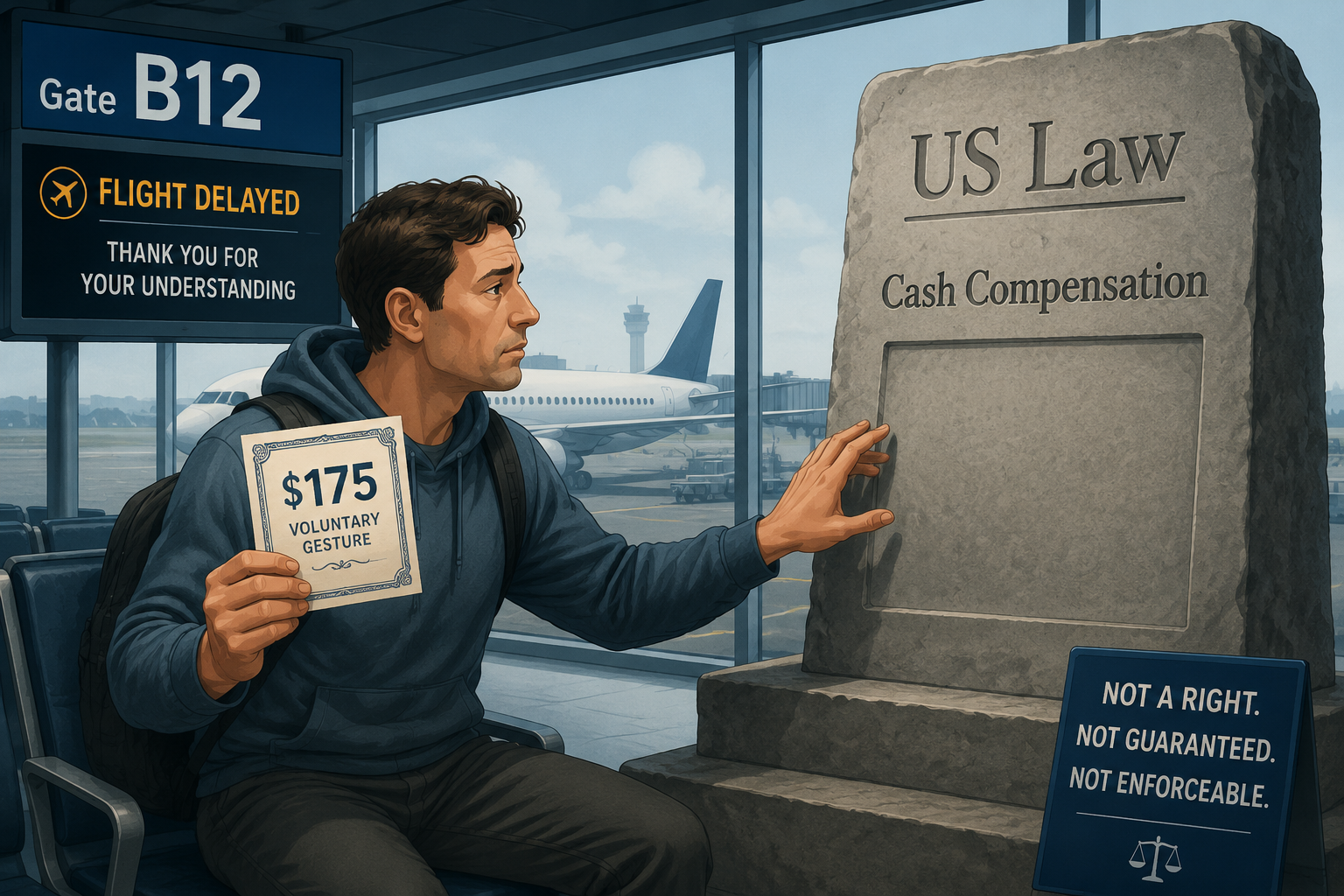
That distinction matters for anyone searching for united airlines system failure passenger compensation after the fact. In the United States, the Department of Transportation’s consumer guidance states the baseline bluntly: airlines are not required to compensate passengers when flights are delayed or canceled, though passengers may be entitled to a refund if the airline cancels or significantly changes a flight and the passenger chooses not to travel.[2] The legal remedy is not the same thing as the airline’s customer-service response.
What Happened On August 6, 2025
The operational event was not minor. United’s Unimatic system, used for weight-and-balance calculations, began failing at about 6:12 p.m. Eastern time on August 6, 2025, and the outage lasted roughly three hours. Ground stops were issued at five United hubs. Contemporary reports counted 1,038 delayed flights, about 34% of United’s daily schedule, and more than 40 cancellations.[3]
A weight-and-balance system is not a cosmetic back-office tool. Dispatching aircraft requires accurate loading and balance information. When that system is unavailable, the practical consequence is that passengers wait while the airline decides which flights can move, which aircraft remain held, and how crews and aircraft can be repositioned after the network starts moving again.
The legally important label was not simply “technology outage.” United classified the failure as a controllable delay, according to The Guardian’s reporting.[4] That classification is the hinge. It helps explain why passengers may have seen meal vouchers, hotel accommodations for overnight disruptions, or later goodwill credits. It does not create a federal cash-compensation entitlement.
Controllable Delay Is Not The Same As Statutory Cash Compensation
The word “controllable” often sounds stronger than it is. For passengers, it seems to imply fault. If the airline’s own system failed, why would compensation be discretionary? Under the current U.S. framework, the answer is that controllability primarily affects the airline’s customer-service commitments, not a federal right to money for lost time.
United’s controllable-delay commitments can cover meals for delays over three hours and hotel accommodations when an overnight disruption is within the airline’s control. Those commitments matter. A stranded traveler who receives a hotel room instead of sleeping in the terminal has received something concrete. But that benefit comes from the airline’s commitments and policies, not from a statute requiring cash compensation for the delay.
| Passenger result | What it means | Legal character under current U.S. rules |
|---|---|---|
| Meal voucher | Food assistance during a qualifying controllable delay | Generally tied to airline commitments, not statutory cash compensation |
| Hotel accommodation | Lodging when a controllable disruption creates an overnight wait | Generally tied to airline commitments, not statutory cash compensation |
| Refund | Return of money when the airline cancels or significantly changes a flight and the passenger does not accept alternative transportation | A distinct DOT-protected remedy, not compensation for inconvenience |
| $175 e-certificate | Reported unsolicited United travel credit for some affected passengers | Discretionary goodwill credit based on available reporting |
| Cash for delay itself | Money paid because the passenger arrived late | Not federally required for domestic U.S. delays or cancellations |
The refund point is where many claims become imprecise. A refund is not a penalty paid by the airline for poor performance. It is the return of the fare when the passenger does not receive, and does not accept, the transportation purchased after a cancellation or significant change. A passenger who takes the rebooked flight may have endured a serious disruption and still have no separate federal right to cash for the hours lost.
The reported $175 e-certificates sit in a different category again. They are not refunds, because they are not necessarily the return of an unused fare. They are not statutory compensation, because no U.S. rule required United to pay that amount for a domestic IT-related delay. And because the available report is a single reader account, it cannot establish who qualified, how many passengers received the credit, or whether United applied the same treatment across affected itineraries.[1]
The Withdrawn DOT Rule Explains Why The Gap Remains
The absence of a U.S. cash-compensation rule is not just a drafting oversight hiding in an old regulatory scheme. The Department of Transportation considered a rulemaking that would have created a tiered cash-compensation framework for airline-caused delays and cancellations, with proposed amounts from $200 to $775. On November 17, 2025, DOT formally withdrew that proceeding.[5]
The withdrawal matters because it confirms the present legal posture after the August 2025 United outage. DOT stated that the FAA Reauthorization Act of 2024 did not authorize the Department to require cash compensation for delays or cancellations. That leaves the current U.S. regime dependent on refunds where applicable, airline service commitments, and voluntary gestures rather than a federal cash mandate for controllable disruptions.[5]
This is the point at which “the airline owes me” needs to be broken into pieces. United may owe a refund if the legal refund conditions are met. It may provide meals or hotel accommodations under its controllable-delay commitments. It may issue a travel credit because it wants to preserve goodwill. Those are different obligations and decisions. A passenger who received a meal voucher and a $175 certificate did not thereby prove that every similarly delayed passenger had an enforceable claim to $175 in cash.
The Points Guy’s 2025 review of airline commitments reached a similar practical conclusion from the consumer side: no U.S. airline guaranteed cash compensation for controllable delays, and only four of the ten largest U.S. airlines voluntarily offered credits or vouchers.[6] That is an adoption finding, not proof that credits make passengers whole, and not evidence of a legal right. It shows that the market contains some voluntary compensation practices while federal law still stops short of requiring cash.
The Same Delay Can Look Different Outside The United States
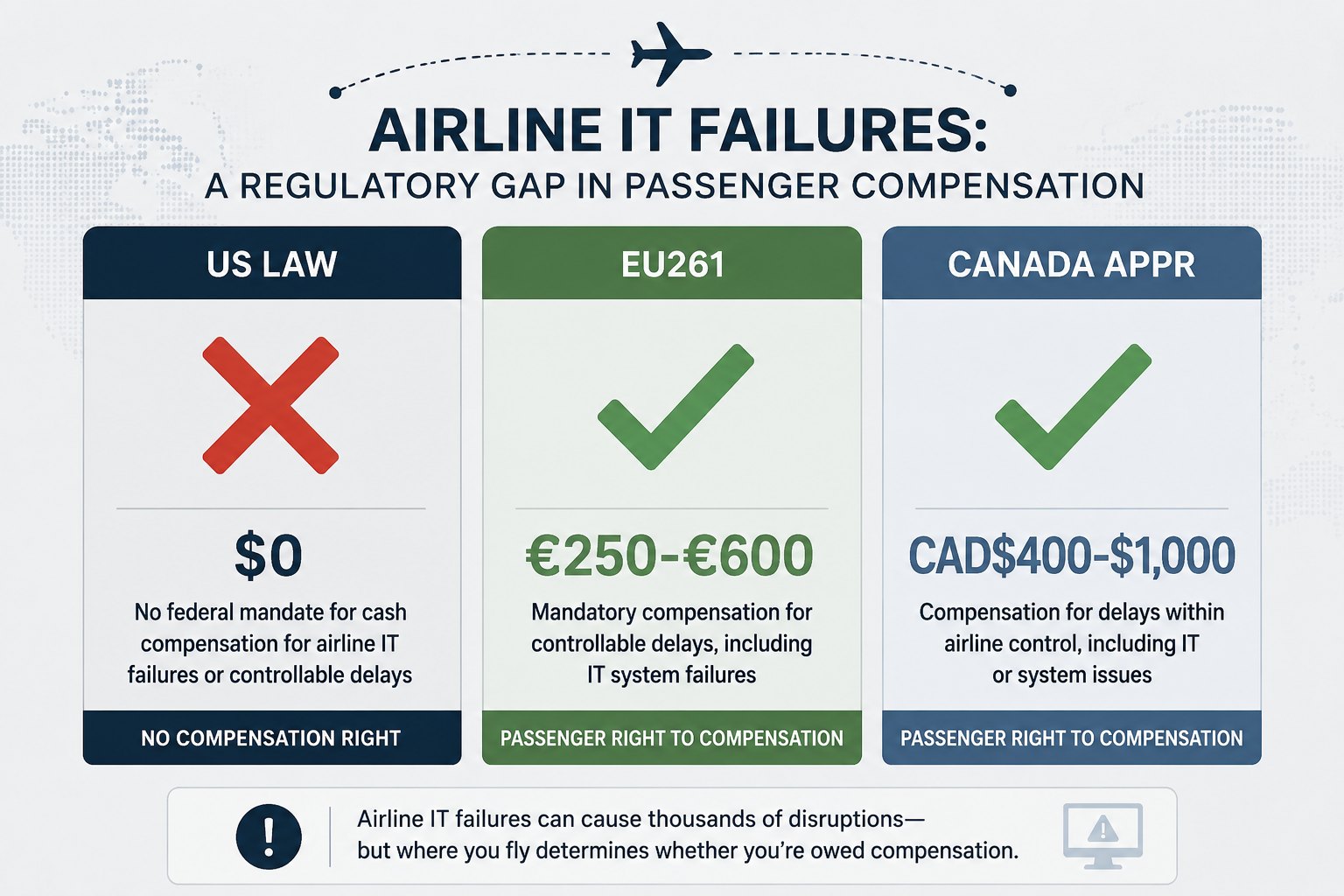
International passenger-rights regimes show that the U.S. outcome is a policy choice, not an operational inevitability. Under EU261, passengers delayed three hours or more on qualifying EU-covered flights may be entitled to €250 to €600, depending on flight distance and other conditions.[7] Under Canada’s Air Passenger Protection Regulations, qualifying passengers on flights to, from, or within Canada may receive CAD$400 to CAD$1,000 for delays within the airline’s control, depending on delay length and carrier category.[8]
Those comparisons should be used carefully. EU261 does not apply to every passenger who happens to be flying a European aircraft or connecting through a U.S. hub, and Canadian rules depend on the itinerary and regulatory conditions. But the contrast is concrete: a controllable airline technology failure can trigger cash compensation in some jurisdictions while producing no comparable statutory cash right on a purely domestic U.S. itinerary.
| Regime | Cash compensation for qualifying controllable delay | What to watch |
|---|---|---|
| Domestic U.S. law | $0 federally mandated for the delay itself | Refund rights and airline commitments are separate |
| EU261 | €250-€600 | Applies only to covered itineraries and qualifying circumstances |
| Canada APPR | CAD$400-$1,000 | Applies to covered Canadian itineraries and qualifying circumstances |
IT Outages Are Not Rare Enough To Treat As A Legal One-Off
The United outage also fits a longer pattern of airline technology failures, though the available federal data is dated. The Government Accountability Office identified 45 airline IT outages between 2015 and early 2019 and found that there was no comprehensive federal tracking system for those events.[9] That finding does not tell us how many comparable outages occurred from 2020 through 2026, and it should not be stretched into a current frequency claim.
The more modest point is enough: airline IT failures have been a recognized operational risk for years, and recent incidents, including Alaska Airlines in July 2025 and United in August 2025, kept that risk visible. Yet the compensation framework for domestic U.S. passengers has not been converted into a statutory cash schedule for controllable technology failures.
Pending legislation can change that only if it becomes law. The Sykes Airline Passenger Compensation Act, introduced in December 2025, remained pending with no reported movement as of July 2026. It should not be treated as a current passenger remedy.
What A Passenger Could Actually Compel
For a domestic passenger affected by United’s August 2025 system failure, the strongest claims were not framed as “cash compensation for delay.” They were narrower. If the passenger’s flight was canceled or significantly changed and the passenger declined alternative transportation, the passenger could look to refund rights. If the disruption was controllable and met the airline’s commitment thresholds, the passenger could point to United’s meal or hotel commitments. If United issued an e-certificate, the passenger could use it according to its terms.
What the passenger could not do, under current U.S. law, was convert the Unimatic outage itself into a federal cash-compensation claim for arriving late. The size of the disruption, the internal cause, and the controllable-delay classification all matter operationally and commercially. They do not supply the missing statutory mandate.
That is why the $175 certificate is such a good illustration and such a poor legal anchor. Where United issued it, the certificate showed discretion. It did not show obligation. For international itineraries, EU261 or Canadian APPR may change the analysis. For domestic U.S. passengers, even a large controllable airline IT failure does not create a statutory right to cash compensation for the delay itself.
References
- United Airlines Sends Out $175 Travel Certificates After Wednesday’s IT Meltdown, LoyaltyLobby, August 13, 2025.
- Fly Rights: A Consumer Guide to Air Travel, U.S. Department of Transportation.
- United Airlines flights resume after technology issue prompted ground stops, NBC News, August 6, 2025.
- United Airlines flights resume after technology issue grounds planes across US, The Guardian, August 6, 2025.
- Withdrawal of Airline Passenger Rights Advance Notice of Proposed Rulemaking, Federal Register, November 17, 2025.
- What you're owed if your flight is delayed or canceled, The Points Guy.
- EU261 Compensation: Know Your Air Passenger Rights, AirHelp.
- Air Passenger Protection Regulations, Canadian Transportation Agency.
- GAO: Airline IT Outages Continue to Strand Passengers, Travelers United.
Comments
Join the discussion with an anonymous comment.